Saturday, June 1, 2013

Budget Moon Flights: letter to NASA.

 Copyright 2013 Robert Clark


 The cost to NASA for lunar or other BEO missions can be cut drastically, perhaps by three orders of magnitude, by following a combination of four cost-cutting approaches.

1.)Commercial space approach. SpaceX and now Orbital Sciences have shown that as much as 90% off of the development cost can be cut by the cost-sharing of the commercial space approach.

2.)Go small. NASA’s SEV weighs about a third that of Orion. Orbital’s Cygnus weighs about a quarter. Imagine how small, and low cost, your lunar mission could be if you only had to transport a quarter of the mass to the Moon.

3.)Use existing components. The huge development costs for the Apollo program and of Constellation were because they had to use all newly developed components. Those costs would be reduced greatly if you only had to adapt already existing components. No Saturn V, Ares V, or SLS, and their huge development costs, required.

4.)Use international partners. The cut in development cost by engaging in cost-sharing is already included in the commercial space approach. However, the cost to NASA can be cut even further by sharing development costs with our international space partners such as the ESA and Japan.


   Bob Clark

****************************************************************


Subject :

Budget Moon Flights.

Date :Fri, May 31, 2013 07:40 AM EDT
From :"Robert Clark" <****@****.edu>
To :****.****@nasa.gov
 Charles Bolden has said that NASA won't us return to the Moon in our
lifetime. However, it's important to keep in mind that such negative reactions
to lunar return are based on the false premise that such a return has to be
hugely expensive. It doesn't.

 Simply by going small such a return can be done for costs in the range NASA
typically spends on its lowest cost, "discovery class", planetary missions,
i.e., in the range of a few hundreds of millions of dollars. This is very
important because rather than going over the constant wrangling with Congress
about funding such multi-billion dollar missions, NASA can simply pull it out
of their discretionary spending.

  I discuss such low cost flights here:

Budget Moon flights: lightweight crew capsule.
http://exoscientist.blogspot.com/2013/04/budget-moon-flights-lightweight-crew.html

  If one uses false premises, one draws false conclusions. So it's very
important to bring to light the fact that expensive policy decisions are being
made by NASA based on incorrect assumptions.

 Given the success NASA has had at cutting costs with its commercial
spaceflight program, NASA should be directed to solicit proposals from
industry for following the cost-cutting commercial approach to produce
small-sized return to the Moon missions.

  The proposals should have as requirement to use at most a crew capsule the
size of the SpaceX Dragon, which is half-size to NASA’s Orion capsule. And
ideally the capsule should even be the size of Orbital Science’s Cygnus
capsule (adapted to carry crew), which is only one-fourth the size of Orion. 
 

  Imagine how small, and low cost, a Moon mission could be if you only had to
send one-fourth the mass to the Moon?

  Still, such a small, low cost approach, would be controversial on safety
grounds. Then the Robonaut would be ideal to test the feasibility of such a
plan:

SpaceX Dragon spacecraft for low cost trips to the Moon, page 3: Falcon Heavy
for BEO test flights.
http://exoscientist.blogspot.com/2012/12/spacex-dragon-spacecraft-for-low-cost.html

 This suggests using the Falcon Heavy test flights beginning in 2014 to do
unmanned test flights to the Moon and to NEO's with the NASA SEV as crew
capsule, "manned" by Robonauts.

 It would be even of lower cost if using the smaller Cygnus as the "crew"
capsule, instead of the SEV. In this case, when carrying Robonauts, you would
not even have to give it life-support, though you would still need to give it
a heat shield. This scenario could be done with a single launch of the Delta
IV Heavy, Ariane 5, or Atlas V 551, no Falcon Heavy needed. 

 Such a mission would have even greater significance if we used it to return
samples from the permanently shadowed craters on the Moon. That way we could
prove definitely that there is abundant water ice on the Moon that can be used
for propellant. Some measurements by the LCROSS mission tentatively have also
identified valuable minerals on the Moon. Then such a sample return could also
provide justification for commercial development of the Moon.

 This scenario with the Cygnus would require one or two half-size Centaur-like
stages. A key viewpoint for such a low cost approach is to use existing
components if possible. Then rather than developing such half-size Centaurs
anew we could use the fact that the ESA already has such stages in the H10-3.
This would actually be beneficial since the current administration wants to
encourage cost-sharing partnerships in space with our international partners
and the ESA wants to do near term robotic Moon missions. We could even use the
German humanoid robot Justin as part of the "crew":

Humanoid Robot Justin Learning To Fix Satellites.
By Erico Guizzo
Posted 17 Jun 2010 | 14:14 GMT
http://spectrum.ieee.org/automaton/robotics/industrial-robots/humanoid-robot-justin-learning-to-fix-satellites

 In addition to partnering with the ESA on such missions, NASA could also
engage in a partnership with the private ventures proposing BEO flights.
Golden Spike, Inc. would be an obvious one but so also would be the asteroid
mining ventures Planetary Resources, Inc. and Deep Space Industries. This is
because flights to many NEO's have a lower delta-v requirement than flights to
the Moon. Then the in-space stages to be used for the Moon flights could also
be used for the flights to the asteroids. Then we could have flights in the
short near term to the asteroids that returned samples that proved
definitively that NEO's can have the trillion dollar deposits of valuable
minerals that has been estimated. 

 SpaceX and now Orbital Sciences have proven that development costs can be cut
by an order of magnitude over those of the traditional fully-government funded
space projects. By following this commercial approach and also going *small*,
the development costs for BEO flights can in fact be cut by orders (plural) of
magnitude over those commonly thought needed.


 Sincerely,


    Bob Clark
***********************************************************************


Saturday, May 18, 2013

On the lasting importance of the SpaceX accomplishment, Page 3: towards European human spaceflight.

Copyright 2013 Robert Clark 


European Human Spaceflight

The EU released a report critical of the ESA's policy on new launchers:

The EU Seems to Really Dislike ESA’s New Launch Vehicle Policy.
Doug Messier
on March 17, 2013, at 5:57 am
www.parabolicarc.com/2013/03/17/the-eu-seems-to-really-dislike-esas-launch-vehicle-policy/

  The report is rather opaque about what changes the EU wants in space policy as opposed to what the ESA is proposing. One thing I noted is that it wants the ESA to keep up with technological advances the other space programs in the world are embarking on.

 This possibly might relate to the proposal of the Ariane 6 to use all solids on the lower stages. This is going backwards, not forwards in technology. A forwards suggestion for the Ariane 6 would have been the option that uses liquid fuel for a core stage simply by adding a second Vulcain to the Ariane 5 core stage.
 Note this would have high commonality with the current Ariane 5 which the ESA also wants to save on costs rather than having to design entire new solid lower stages. But the most important advantage of this is a key technological advance it would provide to keep up with the other space faring nations.

 Russian and China have manned orbital launchers, and the U.S. will again also in the short near term. India is even planning on manned launchers. But the ESA has no plans on producing a manned launcher. Space advocates in Europe should regard this as unacceptable. But the key point is by using the multi-Vulcain option for the Ariane 6 this would provide Europe with a manned spaceflight capability.

 Another source of friction with the EU is that ESA is constrained to apportion work according to members financial participation, while the EU is under no such constraints:

CNES Design Team Sets ‘Triple-seven’ Goal for Ariane 6.
By Peter B. de Selding | Jan. 2, 2013
https://spacenews.com/33019cnes-design-team-sets-triple-seven-goal-for-ariane-6/

From the article:
...after months of hard selling that saw them pitted against much of France’s industry, CNES officials last year convinced Fioraso that Ariane 6 — less expensive and less powerful than Ariane 5, and carrying just one satellite at a time to orbit — is the way of the future.
The design of the rocket — two solid-fueled lower stages and a cryogenic upper stage, plus solid-fueled strap-on boosters — was frozen Nov. 21 during a meeting of ESA government ministers.ESA Launcher Director Antonio Fabrizi said this design, and no other, is what ministers approved.
and:
Ariane 6 has been conceived from the start as a “next-generation” rocket that in many ways looks like a throwback — more of a less-expensive Lockheed Martin Atlas 5, or a Proton launched from the equator. Ariane 5 can do more things for more customers.
But if it meets its design goal, Ariane 6 will reach a financial equilibrium that has eluded Ariane 5. CNES officials say economic criteria account for 43 percent of the design decisions made for the rocket, with technical criteria accounting for just 30 percent.
The remaining 27 percent of the design choices are being made on the basis of Europe’s existing industrial capacity.
French industry is responsible for around 50 percent of the construction of Ariane 5. Eymard said the agency assumes France will carry about the same load for Ariane 6.
Beyond the French contribution, all bets are off. CNES has penciled in Germany at 25 percent, and Italy at 10-15 percent. The Italian share should be relatively easy to secure because Italy already is heavily involved in production, with Snecma of France, of the solid-fueled strap-on boosters used on the Ariane 5 rocket. Italy is also the lead investor in the new Vega small-satellite launcher, which made its inaugural flight in early 2012.
Because of the all-but-guaranteed work share of Italian industry in the Ariane 6 solid-fueled stages, the Italian government is not likely to resist taking its 10-15 percent stake despite its public-debt crisis.
Ensuring German industry sufficient work will not be as straightforward, European government and industry officials said.
 This article shows the difficulty the ESA will have in developing innovative launch solutions. The biggest factor in deciding which launcher to develop is how much work it can provide to the ESA, member countries. This supersedes even lowered costs.

The ESA could develop a low cost launcher that would be comparable in cost to the SpaceX Falcon 9, AND moreover would give Europe an independent manned launch capability simply by adding a second Vulcain to the Ariane 5 core. Ironically though, this option is not chosen because it would be TOO low cost: it would be simple, quick - and not provide enough work to the ESA member countries.

The only way Europe is going to get low cost space access, it now appears, is if it is done under the commercial space approach. As proven by SpaceX this can cut 90% (!) off the development costs when privately financed. And in fact it should be even easier and cheaper than the SpaceX case since the components already exist in the Ariane 5 core, built in France, and Vulcain II engines, built in Germany. Even the capsule for the manned launchers is largely already designed in the Orbital Sciences, Cygnus capsule, which is actually built in Italy. You would just need to supply life support and heat shield to the capsule already designed to be pressurized.

 The only thing needed are entrepreneurs in Europe like Elon Musk in the U.S. with the insight to carry it out. In the blog posts "On the lasting importance of the SpaceX accomplishment" and "On the lasting importance of the SpaceX accomplishment, Page 2" I discussed the fact that space development costs were cut dramatically by SpaceX by private financing.

 NASA has found with its commercial crew program that it can develop manned launchers in general at lower costs by opting for a more commercial approach to their development. In fact NASA's commercial space program was presaged by the Air Force's Evolved Expendable Launch Vehicle (EELV) program. The Air Force only had to pay $500 million out of a $3.5 billion development cost for the Delta IV and $500 million out of a $2 billion development cost for the Atlas V. For the Delta IV, that's a 86% (!) savings in development cost.

 NASA also has saved in development cost on Orbital Science's Antares launcher. It only had to pay $288 million out of a development cost of $472 million for a 5 metric ton class launcher. 

 Then the suggestion to the EU is to institute a similar program for European manned launchers. Politically the ESA appears to be set on the all-solid Ariane 6. But what the EU could do is put out a request to European industry for commercially developed man-rated launchers that would be largely privately funded aside for perhaps some seed money, a la SpaceX. To sweeten the pot, the EU could state that as part of their policy they will use these European launchers for their manned flights as long as they are comparable in price to say what they are paying the Russians for their launchers.

 The Russians are charging $63 million per seat for flights on the Soyuz, so for three crew in the range of $190 million. This is almost the cost of a full Ariane 5 launch, a vehicle capable of 20 metric tons (mT) to LEO.

 A vehicle capable of carrying a manned capsule could be done at a 5 mT payload capability, a quarter the size of the Ariane 5. SpaceX spent $300 million developing the Falcon 9, capable of 10 mT to LEO. Then a vehicle half the size, that was also largely privately funded as was the Falcon 9, might cost ca. $150 million.

 Considering the payload for our twin-Vulcain Ariane likely will be above 5 mT though, we might instead estimate the development cost as $200 million based on how much JAXA spent to add a second cryogenic engine to the H-IIA core.

 Also, I've been informed by people who aware of CNES studies on a multi-Vulcain Ariane that the estimated price for the two-Vulcain Ariane 5 core would be only 50 million euros, about $60 million(!) So for only a ca. $200 million development cost and a $60 million launch cost the ESA could have manned spaceflight ability.

 Another source of income for such a launcher with the Cygnus capsule would be deliveries to the ISS. SpaceX is charging NASA about $133 million for ca. 6,000 kg delivery of cargo using the Falcon 9. Part of this inflated cost above the $54 million cost of the Falcon 9 is the use of the expensive Dragon capsule. The Cygnus is a smaller capsule with a much smaller development cost, so would be much cheaper than the Dragon. Using a ca. 8,000 kg payload for the launcher and ca. 2,000 kg mass for the Cygnus, this launcher could match the 6,000 kg delivery capacity of the Falcon 9 at a much reduced price.

 European Moon Flights

 According to NASA administrator Charles Bolden, NASA will not be returning us to the Moon but may engage in partnerships with other space agencies or private entities who could. Then it's interesting the ESA has the required lightweight in-space stages and lightweight capsule in the Cygnus to accomplish this at low cost.

Another key fact is that NASA has shown with SpaceX and now with Orbital Sciences that development costs can be cut drastically (by 80 to 90% !) by following a commercial approach. Then this could be a project NASA could encourage, at low cost to NASA, by partnering with ESA and private entities like Golden Spike, Planetary Resources, Inc., etc, while at the same time satisfying the critics who want us to return to the Moon.


   Bob Clark

Friday, April 26, 2013

Budget Moon flights: lightweight crew capsule.

Copyright 2013 Robert Clark

 In the post Budget Moon flights, I argued that by using a capsule half-sized to the Dragon capsule at ca. 2,000 kg dry mass, that we could launch a manned lunar landing mission carried to LEO by a single Delta IV Heavy or Ariane 5 ME, with a separate man-rated launcher to carry the capsule and crew. And if using the Falcon Heavy at the stated $1,000 per pound price point it could be done at launch costs of less than $100 million.

 I'll discuss such a half-sized capsule here. This report discusses a capsule with such low dry mass:

Phoenix: A Low-Cost Commercial Approach to the Crew Exploration Vehicle
Abstract: Since the announcement of President Bush’s Vision for Space Exploration (VSE) in early 2004, the architecture of Project Constellation has been selected. The system will be centered around the Crew Exploration Vehicle (CEV), which has been dubbed by NASA administrator Michael Griffin as “Apollo on steroids”. The CEV is to be launched on a new launch vehicle, derived from existing shuttle technology. The development of this new
spacecraft and launch vehicle is a very costly proposition. An alternate approach is proposed in this study. The Phoenix is a smaller spacecraft designed specifically to be launched on the Falcon 5 vehicle under development by SpaceX. Because the SpaceX vehicle will cost only a fraction of today’s launch costs, the Phoenix is estimated to cost less than half of the price of the CEV. This reusable three person capsule utilizes an innovative re-entry concept, which allows for a cylindrical spacecraft with greater interior volume. This extremely cost-effective spacecraft is an attractive option for fulfilling VSE requirements.
 Below is page 3 from this report:

  ...
_______________________________________________________________________
_______________________________________________________________________
  ...

 Our crew capsule would not need its own propulsion system, so get the dry mass by subtracting off the masses in the "Propulsion (SPS)" section to get 2,160 kg. We will retain the RCS system though. Note the 2,160 kg dry mass actually also includes the mass for a crew of three and the mass for their space suits, as well as the food and water for a mission to and from the Moon.
 The heat shield is of the innovative "parashield" design:


This with its truss structure/drive system would amount to about 15% of the capsules dry weight. This is about the same as Apollo era heat shields. However, the lightweight PICA-X material used on the Dragon capsule can withstand lunar return velocities and would only weigh half as much. This would subtract about 160 kg from the dry mass.

 This report on a "Phoenix" capsule only envisions this crew module to carry the crew from LEO to lunar orbit and back with a separate module to be used on a lunar lander, a la the Apollo architecture. But following the Early Lunar Access architecture we could use this one single crew module for the entire flight.

 It is notable that Orbital Sciences Cygnus capsule is of similar size to this "Phoenix" crew capsule.


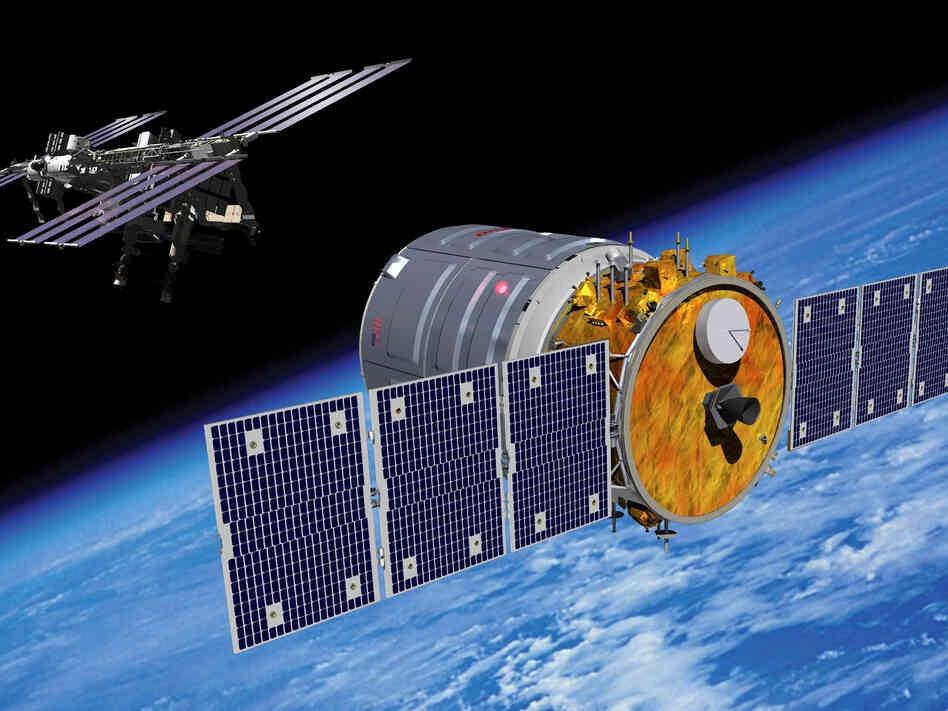
Artist's rendering of Cygnus spacecraft approaching the International Space Station.

CREDIT: Orbital Sciences Corporation

 The Cygnus dry mass is 1,500 kg. This includes the propulsive service module at the base. The service module is based on Orbital's Star satellite bus. According to Astronautix this has a dry mass of about 800 kg. So the capsule itself is 700 kg. Adding on the life support elements as given in the "Phoenix" capsule report, would result in a dry mass of about 2,000 kg.
  This is important because the Cygnus is built by Thales in Italy so it means Europe could make all the components for the Moon mission, including the man-rated launch rocket as described in post The Coming SSTO's: multi-Vulcain Ariane.
 The "Phoenix" capsule report estimates billions of dollars in development cost. But this is using traditional NASA costing estimates. However, SpaceX has shown that development costs can be cut by a factor of 10 by private financing both for launchers and for crew capsules. From its half-size compared to the Dragon we might estimate its development as privately financed at half of the $300 million spent developing the Dragon, so to only $150 million.


   Bob Clark

Update, May 1, 2014:

 For the passage above highlighted in red, I am now inclined to think that 1,500 kg dry mass does not include the mass of the service module, which is, the propulsion unit at the bottom. It's because of this page:

Cygnus Spacecraft Information

Pressurized Cargo Module

Cygnus standard and Cygnus enhanced use Pressurized Cargo Modules built by Thales Alenia Space, Italy. The module is based on the Multi Purpose Logistics Module that was flown on multiple Space Shuttle Missions to deliver pressurized cargo to ISS.

It is 3.07 meters in diameter and has a length of 3.66 meters in its standard configuration and 4.86 meters with one segment added in the enhanced configuration. The standard PCM has a dry mass of 1,500 Kilograms and the enhanced version weighs 1,800kg. 2,000 Kilograms of cargo can be packed into the standard PCM while the enhanced version allows 700kg more to be loaded. The cargo module has a pressurized volume of 18.9 cubic meters in the standard configuration and 27 cubic meters in the enhanced configuration. Power consumption of the PCM is less than 850 watts.
http://www.spaceflight101.com/cygnus-spacecraft-information.html

 This page also has a separate section on the service module which suggests that mass amount above was only for the pressurized module itself.

Saturday, April 6, 2013

SLS for Return to the Moon by the 50th Anniversary of Apollo 11, page 4: further on lightweighting the SLS core.

                                             Copyright 2013 Robert Clark

 NASA has decided to revert to the original Al 2219 aluminum alloy that was first used on the shuttle external tank for the SLS core:


SLS takes on new buckling standards, drops Super Light alloy.
February 18, 2013 by Martin Payne 
http://www.nasaspaceflight.com/2013/02/sls-new-buckling-standards-drops-super-light-alloy/

 This is due to the greater brittleness of the lighter aluminum-lithium alloys used on the later super lightweight ET tank (SLWT). And because the later alloys were not available in the greater thickness needed for optimal lightweight performance. 
 However, NASA itself estimated the Al-li alloys could save 25% off the weight of a propellant tank over the Al 2219 alloy:

RELEASE : 09-096
NASA Uses Twin Processes to Develop New Tank Dome Technology
http://www.nasa.gov/centers/langley/news/releases/2009/09-096.htm

 Still NASA estimated in regards to the SLS tank, reverting back to the Al 2219 alloy would only cost 3,000 kg in lost payload, much smaller than 25%. Apparently, the reduced thickness of the plates available for the aluminum-lithium alloys used on the SLWT results in reduced weight efficiency. 
 However, a new aluminum-lithium alloy Al-Li 2050 has similar strength at lightweight to the SLWT alloys and is available in thicker plate sizes:

Shell Buckling Knockdown Factor (SBKF) Project Update.
http://www.nasa.gov/offices/nesc/home/Feature_ShellBuckling_Test.html

 Then we could recover the ca. 25% saving over using the Al 2219 alloy. This now is a significant increase in payload, beyond just 3,000 kg. The original ET tank using Al 2219 alloy weighed 35,000 kg. The new SLS tank is scaled up 33%, so under the same Al 2219 alloy would weigh in the range of 46,000 kg. Then the new Al-Li alloy saving 25% off this would be a saving of 11,500 kg. 
 NASA made an assessment of cost benefit analysis and decided on the older Al 2219 alloy. But this is Apollo era, 1960's, technology. This is going backwards not forwards in our technological development. 
 Further weight saving can be achieved by using composites for the intertank. NASA with Boeing is investigating large cryogenic composite tanks. This is still a research project. However the intertank is an unpressurized structure. Structures like this have been made of composites for decades. 
 To estimate the weight that can be saved, note the intertank in the al-li SLWT weighed 5,500 kg:

Single Stage To Orbit Mass Budgets Derived From Propellant Density and Specific Impulse.
John C. Whitehead
32nd AIAA/ASME/SAE/ASEE Joint Propulsion ConferenceLake Buena Vista, FL July 1-3, 1996
http://www.osti.gov/bridge/servlets/purl/379977-2LwFyZ/webviewable/379977.pdf

 Then the intertank of the SLS of 33% larger size may be estimated to weigh 7,300 kg. A new composite material known as an isotruss saves significantly on weight:


 It weighs less than 1/7th that of aluminum at the same strength. This would reduce the intertank mass to less than 1,000 kg. This would subtract off an additional 6,000 kg from the tank mass to bring it down to 28,500 kg. This is nearly 18,000 kg in total off from the original SLS tank weight, which could go to extra payload.
 As I mentioned in the blog post SLS for Return to the Moon by the 50th Anniversary of Apollo 11, page 3: lightweighting the SLS core, internal NASA estimates put the actual payload of the SLS as significantly above the 70 mT mark often cited by NASA. Then an additional 18,000 kg added to this payload capability would put the SLS payload to LEO at ca. 100 mT. This is important because it would mean the SLS would have the capability to do manned lunar lander missions, not just lunar flybys.
 NASA administrator Charles Bolden has said NASA, meaning the administrators, has no plans on a Moon mission, being more focused on a mission to an asteroid. However, the public in general, space advocates, industry, and even NASA's own ranks have shown no interest in the asteroid mission:


Back to the Moon? Not any time soon, says Bolden.
By Jeff Foust on 2013 April 5 at 1:05 pm ET
A week from Monday marks the third anniversary of President Obama’s speech at the Kennedy Space Center where he formally announced the goal of a human mission to an asteroid by 2025. While that is an official goal of NASA’s human space exploration program, there remains some opposition or, at the very least, lack of acceptance of the goal by many people, including some with NASA, as a report on NASA’s strategic direction concluded last December.
At a joint meeting of the Space Studies Board and the Aeronautics and Space Engineering Board in Washington on Thursday, the head of that study, Al Carnesale of UCLA, reiterated those concerns. “Since it was announced, there was less enthusiasm for it among the community broadly,” he said of the asteroid mission goal. “The more we learn about it, the more we hear about it, people seem less enthusiastic about it.”
Carnesale suggested that, in his opinion, it might be better to shelve the asteroid mission goal in favor of a human return to the Moon. “There’s a great deal of enthusiasm, almost everywhere, for the Moon,” he said. “I think there might be, if no one has to swallow their pride and swallow their words, and you can change the asteroid mission a little bit… it might be possible to move towards something that might be more of a consensus.”
http://www.spacepolitics.com/2013/04/05/back-to-the-moon-not-any-time-soon-says-bolden/

 The SLS even by its first mission in 2017 can do manned lunar landing missions by incorporating well known and relatively low cost weight saving methods to its core and upper stages.
 This would go a long way towards garnering support both among the public and those in  industry to know that a return to the Moon is in the offing and in the very near term.


  Bob Clark


Update, Sept. 28, 2013:

 Finally, NASA has acknowledged that the Block 1, first version of the SLS to launch in 2017 will have a 90+ mT payload capacity not the 70 mT always stated by NASA:

SLS Dual Use Upper Stage (DUUS).
http://ntrs.nasa.gov/archive/nasa/casi.ntrs.nasa.gov/20130013953_2013013757.pdf

 This is important since it means we will have the capability to do manned lunar landing missions by the 2017 first launch of the SLS:

SLS for Return to the Moon by the 50th Anniversary of Apollo 11, page 5: A 90+ metric ton first launch of the SLS.
http://exoscientist.blogspot.com/2013/09/sls-for-return-to-moon-by-50th.html

Friday, March 29, 2013

The Coming SSTO's: multi-Vulcain Ariane.

Copyright 2013 Robert Clark


 The option the ESA decided on for the planned Ariane 6 was the version using a solid propellant first stage:

CNES, ASI Favor Solid-Rocket Design For Ariane 6.

By Amy Svitak
Source: Aviation Week & Space Technology
October 15, 2010

 However,  one of the other options discussed for the Ariane 6 would also allow manned European flight capability. This would be the two Vulcain core version.


CNES is evaluating these three launch vehicle concepts for a next-generation Ariane 6: two based on solid-rocket-motor technology plus an all-liquid-fueled launcher with optional solid-motor boosters. (Credit: CNES)

 To estimate the payload capability for the twin Vulcain core I'll use John Schillings launch performance calculator:

Launch Vehicle Performance Calculator.

http://www.silverbirdastronautics.com/LVperform.html

 In the calculations for this multi-Vulcain Ariane core stage, I used this page for the specifications on the Ariane:


Space Launch Report:  Ariane 5 Data Sheet.
http://www.spacelaunchreport.com/ariane5.html#config


 For the Vulcain 2 specifications, I've seen different numbers in different sources, though close to each other. I'll use this source:

 I'll also use the earlier Ariane 5 "G" version that is lighter than the current "E" version to be lofted by two Vulcains without side boosters. According to the SpaceLaunchReport page it had a 170 mT gross mass for the core at a 158 mT propellant load, giving a 12 mT dry mass.
 According to the Astronautix page, Vulcain 2 has a 434 s vacuum Isp and 1350 kN vacuum thrust. So two will have a 2700 kN vacuum thrust. The Vulcain's mass is listed as 1,800 kg. So adding another will bring the stage dry mass to 13,800 kg.
Now input this data into Schilling's calculator. Select again default residuals and select "No" for the "Restartable Upper Stage?" option. Select the Kourou launch site for this Ariane 5 core rocket. For the orbital inclination, I input 5.2 degrees. I gather Schilling uses this for Kourou's latitude since deviating from this decreases the payload. I chose also direct ascent for the trajectory.
Then the result I got was 7,456 kg(!) to orbit:

================================
Mission Performance:
Launch Vehicle:     User-Defined Launch Vehicle
Launch Site:     Guiana Space Center (Kourou)
Destination Orbit:      185 x 185 km, 5 deg
Estimated Payload:      7456 kg
95% Confidence Interval:      4528 - 10898 kg
================================

 We should be able to remove a component on the Ariane 5 core to lighten the weight for this application. Ed Kyle on his Spacelaunchreport.com page discusses the Liberty rocket that had been planned to use a SRB first stage and an Ariane 5 core second stage. For the Liberty application, a forward skirt on the core called the JAVE ("Jupe AVant Equipée") that transmits the forces of the two solid boosters to the core would be removed. This will also be removed for our application without solid boosters.
 The JAVE massed 1,700 kg. So our payload could be increased to 9,156 kg. However, Kyle also discusses on his page on the Liberty rocket that the increased thrust from the SRB first stage would require thicker walls on the Ariane core now used as an upper stage.
 The thicker walls on the Ariane 5 core for the Liberty rocket are indicated in this video:


 The 5-segment SRB to be used on the Liberty rocket has 12 times the thrust of the Vulcain engine. Yet as seen in the video the increased thickness to handle the increased axial load is only 50%. Then only doubling the thrust by adding a second Vulcain quite likely will require a much smaller increase in thickness. I'm informed that the 158 mT propellant mass tank has a dry weight in the range of 4,400 kg. So even increasing the thickness 50% increases the weight by ca. 2,200 kg, and the payload would still be approx. 7,000 kg.  A problem with this estimate though, aside from the unknown accuracy of the video, is that it is based on the larger Evolution "E" version of the Ariane 5 core, which might not require as much strengthening to handle the higher thrust loads as the smaller "G" version.  So we'll use a formula for calculating the thickness of a propellant tank based on the axial load as given on this lecture page: Launch Vehicle Design: Configurations and Structures. Space System Design, MAE 342, Princeton University Robert Stengel http://www.princeton.edu/~stengel/MAE342Lecture4.pdf  on page 9:
  From the first formula the critical buckling load without the pressurization effect is:   σc,w/o pressure = [9(t/R)1.6 + 0.16(t/L)1.3]*E.   Multiplying out the second formula for critical buckling with the pressurization effect you see it's:   σc,w/ pressure = σc,w/o pressure + 0.191p(R/t).   Now use the formula on p. 8 that relates the tensile strength of the material to the thickness required of a pressurized tank:
   You see that  σhoop = p(R/t)  so that the formula above becomes:     σc,w/ pressure = σc,w/o pressure + 0.191σhoop .   Now use values for the tensile strength of aluminum alloy. The aluminum alloy used on the Ariane 5 core tanks, Al 2219, happens to get stronger at cryogenic temperatures:
 Table taken from Properties of Aluminum Alloys: Tensile, Creep, and Fatigue Data at High and Low Temperatures, page 86. The table gives the aluminum alloy strength at liquid hydrogen temperatures as 685 MPa and elasticity modulus, E, as 85 GPa.  For the Ariane 5 core "G" version, the hydrogen tank walls are only 1.3 mm thick, while the oxygen's, 4.7 mm. The diameter of the tanks is 5.4 m. Because of its extreme wall thinness it's the hydrogen tank whose stress has to be limited. It's length is about 18 m. Then the formula for the critical buckling load without pressurization gives: σc,w/o pressure = [9(t/R)1.6 + 0.16(t/L)1.3]*E = [9(0.0013/2.7)1.6 + 0.16(0.0013/18)1.3]*85*109 = 3,800,000 Pa.  And the additional buckling strength due to pressurization is 0.191σhoop = 0.191*685,000,000 = 130,800,000 Pa, for a total critical buckling load of 134,600,000 Pa.  The maximum thrust of two Vulcain 2's will be 2,700,000 N. The cross-sectional area of the hydrogen tank walls is 2*π*R*t = 2(3.14)(2.7)(0.0013) = 0.022 m2 . Then the maximum axial pressure is 2,700,000/0.022 = 123,000,000 Pa.  This is indeed less than the critical buckling load of 134.6 MPa. However, for a manned launcher a safety factor of 1.4 is usually included. This will require the maximum axial pressure to be less than 96 MPa. This requires a wall thickness of 1.6 mm, about a 25% increase. This still only increases the tank weight by 1,000 kg, so the payload becomes now ca. 8,000 kg, still quite high for a SSTO. Remember also switching to aluminum-lithium alloy can save as much as 25% off the dry weight which would bring us again to the 9,000 kg payload range.


   Bob Clark

Tuesday, March 5, 2013

Budget Moon flights.

Copyright 2013 Robert Clark 

In the blog post SpaceX Dragon spacecraft for low cost trips to the Moon, I argued that manned flights to the Moon could be mounted for costs in the few hundred million dollars range. This is compared to the $100 billion cost estimated for the now defunct Constellation program.
 The key to the low cost was using the SpaceX Falcon Heavy booster, and using already existing components, such as the Centaur upper stages. But I wondered could we bring the cost down even further using even smaller upper stages? Perhaps to even a few 10's of millions of dollars??
 I'll use again a combination of hydrogen-fueled stages, two copies of the Ariane 4 third stage, version H-10-III this time. There are variations in the cited specifications for this stage in various sources:

Ariane 4.
http://www.b14643.de/Spacerockets_1/West_Europe/Ariane/Design/Ariane_2.htm 

Die Oberstufen H-8, H-10 und ESC-A.
http://www.bernd-leitenberger.de/h-10.shtml 


Ariane-44L H10-3.
http://space.skyrocket.de/doc_lau_det/ariane-44l_h10-3.htm 

Ariane H10-3.
http://www.astronautix.com/stages/arieh103.htm

ARIANE 4 SPECIFICATIONS.
http://www.braeunig.us/space/specs/ariane.htm 

 It may be some sources are including the weight of the Vehicle Equipment Bay (VEB), others not. The VEB carried the avionics and telemetry equipment for the Ariane 4. We may suppose these functions carried out by the crew capsule, and at lighter weight than that used on the Ariane 4, first launched in the mid-90's.
 I'll use the numbers on Braeunig's "ARIANE 4 SPECIFICATIONS" page. It gives the dry mass of the stage as 1,240 kg and the propellant mass as 11,860 kg. The HM-7B engine used on that stage has an Isp of ca. 445 s.

 We'll use again this table of Earth/Moon delta-V's:

Delta-V budget.
Earth–Moon space.


https://en.m.wikipedia.org/wiki/Delta-v_budget#Earth%E2%80%93Moon_space%E2%80%94high_thrust

 With aerobraking on the return to the Earth, the total round-trip delta-V is 8,650 m/s.  We'll  use the architecture that the landing stage is used to return all the way back to Earth, not just to link up with a stage waiting in lunar orbit. And just a single crew capsule will be used that carries the crew all the way from Earth to the Moon and back again, no separate command and lunar modules, as with Apollo. This is analogous to the Early Lunar Access proposal of the early 90's.
 Then we could bring a payload of 2.4 metric tons(mT) to the Moon and back, sufficient for a half-Dragon sized capsule:

445*9.81ln(1 + 11,860/(1,240 + 13,100 + 2,400)) + 445*9.81ln(1 + 11,860/(1,240 + 2,400)) = 8,660 m/s.

 Various weight saving techniques can be used to save further weight on the stages.  The propellant tanks are made of aluminum rather than the heavier steel of the Centaurs. But they can be made lighter in the rang of 15% to 25% by using the aluminum-lithium alloy used on the later versions of the shuttle external tank (ET). Further weight saving techniques would be to use the common bulkhead and "balloon tank", i.e., pressure-stabilized, design of the Centaurs. 
 The tanks can be made even lighter by using composites, perhaps by 30% over aluminum-lithium:

The Composite Cryotank Technologies and Demonstration Project.
http://ntrs.nasa.gov/archive/nasa/casi.ntrs.nasa.gov/20120002943_2012002501.pdf

 This means composites can save as much as 50% (!) off the weight of standard aluminum. Aside from tanks, composites can be used on the structural members to save weight. Composites could be used on the thrust structure, the intertank, the payload and interstage adapters, and the tank structural support members.
 A new composite structural technique is that of the isotruss:

Isotruss


 According to the manufacturer, it weighs only 1/12th as much as steel at the same strength:


 Boeing has already developed a 2.4 meter wide composite cryogenic tank: 

Boeing Develops Game Changing Composite Propellant Tank

 This would be sufficient for the H10-III stage. By next year they expect to have a 5.4 meter wide tank. This would allow a 20 mT standard sized Centaur to have the composite tanks. This size tank would also work for a scaled-up 40 mT Centaur-style stage. ULA has argued a stage this size following various weight saving techniques could get a 20 to 1 mass ratio. This would allow a stage that could make a manned round-trip lunar flight from LEO in a single stage.  

 ULA has discussed improving mass ratio as the best way to improve performance at the NewSpace 2012 conference. 


 From the graphs shown it is apparent propellant mass fraction, or mass ratio, is far and away the best way of increasing performance.  
Then to maximize the payload we can deliver to planetary targets, including on manned missions, it is important to implement such weight saving methods. For instance a single in-space stage for a lunar mission could be made reusable, thus cutting the cost of the in-space stage. 
 Conceivably just as important is that high mass ratio would also allow a single stage to orbit vehicle, SSTO. This has relevance to another ULA proposal of establishing propellant depots. It is known that a single stage capable of reaching LEO could also with orbital refueling make the round-trip from LEO to the lunar surface and back again as a single stage. So this one stage could make the entire trip from Earth to the Moon, with that one stop for refueling.
 The DC-X test VTVL test vehicle will be having its 20th anniversary this year. The event is to be celebrated by the participants in the program in August this year. It will also be marked by restoration of the DC-X for display in the New Mexico Space Museum.
 The DC-X itself was not intended to reach orbit. But interestingly the H-10-III stage, of similar size to the DC-X, may have this capability when lightweighted with composites. The single HM-7B engine it has though does not provide sufficient thrust for liftoff. You may need to add two to three additional engines. The increased thrust  however would add additional stress to the structure. It may require additional strengthening mass.   

COST. 
 For the lunar flight scenario, the total weight for the two H-10-III stages and the 2.4 mT capsule would be 28.4 mT. Using the estimated $2,000 per kilo cost for the Falcon Heavy launcher this would be a launch cost of $56.8 million. There is the cost also of the H-10-III stages. According to the "Ariane H10-3" Astronautix page, it's listed as $12 million. So the total cost of the launch would be $80.8 million.
 There is also however the cost of the capsule. We may suppose though the capsule is reusable so its cost per use might be only in the few million dollars range. Actually at a weight penalty of a few hundred pounds of propellant kept in reserve, which would subtract a proportionally smaller amount from the payload, the first H-100-III stage might be returnable to Earth to also be reusable. The second stage, used as the lander, could already be reusable since under the Early Lunar Access architecture it would also serve as the propulsive stage to return the capsule all the way to Earth. This would reduce the per use cost for the upper stages as well.
You would not be limited to using the Falcon Heavy, though this would be the lowest cost. The Delta IV Heavy with upgraded RS-68a engine has a 28 mT payload capacity to LEO, slightly less than the 28.4 mT needed at around a $300 million launch cost. However, the Delta IV Heavy is not expected to be man-rated anyway so you might as well launch the capsule on another rocket and link up with the propulsive stages in orbit.

ESA VERSION.
 This may be an architecture that could be implemented by the ESA. The Ariane 5 ME  is to have a 20% increase in payload to GTO to 12 mT. If the increase in payload to LEO is also 20% then that would bring the payload capacity to 24 mT. This would be enough to carry the propellant of the two H-10-III stages. Neither the current Ariane 5 nor the ME version will be man-rated however. We will need a separate man-rated rocket to carry the crew to orbit. This would have to lift the two H-10-III dry masses plus the capsule mass for 2*1.24 mT + 2.4 mT = 4.88 mT. I'll show in an accompanying blog post this is well within the capability of a vehicle made from a just a single stage of the Ariane 5 core with a second Vulcain 2 engine added. 
 The cost of the Ariane 5 is about $200 million. If the cost is also increased by 20% on the ME this would bring it to $240 million. And the cost for the manned launcher? I'm informed by a member of ESA that the estimated cost for a modified Ariane 5 core with a second Vulcain 2 engine would be ca. $60 milion. Plus the $24 million cost of the two upper stages brings the cost to $324 million.


  Bob Clark


Could Blue Origin develop a lander for Artemis III?

Copyright 2025 Robert Clark SpaceX is coming under increasing criticism for its delay in developing the Starship lunar lander: U.S. Is Losin...