Showing posts with label Mars Pathfinder. Show all posts

Thursday, July 13, 2023

Low cost commercial Mars Sample Return.

 Copyright 2023 Robert Clark


Introduction.

 Mars Sample Return is again being discussed by NASA, as it was 10 years ago. And as was the case then the chief stumbling block is the $10 billion price tag. However, if done as a fully commercial space mission, i.e., no governmental funding required, it could be done for a fraction of the amount NASA is estimating, probably for a few hundred million dollars, including the launch cost on the Falcon Heavy. 

SpaceX has shown that development costs for rockets can be done at 1/10th the cost of usual government financed rockets by following the commercial space approach. The same was proven for spacecraft in the form of capsules when SpaceX developed the Dragon at 1/10th the usual cost.

 And Planet Labs was able to produce small, highly functional imaging satellites at a fraction of the cost of usual imaging satellites.

 This plus using already existing in-space stages rather than developing entire new ones can greatly reduce the development cost of such a mission. 

 Here, I will propose a solution using a fully aerocapture approach to landing, meaning braking fully aerodynamically, at Mars to minimize the propulsive burns and therefore propellant that is needed on arrival at Mars. Below we'll discuss some possibilities for this hypersonic slowing. First, the delta-v requirements for such a mission.

Delta-V to and From Mars.

Here is a map of delta-v's for some locations in Earth-Moon-Mars space:

Delta-v's between Earth, Moon and Mars.


LEO to GTO:                    2.5 km/s
GTO to Earth C3:               .7 km/s
Earth C3 to Mars transfer:   .6 km/s

Now notice for the delta-v's after this leading into Mars they all have red arrows indicating this part of the trip can be done by aerocapture/aerobraking. So this portion of the flight leaving Earth orbit headed towards Mars, and landing on the surface is only 3.8 km/s, assuming all the slowing on reaching Mars is done aerodynamically.

 After that, for the return trip:

Mars(surface) to low Mars orbit:     4.1 km/s
Low Mars orbit to Phobos transfer:    .9 km/s
Phobos transfer to Deimos transfer:  .3 km/s
Deimos transfer to Mars C3:            .2 km/s
Mars C3 to Mars transfer:               .9 km/s

Now the delta-v's after this leading from the graph into Earth all have red arrows indicating this part of the trip can be done by aerobraking. So the return part of the trip can amount to only 6.4 km/s, for a total of 10.2 km/s for the round trip, if the final part of the trip of returning to the Earth's surface is done fully by aerodynamic braking, i.e., not using propulsive burns.

 As for the heat shield for these Mars return velocities notice that the SpaceX Dragon's PICA-X heat shield was designed to withstand such velocities. It reportedly weighs only half of Apollo era heat shields which would put it at about 8% of the landed mass.

However, for the sample being returned to Earth from Mars there is concern that there may be unknown microorganisms. So current plans include the sample being returned only to Earth orbit or to lunar orbit. Thereafter, the sample would be studied in some orbiting facility only or be placed in a special canister with several redundant layers of security for return to Earth designed not to be breached even if it crashes on return to Earth's surface.

 In such case, we have two additional steps in the delta-v chart:

Mars transfer to Earth C3:  .6 km/s
Earth C3 to GTO:               .7 km/s

 For a total of 6.4 km/s +.6 km/s + .7 km/s = 7.7 km/s.

 This would be for when the sample is returned to geosynchronous transfer orbit(GTO). This is an intermediate orbit for getting to actual geosynchronous orbit. It is a highly elliptical orbit with closest point in low Earth orbit and farthest point at geosynchronous altitude of 35,700 km.

 The other possibility would be to send instead to lunar orbit. Then the additional delta-v steps would be:

Mars transfer to Earth C3:  .6 km/s
Earth C3 to lunar orbit:      .7 km/s

 The total delta-v for the return this time to lunar orbit would also be 7.7 km/s. 

Now for the rocket stages for getting to Mars and returning a sample back. First, we'll use the Falcon Heavy for lofting the in-space stages first into space. Falcon Heavy has a payload capacity of 63.8 tons to LEO, but only 16.8 tons to Mars transfer orbit(MTO). This is a trajectory that sends a spacecraft to encounter Mars in its orbit about the Sun, but makes no attempt to actually enter orbit around Mars. This is the scenario we are considering where, once reaching Mars, the entire braking and landing on the surface is done aerodynamically.

So we have 16.8 tons to work with for in-space stages with capacity to lift off from Mars, fire a burn to direct the return craft back to Earth, and finally make the burn to put the craft in GTO orbit or lunar orbit.

 We'll select existing stages using storable propellant for the in-space stages for this mission that may take up to 3 years round trip duration.

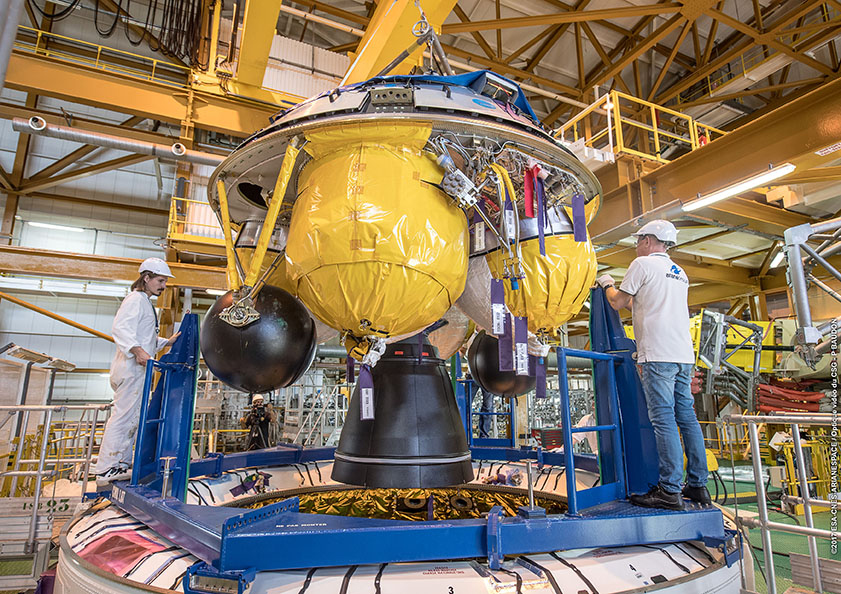
For the first in-space stage we'll use the Ariane 5's EPS storable propellant stage


 This has about ~9.8 ton propellant load and ~1.3 ton dry mass. It uses the Aestus storable propellant, pressure-fed engine at about 324 s vacuum Isp at an 84 to 1 expansion ratio. However, an upgraded version turbopump-fed got 340 s vacuum Isp at 300 to 1 expansion ratio. Astronautix.com lists its price as $6 million.
 
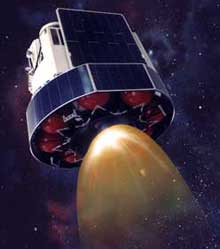
 After that, we'll use two copies of the Integrated Apogee Boost Stage(IABS), at about 1.3 tons storable propellant load and about .275 ton dry mass.


 This stage had an vacuum Isp of 312 s. However, for an in-space only stage vacuum Isp is primarily a function of expansion ratio so we'll assume we can also give it a vacuum isp of 340 s with sufficiently large nozzle of ca. 300 to 1 area expansion ratio. Astronautix.com lists its price as $15 million.

 Then with these three stages we can get about .75 tons, 750 kg, payload to reach the 7.7 km/s delta-v needed for the round trip to Mars and back:

3400(Ln(1 + 1.3/(.275 + .75)) + Ln(1 + 1.3/(.275 + 1.575 + .75)) + Ln(1 + 9.8/(1.3 + 1.575 + 1.575 + .75))) = 7,760 m/s, 7.76 km/s.

 The total mass of all the stages and the payload is 15 tons, within the 16.8 ton limit of the Falcon Heavy to put into Mars Transfer Orbit(MTO).
 

Full Aerocapture/Aerobraking for Landing at Mars.

 The question of using aerocapture at Mars is a major question at NASA now for large payloads in the 15 tons to 25 tons range for landing of human habitats for manned missions to Mars. The earlier methods for landing using to a large extent propulsive landing would require a prohibitive amount of propellant (for the usual propulsion methods. However see below.) 

 On the other land using just parachutes or spherical section reentry capsules because of the thin atmosphere would also be insufficient for such large payloads. See discussion here:

The Mars Landing Approach: Getting Large Payloads to the Surface of the Red Planet.
JULY 17, 2007 BY NANCY ATKINSON
Some proponents of human missions to Mars say we have the technology today to send people to the Red Planet. But do we? Rob Manning of the Jet Propulsion Laboratory discusses the intricacies of entry, descent and landing and what needs to be done to make humans on Mars a reality.

There’s no comfort in the statistics for missions to Mars. To date over 60% of the missions have failed. The scientists and engineers of these undertakings use phrases like “Six Minutes of Terror,” and “The Great Galactic Ghoul” to illustrate their experiences, evidence of the anxiety that’s evoked by sending a robotic spacecraft to Mars — even among those who have devoted their careers to the task. But mention sending a human mission to land on the Red Planet, with payloads several factors larger than an unmanned spacecraft and the trepidation among that same group grows even larger. Why?

Nobody knows how to do it.


  One possibility for how to do it is hypersonic waveriders:

Hypersonic waveriders for planetary atmospheres.
December 1989 Journal of Spacecraft and Rockets -1(4)
DOI: 10.2514/3.26259
Anderson, John D., Jr MARK J. LEWIS, Ajay Kothari, Stephen Corda
International Hypersonic Waverider Symposium, 1st, University of Maryland, College Park, MD, Oct. 17-19, 1990, Proceedings
Article
January 1990
The concept of a hypersonic waverider for application in foreign planetary atmospheres is explored, particularly in regard to aero-assist for space vehicle trajectory modification. The overall concept of hypersonic waveriders is discussed in tutorial fashion. A review of past work is given, and the role of a new family of waveriders - the viscous optimized waveriders generated at the University of Maryland - is highlighted. The mechanics of trajectory modification by aerodynamic vehicles with high lift-to-drag ratios in planetary atmospheres is explored. Actual hypersonic waverider designs for Mars and Venus atmospheres are presented. These are the first waveriders ever presented for foreign planetary atmospheres. Moreover, they exhibit very high lift-to-drag ratios, as high as 15 in the Venus atmosphere. These results graphically demonstrate that a hypersonic waverider is a viable candidate for aero-assist maneuvers in foreign planetary atmospheres.


  As shown if Figure 4 from the article, the hypersonic L/D ratio with waveriders can approach 10. 

Further examination of hypersonic waveriders for reentry given here:

An overview of research on waverider design methodology

  • August 2017
  • Acta Astronautica 140
  •  

     
     A variation on that idea is clam-shell wings during reentry: 

    Clamshell wings for hypersonic reentry of rocket stages. UPDATED, May 4, 2023.

     An advantage of this over usual caret-shaped hypersonic waveriders is that split in two parts and being curved they can they can more than double the underside surface area.


      Falcon 9 opened up fairing as clam-shell wings.
      Renders Credit Caspar Stanley 
     Research has shown that further lift can be provided by hypersonic bi-foils:


     A key advantage of such high hypersonic L/D ratios, is that using lift we can curve the craft around the planet giving it further time to slow down in contrast to traveling in a straight-line and exiting the planets atmosphere with insufficient braking to fall below the planets escape velocity.

    Possible Light Weight Propulsive Methods for Landing.

     Because of the high delta-v requirements for such a mission it was thought the propellant requirements for a propulsive landing would be prohibitive. However, at least two different methods might make it possible, both by getting all or part of the propellant from the Martian atmosphere.

    1.)On Earth, oxygen is the common oxidizer for burning. However some metals in such as magnesium and aluminum burn quite well in a carbon dioxide atmosphere, especially as fine powdered particles:

    The General Chemistry Demo Lab
    Reaction Of Magnesium Metal With Carbon Dioxide.

    Original Articles
    Combustion of Aluminum Particles in Carbon Dioxide
    SERGIO ROSSI,EDWARD L DREIZIN &CHUNG K. LAW
    Pages 209-237 | Received 05 May 2000, Accepted 30 Nov 2000, Published online: 27 Apr 2007

    2.)Both oxygen and carbon monoxide from the Martian atmosphere. 
    That Mars atmosphere is overwhelmingly carbon dioxide is well known. However, it is notable that it contains small amounts of oxygen and carbon monoxide. 


    This is quite important because carbon monoxide can be made to combust in oxygen by the reaction:

    2CO+O22CO2;ΔH=569kJ/mol

     This is not as high energy reaction as hydrogen or methane with oxygen but may be enough to provide sufficient thrust to slow down the craft to enable a soft landing via parachutes. 

     We have then though a similar problem as with scramjet propulsion on Earth. The craft will be moving so fast there might not be enough time for combustion to take place. The problem is made worse because there is additional time that must be taken to separate out by filtration the carbon monoxide and oxygen from the carbon dioxide.

     Still, whether or not this problem can be solved, it is extremely important that this reaction be employed for ISRU once down on Mars. A criticism of the approach of SpaceX of landing the large Starship on Mars is the high energy requirements of producing the methane propellant requiring separating oxygen and hydrogen water(ice) in the soil by electrolysis.

     For a vehicle the size of the Starship Robert Zubrin has suggested it might take  10 football fields of solar panels or even take a nuclear power plant. However, when CO can be obtained from low energy filtration from the Martian atmosphere then free hydrogen for propulsion can be obtained by the reaction:

    CO + H2O → CO2 + H2,  ΔH = -41 kJ mol-1
     
     You can then get methane if that is the preferred fuel over hydrogen by reacting the free hydrogen with CO2 by the famous Sabatier reaction:

     H = −165.0 kJ/mol
     
     So obtaining free O2 and CO from the Marian atmosphere by low energy filtration makes obtaining propellant for the return flight for manned missions much more feasible.

    Financing a Commercial Approach to a Mars Sample Return Mission.

     If this is to be a fully commercial mission how is it to be funded?

     Recall back in 1997 the great interest over the internet from people world-wide on the Mars Pathfinder mission. The Mars Pathfinder mission actually "broke the internet", with its sites getting up to 60+ million total hits per day, to the extent some mirror sites crashed or had to have access limited:

    Traffic on Mars
    by Chuck Toporek
    Asst. Managing Editor
    Web Review
    However, the most interesting and little known fact about the amount of traffic to the mirror sites comes from France, where the government actually pleaded with computer users to stop accessing the two Mars Pathfinder mirrors. You see, the phone systems in France carry all of the Internet traffic in the country, so when people started visiting the mirror sites at VisuaNet and Le Centre National D'Etudes Spatiales (CNES), they tied up the phone lines and basically disabled the country.
    http://mars.jpl.nasa.gov/MPF/press/webreview/index4.html

     The web traffic to the NASA web site for the Mars Exploration Rovers was even more extraordinary, measuring in the billions of hits:

    NASA’s Web Site for 2005
    By Digital Trends Staff — January 7, 2005
    The U.S. National Aeronautics and Space Administration Web portal continues to drive high traffic numbers — more than 17 billion hits in 2004, report both NASA and Speedera Networks, a leading global provider of on-demand distributed application hosting and content delivery services. Speedera delivers content from the space agency’s portal to visitors seeking access to the site from around the world. Popular events on the NASA Web site, including the ongoing Mars Exploration Rover mission entering its remarkable second year, as well as upcoming major projects such as the launch and comet encounter of NASA’s Deep Impact satellite mission in 2005, are expected to drive continued high levels of traffic, according to NASA officials.
    http://www.digitaltrends.com/computing/nasas-web-site-for-2005/

     It was estimated there were 142 million visits to the site during this period. So the question is how much advertising could be sold for a site this well visited?

     It could be financed in the fashion of YouTube videos where the content creator is paid according to the number of views of the video:
    How much do YouTubers make? 2023 facts and figures.
    Edited by:
    Erin Dunn • 
    May 23, 2023
    Curious about how much money YouTubers make per view? YouTubers make an average of $0.018 per ad view, according to Influencer Market Hub. Rates can range from $0.10 to $0.30 per ad view. However, the amount of money YouTube pays depends on a variety of factors, such as:
    • The number of views your video receives...
     The most successful YouTube millionaires however make even more money by partnering with advertisers on their channels. Then the financial backers of the mission could sell the rights for products to be associated with financing the mission.
      Robert Clark

    Sunday, February 15, 2015

    Low cost Europa lander missions.

    Copyright 2015 Robert Clark
      
     NASA has proposed funding for a future orbital mission to Europa. This is expected to have a billion dollar cost. A NASA-funded lander mission to Europa was expected to be too expensive. University of Arizona researcher Christopher Impey suggests doing privately funded missions to Europa:

    SUNDAY, FEBRUARY 8, 2015
    Let’s Send a Private Mission to Europa, Expert Says.
    http://www.astrowatch.net/2015/02/lets-send-private-mission-to-europa.html

     Indeed, by following the commercial space approach an actual lander mission, not just orbital, can be mounted for costs in the range of one of NASA's lowest cost Discovery-class missions.

     Some observations by the Hubble telescope were that Europa may have plumes like Enceladus though those observations have not been confirmed. If it does, then it may be the subice ocean on Europa could be reached simply by traveling though the fissures, like on Enceladus, not requiring melting through the ice.

     For getting funding for a privately-financed mission, imagine how much interest there would be among the public if we could actually access this subsurface ocean. As a point of comparison the Mars Pathfinder missions web site caused such overloads, with 40+ million hits per day, that some mirror sites crashed or had to have access limited:

    Traffic on Mars
    by Chuck Toporek
    Asst. Managing Editor
    Web Review
    However, the most interesting and little known fact about the amount of traffic to the mirror sites comes from France, where the government actually pleaded with computer users to stop accessing the two Mars Pathfinder mirrors. You see, the phone systems in France carry all of the Internet traffic in the country, so when people started visiting the mirror sites at VisuaNet and Le Centre National D'Etudes Spatiales (CNES), they tied up the phone lines and basically disabled the country.
    http://mars.jpl.nasa.gov/MPF/press/webreview/index4.html

     Private companies that provided funding could be allowed to advertise on the mission web site.

    Mission Delta-V requirements.
     The spacecraft first has to be sent on a trajectory towards Jupiter. This requires a delta-v of 6.3 km/s. Following a Hohmann trajectory it takes about 2.7 years to arrive at Jupiter. Aside from this Jupiter transfer delta-v, it will need to be placed into Jupiter/Europa orbit on arrival, and then sent towards a landing on Europa. According to this report this will require a delta-v in the range of 3.9 km/s:
    European Cryo-Ocean Exploration Submersible (ECOES).
    Preliminary Design Report. 
     We'll use a cryogenic, hydrogen-fueled stage for the injection into a trajectory towards Jupiter. And because of the long travel time, we'll use storable (hypergolic) propellants for the propulsive maneuvers at Jupiter.
    Falcon 9 v.1.1 sized launcher.
     The expendable version of the Falcon 9 v1.1 has a payload to LEO of ca. 16.6 metric tons (mT). We'll use the Ariane H10-3 hydrogen-fueled upper stage for the Jupiter trajectory insertion. It has a 11.86 mT propellant mass, 1.24 mT dry mass, and 445 s Isp. Then it can carry 2.4 mT to the 6.3 km/s delta-v needed for the flight towards Jupiter:
    445*9.81ln(1 + 11.86/(1.24 + 2.4)) = 6,324 m/s
     For the stage, at Jupiter we'll use the Integrated Apogee Boost Subsystem (IABS) stage.
     An artist's concept of a DSCS satellite being boosted by the IABS. Photo: U.S. Air Force
     
     This is a small kick-stage used to put geosynchronous satellites in their final orbits. It has a 1,578 kg gross mass and 275 kg dry mass, for a 1,303 kg propellant mass, and a 312 s Isp. Then this could provide a 220 kg spacecraft with the 3.92 km/s delta-v needed to land on Europa:
    312*9.81ln(1 + 1303/(275 + 220)) = 3,947 m/s. 
     The Falcon 9 v.1.1 costs in the range of $56 million, the Ariane H10-3 cryogenic stage costs in the range of $12 million and the IABS stage costs in the range of $15 million, for a ca. $83 million launch cost.
     For a model of a low cost lander we might use the Mars Pathfinder mission. This weighed only 264 kg for the lander plus 10.5 kg for the rover. The development cost for the lander was less than $150 million. The development cost of  $150 million is quite low for a planetary mission. However,  privately financed it would be even less than that, perhaps as much as a factor of 10 cheaper.
      SpaceX was able to develop the Falcon 9 at a 90% (!) saving off  the development cost of a fully government-financed launcher of similar size. Planetary Resources Inc. plans to produce imaging satellites at a fraction of the usual cost.
    Arkyd 100 space telescope.
     With mission costs this low we might want to produce a separate orbiter mission at Europa. As models for this we might use the small Mars orbiters Mars Odyssey and Mars Climate Orbiter.

    Falcon Heavy sized launcher.
    
     The Falcon Heavy will allow a larger payload to be transported to the Europan surface. It is expected to be able to carry 53 metric tons to LEO. We'll use two Centaur stages together for the injection into a trajectory towards Jupiter. For the maneuvers at Jupiter, we'll use the storable propellant stage Delta K. This has a 6 mT propellant load, 0.95 mT dry mass, and 319 s Isp. Then it can provide a 1 mT spacecraft with the 3.9 km/s delta-v needed for the Europa landing:
    319*9.81ln(1 + 6/(0.95 + 1)) = 4,397 m/s.
     The Centaur has several incarnations. It's propellant load is in the range of 20 mT, dry mass ca. 2 mT, and Isp ca. 451 s. Then two Centaurs together could provide the 6.3 km/s delta-v needed for the Jupiter flight carrying the 7.95 mT total mass of the Delta K stage + Europa lander:
    451*9.81ln(1 + 40/(4 + 7.95)) = 6,500 m/s.
      The Falcon Heavy will cost in the range of $125 million. The Centaurs cost in the range of $30 million each and the Delta K stage costs ca. $4.35 million. Then the total launch cost will be in the range of $189.35 million.
     As a model of a 1 metric ton lander we might use the Mars Curiosity rover. This is a $1 billion mission however. The commercial space approach however should be able to produce a similar size spacecraft for a fraction of this cost.
     
       Bob Clark 
     

    UPDATE, February, 20, 2015:

     The web traffic to the NASA web site for the Mars Exploration Rovers was even more extraordinary, measuring in the billions of hits:

    NASA’s Web Site for 2005
    By Digital Trends Staff — January 7, 2005
    The U.S. National Aeronautics and Space Administration Web portal continues to drive high traffic numbers — more than 17 billion hits in 2004, report both NASA and Speedera Networks, a leading global provider of on-demand distributed application hosting and content delivery services. Speedera delivers content from the space agency’s portal to visitors seeking access to the site from around the world. Popular events on the NASA Web site, including the ongoing Mars Exploration Rover mission entering its remarkable second year, as well as upcoming major projects such as the launch and comet encounter of NASA’s Deep Impact satellite mission in 2005, are expected to drive continued high levels of traffic, according to NASA officials.
    http://www.digitaltrends.com/computing/nasas-web-site-for-2005/

     It was estimated there were 142 million visits to the site during this period. So the question is how much advertising could be sold for a site this well visited?

    Could Blue Origin develop a lander for Artemis III?

    Copyright 2025 Robert Clark SpaceX is coming under increasing criticism for its delay in developing the Starship lunar lander: U.S. Is Losin...