Showing posts with label TSTO. Show all posts

Monday, February 27, 2023

The Missed Lesson of the Falcon Heavy

  Copyright 2023 Robert Clark


  Every time Gwen Shotwell or Elon Musk are interviewed about the Superheavy launch they are always fretting about a possible explosion on the launch pad, possibly damaging the launch tower.

 Shotwell and Musk have even said the test launch will be considered a success just clearing the tower without damaging it. Presumably then, the test launch will still be considered a success even if it does explode during the flight, as long as it first clears the tower. This hardly instills confidence in the reliability of the flight. Indeed it begins to look like the approach of the Russian N-1 engineers who tested the N-1 by launching it multiple times without sufficient ground testing first, resulting in the  rocket exploding on each test flight.

 One wonders, if the SuperHeavy does explode during flight, would SpaceX like the N-1 engineers before them do the next test launch again without full length test firing of all engines together, as long as the launch tower is undamaged? Suppose the launch tower is damaged, would they still take this same approach?


 What should have been done in regards to the SuperHeavy booster is to construct a separate test stand to test all 33 engines at the same time for the full, true flight burn time of the engines. The static test fire done so far was barely more than 5 seconds long, hardly a true shake out of the complete engine package at once. Plus, it was only at half thrust. During that short test, 2 engines failed. Without further information it can just as well be every 5 seconds or so another 2 engines would fail.

 Constructing a separate test stand will allow the engines all together to gradually be ramped up to full thrust and to full, true burn length duration. The automatic and manual shutoff of the two engines in the last test is encouraging. If might mean in a gradual testing program, flaws could be detected and the test curtailed if one or more engines failed. Then the flaws in those engines could be corrected and the tests conducted again.

 Note this was how it was done for the five F-1 engines of the Saturn V, conducting true, full duration tests of all five engines at once. The engines were not certified for flight until all five engines successfully completed true, full duration test firings all together, for multiple test firings.


 However, more importantly SpaceX missed major advantages of the Falcon Heavy approach of using three cores to form a heavy lift vehicle. They incorrectly concluded the Falcon Heavy was not a good approach because it cost something(!) The SpaceX engineers should have noted that for the Delta IV Heavy, also a triple-cored vehicle from existing cores, the development cost was in the range of $500 million. The correct conclusion they should have drawn is how much cheaper it was than building an entire new booster three times as big. The FH development cost also turned out about $500 million. This is only about 50% more than that of developing the original Falcon 9 at $300 million but at 3 times the payload of the current Falcon 9. 

 Actually the advantage may be even greater than that. The original Falcon 9 was only about 10 tons to LEO. So the Falcon Heavy is at 6 times the payload of the original Falcon 9. On the other hand the total development cost for all the Falcon 9 versions up to the current Falcon 9 FT has been estimated in the billion dollar range. So the Falcon Heavy increased the payload by a factor 3 over the current F9, but at a development cost less than half that of the current version 

 Likewise to the Falcon Heavy, a triple-cored Starship could have formed a launcher at 3 times the payload of a two-stage launcher based on the Starship being the booster with a smaller mini-Starship as the second stage.This was discussed here:

Starhopper+Starship as a heavy-lift launcher. Triple-cored Starship for super-heavy lift. 2nd UPDATE, 9/2/2019: Starhopper as a lunar lander.


 Quite importantly the two-stage to orbit vehicle, TSTO, would be able heavy lift 100+ tons to LEO. This is important because a 100 ton launcher is regarded as a requirement for a manned lunar mission in a single launch architecture. So already in 2021 with the Starship performing its test launches then we would already have had a manned lunar mission capable launcher. This is assuming the "Starhopper" as a small upper stage would also have had its development continued.

 This is for a single launch architecture, no 4 to 16 launches needed to refuel the Starship in orbit as a lunar lander. Note also the triple-cored version also could do a manned Mars mission in a single launch.

 And before the Falcon Heavy flew, there were over a 100 flights of the Falcon 9. That's over 1,000 actual full, operational burns of the Merlin engines. The equivalent of more than 30 full flights of the Falcon Heavy. 

  This brings up another major advantage of this approach, in regards to safety. Gwen Shotwell has said ideally Starship would have 100 launches before launching people. This is actually a logical disconnect to the Artemis missions with the Starship intending to carry people to the Moon as a lander by 2025:

Shotwell says SpaceX ready for Starship static-fire test
Jeff Foust
February 8, 2023
She said she expected Starship to fly at least 100 times before it carries people for the first time, a challenge as the company prepares a lunar lander version of Starship for NASA’s Artemis 3 mission, currently scheduled for as soon as 2025.

In her later conversation with reporters, she called that 100-flight milestone a “great goal” but suggested it was not a requirement. “I would love to do hundreds before. I think that would be a great goal and it’s quite possible that we could do that,” she said.

She noted the company has a goal of 100 Falcon launches this year. “If we can do 100 flights of Falcon this year, I’d love to be able to do 100 flights of Starship next year. I don’t think we will do 100 flights of Starship next year, but maybe 2025 we will do 100 flights.”

 But the Starship making 100 flights would mean the SuperHeavy making 100 flights by 2025. This is highly unlikely with the Superheavy not having made a single launch yet.

 Note the Falcon 9 made 85 unmanned flights before it launched crew to orbit. With, instead, a Starship  TSTO making its first flight in 2021 at over 5 times the payload as the Falcon 9, it very well could have already superseded Falcon 9 at that role and have been making ~25 flights per year over the 4 years from 2021 to 2025.

Single Stage to Orbit(SSTO) possibility.  

 The accepted interpretation of the SSTO as infeasible stems from the earliest days of the Space Age where ground launch engines only had ca. ~300 s vacuum Isp. Having to fire from the ground put severe limits on the engine efficiency as measured by Isp of engines. Because of that, it was argued an SSTO would need some major technical advance to be feasible, such as nuclear engines with ca. 900 s Isp.

 It is unfortunate that the paradigm for making a SSTO feasible was by assuming nuclear thermal propulsion. In point of fact for a kerosene-fueled engine only a ~330 s vacuum Isp was needed and for hydrogen fueled only ~440 s vacuum Isp for the ground-launch engines. Both of these became possible by the 1970's with the Russian RD-180 for kerosene-fueled at 338 s vacuum Isp and the American SSME at 452 s vacuum Isp. 

And now, with the SpaceX Raptor as a ground-launch capable engine reaching 370+ s vacuum Isp, quite significant payload becomes possible as an SSTO.

 With the Starship and mini-Starship as SSTO's radical increases in orbital flight especially for point-to-point transport would have been possible.

  Robert Clark


Monday, June 21, 2021

SSME based SSTO’s. UPDATED, 6/28/2021 - Extension to the Delta IV Heavy

 Copyright 2021 Robert Clark


 The SSME makes possible *practical* SSTO’s, that is, with significant payloads. Need to use known lightweight materials, such as carbon fiber. As discussed in the blog post,


DARPA's Spaceplane: an X-33 version, Page 2

https://exoscientist.blogspot.com/2018/06/darpas-spaceplane-x-33-version-page-2.html 


some ultra high strength metals would also work:


 The standard aluminum the Delta IV used for its propellant tanks had about a 25 to 1 propellant to tank mass ratio. At 200 ton propellant mass, this gives a tank mass of 8 tons. So using light weight materials we can get this down to 4 tons.


 To estimate payload possible we need the required delta-v to low Earth orbit(LEO). Various estimates are given for this depending on altitude and orbital inclination. I’ll use the estimate give in this report of 9,000 m/s:


Towards Reusable Launchers - A Widening Perspective.

https://www.esa.int/esapub/bulletin/bullet87/pfeffe87.htm


 The Delta IV launch vehicle used the low cost, RS-68, an engine designed for low cost, but only at mid level performance. But for an SSTO you need both high performance engines and weight optimized structures. So we’ll replace the RS-68 with two SSME’s. The two SSME’s will have about the same mass as the RS-68 with slightly more thrust. But most importantly they have a much better vacuum Isp at 452.3 s compared to 412 s.


 The dry mass of the Delta IV first stage is about 26 tons. By light weighting the tank, we cut 4 tons from the tank mass to bring the dry mass to 22 tons. Then we can get a payload of 8 tons to orbit. By the rocket equation:


452.3*9.81ln(1 + 200/(22 + 8.2)) = 9,012 m/s.


 The Delta-IV TSTO, with no side boosters, has about the same payload to LEO using a Centaur upper stage:


https://en.m.wikipedia.org/wiki/Delta_IV#RS-68A_booster_engine_upgrade


The higher Isp of the SSME’s explains why the SSTO can match the performance of the TSTO to LEO.


 It is true that most launches now are for satellites actually to go to GEO, geosynchronous orbit. For this you can use the current Centaur upper stage. But firstly the use of the Centaur would allow higher payload to LEO than the current TSTO. The Centaur has about a 21 ton propellant load and 2 ton dry mass for a 23 ton gross mass with an Isp of 462 s. Then the TSTO could now get 21 tons to LEO:

452.3*9.81ln(1 + 200/(22 + 23 + 21.5)) + 462*9.81ln(1 + 21/(2 + 21.5)) = 9,050 m/s. 


 This is well above the 8 tons or so of the current TSTO version and is close to the payload of the Falcon 9 full thrust version.


 This TSTO does get more than the SSTO, but in point of fact you don’t need the maximal payload for most launches, so why use the upper stage if it is unneeded? 


 The additional delta-v required to GEO is about 3,800 m/s. Then a total of 12,800 m/s would be required to get the payload to GEO. This TSTO version could get 6 tons to GEO:


452.3*9.81ln(1 + 200/(22 + 23 + 6)) + 462*9.81ln(1 + 21/(2 + 6)) = 12,900 m/s. 


 This is multiple times higher than the current version:


http://spacelaunchreport.com/delta4.html#config


However, the SSME’s are expensive engines. To get the full usefulness of an SSTO you really need reusability. In point of fact by using lightweight thermal protection and landing legs, and lightweight wings or propellant storage for final approach, the additional mass for reusability can be less than 10% of the landed mass. So the SSTO would still get significant mass to LEO.


 Reusables do get their most usefulness at high launch rates. Then to serve various markets we would also want a smaller vehicle than this SSTO. We could get this by cutting down the tank size and using a single SSME: 


 We’ll cut down the propellant size to 150 tons, 3/4ths the usual size, and again we’ll use light-weighting on the tank of the Delta IV first stage. Subtracting off the 8 tons for the standard tank the dry mass is 18 tons. The tank mass at 3/4ths size would be 6 tons. But we’re lightweighting it so it’ll be 3 tons. That brings the dry mass to 21 tons.


 But the SSME at 3.2 tons is also a lighter engine than the RS-68, at 6.6 tons. So we’ll subtract off an additional 3.4 tons from the dry mass to bring it to 17.6 tons. There will be additional reductions in the dry mass due to smaller thrust structure for the lower thrust of the single SSME, and smaller insulation and wiring for the smaller vehicle, but not as large as the other reductions. 

 So for the first estimate take the dry mass as 17.6 tons. Then we can get 5 tons to LEO with this smaller SSTO:


452.3*9.81ln(1 + 150/(17.6 + 5)) = 9,020 m/s.


 Since less than 10% would be needed for reusability we can still get ca. 3 tons to LEO as a reusable SSTO.


   Robert Clark


UPDATED, 6/28/2021.

 The advantage of using high performance engines and lightweight tanks is not just for getting a SSTO. As mentioned above using this, the two-stage-to-orbit(TSTO) Delta IV can double its LEO payload to ca. 20 tons to match that of the Falcon 9 Full Thrust. Its payload capacity to the lucrative GEO satellite market would also match that of the Falcon 9 FT.


 ULA could then be competitive with SpaceX for the largest current market for commercial launches. Note that ULA could also match SpaceX in it's partially reusable approach of returning only the first stage. ULA head Tory Bruno has said the SpaceX approach of boosting back the first stage to the launch site requires too much fuel, and loses too much payload.


 Instead what ULA has proposed doing is returning the engine package only, catching it in midair on return by parachute. The rest of the first stage would be thrown away. This is a kludge, an inelegant solution just to get by. A kludge never provides a long lasting solution. The Space Shuttle was a kludge, which explains why it never reached its goal of fast and low cost reusability. However, by increasing the Delta IV's payload capacity in the described manner, ULA can also boost back to the launch site and match SpaceX in reusable payload capacity.


 The startling increase in payload would also apply to the Delta IV Heavy, with the addition of cross-feed fueling. This is where for a parallel staged vehicle the fuel for the central core is taking from the side boosters during the parallel burn portion of the flight. This allows the central core to be fully fueled when the side boosters are jettisoned.


55th International Astronautical Congress 2004 - Vancouver, Canada 

1 IAC-04-V.4.03 

DELTA IV LAUNCH VEHICLE GROWTH OPTIONS TO SUPPORT NASA’S SPACE EXPLORATION VISION

https://www.ulalaunch.com/docs/default-source/evolution/delta-iv-launch-vehicle-growth-options-to-support-nasas-space-exploration-vision.pdf

 We'll use the rocket equation to again estimate the payload possible for the Delta IV Heavy. Because of how cross-feed fueling works, the calculation works as if the it were a three stage vehicle with the fuel only being from the side-boosters during the "first stage":

452.3*9.81ln(1 + 400/(44 + 220 + 23 + 68)) + 452.3*9.81ln(1 + 200/(22 + 23 + 68)) +462*9.81ln(1 + 21/(2 + 68)) = 9,060 m/s.

 This payload of 68 tons nearly triples the payload of the current version of the Delta IV Heavy, and now matches the payload of the Falcon Heavy.


 This is still using the expensive SSME's however. But the point of the matter is this is doable for the current engine RS-68 used on the Delta IV as well if given altitude compensating nozzles.


 There are various means of adding altitude compensating nozzles to existing engines. They could be like the RL-10B with extendible nozzles, or flexible, expandable nozzles, or mechanically moving "petal" arrangements as with variable area nozzles on jet engines, or several other ways. 


 This last is interesting in that this method of achieving variable area nozzles has been in existence since the 70's. As a total WAG it might improve the performance for jets by, say, 10%. But for rockets using variable nozzles could improve performance by 100% or more and it still has not been used for rockets. 


 In such a way, a midlevel performance engine such as the RS-68 could be upgraded to achieve comparable performance of the high performance SSME's. I won't offer a calculation here using the rocket equation for this case. The reason is while such estimates frequently take the vacuum Isp for a fixed nozzle engine, this may or not be accurate for the case of an altitude compensating nozzle. On the one hand you can give the RS-68 a higher vacuum Isp than SSME, even at 470+ s, but the higher chamber pressure of the SSME, suggests it should have better performance at ground level than the RS-68 given alt.comp.  


 The calculation of the delta-v possible through altitude compensation is one that should be made by the launch companies.


Regular Manned Lunar Flights.

 The use of the higher performance engines gives us the capability of SSTO's with the Delta IV and also heavy lift with the Delta IV Heavy, with payload comparable to the first planned version of the SLS at ca. 70 tons. With this we have the possibility of routine manned flights to the Moon and beyond. Robert Zubrin has written a proposal for a low cost architecture for setting up a Moon base with regular flights to the Moon. Remarkable all it would need beyond the current capability is a reusable lunar lander.

 In the Zubrin proposal it would take only 3 flights of the Falcon Heavy and one flight of a manned Falcon 9 to set up the manned lunar base:


Op-ed | Moon Direct: How to build a moonbase in four years.

by Robert Zubrin — March 30, 2018

https://spacenews.com/op-ed-moon-direct-how-to-build-a-moonbase-in-four-years/


 But with the extra capabilities of the Delta IV Heavy, the three Falcon Heavy launches could be replaced by three launches of the Delta IV Heavy.


 Recall I said Zubrins plan only needed a lunar lander. ULA is planning the upper stage of its upcoming Vulcan lander, the Centaur V, to have in-space reusability. Then this upper stage could also be used as a reusable lunar lander. See discussion here:


Robust Lunar Exploration Using an Efficient Lunar

Lander Derived from Existing Upper Stages

AIAA 2009-6566

Bernard F. Kutter et al.

https://www.ulalaunch.com/docs/default-source/exploration/dual-thrust-axis-lander-(dtal)-2009.pdf


 In regards to adapting the Centaur V or a currently in use Centaur to a horizontal landing lunar lander, I advise the landing rockets be just pressure-fed thrusters fueled from the regular tanks of the hydrolox tanks of the Centaur.


Monday, September 2, 2019

The prospect of SSTO once more rears its ugly head.

Copyright 2019 Robert Clark
This Aug. 28th tweet from Elon Musk surprised many when it asserted a 20km altitude Starship test hop in October and an orbital flight “shortly thereafter”:
https://twitter.com/elonmusk/status/1166860032052539392?s=21
That was surprising because, it is taken, that an orbital flight will require the Super Heavy booster stage. The problem is the Super Heavy is to have 35 Raptor engines. At current production rates it’s not likely you could have 35 Raptor engines for the SH and 6 Raptors for the Starship by the end of, say, October.
The “Everyday Astronaut” who usually has good info on the progress of SpaceX suggests as of Aug. 25th, only the 7th and 8th Raptors have been produced and he estimates a production rate of one Raptor per 2 weeks:

https://twitter.com/Erdayastronaut/status/1165630118603251712?s=20
So some began to speculate, again, that at least for the initial test flights the Starship might be flown to orbit as an SSTO. But that’s OK. SSTO is not after all a four-letter word. Elon has said the Starship technically could be SSTO but not reusably as not having enough payload for adding thermal protection systems and landing fuel.
However, it is important to keep in mind the first test flights will not have the passenger quarters for the full operational Starship so will have a quite a bit lighter dry mass. For the first test flights it will more closely resemble the tanker version of the BFR upper stage. Elon has said that a stripped down Starship with no payload fairing and only three Raptor engines will have a dry mass of only 40 tons:

Having only 3 Raptors would work for the application mentioned in that tweet as upper stages commonly have lower thrust than their gross weight, as they don’t have to lift off from ground.
The test version of the Starship to only do the 20 km test hop is supposed to only use three engines, with reduced propellant load. So we can get an idea how accurate that dry mass of only 40 tons is for a 3 engined Starship-version with no passenger quarters in this case as the first test vehicle, if Elon releases the dry mass for it, which is open to doubt.
The Raptor engine might have a mass of 1 ton based on its high estimated T/W ratio and thrust ratings. So adding 3 additional Raptors to have 6 Raptors as planned for the full Starship might only have a dry weight of 43 tons. You would have to add the weight of the fairing but since the fairing is ejected once reaching near vacuum and well before attaining orbit, this should subtract only a proportionally small amount from the payload.
But 6 Raptors at 200 ton sea level thrust each would just barely be able to lift off a 1,200 ton BFR upper stage. You might have to reduce the propellant load somewhat to get a better liftoff T/W ratio. With a vacuum Isp of 356s vacuum Isp and 334s sea level Isp you would still be able to reach orbit with significant payload as long as the propellant is reduced by a proportionally small amount. _______________________________________________________________
That’s the argument why the first test flights might be SSTO. However, it still is possible that the Super Heavy booster will be used. This may have been aspirational on his part, but Elon tweeted back in May they want to ramp up Raptor production to one every three days by the Summer:
If they have reached this production level, then over the next 60 days to the end of October you could have 20 additional Raptors produced. This still will not be enough for the full 41 engined two-staged BFR. But there has been suggestion the initial test Super Heavy might only be given 20 Raptors:

https://twitter.com/rdstrick777/status/1167458646579564544?s=21
With the 8 Raptors already produced, this would be enough using 6 or 3 Raptors on the upper stage. This could not lift the full propellant loads of the Super Heavy and Starship. So also in this case you would have one or both stages with reduced propellant loads.
But this introduces additional problems for reusability in regards to this test flight because such large amounts of propellant need to be kept on reserve for returning the first stage booster to the launch site.
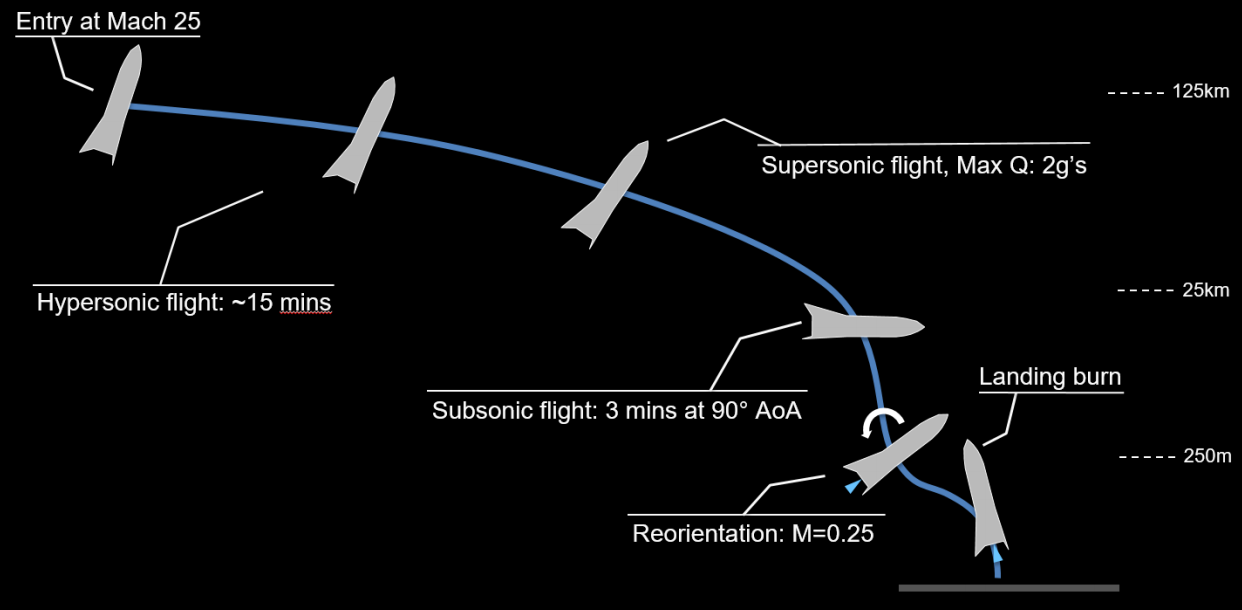
Then actually the SSTO test might be better because for reusability of a returning upper stage only a proportionally small amount of propellant needs to be kept on reserve to cancel out ca. Mach 0.25 = 80 m/s on landing:


Bob Clark

Wednesday, August 7, 2019

Case proven: SSTO's are better than two-stage launchers.

Copyright 2019 Robert Clark


I remember thinking when reading of the debate about reusable vehicles between proponents of horizontal winged and vertical propulsive landing that all this debate was about a measly 100 m/s delta-v. The reason is whether you use wings or not almost all the speed of orbital velocity is going to be killed off aerodynamically on return. For even for vertical landing, the stage entering broadside will be slowed to terminal velocity, ca. 100 m/s. This is only about 1.3% that of orbital velocity of 7,800 m/s.
This was confirmed by a graphic just released by SpaceX about the BFR’s Starship upper stage reentry:


As discussed for example in this article:
 Here is Elon also discussing how the Starship will land on Earth, including the low terminal velocity, and low final landing burn:
How SpaceX's BFR Rocket Will Land - Elon Musk Explains.
 This shows for the Starship it only has to fire the engines at about Mach 0.25, 80 m/s. So it only has to kill off 80 m/s propulsively. But with the Starship just needing to kill off a 80 m/s velocity with a 3,300 m/s Raptor sea level exhaust velocity, about 330s Isp, by the rocket equation the mass ratio to do this is e[80/3300] = 1.025. Subtracting 1 from this is the ratio of the propellant required to the dry mass. The tanker version of the BFR upper stage, i.e., without the passenger quarters, will have a dry mass of ca. 50 tons (compared to the 85 tons of the Mars Colonial Starship version.) This means you only lose 1.25 tons for the landing.
But a rocket equation estimate using a 356 s vacuum Isp for the sea level raptors gives a ca. 40 ton payload for the tanker version as an SSTO.
See for example here:
Then the 1.25 tons lost due to propellant kept on reserve loses ca. 3% of the payload due just to the reserve propellant required. You also lose a proportion due to thermal protection system and landing legs but that’s also true for the TSTO.
However, because of the huge amount that needs to be kept on reserve for a first stage booster of a TSTO for slowing the booster down for reentry and for boost back to the launch site as well as for final landing approach, you can lose 40% of the payload for full reusability as indicated by the Falcon 9. Actually, for the BFR for full reusability Elon has said it will lose 50% payload off the expendable version.
Because of this huge loss for reusability for the TSTO, on a percentage of the rocket size basis, and therefore also on a cost basis, the SSTO is more cost effective.
The advantage of the SSTO becomes even greater when you add altitude compensation nozzles. Used on a TSTO this can improve the payload ca. 25%. But on a SSTO it can improve the payload 100% or even more.

 Bob Clark

Monday, June 27, 2016

Altitude compensation attachments for standard rocket engines, and applications, Page 3: stretchable metal nozzles.

Copyright 2016 Robert Clark
(patents pending)


 Some calculations show a surprising increase in the amount of payload that can be carried by a single-stage-to-orbit rocket (SSTO) by using altitude compensation [1], such as the aerospike, even multiple times more than possible without it. Indeed, the calculations revealed that for an already high propellant fraction stage such as the Falcon 9, alt. comp. gives the SSTO a better cost per kilo ratio than the two stage rocket (!) 

 This was a surprising result since during much of the era of orbital rockets it was received wisdom that SSTO's were not technically feasible. Then, it gradually became accepted it could be done, but it was then felt it would not be worthwhile because of the small payload. Therefore it is quite remarkable that the exact opposite of this is true, the SSTO is more cost effective than the TSTO (two-stage-to-orbit) when using altitude compensation [1]. 

 But the usefulness of altitude compensation is not just for SSTO's. The payload for a two-stage to orbit launcher can be increased 25% by using it [2]. And triple-cored rockets such as the Delta IV Heavy, and Falcon Heavy can have their payload doubled when using altitude compensation in concert with cross-feed fueling [2]. Moreover, by using alt. comp., simple pressure-fed stages that are within the technical means of most university engineering departments can be made to make suborbital [3] and orbital launchers [4].

 However, an argument has been made that transforming already existing engines to altitude compensation such as the aerospike would be expensive since it would require changing the combustion chamber to a toroidal shape. Then I investigated other means of achieving altitude compensation other than the aerospike [5].

 One of these methods was to use high temperature carbon nanotube "rubber" [6] as a nozzle extension. This could be attached to the nozzle of already existing engine nozzles and be variably extended as the rocket gained altitude.

 But could we use metals for this purpose? The metal would have to be stretchable as is rubber to become twice as long or more as the nozzle is extended. Normally though metal can only be stretched by a fraction of its original length before fracturing and even then it takes quite a large amount of force to do the stretching.

 There is a scenario though where metals can be stretched for a longer length and at a small amount of required force, that is at elevated temperatures. This is through forging. This takes place while the metal is still solid. The forging temperature [7] is where the metal is more malleable but below the melting temperature. It is commonly in the range of 60% of the melting temperature. Then the idea would be as the nozzle becomes heated as the engine is firing it would become more and more easily extended further out. 

 For how to extend, that is stretch, the nozzle, one possibility would be to use high pressure inert gas such as helium injected within the hollow walls of the nozzle to stretch it you as would for blowing up a a hollow balloon. Another would be actuators attached to the end to stretch it out.

 For either method you would want the nozzle to maintain the usual bell nozzle shape. You could have the wall thickness vary along the nozzle's length so that as it is stretched out the required shape is maintained. You might also have ribs along the vertical length of the nozzle to help encourage the stretching to proceed in the desired direction.

 Another consideration is that you don't want the nozzle to reach a degree of heating so that it reaches the melting point. An interesting fact about rocket nozzles and combustion chambers is that they actually operate at temperatures above the melting point of the metal composing them. The reason why they don't melt is that for a material to undergo the phase change from solid to liquid, not only does the temperature have to be at the melting point, but a sufficient quantity of heat dependent on the material has to be supplied to the material, the enthalpy of fusion [8].

 Then rocket engines have cooling mechanisms applied to the chamber and nozzle walls to draw away the heat supplied by the combustion products so that this amount of heat is never applied to chamber and nozzle. One key method that is used for high performance engines is regenerative cooling. This is where the fuel is circulated through channels in the walls of the engine to draw away the heat.

 Another factor to limit the temperature and heat applied to the nozzle is that this is envisioned as an attachment to a usual, static nozzle. However, as the engine exhaust is expanded out by a bell nozzle the temperature drops. So for the attachment at the bottom of the usual nozzle, the temperatures it would have to withstand would be reduced.

 A diagram showing the stress-strain curve at elevated temperatures for titanium alloys is here [9]:


  The strain at room temperature is commonly only a fraction of a percent, ca. 0.2%, or 0.002. But here at elevated temperatures in the range of 800C to 1,050C, we see the strain can reach .7, and likely above with continued pressure applied.


REFERENCES.

1.)Thursday, November 7, 2013
The Coming SSTO's: Falcon 9 v1.1 first stage as SSTO, Page 2.

2.)Monday, January 11, 2016
Altitude Compensation Improves Payload for All Launchers.

3.)Thursday, January 15, 2015
NASA Technology Transfer for suborbital and air-launched orbital launchers.

4.)Thursday, August 13, 2015
Orbital rockets are now easy.
http://exoscientist.blogspot.com/2015/08/orbital-rockets-are-now-easy.html

5.)Saturday, October 25, 2014
Altitude compensation attachments for standard rocket engines, and applications.
http://exoscientist.blogspot.com/2014/10/altitude-compensation-attachments-for.html

6.)Carbon Nanotube Rubber Stays Rubbery in Extreme Temperatures.
Liming Dai
Angew. Chem. Int. Ed. 2011, 50, 4744 – 4746
http://case.edu/cse/eche/daigroup/Journal%20Articles/2011/Dai-2011-Carbon%20Nanotube%20Rubb.pdf

7.)Forging temperature.
https://en.wikipedia.org/wiki/Forging_temperature

8.)Enthalpy of Fusion.
https://en.wikipedia.org/wiki/Enthalpy_of_fusion

9.)MODELLING HIGH TEMPERATURE FLOW STRESS CURVES OF
TITANIUM ALLOYS
Z. Guo, N. Saunders, J.P. Schillé, A.P. Miodownik
Sente Software Ltd, Surrey Technology Centre, Guildford, GU2 7YG, U.K
http://www.sentesoftware.co.uk/media/2524/flow_stress_curve.pdf


Saturday, November 29, 2014

A half-size Ariane for manned spaceflight.

Copyright 2014 Robert Clark

 The current agreed  upon design for the Ariane 6 is to use a slightly reduced in size Ariane 5 core with strap-on solid boosters about half-size to the solids used on the Ariane 5:

Ariane 6.

   I believe this is a preferred solution for the Ariane 6 than the version using all solid lower stages. For one thing, if SpaceX succeeds in producing a reusable first stage, then ESA can keep pace by making the core stage of the Ariane 6 reusable.

 My ideal solution however would have used two to three Vulcain engines on the core stage. This would have an additional advantage of being able to be used as a manned launcher with no solids attached:

Friday, March 29, 2013
The Coming SSTO's: multi-Vulcain Ariane.
Copyright 2013 Robert Clark
http://exoscientist.blogspot.com/2013/03/the-coming-sstos-multi-vulcain-ariane.html


Single-Stage To Orbit Case. Still we can get a manned launcher retaining a single Vulcain II on the core and shrinking the size of the stage, to half-size. As discussed in the "The Coming SSTO's: multi-Vulcain Ariane" post, the propellant mass of the Ariane 5G core is 158,000 kg, with a 12,000 kg dry mass. We may remove a forward skirt called the "JAVE" used to attach the solids to the Ariane 5. This massed 1,700 kg bringing the dry mass down to 10,300 kg. The propellant tank on the Ariane 5G weighed 4,400 kg. So half-size this will weigh 2,200 kg, bringing the dry mass down to 8,100  kg. 
 In Dr. John Schilling's Launch Performance Calculator, enter in now also 79,000 kg for the propellant mass, 1,350 kN for the vacuum thrust and 434 s for the vacuum Isp. Select Kourou as the launch site with a launch inclination of 5.2 degrees, to match the launch site latitude. The "Restartable Upper Stage" option should be checked "No" even for a single stage, otherwise the payload will be reduced. Then the calculator gives:


Mission Performance:
Launch Vehicle:  User-Defined Launch Vehicle
Launch Site:  Guiana Space Center (Kourou)
Destination Orbit:  185 x 185 km, 5 deg
Estimated Payload:  2528 kg
95% Confidence Interval:  1064 - 4248 kg
"Payload" refers to complete payload system weight, including any necessary payload attachment fittings or multiple payload adapters
This is an estimate based on the best publicly-available engineering and performance data, and should not be used for detailed mission planning. Operational constraints may reduce performance or preclude this mission.

  This payload of 2,500 kg is for a single stage to orbit vehicle. As discussed in the blog post "Budget Moon flights: lightweight crew capsule", this may be sufficient for a 3-person capsule to LEO. For instance the Cygnus capsule given life support may fit within this size range. I have discussed though an SSTO reaches its best performance when using altitude compensation: "Altitude compensation attachments for standard rocket engines, and applications".

 By using altitude compensation the vacuum Isp can be raised to 466 s and the vacuum thrust to 1,350 kN*(466/434) = 1,450 kN. Schilling's calculator now gives a result of: 

Mission Performance:                  
Launch Vehicle:  User-Defined Launch Vehicle
Launch Site:  Guiana Space Center (Kourou)
Destination Orbit:  185 x 185 km, 5 deg
Estimated Payload:  4544 kg
95% Confidence Interval:  2894 - 6480 kg
"Payload" refers to complete payload system weight, including any necessary payload attachment fittings or multiple payload adapters
This is an estimate based on the best publicly-available engineering and performance data, and should not be used for detailed mission planning. Operational constraints may reduce performance or preclude this mission.


 As discussed in the "altitude compensation" blog post though characteristics of how the Schilling calculator makes its estimates may make it less accurate in a scenario using altitude compensation. A more accurate analysis that varies the Isp from ground to orbit may be needed in this case.

Two-Stage To Orbit Case.

 We can get a higher payload manned launcher by making it TSTO. We'll use the cryogenic upper stage the Ariane H10-3. The Astronautix page gives it a gross mass of 12,310 kg and dry mass of 1,570 kg, for a propellant mass of 10,740 kg. The Isp is listed as 446 s with a vacuum thrust of 62.70 kN. However, this extra mass for the upper stage would mean the single Vulcain II on the core could not loft it.


 Then we'll reduce the propellant load in the core stage. It might also work to run the Vulcain at some percentage above the rated thrust, or use a varied mixture ratio at launch compared to high altitude. But using a reduction of the propellant load method, we'll lessen the propellant in the first stage by the mass of the upper stage, so by 12,310 kg. This brings the propellant load of the first stage to 66,690 kg. There is about a 35 to 1 ratio of propellant to tank mass so this will reduce the tank mass of the first stage by 12,310 kg/35 =350 kg. Then the dry mass of the core becomes 7,750 kg.  Then the calculator gives:


Mission Performance:
Launch Vehicle:  User-Defined Launch Vehicle
Launch Site:  Guiana Space Center (Kourou)
Destination Orbit:  185 x 185 km, 5 deg
Estimated Payload:  4891 kg
95% Confidence Interval:  3970 - 5982 kg
"Payload" refers to complete payload system weight, including any necessary payload attachment fittings or multiple payload adapters
This is an estimate based on the best publicly-available engineering and performance data, and should not be used for detailed mission planning. Operational constraints may reduce performance or preclude this mission.


 We'll also estimate the payload for the altitude compensation case. Again take the first case vacuum thrust as 1,450 kN and the vacuum Isp as 466 s. But also improve the thrust and Isp for the upper stage, The thrust becomes 62.70 *(466/446) =  65.5 kN, with vacuum Isp also 466 s. Then the Schilling calculator gives:


Mission Performance:
Launch Vehicle:  User-Defined Launch Vehicle
Launch Site:  Guiana Space Center (Kourou)
Destination Orbit:  185 x 185 km, 5 deg
Estimated Payload:  6075 kg
95% Confidence Interval:  5016 - 7334 kg

"Payload" refers to complete payload system weight, including any necessary payload attachment fittings or multiple payload adaptersThis is an estimate based on the best publicly-available engineering and performance data, and should not be used for detailed mission planning. Operational constraints may reduce performance or preclude this mission.

 Again however this estimate for the altitude compensation case would have to be confirmed with more accurate estimation methods.


  Bob Clark

Thursday, November 7, 2013

The Coming SSTO's: Falcon 9 v1.1 first stage as SSTO, Page 2.

Copyright 2013 Robert Clark

 Though in the first test flight of the new version of the Falcon 9, the F9 v1.1, they did not stably "land" the first stage, SpaceX is optimistic they can solve the problem to get a reusable first stage:

SpaceX Hit Huge Reusable Rocket Milestone with Falcon 9 Test Flight (Video).
By Mike Wall, Senior Writer   |   October 17, 2013 02:01pm ET
Combining information from the Falcon 9 v1.1's maiden flight and the ongoing Grasshopper tests should help bring a rapidly reusable rocket closer to reality, SpaceX officials said.
"SpaceX recovered portions of the [Falcon 9 v1.1's first] stage and now, along with the Grasshopper tests, we believe we have all the pieces to achieve a full recovery of the boost stage," they wrote in the Oct. 14 update.
http://www.space.com/23230-spacex-falcon9-reusable-rocket-milestone.html

 SpaceX also plans to transition the half-scale Grasshopper VTVL test vehicle to a full scale Falcon 9 first stage:

Final flight of Grasshopper v1.0 sets new record.
By Brian Dodson
October 14, 2013
http://www.gizmag.com/grasshopper-retires-altitude-record/29384/

 This article says this "Grasshopper 2", as it were, would have all 9 engines of the regular F9 first stage. However, discussions on other forums have said it would only have 3 engines. That would make sense since on stage return, you are using at most 3 engines, and moreover this way, you would not be risking an expensive 9 copies of the Merlins during these Grasshopper test flights.

 Still, in point of fact there would be an advantage of using all 9 engines on this first stage Grasshopper, and with a full propellant load. In November, 2012 Elon Musk gave a lecture in London at the Royal Aeronautical Society.


 About 30 minutes in, he gave the propellant fraction of the new Falcon 9 v1.1 first stage as around 96%, or perhaps 95.5%. The 96% propellant fraction number gives a 25 to 1 mass ratio. But at an Isp of 311 s for the Merlin 1D, the rocket equation gives a delta-v of 311*9.81ln(25) = 9,800 m/s. Since the delta-v to orbit is only about 9,100 m/s, this would allow a significant amount of payload. Then using the 9 engines and the full propellant load on the F9 first stage would allow in fact not just a VTVL test vehicle, but in fact a fully reusable and fully orbital vehicle.  Amusingly, about 36 minutes into Elon's lecture someone asks a question about what he sees as the next big breakthrough in rockets after full reusability. Elon thinks for awhile and can't come up with an answer. He finally jokes maybe warp drive. Ironically, he already has the next big advance: a reusable SSTO.
 
In the blog post "The Coming SSTO's: Falcon 9 v1.1 first stage as SSTO" I had already discussed the F9 v1.1 first stage being used as a SSTO. But there I actually used the side boosters of the Falcon Heavy, which are based on the F9 v1.1 first stage, since they were supposed to have such a high mass ratio, at 30 to 1. However, this information in Elon's lecture on the first stage of the F9 v1.1 suggests it itself would have a surprisingly high mass ratio.
 We'll enter this data into Dr. John Schilling's launch performance calculator to estimate the payload it could carry. On the SpaceX page on the Falcon 9 v1.1 the vacuum thrust is given as 6,672 kN. The Merlin 1D has a vacuum Isp of 311 s. We need to know the propellant mass of the F9 v1.1 first stage.

  I found the propellant loads for the Falcon 9 v1.1 first stage and second stage in this environmental impact report: 

Draft Environmental Impact Statement: SpaceX Texas Launch Site. 
http://www.faa.gov/about/office_org/headquarters_offices/ast/environmental/nepa_docs/review/documents_progress/spacex_texas_launch_site_environmental_impact_statement/media/SpaceX_Texas_Launch_Site_Draft_EIS_V2.pdf  

  They're given on page 66, by the PDF file page numbering:

First and Second Stages  
The first stage of the Falcon 9 is approximately 12 ft by 150 ft, and includes nine Merlin 1D engines. The Merlin engine produces 146,000 lbs of thrust and contains a pump-fed gas generator cycle, turbine exhaust roll control, and hydraulic thrust-vector control. The first stage consists of aluminum LOX and RP-1 tanks that hold approximately 62,000 gallons (gal) of LOX and 38,000 gal of RP-1. The second stage is approximately 12 ft by 41 ft, not including the fairing and payload, and uses one Merlin vacuum engine. The fairing (the top portion of the vehicle where the payload is encapsulated) would be 17 ft by 35 ft, and a smaller version may also be used. The second stage consists of approximately 15,000 gal of LOX and 9,000 gal of RP-1 in tanks with a common bulk head.  

 The conversion factor between gallons and liters is 1 gallon to 3.7854 liters. So the amount of LOX in liters is 62,000*3.7854 = 234,700 liters, 234.70 m³. And the amount in liters of RP-1 is 38,000*3.7854 = 143,800 liters, 143.8 m³. The density of LOX is 1140 kg/m³ and the density of RP-1 is 820 kg/m³. So the total mass of propellant is 1140*234.7 + 820*143.8 = 385,500 kg. This is in the range of what has been estimated for instance on Ed Kyle's site of ca. 389 metric tons (mT): 

Space Launch Report:  SpaceX Falcon 9 v1.1 Data Sheet. 
http://spacelaunchreport.com/falcon9v1-1.html#components  

 However, there is a significant difference from the estimates and the actual propellant load of the second stage. Using the same conversion factors and densities, the total propellant for the second stage is 92,670 kg, whereas Kyle gives it as approx. 64 mT.  

 Take, optimistically, the propellant fraction of the F9 v1.1 first stage as 96%, corresponding to a mass ratio of 25 to 1. Then the dry mass is 16,040 kg, which I'll round to 16,000 kg.  In the calculator input the vacuum values for the Isp and thrust, as it takes into account the reduction at sea level. Select "No" for the "Restartable Upper Stage" option, otherwise the payload will be reduced. Select Cape Canaveral as the launch site at a launch inclination of 28.5 degrees to match the latitude of the launch site. Then the calculator gives an estimated payload of 5,147 kg: 

Mission Performance:
Launch Vehicle:   User-Defined Launch Vehicle
Launch Site:   Cape Canaveral / KSC
Destination Orbit:  185 x 185 km, 28 deg
Estimated Payload:   5147 kg
95% Confidence Interval: 1242 - 9908 kg

 This is surprisingly high for a stage using engines without an especially high Isp. However an SSTO reaches its best performance when using altitude compensation. Let us suppose we use altitude compensation so that the engines on the first stage have the same vacuum Isp as the Merlin Vacuum at 340 s. 
 Note that because of the higher Isp, the thrust is also increased. On that SpaceX page on the Falcon 9 v1.1, the thrust of the single Merlin Vacuum on the upper stage is given as 801 kN. So 9 would have a thrust of 7209 kN, which I'll round to 7,210 kN. Select "Optimal" in the calculator for the "Trajectory". Then the calculator gives the result:

Mission Performance:
Launch Vehicle:   User-Defined Launch Vehicle
Launch Site:   Cape Canaveral / KSC
Destination Orbit:   185 x 185 km, 28 deg
Estimated Payload:   12068 kg
95% Confidence Interval:   7319 - 17788 kg
 This is remarkable as being near the payload cited by SpaceX for the full two stage Falcon 9 v1.1 of 13,150 kg.  

 But for a fair comparison we should see also how high the payload would get for the two stage F9 when altitude compensation is also given to the first stage. The calculation here is made difficult by the fact that we don't know the propellant fraction of the upper stage, so we can't calculate the dry mass from the known propellant mass of 92,670 kg.
 For the upper stage much smaller than the first stage, the mass ratio would not be as great. It is known that as you scale up a rocket the mass ratio improves. The reverse is also true, when you scale down a stage the mass ratio becomes worse. The acceleration at burn out for just an empty upper stage, and payload would also be rather high. Then I'll take the mass ratio for the upper stage at only 10 to 1, giving a 9,200 kg upper stage dry mass. Let's calculate first what the calculator gives as the payload for the present case using the standard Merlin 1D at 311 s Isp. The calculator gives:
Mission Performance:
Launch Vehicle:   User-Defined Launch Vehicle
Launch Site:   Cape Canaveral / KSC
Destination Orbit:  185 x 185 km, 28 deg
Estimated Payload:   13831 kg
95% Confidence Interval: 10061 - 18407 kg
 Rather close to the actual value of 13,150 kg. Now we'll calculate it for the case where the first stage has been given altitude compensation to get a 340 s Isp. We'll change the Isp input to 340 s and also increase the thrust to 7,210 kN as before. Then the calculator gives:


Mission Performance:
Launch Vehicle:   User-Defined Launch Vehicle
Launch Site:   Cape Canaveral / KSC
Destination Orbit:  185 x 185 km, 28 deg
Estimated Payload:   17056 kg
95% Confidence Interval: 12781 - 22223 kg
 This is a significant increase but not nearly as dramatic as the increase for the SSTO case. For the SSTO case the payload more than doubled. But for the TSTO case it increased by less than 25%.

 This could mean the SSTO could approach that of the TSTO on a cost per kilo basis. Elon Musk has said the Falcon 9 first stage takes up about three-quarters of the cost of the Falcon 9:
Musk lays out plans for reusability of the Falcon 9 rocket
October 3, 2013 by Yves-A. Grondin 
Performance hit for reusable rockets:
Musk also addressed the performance hit that results from reserving propellant for landing the first stage.
“If we do an ocean landing (for testing purposes), the performance hit is actually quite small, maybe in the order of 15 percent. If we do a return to launch site landing, it’s probably double that, it’s more like a 30 percent hit (i.e., 30 percent of payload lost).”
...
Musk believes that the most revolutionary aspect of the new Falcon 9 is the potential reuse of the first stage “which is almost three-quarters of the cost of the rocket.”

http://www.nasaspaceflight.com/2013/10/musk-plans-reusability-falcon-9-rocket/
 This would put it at about $40 million out of the $54 million for the full rocket. Then the cost per kilo for the SSTO would be $40,000,000/12,068 = $3,314 per kilo, while for the TSTO it would be $54,000,000/17,056 kg = $3,166 per kilo.

 The benefits of the SSTO would be even more dramatic in the reusable case. In the Nasaspaceflight.com article Elon says the loss in payload for the F9 for returning just the first stage to the launch site was about 30%. This is interesting because he said in another interview the loss in payload for returning both stages would be a loss of about 40%:

Elon Musk on SpaceX’s Reusable Rocket Plans.
By Rand Simberg
February 7, 2012 6:00 PM

Despite the dangers, Musk is clearly a fan of the rocket-powered approach. He told PM that SpaceX has come up with a solution to make both the lower and upper stages of the Falcon 9 reusable. (The Dragon capsule that will fly atop the rocket has already demonstrated that it can be recovered in the ocean after it splash-lands with a parachute, though SpaceX is building vertical-landing capability into that as well.)
The key, at least for the first stage, is the difference in speed. "It really comes down to what the staging Mach number would be," Musk says, referencing the speed the rocket would be traveling at separation. "For an expendable Falcon 9 rocket, that is around Mach 10. For a reusable Falcon 9, it is around Mach 6, depending on the mission." For the reusable version, the rocket must be traveling at a slower speed at separation because the burn must end early, preserving enough propellant to let the rocket fly back and land vertically. This also makes recovery easier because entry velocities are slower.
However, the slower speed also means that the upper stage of the Falcon rocket must supply more of the velocity needed to get to orbit, and that significantly reduces how much payload the rocket can lift into orbit. "The payload penalty for full and fast reusability versus an expendable version is roughly 40 percent," Musk says. "[But] propellant cost is less than 0.4 percent of the total flight cost. Even taking into account the payload reduction for reusability, the improvement is therefore theoretically over a hundred times."

http://www.popularmechanics.com/science/space/rockets/elon-musk-on-spacexs-reusable-rocket-plans-6653023 


 These two quotes together could mean the payload loss from making the upper stage also reusable is 10%, assuming Elon was being consistent between the two quotes. Then a question arise: would the payload loss from the making the SSTO reusable also be just 10% of the payload? 

 This doesn't seem likely, for if you changed the relative sizes of the first and upper stages while keeping the payload the same, then the extra added components for the upper stage such as heat shield, landing legs, and propellant reserve for landing should also change. It should not stay as the same 10% of the payload, regardless of the size of the stage. So we'll need to do use some other sources to see how much payload would likely be lost under the reusable SSTO case.

Payload Lost for a Reusable SSTO.

 We need a heat shield, landing legs, and reserve propellant for the landing. This interesting discussion between noted space-historian Henry Spencer and a former manager for both the DC-X and X-33 programs, Mitchell Burnside Clapp, is about the relative benefits of horizontal versus vertical landing of RLV's:

Horizontal vs. vertical landing (Henry Spencer; Mitchell Burnside Clapp).
http://yarchive.net/space/launchers/horizontal_vs_vertical_landing.html 

 Burnside Clapp conservatively estimates the propellant that needs to be kept on reserve for the landing amounts to about 30 seconds of engine firing. Spencer optimistically estimates it might be as low as 10 seconds. I'll estimate it as 20 seconds. Assume the engine used for the landing has similar sea level Isp as the Merlin at 282 s. But this is not for the full firing of all engines as would be needed for takeoff of a fully loaded rocket. 

 We'll assume we only need enough thrust for the dry mass of the stage, as the needed reserve propellant is a small proportion of this. Taking the dry mass of the first stage as 16,000 kg, 157,000 N, the flow rate of such an engine would be (flow rate) = (thrust)/(exhaust velocity) = 157,000N/2370m/s = 57.5 kg/s. And the propellant for a 20 second burn would be 1,150 kg, 7% of dry mass.

 For the heat shield, it will be the PICA-X material of SpaceX. The mass for this heat shield  used for the Dragon has been estimated in the range of 226 kg. However, the video SpaceX has released of a reusable Falcon 9 shows a heat shield on the upper stage that extends partially down the side of the stage. Then I'll estimate the mass as double that of the Dragon at 550 kg.

 For the landing gear the example of the lighweight gear for the B-58 suggests it can be as low as 1.5% of the landing weight:

Landing gear weight (Gary Hudson; George Herbert; Henry Spencer).
http://yarchive.net/space/launchers/landing_gear_weight.html 


 With lightweight composites this might be reduced to 1% of the landed weight, 160 kg. The total of all three of these extra systems for reusability would then be 1,860 kg, about 12% of the 16,000 kg dry weight. 

 This would need to be subtracted off from the delivered mass to LEO. Then the reusable F9 v1.1 first stage would have a payload to LEO of 10,200 kg.

Comparsion of Costs of Reusable SSTO, Partially Reusable TSTO, and Fully Reusable TSTO.

  First, under the partially reusable case of just the first stage being reusable, this would subtract off 30% of the payload, so from 17,056 kg to 11,940 kg. Now assume the first stage is reusable 10 times and this cuts the cost of that stage by a factor of 10, so to $4 million per flight. Then the upper stage being expendable would be $14 million, i.e. $54 million - $40 million, and the total cost would be $18 million per flight, at a cost per kilo of $1,500 per kilo.

 Now compare to the reusable SSTO case. Again assume 10 uses at a cost of $4 million per flight. Use the reusability loss estimate above that lowers the payload to LEO to 10,200 kg. Then the cost per kilo would be only $390 per kilo(!)

 Perhaps a fairer comparison though would be to the fully reusable TSTO case. This would cut the payload by 40% so from 17,056 kg to 10,230 kg. Since we're using the full rocket 10 times, assume the cost is cut to $5.4 million per flight. This would be a cost per kilo of $527 per kilo. So the reusable SSTO would carry about the same payload but at a better cost per kilo.

 Admittedly though this conclusion is based on very rough estimates for the propellant reserve needed for landing and the mass needed for the heat shield for a long rocket stage compared to that of a capsule.


   Bob Clark


Update, October 18, 2014:

 The calculations here were assuming the Falcon 9 v1.1 had payload to LEO of 13,150 kg. However, as discussed in the post "Golden Spike" Circumlunar Fights, Page 2 this payload is actually that of the partially reusable version. The actual payload of the expendable version is ca. 16,600 kg. 

Then assuming altitude compensation increases the payload of a TSTO by 25%, the Falcon 9 v1.1 with altitude compensation on the first stage would have a payload of ca. 20,000 kg. So in the last section with comparisons of the price per kilo of a reusable SSTO and TSTO, the fully reusable TSTO with 40% loss should have a payload of 12,000 kg. This would still mean the reusable SSTO would have a lower price per kilo than the fully reusable TSTO.


UPDATE, October 25, 2014:

 SSTO's achieve their best usefulness with altitude compensation. Low cost methods of giving already existing engines altitude compensation are discussed here:

Altitude compensation attachments for standard rocket engines, and applications.
http://exoscientist.blogspot.com/2014/10/altitude-compensation-attachments-for.html


Could Blue Origin develop a lander for Artemis III?

Copyright 2025 Robert Clark SpaceX is coming under increasing criticism for its delay in developing the Starship lunar lander: U.S. Is Losin...