Showing posts with label Orbital Sciences. Show all posts

Thursday, November 10, 2022

A low cost, lightweight lunar lander.

 Copyright 2022 Robert Clark


 In the blog post Possibilities for a single launch architecture of the Artemis missions I discused that a single launch architecture is possible for the SLS rocket if there is a lightweight lunar lander. Such is possible using currently existing space stages. Firstly, a lunar crew module of ca. 2 ton mass is possible based on Orbital Sciences Cygnus capsule, discussed in Budget Moon flights: lightweight crew capsule. The Cygnus is actually build in Italy by Thales Alenia Space. As it is already built, the additional modications for added life support would be comparatively low cost.

 Note Thales Alenia Space is already adding life support sysmtems to a larger version of the Cygnus for the lunar Gateway. Then a lower cost version would simply use the smaller Cygnus itself, at a ~2 ton dry mass for a short term stay on the lunar surface.

 As for the propulsion system, the earlier Ariane 5 EPS storable propellant upper stage prior to the current cryogenic upper stage could be used for the purpose: it had a 1.275 ton dry mass and 9.750 ton propellant mass, for a 11 ton gross mass. Then the crew module and propulsion stage would mass 13 tons.


 An advantage over the SpaceX Starship lunar lander plan is that it is only 3 meters high, the same height as for the Apollo lunar lander descent stage, making it easy for the astronauts to climb down to the lunar surface, compared to the 25 meter height for the Starship.

 Calculation.

The delta-v to the lunar surface from low lunar orbit is 1,870 m/s:


 The Aestus engine on the stage has a Isp of 324s. Then the delta-v it could achieve carrying a 2 ton crew module would be:

324*9.81Ln(1 + 9.75/(1.25 + 2)) = 4,400 m/s. Then it could work as single stage to go down to the lunar surface from low lunar orbit and back again.

 It is notable a stage derived from the Space Shuttle OMS pods would also have this capability.


 The specifications for the OMS pods are given here:

SHUTTLE PERFORMANCE ENHANCEMENTS USING AN OMS PAYLOAD BAY KIT 1991

The middle size version has a dry mass of 3,955 lbs, 1,800 kg, and propellant load of 25,064 lbs, 11,400 kg. It has an Isp of 316 s. Then with a 2 ton crew module it would have a delta-v of 4,300 m/s:

316*9.81Ln(1 + 11.4/(1.8 +2)) = 4,300 m/s, sufficient for single-stage lunar lander.

  Robert Clark


Tuesday, January 5, 2016

Triple Cored New Shepard as an orbital vehicle.

Copyright 2016 Robert Clark


 Blue Origin made a significant achievement in successfully landing their New Shepard rocket after a suborbital spaceflight:


 As their next development Blue Origin intends to make a several million pound thrust rocket capable of sending 25 metric tons to LEO. This would be a very large and expensive development for their first orbital rocket, comparable in size to the largest orbital rockets available now, larger for example than the Falcon 9.

 I suggest an intermediate development for their first orbital rocket. Running the numbers, their New Shepard suborbital rocket could be used to make an orbital rocket using three cores with a smaller upper stage, a la the Delta IV Heavy.

 It would have a payload to LEO in the range of 3,000 kg, about the size of the Arianespace Vega rocket. The Vega costs in the range of $35 million. Considering the small size of the New Shepard, even at three cores, Blue Origin should be able to beat this price.

 Moreover, this version would have the capability to be reusable. SpaceX is planning to make the three cores of the Falcon Heavy reusable by returning the two side cores to the launch site and recovering the central core by a barge landing out at sea. Quite likely this would work for a 3-cored New Shepard launcher as well.

Specifications of the New Shepard BE-3 engine.


 Here's a formula for calculating the sea level thrust from the vacuum thrust and back pressure:


F = q × Ve + (Pe - Pa) × Ae
where F = Thrust
q = Propellant mass flow rate
Ve = Velocity of exhaust gases
Pe = Pressure at nozzle exit
Pa = Ambient pressure
Ae = Area of nozzle exit
http://www.braeunig.us/space/sup1.htm

 Estimating the nozzle exit diameter as 1 meter, the exit plane area would be: π*0.5^2 = .7854. Then the back pressure to be subtracted off would be 101,000Pa*.7854 = 79,325 N. 
Blue Origin has given the sea level thrust as 110,000 lb, 110,000*4.45 = 489,500 N. So the vacuum thrust is 489,500N + 79,325N = 568,825 N. 

 We also need to calculate the Isp. One other piece of information will allow us to calculate this. This Blue Origin page gives the horsepower of the BE-3 as over 1,000,000 hp:

https://www.blueorigin.com/technology

 The power of a jet or rocket engine is (1/2)*(thrust)*(exhaust velocity). The 1,000,000 hp at sea level is 1,000,000*746 = 746,000,000 watts. Then using the formula the exhaust velocity at sea level is 3,048 m/s, and the Isp is 310 s.

 Since (thrust) = (exhaust velocity)*(propellant flow rate), we also get the propellant flow rate as 489,500/3,048 = 160.6 kg/s. Now we can get the exhaust velocity and Isp at vacuum. From the 568,825 N vacuum thrust, we get the vacuum exhaust velocity as 568,825 N/160.6 = 3,540 m/s, and the vacuum Isp as 360 s.


  It is interesting that the diameter and sea level and vacuum Isp's are close to those of the RL-10A5,  the sea level version of the RL-10 used on the DC-X:

http://www.astronautix.com/engines/rl10a5.htm


Size Specifications for the New Shepard.
 The Blue Origin environmental impact statement:

Final Supplemental Environmental Assessment for the Blue Origin West Texas Launch Site.
February 2014
https://www.faa.gov/about/office_org/headquarters_offices/ast/media/Blue_Origin_Supplemental_EA_and_FONSI.pdf

on p. 4 lists the max dry mass as 30,000 pounds (13,600 kg) and max propellant load as 60,000 pounds (27,300 kg). This corresponds to estimates made of the New Shepard gross mass based on its dimensions.


 We need also a small upper stage. The cryogenic upper stage of the Ariane 4 will suit the purpose, the Ariane H10-3. It had a dry mass of 1,240 kg and a propellant mass of 11,860 kg. The Isp was 445 s with a vacuum thrust of 64.8 kN. However, simply using a nozzle extension as on the RL-10B-2 can give it likewise an Isp of 462 s and vacuum thrust of 110 kN. So we'll use these values.

 Use now Dr. John Schilling's Launch Performance Calculator to estimate the payload. We'll also use cross-feed fueling to increase the payload. Cross-feed fueling is not an unknown technology having been used on jet aircraft such as the Concorde for decades and also on the Space Shuttle's OMS engines.


 To emulate cross-feed fueling with the Schilling calculator for two side boosters, enter in 2/3rds of the actual propellant load into the propellant field for the side boosters. And for the central core enter in (1 + 2/3) times the propellant load in the field for the first stage. (See  discussion here for explanation of how the Schilling calculator emulates cross-feed fueling.)


 So in the dry mass fields for the side boosters and first stage enter 13,600 kg. And in the propellant field for the side boosters enter 18,200 kg and 45,500 kg for the first stage. For the second stage enter 11,860 kg for the propellant and 1,240 kg for the dry mass.


 In the thrust fields and Isp fields enter in the vacuum values. So for the side boosters and first stage enter 568.8 for the thrust in kilonewtons and 110 for the second stage. In the Isp fields enter 360 for the side boosters and first stage Isp in seconds and 462 for the second stage. 


 For the "Restartable upper stage" option check "No", otherwise the payload will be reduced. Select Cape Canaveral as the launch site and enter 28.5 for the launch inclination in degrees to match the latitude of the launch site.


 The calculator gives:


Mission Performance:
Launch Vehicle:  User-Defined Launch Vehicle
Launch Site:  Cape Canaveral / KSC
Destination Orbit:  185 x 185 km, 28 deg
Estimated Payload:  3420 kg
95% Confidence Interval:  2766 - 4205 kg

"Payload" refers to complete payload system weight, including any necessary payload attachment fittings or multiple payload adapters

This is an estimate based on the best publicly-available engineering and performance data, and should not be used for detailed mission planning. Operational constraints may reduce performance or preclude this mission.


  This would be using an Arianespace upper stage. But this would be a competitor to their Vega launcher so that is problematical. Blue Origin could use instead the Rl-10B2 engine and their own constructed upper stage. The RL-10 though is a rather expensive engine. Another possibility is the 25,000 lb thrust hydrolox engine being developed by XCOR.


Altitude Compensation Increases Payload Even for Multistage Vehicles.

 It is unfortunate that SSTO's have (incorrectly) been deemed unviable. Since altitude compensation has only been thought of in terms of improving the payload of SSTO's, little research has gone into such methods, with SSTO's not being considered worthwhile.

 However, in point of fact altitude compensation improves the payload even for multistage rockets. As with the RL-10B-2 we can get a vacuum Isp of 462 s on the New Shepard hydrolox engine simply by the addition of a nozzle extension. Other methods of accomplishing it are discussed in the blog post "Altitude compensation attachments for standard rocket engines, and applications."


 Increasing the Isp will also increase the thrust proportionally. So at a 462 s Isp for the BE-3, the thrust becomes 568.8*(462/360) = 730 kN. Entering these values into the thrust and Isp fields for the side boosters and first stage gives the result:


Mission Performance:
Launch Vehicle:  User-Defined Launch Vehicle
Launch Site:  Cape Canaveral / KSC
Destination Orbit:  185 x 185 km, 28 deg
Estimated Payload:  5302 kg
95% Confidence Interval:  4359 - 6438 kg

"Payload" refers to complete payload system weight, including any necessary payload attachment fittings or multiple payload adapters

This is an estimate based on the best publicly-available engineering and performance data, and should not be used for detailed mission planning. Operational constraints may reduce performance or preclude this mission.


 This now is a serious payload capability. Note for example NASA awarded Orbital Sciences with a billion dollar contract to deliver payload to the ISS with their Antares rocket with a 5,000 kg payload to LEO capacity.


 Bob Clark


UPDATE, February, 3, 2016:

 Jonathan Goff on his SelenianBoondocks.com blog raised the possibility that a single New Shepard could serve as a booster for an orbital rocket. I confirmed it could at the 1 to 2 metric ton payload range by using the same type of hydrolox upper stage as discussed above in the triple-cored case:

New Shepard as a booster for an orbital launcher.
http://exoscientist.blogspot.com/2016/01/new-shepard-as-booster-for-orbital.html

 It could also serve as a booster for a smaller launcher by using instead one of the Star solid rocket upper stages, giving a few hundred kilos payload. This would have the advantage that little extra development would be required.

 Plus, it may allow Blue Origin to beat SpaceX at reusing a booster for an orbital launcher.

Saturday, November 15, 2014

Altitude compensation to allow the use of American engines on the Antares rocket.

Copyright 2014 Robert Clark

 In the blog post "Altitude compensation attachments for standard rocket engines, and applications", I noted that the idea that altitude compensation was only useful for SSTO's prevented their implementation and therefore their usefulness for multi-stage rockets was not realized. 

 An example of this is Orbital Sciences Antares rocket. The failed flight of the Antares in October, 2014 put renewed emphasis on the choice of 1960's era Russian engines AJ-26/NK-33. It is understandable why they were used since on the key performance metric of Isp, at 330+ s they were significantly better than American engines, at ca. 300 s. 

 However, by using altitude compensation the Isp of the low performance American rocket engines can even exceed that of the Russian engines. Orbital Sciences has decided not to use anymore of the Russian-derived engines on the Antares, and therefore need a replacement engine. I suggest investigating altitude compensation attachments that can made to already existing American engines so would be relatively low cost to implement.

 One possible engine that could be used would be the Rocketdyne RS-27A. It is used on the venerable Delta II rocket. Rocketdyne claims a 100% reliability record for the engine. You would need three of them though at ca. 200,000 lbs. thrust to make up for the two AJ-26/NK-33 engines at ca. 300,000 lb. thrust.

 How high could we get with the Isp on the RS-27A using altitude compensation? At an area ratio of only 12 to 1, the RS-27A only gets a vacuum Isp of 302 s. To see how much better we can do with a larger nozzle, we might make a comparison to the Russian RD-58, which gets a vacuum Isp of 349 s by using a high area ratio of 189 to 1 with not a particularly high chamber pressure of 78 bar. A better comparison might be to the Russian RD-0124 with a vacuum Isp of 359 s, but at a high chamber pressure of 162 bar. Unfortunately the area ratio of this engine is not specified, but it is certain to be high since it is an upper stage engine.

 Actually for vacuum Isp, just having a high nozzle area ratio is more important than the chamber pressure, a high chamber pressure being needed to insure a high sea level Isp. As a point of comparison, the hydrogen fueled RL-10B2 has only a chamber pressure of 39 bar but by using a nozzle extension to bring the area ratio to 280 to 1, it gets the highest Isp of any chemical engine at 465.5 s.

 Support for the idea a high area ratio on a kerosene engine can get a vacuum Isp of ca. 360 s even with a low chamber pressure is provided by the Rocket Propulsion Analysis program. Using the free Lite version you can estimate some fairly accurate vacuum Isp's for rocket engines, the sea level estimates though for the free version being not so accurate. Here are results using the specifications given on the Astronautix page on the RS-27A:


  The "Optimum Expansion" Isp number I've found to be a relatively accurate estimate for the actual vacuum Isp of existing engines. By the way, the negative values for the "Sea level" Isp are coming from the fact there would be severe losses for a low chamber pressure engine using such a large expansion ratio nozzle.

 Now compare this to the results if the chamber pressure were say 160 bar:


 You see the large increase in chamber pressure only adds minimally to the vacuum Isp, though it would have a great effect on the sea level Isp.

  So we'll take the vacuum Isp of the RS-27A with an adaptive nozzle attachment as 360 s. Now to calculate how much payload we can get on the Antares with these new engines I'll use the original's dry mass and propellant mass specifications here: Antares Launch Vehicle Information. The dry mass  of the first stage is given as 18,700 kg and the gross mass as 260,700 kg. 

 The two AJ-26 engines weighed 1,200 kg each for a total of 2,400 kg. The RS-27A weighs 1,000 kg, So three will be 3,000 kg. So the dry mass raises to 19,300 kg and the gross mass to 261,300 kg. I am assuming the adaptive nozzles can be made lightweight so as not to significantly increase the engine weight. The three RS-27A's though will have a lower liftoff thrust than the two AJ-26's. To make up for that I'll use a higher efficiency upper stage such as the hydrogen-fueled Ariane 4 H10-3 rather than the solid Castor stage now used.

 Now consider that we are assuming our adaptive nozzle will allow near optimal expansion from sea level to vacuum. Then note the RS-27A is a later edition of the RS-27 where the area ratio was increased from 8 to 1 to 12 to 1 to improve the vacuum Isp. But this reduces the sea level performance. The sea level Isp and thrust were reduced from 264 s and 93,357 kilogram-force (kgf) for the RS-27 to 255 s and 90,770 kgf for the RS-27A. But considering our adaptive nozzle I'll assume we are able to also get the 264 s Isp and 93,357 kgf thrust at sea level or perhaps do even better with a shorter nozzle equivalent at sea level. 

  At a 93,357 kgf liftoff thrust the total thrust at liftoff would be 280,071 kgf. The H10-3 stage has a gross mass of 13,100 kg. Then the total mass without payload will be 261,300 kg + 13,100 kg = 274,400 kg. This would result in a rather low thrust/weight ratio at liftoff which will reduce payload capacity through gravity drag.

 A couple of ways to improve this liftoff T/W ratio. First note on the page on the Antares linked above the specifications include the thrust at 108% of the "rated thrust". This is rather common that an engine can actually operate at a few percentage points above its rated thrust. This is the case for example with the Space Shuttle Main engines. If the RS-27A with adaptive nozzles can operate at 108% of its rated thrust that would bring the sea level thrust to 302,476 kgf.

  Another way to improve the liftoff T/W would be to reduce the propellant load by say 20,000 kg. As we'll see below the payload would still be rather high.

 We'll use Dr. John Schilling's launch performance calculator to estimate the payload possible. Select the Wallops launch site in the calculator and input the "inclination, deg" as 38, to match the Wallops site latitude.

 The calculator uses the vacuum values for the Isp and thrust inputs. This will be raised to 360 s for the Isp with our adaptive nozzles. But note also this increase in vacuum Isp also results in an increase in the vacuum thrust by a factor of the ratio of the Isp's, that is, by a factor of 360/302. Then the three RS-27A with adaptive nozzles will have vacuum thrust (360/302)*3*1054.20 kN = 3,700 kN.

 Input also the specifications for the Ariane 4 H10-3 for the second stage in the calculator. The HM7-B engine used on that stage has a vacuum Isp of 447 s. Then the results are:

Mission Performance:
Launch Vehicle:  User-Defined Launch Vehicle
Launch Site:  Wallops Flight Facility
Destination Orbit:  185 x 185 km, 38 deg
Estimated Payload:  9458 kg
95% Confidence Interval:  7735 - 11589 kg

 The estimate of 9,458 kg is nearly twice the payload of the current Antares. Notably though this is using the high efficiency hydrogen-fueled upper stage.

 To address the low liftoff T/W I mentioned one way was to reduce the propellant load by, say, 20,000 kg. Doing this results in a payload of:

Mission Performance:
Launch Vehicle:  User-Defined Launch Vehicle
Launch Site:  Wallops Flight Facility
Destination Orbit:  185 x 185 km, 38 deg
Estimated Payload:  8764 kg
95% Confidence Interval:  7166 - 10736 kg

 Still a pretty high result.  

 A consideration in regards to the accuracy of this estimate however is the effect of the altitude-compensating high vacuum Isp compared to the assumptions that go into the calculator. The Schilling calculator takes the vacuum Isp and thrust as inputs and automatically takes into account the reductions at sea level. However, since it assumes it is using a fixed nozzle it would assume the sea level Isp and thrust are much closer to the vacuum values than they would be in this scenario. On the other hand the altitude compensating nozzle would not have the losses of a fixed nozzle. Then more accurate payload calculators that take into account the variations of Isp and thrust with altitude would need to be used to get a more accurate estimate of the payload to orbit.


  Bob Clark

Monday, June 30, 2014

The Commercial Space Approach to Beyond Low Earth Orbit Spaceflight.

Copyright 2014 Robert Clark

 The National Research Council has released a report on NASA's plans for human spaceflight beyond low Earth orbit (BEO). It confirmed what many observers of the space program had already realized that NASA's current approach is unfocused and uninspiring, and most importantly unlikely to succeed:

NASA could not deliver humans to Mars, says new strategy report.
Published time: June 05, 2014 02:39
Landing humans on Mars is unattainable for NASA if the space agency’s current strategy and level of funding are not modified in the near future, according to a new congressionally-mandated report.

Of the three pathways to Mars that NRC suggested, two were associated with a return to the moon. A lunar landing and habitat would hone technologies that could later be employed on a Mars mission, the report said.
The Obama administration has publicly expressed distaste for continued, expensive moon landings. In outlining US space policy in 2010, President Barack Obama said, “I just have to say pretty bluntly here: We’ve been there before.”
The third option outlined by the report includes the Asteroid Redirect Mission, a plan still in the study phase but currently endorsed by the Obama administration.
Such a mission would send robotic spacecraft to essentially grab and re-orbit an asteroid passing near Earth, allowing astronauts to take samples of the rock.
That mission, though, is not preferred by authors of the report. Safety issues and development of “dead end” technologies render the asteroid mission inferior if NASA wants to reach Mars, it said.
The asteroid option “cannot provide the flight frequency required to maintain competence and safety,” the report posits.
http://rt.com/usa/163736-mars-nasa-funding-strategy/


 A major problem is that NASA is taking the Apollo approach to such missions, which required huge expenditures:

It’s time for NASA to abandon the Apollo mission model.
by John K. Strickland
Monday, June 23, 2014
What, then, is the opposite of the Apollo Mission model? It is the concept of a set of continuing missions designed to operate with a set of reusable space vehicles (both for crew and cargo), allowing the creation (and construction) of enduring infrastructure in specific locations in space and at surface destinations beyond low Earth orbit, using local materials, and making each subsequent mission easier, safer, and cheaper. One very critical aspect of this concept is the use of fully reusable spacecraft in an integrated cislunar transport system. Despite its name, such a cislunar system is not focused exclusively on access to the Moon, but to multiple cislunar and other inner solar system destinations. While at least one booster is about one year away from being operationally reusable, almost all spacecraft and other boosters are not, and according to some are in fact prohibited from being reused by NASA.
http://thespacereview.com/article/2537/1


  The Apollo program absorbed 5% of the federal budget at the time. This is compared to the 0.5% NASA currently gets. If NASA were funded to the same extent as during the Apollo era, it would be getting in the range of $180 billion per year(!) That's not happening.

 However, there is a way to get similar results without the huge payouts, and that is to follow the commercial space approach. Both SpaceX and Orbital Sciences were able to develop both launchers and capsules at 1/10th the cost of the usual fully-funded government projects. That's four separate systems able to cut 90% off the development costs. That is not just a coincidence.

 Detractors of commercial space have complained the name is a misnomer for they still get federal funding. However, the name you apply to it is irrelevant. What is important is the results you get for an order of magnitude lower cost. For the commercial space approach to work though the companies involved have to be convinced they can make a profit on the projects, for it involves a public and private partnership where the companies share part of the development cost, rather than it being fully government funded.

 But what BEO projects can be expected to make a profit? Well, SpaceX believes they can make a profit on making passenger flights to Mars, and the Golden Spike Company and Bigelow Aerospace believe they can make a profit by making crewed flights to the Moon. Also, Planetary Resources Inc. and Deep Space Industries believe they can make a profit on asteroid mining.

 This will be dependent though on these companies being willing and able to provide the needed funding for their part of the costs. For companies like SpaceX and Bigelow with wealthy, visionary leaders such as Elon Musk and Robert Bigelow this will likely be possible. But for the other start-up companies clearly this will depend on the size of the investment they need to make. Then a quite key fact to keep in mind is actually such missions can be accomplished at orders of magnitude lower costs than the amounts NASA estimates.

 The example of a lunar lander illuminates this quite clearly. NASA has said that we can't afford to return to the Moon because a manned lunar lander would cost $10 billion to develop. But the examples of the Masten XEUS lunar lander and the NASA Morpheus lunar lander show a manned lander actually can be developed for only a few ten's of millions of dollars in development cost. And the costs that need to be borne by the companies will be even less with the cost-sharing with government space agencies.

  I used the term "government space agencies" instead of NASA intentionally. The costs that needed to be borne by the companies would be reduced even further when more than one space agency contributed to the costs. For instance both NASA and ESA are contributing to the development of the Sierra Nevada Dream Chaser spacecraft. You could conceivably have all of NASA, ESA, JAXA, and Roscosmos contributing to the development cost of the BEO projects. Then the costs financed by the companies might only be 1/5th that of the already low commercial-space-approach development cost.


  Bob Clark

Monday, August 26, 2013

The Coming SSTO's: Page 2.

Copyright 2013 Robert Clark

 In the blog post, The Coming SSTO's I calculated some delta v's that suggested we already have the capability to do SSTO's with significant payload. However, here I'll provide some more accurate estimates by using Dr. John Schilling's Launch Vehicle Performance Calculator page. I'll go back to the Atlas rocket SLV-3 Atlas / Agena B. The specifications are given here:

SLV-3 Atlas / Agena B.
Family: Atlas. Country: USA. Status: Hardware. Department of
Defence Designation: SLV-3.
Standardized Atlas booster with Agena B upper stage.
Specifications
Payload: 600 kg. to a: 19,500 x 103,000 km orbit at 77.5 deg
inclination trajectory.
Stage Number: 0. 1 x Atlas MA-3 Gross Mass: 3,174 kg. Empty Mass:
3,174 kg. Thrust (vac): 167,740 kgf. Isp: 290 sec. Burn time: 120 sec.
Isp(sl): 256 sec. Diameter: 4.9 m. Span: 4.9 m. Length: 0.0 m.
Propellants: Lox/Kerosene No Engines: 2. LR-89-5
Stage Number: 1. 1 x Atlas Agena SLV-3 Gross Mass: 117,026 kg.
Empty Mass: 2,326 kg.
 Thrust (vac): 39,400 kgf. Isp: 316 sec. Burn
time: 265 sec. Isp(sl): 220 sec. Diameter: 3.1 m. Span: 4.9 m. Length:
20.7 m. Propellants: Lox/Kerosene No Engines: 1. LR-105-5
Stage Number: 2. 1 x Agena B Gross Mass: 7,167 kg. Empty Mass: 867
kg. Thrust (vac): 7,257 kgf. Isp: 285 sec. Burn time: 240 sec. Isp(sl): 0
sec. Diameter: 1.5 m. Span: 1.5 m. Length: 7.1 m. Propellants: Nitric
acid/UDMH No Engines: 1. Bell 8081

http://www.friends-partners.org/partners/mwade/lvs/slvgenab.htm

 We see stage 1 called the sustainer stage has nearly a 50 to 1 mass ratio. However, the Atlas had an unusual "stage and a half" structure where engines needed to lift off from the pad were jettisoned later on in the flight, leaving only a smaller, lower thrust engine behind. This engine which is the one used in stage 1, did not have enough thrust to lift off from the pad. So as in The Coming SSTO's post,  I'll replace it with the NK-33 engine which has now flown successfully on the Orbital Sciences Antares. 
 The propellant load remains 114,700 kg as in the original Atlas but the dry mass increases to 3,086 because of the heavier engine. The vacuum Isp is 331 s for the NK-33, and the vacuum thrust is 1,638 kN. Now input these numbers into Schilling's calculator. Select "No" for the "Restartable Upper Stage?" option and Cape Canaveral for the launch site. For the orbital inclination choose 28.5 degrees to match the latitude of Cape Canaveral. Then the Calculator gives these results:

====================================================
Mission Performance:
Launch Vehicle:   User-Defined Launch Vehicle
Launch Site:   Cape Canaveral / KSC
Destination Orbit:  185 x 185 km, 28 deg
Estimated Payload:   4113 kg
95% Confidence Interval: 2860 - 5625 kg

====================================================

 This value of 4,113 kg is remarkable in being close to that of the payload capability of the full Antares at 5,000 kg, a rocket of twice the gross mass, using two stages and two of the NK-33 engines on the first stage.
 Based on this, this SSTO version could be significantly cheaper than the current Antares. Plus in being only liquid fueled, it could be used as a manned launcher. Note that Orbital already has the Cygnus capsule which with the addition of a heat shield and life support could be a manned capsule.

 The mass ratio of 50 to 1 for the original Atlas is so high it would be interesting to calculate the payload capacity if we used instead the lower Isp Merlin 1D engine. By the SpaceX page, nine Merlin 1D's have total vacuum thrust of 6,672 kN. So one is 741 kN. We will need two to lift off, at 1,482 kN vacuum thrust. The two Merlin 1D's together weigh about 330 kg less than the NK-33 case, so subtract that much from the dry mass of the NK-33 case. However, the Isp is also reduced to 311 s Isp for the Merlin:
 Then Schilling's calculator gives:

====================================================

Mission Performance:
Launch Vehicle:   User-Defined Launch Vehicle
Launch Site:   Cape Canaveral / KSC
Destination Orbit:  185 x 185 km, 28 deg
Estimated Payload:   3025 kg
95% Confidence Interval: 1952 - 4331 kg
====================================================

 It is the quite high mass ratio that leads to these rather high payload capabilities.

 SpaceX might not be inclined to support such an experiment, as they are deeply invested in keeping the Falcon 9 first stage and Merlin 1D engines. However, Orbital Sciences farms out its construction of the Antares first stage to a company in the Ukraine.  So they may be inclined to try a new stage that would at the same time prove to be a revolutionary step of creating an operational SSTO.                                                                                            

   Bob Clark

Saturday, July 27, 2013

Medium lift circumlunar flights.

Copyright 2013 Robert Clark

 In the post  "Golden Spike" circumlunar flights I argued the new Falcon 9 v1.1 would be able to do manned circumlunar flights carrying a Dragon capsule. Note that this could also prove Elon's claims that the Dragon could serve as a lunar mission capsule. Moreover, such a unmanned test could be carried out this year with the first test flight of the Falcon 9 v1.1.

This is important because the original circumlunar flight carrying Apollo 8 used the huge Saturn V rocket. Then the feeling came about that even to do a manned circumlunar flight required a super heavy lift rocket such as the Saturn V. Then showing a much smaller rocket such as the Falcon 9 v1.1 could accomplish such a mission would be important to confirming the idea that lunar landing missions also could be much smaller, and much cheaper, than imagined.

 As further support of that, currently existing medium class launchers such as the Delta IV Medium and Atlas V without side boosters, can also do circumlunar missions by using a capsule half-sized to the Dragon. One such half-sized capsule would be the Orbital Sciences Cygnus, given life support systems and heat shield, as discussed in Budget Moon flights: lightweight crew capsule

 Another possibility might be the capsule designed by Andy Elson for SpaceX for the Falcon 5 rocket. Since the Falcon 5 had half the payload capability of the Falcon 9, and this capsule was to carry half the passengers of the Dragon, quite likely it would be about half-size to the Dragon:

Magic Dragon: The UK's first commercially built manned capsule demonstrator.
By Rob Coppinger on April 9, 2008 4:13 PM | 
http://www.flightglobal.com/blogs/hyperbola/2008/04/magic-dragon-the-uks-first-com.html

  The Delta IV Medium and Atlas V without side boosters have a payload capability of about 10 metric tons (mT) to LEO. Page 2 of Boeing's "Delta IV Technical Summary"  gives the translunar injection (TLI) payload capability of the Delta IV Medium as 3 mT, sufficient for the dry mass of the Cygnus. 

 The payload capability to TLI for the Atlas V can be estimated by Dr. John Schilling's Launch Performance Calculator by selecting the escape trajectory option. This gives about 3.4 mT capability to TLI.

 The Ariane 6 is to be a medium class launcher comparable to the Delta IV Medium and Atlas V. Then the liquid-fueled version would not only have the advantage over the solid-fueled version of being able to do manned missions to LEO but manned circumlunar missions as well.


  Bob Clark


Saturday, June 8, 2013

On the lasting importance of the SpaceX accomplishment, Page 4: how the Ariane 6 can beat both SpaceX and the Russians.

Copyright 2013 Robert Clark


Europe Urged To Halt Work on ‘Dead End' Ariane 6 Design.
By Peter B. de Selding | May. 30, 2013
The academy is urging the agencies to stop work on the Ariane 6 they approved in November with a view to beginning full development in 2014. The academy-favored rocket would use liquid propulsion instead of solid, and would face four more years of preparatory work before moving to full development in 2018.
In the meantime, the academy says, Europe should focus on an upgraded heavy-lift Ariane 5 that would fly for a decade before both it and the Europeanized version of Russia’s medium-lift Soyuz rocket are replaced by the all-liquid Ariane 6 in 2027. This rocket, called Ariane 5 ME, has been in design for several years. Continued work on it was approved, alongside Ariane 6, at the November meeting of European Space Agency (ESA) governments.
http://www.spacenews.com/article/launch-report/35546europe-urged-to-halt-work-on-%E2%80%98dead-end-ariane-6-design
 The Academy should also emphasize another key advantage of the liquid-fueled version of the Ariane 6 that it could be used for a manned launch vehicle.
 Note that Russia is raising their prices to $73 million per seat or $220 million for three. This is greater than the launch cost of the full 20 metric ton class Ariane 5. The smaller Ariane 6 would certainly be cheaper than that. By producing this liquid fueled Ariane 6, Europe could also get their own manned space flights and more cheaply than by paying the Russians.
 Both Russia and China have their own manned spaceflight programs, as will the U.S. in the near, short time frame. And even India and Japan are planning their own manned spaceflight programs. The Japan case is quite notable in that their plan is to use twin cryogenic engines of similar characteristics to the Vulcain II.
 The European Union has been the highest economic power or a close second to the U.S. in the world over the last few years. It should be regarded as unacceptable by European space advocates, private, governmental, and industry, that there has been no plan to give Europe a manned space program as with these other space agencies.
 Such a manned-capable launcher could be done more quickly and cheaply by using a commercial space approach. The Falcon 9 and the Antares only took 4 years and a few hundred million dollars in development cost that had to be paid by NASA.
 I also estimate the cost per launch of a single stage version could be done for half the $127 million cost given by the Academy in that report for their version of the Ariane 6, vastly undercutting the Russians:

On the lasting importance of the SpaceX accomplishment, Page 3: towards European human spaceflight.
http://exoscientist.blogspot.com/2013/05/on-lasting-importance-of-spacex.html

 Here's an argument for producing the Ariane 6 at a faster time frame than just 2027. The Ariane 6 is supposed to be one-half to one-third as expensive as the Ariane 5. The Ariane 5 is already being used to deliver cargo to the ISS but using the very expensive to develop and produce ATV. In fact ESA doesn't want to produce any more ATV's after the last one to launch in 2014.
 But if you have this less expensive launcher in the Ariane 6 then you have a much less expensive route to sending cargo to the ISS. But then you need a pressurized capsule to transport it. Why spend the expense of developing a new small pressurized capsule when you already have one in the European developed Cygnus? (By the way this raises an interesting economic question I'll discuss at the end.)
 SpaceX is charging NASA $133 million to transport a maximum of 6,000 kg to the ISS. Note this is well above the launch cost of the Falcon 9 alone. The large extra cost is due to the use of the expensive Dragon capsule. The Ariane 6 would have comparable payload capacity as the Falcon 9 but using a 2,000 kg lighter capsule in the Cygnus. Then it could be at or above the cargo capability of the Falcon 9 to the ISS. And from the estimated launch cost of the Ariane 6 and the low cost of the Cygnus compared to the Dragon their price could be at or below that of the Falcon 9/Dragon. How's that for wanting to be competitive with SpaceX?
 Now, the Academy wants ESA to make a liquid-fueled version of the Ariane 6 instead of the planned solid-fueled one. Imagine you have that and it is being used to send cargo via the Cygnus capsule to the ISS. It's not much of leap at all that if you add life support and a heat shield to the Cygnus then you would have a European vehicle capable of sending astronauts to the ISS as well. And you could do it at a price to undercut the Russians.
 I want to argue again here for the commercial space approach for accomplishing this. The 2027 time frame for such a liquid fueled Ariane 6 is following the usual glacial pace of government financed space programs. This would be near the end of the ISS (expected) extended life time. However, both SpaceX and Orbital Sciences by following the commercial space approach were able to develop their launchers in 4 years. Commercial space is both cheaper and faster than government space.
 To do the cost sharing of commercial space though the industry partners, or their investors, would have to be convinced it could be profitable. Note that SpaceX has gotten a $1.6 billion contract from NASA for delivering cargo to the ISS. The $127 million per launch cost estimated by the Academy is coming from the large, billion dollar, development costs under the usual governmental financing approach that would need to be recouped. Commercial space has proven though that both total development cost and the portion paid by the government are a fraction of those of the usual governmental financing. Then getting a similar billion dollar ISS supply contract as SpaceX and with a development cost that, literally, might only be a few hundred million dollars, would result in such a contract being highly profitable.

 About that economic question I mentioned above, Orbital Sciences paid for the development of the Cygnus to the Italian Space Agency(ISA). But certainly the ISA would not want to turn over the full rights to the Cygnus to a foreign company. It's quite likely ISA retains ownership of the Cygnus. This becomes interesting in regards to the price they would charge for the Cygnus compared to the price Orbital Sciences would charge.
 Because Orbital paid for the development of the Cygnus they would want to recoup that cost in the price they charge. But the ISA does not have to recover that cost. This means they could charge much less. But then why would anyone pay for the higher cost from Orbital when they could get it cheaper from the ISA?
 A puzzling question. It may be Orbital retains the rights to sell the Cygnus to NASA or even for all American launches.


    Bob Clark

Saturday, May 18, 2013

On the lasting importance of the SpaceX accomplishment, Page 3: towards European human spaceflight.

Copyright 2013 Robert Clark 


European Human Spaceflight

The EU released a report critical of the ESA's policy on new launchers:

The EU Seems to Really Dislike ESA’s New Launch Vehicle Policy.
Doug Messier
on March 17, 2013, at 5:57 am
www.parabolicarc.com/2013/03/17/the-eu-seems-to-really-dislike-esas-launch-vehicle-policy/

  The report is rather opaque about what changes the EU wants in space policy as opposed to what the ESA is proposing. One thing I noted is that it wants the ESA to keep up with technological advances the other space programs in the world are embarking on.

 This possibly might relate to the proposal of the Ariane 6 to use all solids on the lower stages. This is going backwards, not forwards in technology. A forwards suggestion for the Ariane 6 would have been the option that uses liquid fuel for a core stage simply by adding a second Vulcain to the Ariane 5 core stage.
 Note this would have high commonality with the current Ariane 5 which the ESA also wants to save on costs rather than having to design entire new solid lower stages. But the most important advantage of this is a key technological advance it would provide to keep up with the other space faring nations.

 Russian and China have manned orbital launchers, and the U.S. will again also in the short near term. India is even planning on manned launchers. But the ESA has no plans on producing a manned launcher. Space advocates in Europe should regard this as unacceptable. But the key point is by using the multi-Vulcain option for the Ariane 6 this would provide Europe with a manned spaceflight capability.

 Another source of friction with the EU is that ESA is constrained to apportion work according to members financial participation, while the EU is under no such constraints:

CNES Design Team Sets ‘Triple-seven’ Goal for Ariane 6.
By Peter B. de Selding | Jan. 2, 2013
https://spacenews.com/33019cnes-design-team-sets-triple-seven-goal-for-ariane-6/

From the article:
...after months of hard selling that saw them pitted against much of France’s industry, CNES officials last year convinced Fioraso that Ariane 6 — less expensive and less powerful than Ariane 5, and carrying just one satellite at a time to orbit — is the way of the future.
The design of the rocket — two solid-fueled lower stages and a cryogenic upper stage, plus solid-fueled strap-on boosters — was frozen Nov. 21 during a meeting of ESA government ministers.ESA Launcher Director Antonio Fabrizi said this design, and no other, is what ministers approved.
and:
Ariane 6 has been conceived from the start as a “next-generation” rocket that in many ways looks like a throwback — more of a less-expensive Lockheed Martin Atlas 5, or a Proton launched from the equator. Ariane 5 can do more things for more customers.
But if it meets its design goal, Ariane 6 will reach a financial equilibrium that has eluded Ariane 5. CNES officials say economic criteria account for 43 percent of the design decisions made for the rocket, with technical criteria accounting for just 30 percent.
The remaining 27 percent of the design choices are being made on the basis of Europe’s existing industrial capacity.
French industry is responsible for around 50 percent of the construction of Ariane 5. Eymard said the agency assumes France will carry about the same load for Ariane 6.
Beyond the French contribution, all bets are off. CNES has penciled in Germany at 25 percent, and Italy at 10-15 percent. The Italian share should be relatively easy to secure because Italy already is heavily involved in production, with Snecma of France, of the solid-fueled strap-on boosters used on the Ariane 5 rocket. Italy is also the lead investor in the new Vega small-satellite launcher, which made its inaugural flight in early 2012.
Because of the all-but-guaranteed work share of Italian industry in the Ariane 6 solid-fueled stages, the Italian government is not likely to resist taking its 10-15 percent stake despite its public-debt crisis.
Ensuring German industry sufficient work will not be as straightforward, European government and industry officials said.
 This article shows the difficulty the ESA will have in developing innovative launch solutions. The biggest factor in deciding which launcher to develop is how much work it can provide to the ESA, member countries. This supersedes even lowered costs.

The ESA could develop a low cost launcher that would be comparable in cost to the SpaceX Falcon 9, AND moreover would give Europe an independent manned launch capability simply by adding a second Vulcain to the Ariane 5 core. Ironically though, this option is not chosen because it would be TOO low cost: it would be simple, quick - and not provide enough work to the ESA member countries.

The only way Europe is going to get low cost space access, it now appears, is if it is done under the commercial space approach. As proven by SpaceX this can cut 90% (!) off the development costs when privately financed. And in fact it should be even easier and cheaper than the SpaceX case since the components already exist in the Ariane 5 core, built in France, and Vulcain II engines, built in Germany. Even the capsule for the manned launchers is largely already designed in the Orbital Sciences, Cygnus capsule, which is actually built in Italy. You would just need to supply life support and heat shield to the capsule already designed to be pressurized.

 The only thing needed are entrepreneurs in Europe like Elon Musk in the U.S. with the insight to carry it out. In the blog posts "On the lasting importance of the SpaceX accomplishment" and "On the lasting importance of the SpaceX accomplishment, Page 2" I discussed the fact that space development costs were cut dramatically by SpaceX by private financing.

 NASA has found with its commercial crew program that it can develop manned launchers in general at lower costs by opting for a more commercial approach to their development. In fact NASA's commercial space program was presaged by the Air Force's Evolved Expendable Launch Vehicle (EELV) program. The Air Force only had to pay $500 million out of a $3.5 billion development cost for the Delta IV and $500 million out of a $2 billion development cost for the Atlas V. For the Delta IV, that's a 86% (!) savings in development cost.

 NASA also has saved in development cost on Orbital Science's Antares launcher. It only had to pay $288 million out of a development cost of $472 million for a 5 metric ton class launcher. 

 Then the suggestion to the EU is to institute a similar program for European manned launchers. Politically the ESA appears to be set on the all-solid Ariane 6. But what the EU could do is put out a request to European industry for commercially developed man-rated launchers that would be largely privately funded aside for perhaps some seed money, a la SpaceX. To sweeten the pot, the EU could state that as part of their policy they will use these European launchers for their manned flights as long as they are comparable in price to say what they are paying the Russians for their launchers.

 The Russians are charging $63 million per seat for flights on the Soyuz, so for three crew in the range of $190 million. This is almost the cost of a full Ariane 5 launch, a vehicle capable of 20 metric tons (mT) to LEO.

 A vehicle capable of carrying a manned capsule could be done at a 5 mT payload capability, a quarter the size of the Ariane 5. SpaceX spent $300 million developing the Falcon 9, capable of 10 mT to LEO. Then a vehicle half the size, that was also largely privately funded as was the Falcon 9, might cost ca. $150 million.

 Considering the payload for our twin-Vulcain Ariane likely will be above 5 mT though, we might instead estimate the development cost as $200 million based on how much JAXA spent to add a second cryogenic engine to the H-IIA core.

 Also, I've been informed by people who aware of CNES studies on a multi-Vulcain Ariane that the estimated price for the two-Vulcain Ariane 5 core would be only 50 million euros, about $60 million(!) So for only a ca. $200 million development cost and a $60 million launch cost the ESA could have manned spaceflight ability.

 Another source of income for such a launcher with the Cygnus capsule would be deliveries to the ISS. SpaceX is charging NASA about $133 million for ca. 6,000 kg delivery of cargo using the Falcon 9. Part of this inflated cost above the $54 million cost of the Falcon 9 is the use of the expensive Dragon capsule. The Cygnus is a smaller capsule with a much smaller development cost, so would be much cheaper than the Dragon. Using a ca. 8,000 kg payload for the launcher and ca. 2,000 kg mass for the Cygnus, this launcher could match the 6,000 kg delivery capacity of the Falcon 9 at a much reduced price.

 European Moon Flights

 According to NASA administrator Charles Bolden, NASA will not be returning us to the Moon but may engage in partnerships with other space agencies or private entities who could. Then it's interesting the ESA has the required lightweight in-space stages and lightweight capsule in the Cygnus to accomplish this at low cost.

Another key fact is that NASA has shown with SpaceX and now with Orbital Sciences that development costs can be cut drastically (by 80 to 90% !) by following a commercial approach. Then this could be a project NASA could encourage, at low cost to NASA, by partnering with ESA and private entities like Golden Spike, Planetary Resources, Inc., etc, while at the same time satisfying the critics who want us to return to the Moon.


   Bob Clark

Friday, April 26, 2013

Budget Moon flights: lightweight crew capsule.

Copyright 2013 Robert Clark

 In the post Budget Moon flights, I argued that by using a capsule half-sized to the Dragon capsule at ca. 2,000 kg dry mass, that we could launch a manned lunar landing mission carried to LEO by a single Delta IV Heavy or Ariane 5 ME, with a separate man-rated launcher to carry the capsule and crew. And if using the Falcon Heavy at the stated $1,000 per pound price point it could be done at launch costs of less than $100 million.

 I'll discuss such a half-sized capsule here. This report discusses a capsule with such low dry mass:

Phoenix: A Low-Cost Commercial Approach to the Crew Exploration Vehicle
Abstract: Since the announcement of President Bush’s Vision for Space Exploration (VSE) in early 2004, the architecture of Project Constellation has been selected. The system will be centered around the Crew Exploration Vehicle (CEV), which has been dubbed by NASA administrator Michael Griffin as “Apollo on steroids”. The CEV is to be launched on a new launch vehicle, derived from existing shuttle technology. The development of this new
spacecraft and launch vehicle is a very costly proposition. An alternate approach is proposed in this study. The Phoenix is a smaller spacecraft designed specifically to be launched on the Falcon 5 vehicle under development by SpaceX. Because the SpaceX vehicle will cost only a fraction of today’s launch costs, the Phoenix is estimated to cost less than half of the price of the CEV. This reusable three person capsule utilizes an innovative re-entry concept, which allows for a cylindrical spacecraft with greater interior volume. This extremely cost-effective spacecraft is an attractive option for fulfilling VSE requirements.
 Below is page 3 from this report:

  ...
_______________________________________________________________________
_______________________________________________________________________
  ...

 Our crew capsule would not need its own propulsion system, so get the dry mass by subtracting off the masses in the "Propulsion (SPS)" section to get 2,160 kg. We will retain the RCS system though. Note the 2,160 kg dry mass actually also includes the mass for a crew of three and the mass for their space suits, as well as the food and water for a mission to and from the Moon.
 The heat shield is of the innovative "parashield" design:


This with its truss structure/drive system would amount to about 15% of the capsules dry weight. This is about the same as Apollo era heat shields. However, the lightweight PICA-X material used on the Dragon capsule can withstand lunar return velocities and would only weigh half as much. This would subtract about 160 kg from the dry mass.

 This report on a "Phoenix" capsule only envisions this crew module to carry the crew from LEO to lunar orbit and back with a separate module to be used on a lunar lander, a la the Apollo architecture. But following the Early Lunar Access architecture we could use this one single crew module for the entire flight.

 It is notable that Orbital Sciences Cygnus capsule is of similar size to this "Phoenix" crew capsule.


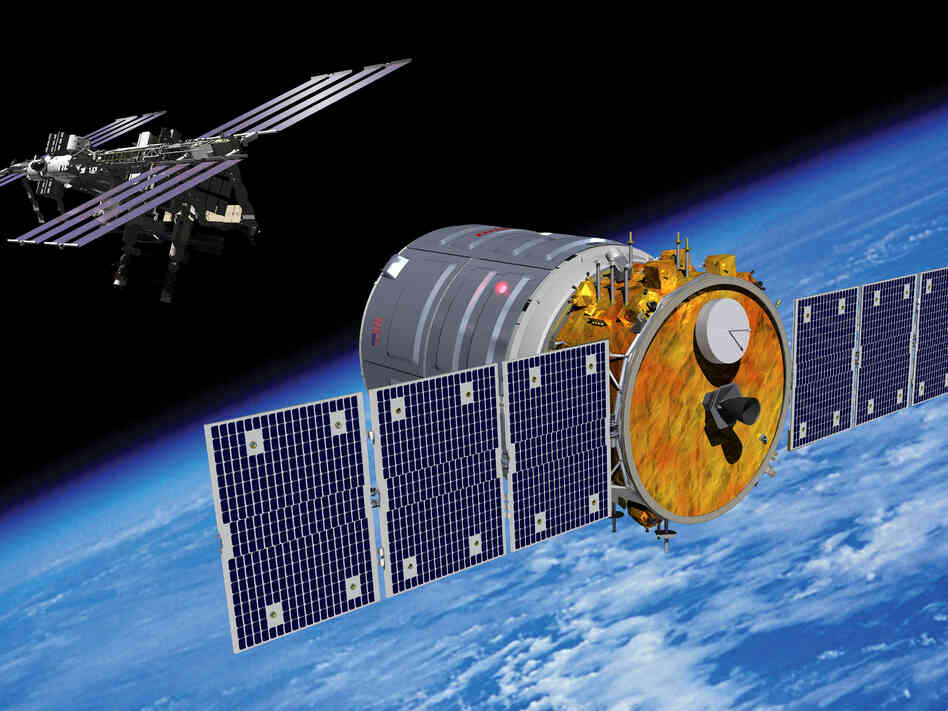
Artist's rendering of Cygnus spacecraft approaching the International Space Station.

CREDIT: Orbital Sciences Corporation

 The Cygnus dry mass is 1,500 kg. This includes the propulsive service module at the base. The service module is based on Orbital's Star satellite bus. According to Astronautix this has a dry mass of about 800 kg. So the capsule itself is 700 kg. Adding on the life support elements as given in the "Phoenix" capsule report, would result in a dry mass of about 2,000 kg.
  This is important because the Cygnus is built by Thales in Italy so it means Europe could make all the components for the Moon mission, including the man-rated launch rocket as described in post The Coming SSTO's: multi-Vulcain Ariane.
 The "Phoenix" capsule report estimates billions of dollars in development cost. But this is using traditional NASA costing estimates. However, SpaceX has shown that development costs can be cut by a factor of 10 by private financing both for launchers and for crew capsules. From its half-size compared to the Dragon we might estimate its development as privately financed at half of the $300 million spent developing the Dragon, so to only $150 million.


   Bob Clark

Update, May 1, 2014:

 For the passage above highlighted in red, I am now inclined to think that 1,500 kg dry mass does not include the mass of the service module, which is, the propulsion unit at the bottom. It's because of this page:

Cygnus Spacecraft Information

Pressurized Cargo Module

Cygnus standard and Cygnus enhanced use Pressurized Cargo Modules built by Thales Alenia Space, Italy. The module is based on the Multi Purpose Logistics Module that was flown on multiple Space Shuttle Missions to deliver pressurized cargo to ISS.

It is 3.07 meters in diameter and has a length of 3.66 meters in its standard configuration and 4.86 meters with one segment added in the enhanced configuration. The standard PCM has a dry mass of 1,500 Kilograms and the enhanced version weighs 1,800kg. 2,000 Kilograms of cargo can be packed into the standard PCM while the enhanced version allows 700kg more to be loaded. The cargo module has a pressurized volume of 18.9 cubic meters in the standard configuration and 27 cubic meters in the enhanced configuration. Power consumption of the PCM is less than 850 watts.
http://www.spaceflight101.com/cygnus-spacecraft-information.html

 This page also has a separate section on the service module which suggests that mass amount above was only for the pressurized module itself.

Could Blue Origin develop a lander for Artemis III?

Copyright 2025 Robert Clark SpaceX is coming under increasing criticism for its delay in developing the Starship lunar lander: U.S. Is Losin...