Showing posts with label LCROSS. Show all posts

Wednesday, August 16, 2023

Game changer for propellant generation on the Moon.

 Copyright 2023 Robert Clark


ABSTRACT

 Proponents of getting propellant from the Moon for spacecraft already in Earth orbit, as for orbital propellant depots, base this on using high power to separate hydrogen and oxygen by electrolysis applied to the water ice in the Moon's south polar region. However, quite surprisingly there may already be free hydrogen at the Moon's south pole or available in far more energy efficient way then by electrolysis. This hydrogen may be so easily obtainable then it may be it can be profitably shipped to Earth for a clean energy economy.


Free Propellant on Mars and the Moon.

 In the blog post "Potential Game-Changer for Generating Propellant on Mars," I suggested that getting free oxygen and carbon monoxide from the Martian atmosphere would provide a free means of producing propellant on Mars. This is important since rather than requiring several football fields of solar panels or a nuclear power plant to generate the megawatts of power needed to separate the CO2 or H2O into carbon, oxygen, and hydrogen by electrolysis, we could actually generate megawatts of power after collecting the free CO and O2 in the Martian air then combusting them together:

2CO+O22CO2;ΔH=569kJ/mol

 This may may seem odd that we can generate power by collecting the natural resources already there but note this is exactly what we're doing when we collect the coal or petroleum or uranium from the ground on Earth. You get far more potential energy out than what you put in to collect it.

 And in fact we could also generate hydrogen in a way that at the same time generates power as well. This comes from the reaction:

1.)CO + H2O → CO2+ H2, ΔH = -41 kJ/mol 

 The H2O could come from the abundant ice in the Martian soil or in fact from the Martian air as well. The hydrogen(H2) would then come from what is called the water-gas shift reaction: 


The water–gas shift reaction (WGSR) describes the reaction of carbon monoxide and water vapor to form carbon dioxide and hydrogen:

CO + H2O ⇌ CO2 + H2

The water gas shift reaction was discovered by Italian physicist Felice Fontana in 1780. It was not until much later that the industrial value of this reaction was realized. Before the early 20th century, hydrogen was obtained by reacting steam under high pressure with iron to produce iron oxide and hydrogen. With the development of industrial processes that required hydrogen, such as the Haber–Bosch ammonia synthesis, a less expensive and more efficient method of hydrogen production was needed. As a resolution to this problem, the WGSR was combined with the gasification of coal to produce hydrogen. As the idea of hydrogen economy gains popularity, the focus on hydrogen as an energy storage medium when an alternative replacement energy source for hydrocarbons is used.

https://en.wikipedia.org/wiki/Water%E2%80%93gas_shift_reaction


 However, it may be this process can also work on the Moon. The LCROSS mission to my mind may have been one of the most significant planetary science missions ever conducted by NASA, as measured in relation to its cost. It was designed as a low cost "Discovery" class mission but what it returned was profoundly important. It had an ingenious design that sent a rocket stage to impact the Moon at the south polar region and observe spectroscopically the material sent up in the impact plume by a second spacecraft..

 The mission confirmed what was suspected that there was great amounts of water as ice in the Moon's south polar region. In fact LCROSS found an extensive list of volatiles concentrated at the south pole of the Moon:


Moon Blast Reveals Lunar Surface Rich With Compounds.
Science Oct 21, 2010 2:05 PM EDT.
There is water on the moon … along with a long list of other compounds, including, mercury, gold and silver. That’s according to a more detailed analysis of the chilled lunar soil near the moon’s South Pole, released as six papers by a large team of scientists in the journal, Science Thursday.
https://www.pbs.org/newshour/science/its-confirmed-there-is-water


 The amounts of volatiles found by LCROSS was extraordinary:


Lunar Impact Uncovered More Than Just Moon Water.

Oct. 21, 2010:  Nearly a year after announcing the discovery of water molecules on the moon, scientists have revealed new data uncovered by NASA's Lunar CRater Observation and Sensing Satellite, or LCROSS, and Lunar Reconnaissance Orbiter, or LRO—and it's more than just water.

In addition to water, the plume contained "volatiles." These are compounds that freeze in the cold lunar craters and vaporize easily when warmed by the sun. The suite of LCROSS and LRO instruments determined as much as 20 percent of the material kicked up by the LCROSS impact was volatiles, including methane, ammonia, hydrogen gas, carbon dioxide and carbon monoxide.

https://science.nasa.gov/science-news/science-at-nasa/2010/21oct_lcross2 


 These last three are quite important in regards to the lunar propellant issue. If the hydrogen is indeed free then that gives us a ready made source for the clean-energy hydrogen. However, I suspect the hydrogen seen from orbit after the rocket stage impact, was derived from the water-gas shift reaction. This reaction shown in eq. 1.) reacts carbon monoxide and water to produce hydrogen and carbon dioxide and is helped by high temperatures, as would have obtained after the rocket stage impact. So the carbon monoxide could have reacted with the water to generate hydrogen.

 Once we have hydrogen then we can send it back to Earth for clean energy. The gravity and required launch speed from the Moon is so low we could use continual launch methods such as railguns or even the space elevator, which is possible with current materials under the Moons low gravity.

 As in the case of the getting hydrogen or other propellants on Mars discussed in the prior blog post, we would need low energy separation methods.  A new method sounds quite promising:


Mechanochemical breakthrough unlocks cheap, safe, powdered hydrogen

By Loz Blain July 18, 2022

Australian scientists say they've made a "eureka moment" breakthrough in gas separation and storage that could radically reduce energy use in the petrochemical industry, while making hydrogen much easier and safer to store and transport in a powder.

https://newatlas.com/energy/mechanochemical-breakthrough-unlocks-cheap-safe-powdered-hydrogen/


 This proposed solution for low energy gas separation though still needs to be confirmed by other researchers. 


 Hydrogen on the Moon Cheaper and Cleaner than on Earth?

 The Department of Energy(DOE) set a goal in 2021 to reduce the cost of producing hydrogen in a clean fashion by 80% to $1 per kg in 1 decade. The chemical methods for producing hydrogen can already do it about a $1 per kg cost, but results in additional CO2 being added to the atmosphere. Using solar power for a clean energy hydrogen generation approach is more expensive. This described on this DOE page:


7.1. WHY HYDROGEN?

Clean hydrogen is of the greatest interest in addressing the climate crisis, with the recognition that hydrogen could play a crucial role in economy-wide decarbonization, particularly in the transportation and industrial sectors including sustainable fuels, iron & steel, ammonia and chemicals, and more.1 Hydrogen is an extremely clean energy carrier, as its consumption produces only water; it also has a high energy density by mass. Hydrogen can be used to power fuel cells or combusted in a hydrogen turbine to generate electricity, and could also serve as clean transportation fuel.

The first Energy Earthshot, the Hydrogen Shot launched in 2021, seeks to reduce the cost of clean hydrogen by 80% to $1 per kilogram in 1 decade. This is an ambitious initiative, since current costs of clean hydrogen are much higher. For example, electrolytic generation of hydrogen using renewable electricity costs at least $6 per kilogram.

Worldwide, about half of all hydrogen production is from reforming of natural gas (mainly steam methane reforming or SMR), with the remainder deriving from gasification of liquid and solid feedstocks such as coal, petcoke, and petroleum residuals, from oil as a byproduct, and with a few percent from electrolysis. Syngas from gasification already contains a significant amount of hydrogen, which can be increased through water gas shift (WGS) and separated into a pure hydrogen product meeting industry product quality standards. There are several conventional hydrogen separation processes, with the well-proven and moderate cost pressure swing adsorption (PSA) methods commonly chosen. PSA has the ability to produce high purity (99.9%) hydrogen at near feed pressure; however, relatively high hydrogen concentration in feed gases is required for its economics to remain favorable.

For either natural gas reforming or gasification routes, hydrogen production costs are lower than the electrolytic route, but the challenge is that the carbon footprint of conventional hydrogen production is large, as shown in the following table:


Hydrogen product (kg/h)

CO2 product (kg/h)

CO2 emitted in stack gas (kg/h)

Carbon intensity kg CO2/kg H2

SMR w/ 90% capture

25,700

227,600

25,300

1.0

Coal gasification w/ 90% capture

25,700

456,700

49,300

1.9

Carbon Intensities of SMR and Coal Gasification-based Hydrogen Production (with 90% capture)

If all CO2 produced in these processes is emitted, and CO2 footprint ranges from about 10 to 20 times the mass of the hydrogen produced. Only 0.7% of fossil fuel-based hydrogen production is currently performed in conjunction with carbon capture and storage.2

The gasification route to hydrogen presents an opportunity to use low-cost and liability feedstocks including biomass, solid wastes, and waste coal, which could help reduce the environmental costs and liabilities of solid waste disposal and legacy waste impoundments. Carbon-neutral biomass feedstocks significant reduce the carbon footprint of gasification, and combined with high levels of carbon capture facilitated by high syngas concentrations of CO2 and hydrogen characteristic of efficient gasification processes, production of clean hydrogen from gasification could be a compelling option in the emerging decarbonized economy.

__________________________________________________________________

https://www.netl.doe.gov/research/Coal/energy-systems/gasification/gasifipedia/hydrogen

  Note then on the Moon, either the hydrogen is already free, or it can be obtained by the water-gas shift reaction that obtains for the low cost chemical production methods used on Earth. But now this can be considered clean production, at least in regards to Earth, in that the CO2 released would be on the Moon.

 As for energy generation actually solar or nuclear generation would not be needed. The materials for energy generation would be available in the Moon's regolith, according to the LCROSS results. See here:.


 You see there are abundances listed for H2 and H2O and CO and CO2 but nothing for O2 for combustion. Oxygen could be obtained from high temperature burning of lunar rocks, but this is energy intensive. We want an energy production method that does not require high energy input in the first place.

 One possibility might be to use the free magnesium Mg seen in the LCROSS data. Magnesium can burn in CO2 without requiring oxygen:

The General Chemistry Demo Lab
Reaction Of Magnesium Metal With Carbon Dioxide.

  Another possibility would be to use the free sodium Na seen by LCROSS. Sodium reacts explosively with water releasing heat and also hydrogen, so this might provide an additional method of producing hydrogen.


 Robert Clark

Friday, August 4, 2023

U.S. will lag behind in utilization of resources on the Moon.

 Copyright 2023 Robert Clark


 Quite annoying that NASA won’t be including any instruments on the VIPER lander at the lunar South pole to detect heavy metals, only ones for detecting water and light elements. Nor will the Astrobotic Peregrine commercial lander. 

 The LCROSS mission provided tantalizing hints of valuable metals from its orbital observations: 

Moon Blast Reveals Lunar Surface Rich With Compounds.
Science Oct 21, 2010 2:05 PM EDT.
There is water on the moon … along with a long list of other compounds, including, mercury, gold and silver. That’s according to a more detailed analysis of the chilled lunar soil near the moon’s South Pole, released as six papers by a large team of scientists in the journal, Science Thursday.
https://www.pbs.org/newshour/science/its-confirmed-there-is-water

 And a Japanese lunar orbiter gave indications of uranium: 

Uranium could be mined on the Moon. Uranium could one day be mined on the Moon after a Japanese spacecraft discovered the element on its surface.
By Julian Ryall in Tokyo 4:58PM BST 01 Jul 2009.
The space probe Kaguya detected the radioactive element in samples of the Moon's surface with a gamma-ray spectrometer, along with thorium, potassium, magnesium, silicon, calcium, titanium and iron.
The discovery opens up the possibility of mining operations on a commercial basis or even nuclear power plants being constructed on the Moon.

https://web.archive.org/web/20110423155534/http://www.telegraph.co.uk/science/space/5711129/Uranium-could-be-mined-on-the-Moon.html

 Note that one of the locations the urianium was detected was the mysterious South Pole Aitken impact basin.

 The later Surveyor landers to the Moon by NASA since the 60’s all contained x-ray spectrometers(XRF) for detecting heavy elements. And all of the Mars landers since the Viking landers in the 70’s either had XRF spectrometers or more accurate alpha-proton x-ray spectrometers(APXS) for detecting heavy elements.

 Moreover, both the just launched Indian lunar south polar lander and Chinese lander to lunar south pole will contain a detector for heavy elements.

The upcoming lunar lander from Japan will also include an X-ray spectrometer for detecting heavy metals:

Japan gearing up to launch small moon lander next month.
By Andrew Jones published about 17 hours ago.
SLIM is scheduled to lift off on Aug. 25.
Also joining the lunar ride will be the X-ray Imaging and Spectroscopy Mission, or XRISM, a JAXA-NASA collaborative mission that also involves participation from the European Space Agency.
https://www.space.com/japan-slim-moon-lander-launch-august-2023

 This lander will not be to the lunar South Pole but this still confirms the point that every other lander to ANY space body, including asteroids and comets, always contains detectors for measuring heavy elements.

Even the little Sojouner rover on the Mars Pathfinder mission had its own alpha-proton x-ray(APXS) spectrometer for measuring heavy elements:

 The APXS is the round instrument in front.

 The Sojourner rover only weighed 25 lbs, 11 kg, and only needed 15 watts to run on, which can be supplied by a few oz of rechargeable lithium batteries. So the weight and power requirements for the APXS instrument itself would have been much smaller than that still.

 It’s really unfathomable that the U.S.’s landers VIPER and Astrobotic Peregrine to the lunar South Pole will be the only ones to ANY space body, probably numbering into the couple of dozen now, that won’t have instruments for detecting heavy elements.

 There’s no guarantee that India or China will share with the U.S. the discovery by their landers of valuable metals or other minerals on the Moon. They would probably figure if the U.S. didn’t see the importance of including such instruments on their own  missions to the lunar South Pole, then that’s their problem.

 These landers to the lunar south pole may return literally world-changing results. There has been speculation that the metal containing asteroid Psyche may contain many trillions of dollars of valuable metals.

 Then in this regard quite notable is this:

Weird 'Anomaly' at the Moon's South Pole May Be a Metal Asteroid's Grave
By Meghan Bartels published June 10, 2019
https://www.space.com/moon-south-pole-anomaly-metal-asteroid-impact.html

 I mentioned at least two independent orbital missions that observed valuable minerals specifically at the lunar South Pole, LCROSS and Kaguya. This article concerns another lunar orbital mission mission, GRAIL, measuring gravity variations on the Moon, that found intense gravity at the South Pole Aitken impact basin. The researchers suggested it was from the impact of a large asteroid, actually a Ceres-sized dwarf planet, emplacing heavy metals there. If so, then it conceivably could have been an asteroid of the Psyche-type containing trillions of dollars of valuable metals.

 Conceivably, the trillions of dollars of valuable metals speculated to be on Psyche could already be just next door!


  Robert Clark

Sunday, May 7, 2017

Test flights of the Falcon Heavy for missions to the moons of Earth and Mars, Page 1.

Copyright 2017 Robert Clark

  The SpaceX Red Dragon lander mission to Mars on the Falcon Heavy has been pushed back to 2020, perhaps to return a Mars surface sample. SpaceX though plans for two Falcon Heavy test flights for the latter part of this year, 2017.

  Elon has discussed testing recovery of the stages on these first test flights which will reduce payload. He has also discussed putting a "fun" payload on one of them, like his cheese wheel on the first Dragon test flight.

  I suggest instead missions be undertaken of great scientific and practical importance, missions to the moons of Earth and Mars. 

Flight to a Permanently Shadowed Crater on the Moon.
 Abundant evidence suggest ice water deposits in the permanently shadowed craters on the Moon. This has been proposed to be used to produce orbital propellant depots. This would radically reduce the mass that would need to be launched to orbit for a Mars mission since most of this mass is just propellant. 

 There have also been some tantalizing indications from the LCROSS mission of valuable metals in the shadowed craters. Then the first space mining missions may be to the Moon rather than the asteroids.
 I'll estimate the delta-v to land on the Moon using this diagram:


 The delta-v to GTO (geosynchronous transfer orbit) is 2.5 km/sec. Then after that according to the delta-v diagram we need an additional 3.2 km/sec to land on the Moon. We wish to use the cargo version of the Dragon to land on the Moon. This weighs about 5.5 metric tons (mT) fueled with its own propellant, while the FH can get 26.7 mT to GTO. 

 So the idea would be to get extra delta-v by using the smaller mass of the Dragon capsule. To estimate this we'll need the specs for the upper stage of the Falcon Heavy, same as for the Falcon 9's upper stage, 348 s Isp for the Merlin 1D FT, approx. 107.5 mT propellant load, and approx. 4 mT dry mass. Then the delta-V this upper stage achieves with the 26.7 mT payload is 348*9.81*Ln(1 + 107.5/(4 + 26.7)) = 5,136 m/s.

 So by reducing the payload mass from 26.7 mT to 5.5 mT we want this upper stage to achieve a delta-v of:

5.1(to reach GTO) + 3.2(to land on the Moon) = 8.3 km/sec .

 And calculating the delta-v of the stage with the reduced payload we get:

348*9.81*Ln(1 + 107.5/(4 + 5.5)) = 8,572 m/s.

 This is above the needed 8.3 km/s, though close. Actually we'll get somewhat better than this because the lower stages having to loft a lighter payload will be able to provide more delta-v than before.

 Also, we actually will use the Draco thrusters on the Dragon to do the actual landing since the FH upper stage would put the capsule to high up if it were to land vertically, and it's thrust is so high achieving the stable landing is made difficult.

 That raises another difficulty because of the low thrust of the Draco thrusters. There are 18 Dracos of the cargo Dragon each of thrust level 400 N, for a total of 7,200 N. This can lift 7,200/9.81 =  734 kg in Earth's gravity. In the lunar gravity at 1/6th g, the Dracos could lift, 4,404 kg. But the fueled mass is 5,500 kg.

 There are a couple of things we can do to lighten the Dragon. We could remove both the parachute and thermal protection systems since the capsule won't be returning to Earth in this mission.  These weigh about 5% each of the landed mass, so about 10% all together. So this shaves 420 kg off the landed mass.

 Another possibility would be to replace the Dracos with Superdracos, which have many times greater thrust. But I'm not sure how well these would fit in the same housing for the Dracos.

 We could also remove most of the pressure vessel for landing on the airless Moon. From images of the Dragon's pressure vessel, this could be a significant mass:


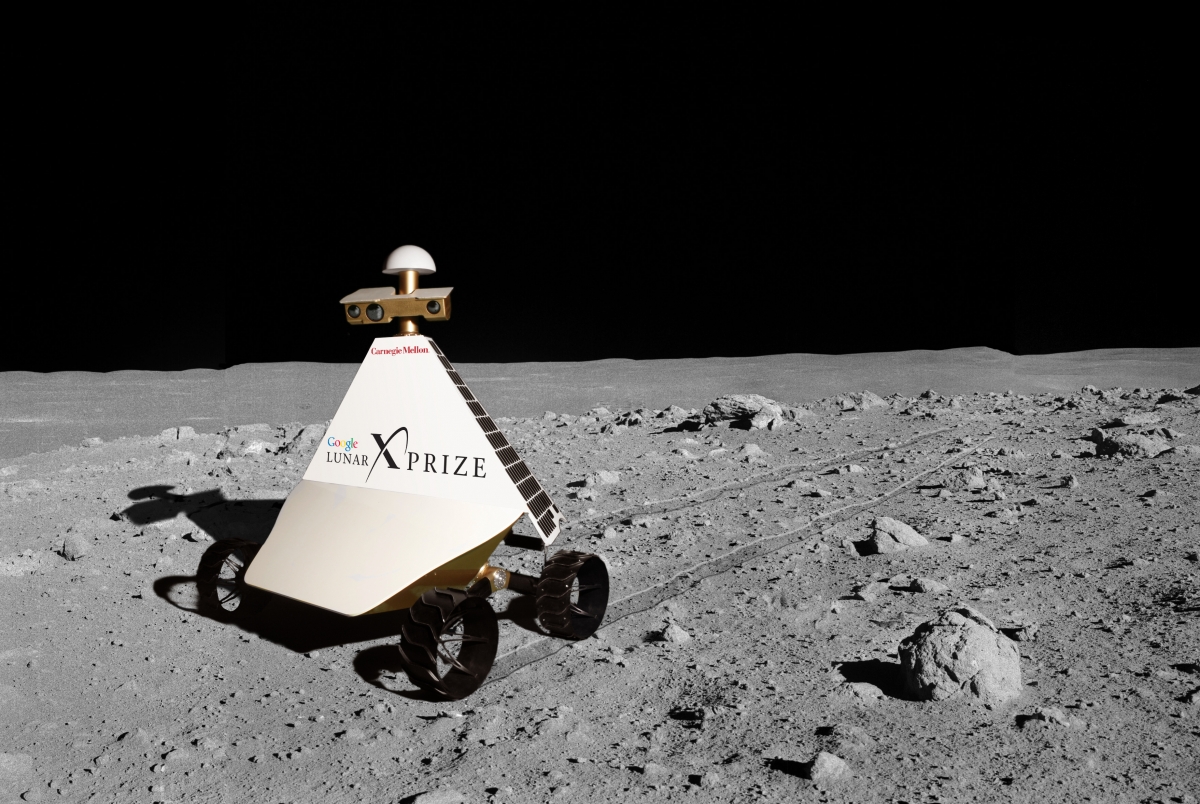
 For the rover, we might use a copy of the Mars Pathfinder mission. NASA often makes two or more copies of its spacecraft for testing purposes. Then we could use one of these copies. This weighed only 264 kg for the lander plus 10.5 kg for the Sojourner rover.

 Other possibilities for a lightweight rover might be those being developed independently by entrants to the Google Lunar X-prize:


Flight to Phobos, the mysterious moon of Mars.
 A great scientific mystery also is the make-up of the Mars moon Phobos. Flyby missions showed it to have surprisingly low density. Serious scientific speculation included that it may actually be hollow. Current theories are though that it may be analogous to a "rubble-pile" type asteroid. This is not known for sure however. A lander mission may help to resolve the issue.

 Note also that key to Elon's plan for manned flights to Mars is getting the fuel for the return trip from Mars. Taking the fuel from the Martian moons instead would have advantages such as low gravity for getting the fuel to an orbiting propellant depot. Then these first flights to the Martian moons could serve as scout missions for water ice deposits.

  The Falcon Heavy test flights this year will be outside the optimal launch window in 2018. This means they will require higher delta-v to reach Mars, and higher delta-v to slow down on reaching the destination. This limits the mass that can be transported to and landed on Mars, in addition to the expense of the extra in-space stages required.

 Then I will suggest here a method that has long been proposed for arriving at Mars but never attempted, aerocapture. This slows down a craft arriving at Mars by plunging deep within the atmosphere so that minimal propellant burn is required. Note, that if these tests missions using aerocapture succeed then this will suggest it will work to solve the problem of landing large masses on Mars such as a crew habitat, a key enabling technology for manned flights to Mars.

 For the delta-v required to depart from Earth I'll use the orbital calculation program:

Trajectory Planner.

 This provides the delta-v's required for the Hohmann tranfer orbits between the various planets. The program provides pork-chop plots that allow you to estimate departure and arrival delta-v's dependent on departure time.

 The program though uses Modified Julian Date format, which can be converted to standard date format here:

http://www.csgnetwork.com/julianmodifdateconv.html

 For a Dec. 23, 2017 departure, which is given in Modified Julian Date format of 58110 in the "Trajectory Planner", the delta-v Hohmann transfer delta-v is 6.155 km/s. We then need to calculate the delta-v needed on leaving Earth orbit. On the Orbiter-Forum discussion forum for the Orbiter space simulation program this formula was provided by member Dgatsoulis:

 \Delta V = \sqrt{V_{\infty}^2 + V_{esc}^2} - V_{orb}

where V_{\infty} is the hyperbolic excess velocity (departure deltaV from trajectory planner).

V_{esc} is the local escape velocity, aka the escape velocity for the parking orbit altitude.

V_{esc} = \sqrt{\frac{2GM_{planet}}{R_{planet}+alt}}

where G is the gravitational constant, M_{planet} is the planet's mass, R_{planet} is the planet's radius and alt is the altitude of the parking orbit.

V_{orb} is the parking orbit velocity.

V_{orb} = \frac{V_{esc}}{\sqrt{2}} 


 Same applies for arrival. If you want to simply calculate the periapsis velocity and not the orbit insertion/injection dV, then don't use the V_{orb} term.

Source: ORBITAL MECHANICS 

http://orbiter-forum.com/showthread.php?p=556772&postcount=26

 So the  delta-v on leaving Earth orbit is:
 This 1.11 km/sec more than the usual delta-v to make a Trans Mars Injection during the optimal departure windows of 3.8 km/s.

 We need to calculate how much mass the FH upper stage could get to this higher delta-v of 4.89 km/s. By the FH specs it can get 16.8 mT to Trans Mars Injection.This FH upper stage with the 16.8 mT payload mass can do 348*9.81Ln(1 + 107.5/(4 + 16.8)) =  6,211 m/s delta-v. So with a smaller mass we want to achieve 6,211 + 1,110 = 7,321 m/s delta-v. This can be done with a 10 mT payload:

338*9.81Ln(1 + 107.5/(4 + 10)) = 7,377 m/s.

 Now we have to calculate how much is the speed on arrival at Mars.  The Trajectory Planner gives the "arrival" speed as 4.275 km/s. However, again this is not the speed the spacecraft would have on entering Mars's atmosphere. This is instead the speed at which it arrives at Mars's position in its orbit around the Sun, i.e., the Hohmann orbit delta-v needed to be supplied to match Mars' solar orbital speed.

 To get the entry speed into Mars' atmosphere, use the Dgatsoulis formula above without the Vorb term. Using 5.0 km/s as the escape velocity for Mars we get:


 If all we wanted was to slow down to enter Mars orbit then we would subtract off from this by aerocapture to bring the speed down to Mars' orbital velocity of 3.56 km/s. However we also want to be put it on a trans Phobos insertion from Mars. By the delta-v chart above we need an additional .9 km/s, so to 4.46 km/s. So by the aerocapture we only need to slow it down by about 2.11 km/s.

 This should be well within the capabilities of aerocapture. However, the payload mass may be as high as 10 mT. The question is could the dragon's approx. 10 square meter base provide sufficient air drag to slow down that high mass, and would its heat shield be thick enough?

 In follow up posts I'll present some preliminary calculations that suggest that plunging deep into Mars atmosphere, skimming the tree-tops so to speak, should allow large masses such as this to be slowed at such high entry speeds.

 With the payload of the FH as high a 10 mT, the rovers and equipment that could be transported could be 4.5 mT above the 5.5 mT fueled weight of the cargo Dragon. But according to the delta-v chart we still need 0.5 km/s delta-v to land on Phobos. The cargo Dragon has a delta-v capability of about 600 m/s with its Draco thrusters for the Dragon capsule alone. So this should be sufficient, but it would not be if the extra cargo was several metric tons. So we could keep the cargo low as for a Mars Pathfinder sized rover or we could add additional propellant tanks to increase the landing capability.

 The possible cargo carried by the Dragon being as high as 4.5 mT suggests though we should try to make use of that cargo space. One possibility would be the processing equipment to produce ISRU (in situ resource utilization) propellant. Perhaps a rocket to do a sample return. Possibly orbiting imaging spacecraft for Phobos or Mars. Others?


    Bob Clark


Note: thanks to members of Orbiter-Forum.com Keithth G and DGatsoulis for helpful discussions on this topic and member Piper, for writing the Trajectory Planner program.


Could Blue Origin develop a lander for Artemis III?

Copyright 2025 Robert Clark SpaceX is coming under increasing criticism for its delay in developing the Starship lunar lander: U.S. Is Losin...