Showing posts with label ULA. Show all posts

Friday, May 19, 2023

Who in European space will ask the impertinent question: How much would it cost to add a second Vulcain to the Ariane 5/6?

 Copyright 2023 Robert Clark


ArianeSpace Needs to Transition to Reusability to Survive.

 European space advocates have been lamenting that there seems to be no near term route to keeping up with SpaceX, getting reusable launchers, and towards achieving manned space flight. However, in point of fact ESA already has the components to form a launcher comparable to the Falcon 9 and at lower price, while keeping pace with SpaceX in reusability, and in manned spaceflight.

 All it would require is someone, anyone in the Europeans space community to ask the impertinent question, "How much would it cost to add a 2nd Vulcain to the Ariane 5/6?"

  For once that question is asked, and ArianeSpace forced to answer honestly, they would have to admit it could be done for only a development cost in the range of only ~$200 million. But then it would become obvious how to proceed.

 First, note that the Ariane 6 that was planned to compete with the SpaceX Falcon 9 has been pushed back to 2024, when its original launch date was in 2020, extending the time where SpaceX is cornering the market. Note also the Ariane 6 will not be reusable. In fact ArianeSpace has admitted they won't be fielding a reusable launcher until the 2030's. 

 ULA was driven to the brink of bankruptcy by denying the importance of reusability. There is little doubt the same will happen to ArianeSpace if they wait a decade to field a reusable vehicle. Independent European space observers have also made this point about the choice of the non-reusable Ariane 6:

Europe’s lack of rocket ‘audacity’ leaves it scrambling in the space race
European policymakers want to stop SpaceX from dominating the launch market.
BY JOSHUA POSANER
JANUARY 15, 2021 12:28 PM CET 6 MINUTES READ
That 2014 decision haunts French Economy Minister Bruno Le Maire, who keeps a warning of that moment on his desk.
“The European space adventure is magnificent, but in 2014 there was a fork in the road, and we didn’t take the right path,” Le Maire told a conference last September. “We should have made the choice of the reusable launcher. We should have had this audacity.”

https://www.politico.eu/article/europe-arianespace-rocket-space-race/

 The Fast Route to Reusability.

 The problem with reusability for the Ariane 5 and 6 is they use solids for a large portion of their takeoff thrust. These large side boosters also make up a large portion of the cost. In fact, the situation has actually gotten worse with the Ariane 6. But the Space Shuttle program demonstrated you don't save on reuse with solid side boosters. By the time you fish the SRB's out of the ocean, tow them to port, transport them from port back to the manufacturing facility, clean them out from all the burnt on combustion products, and then finally refill them with propellant, the cost is no better than just using new ones to begin with. A little thought makes it easy to see why. Solid side boosters are just a filled in metal pipe. The cost of that metal pipe is small compared to all the processing involved in making the SRB. Keeping the same metal pipe but increasing all the needed steps for processing does not reduce the cost of the SRB.

 So to get the low cost reusable rocket you have to dispense with the SRB's. Necessarily that means you have to use additional liquid-fueled core engines. Then is adding an additional core engine a multi-billion dollar, or euro, development? 

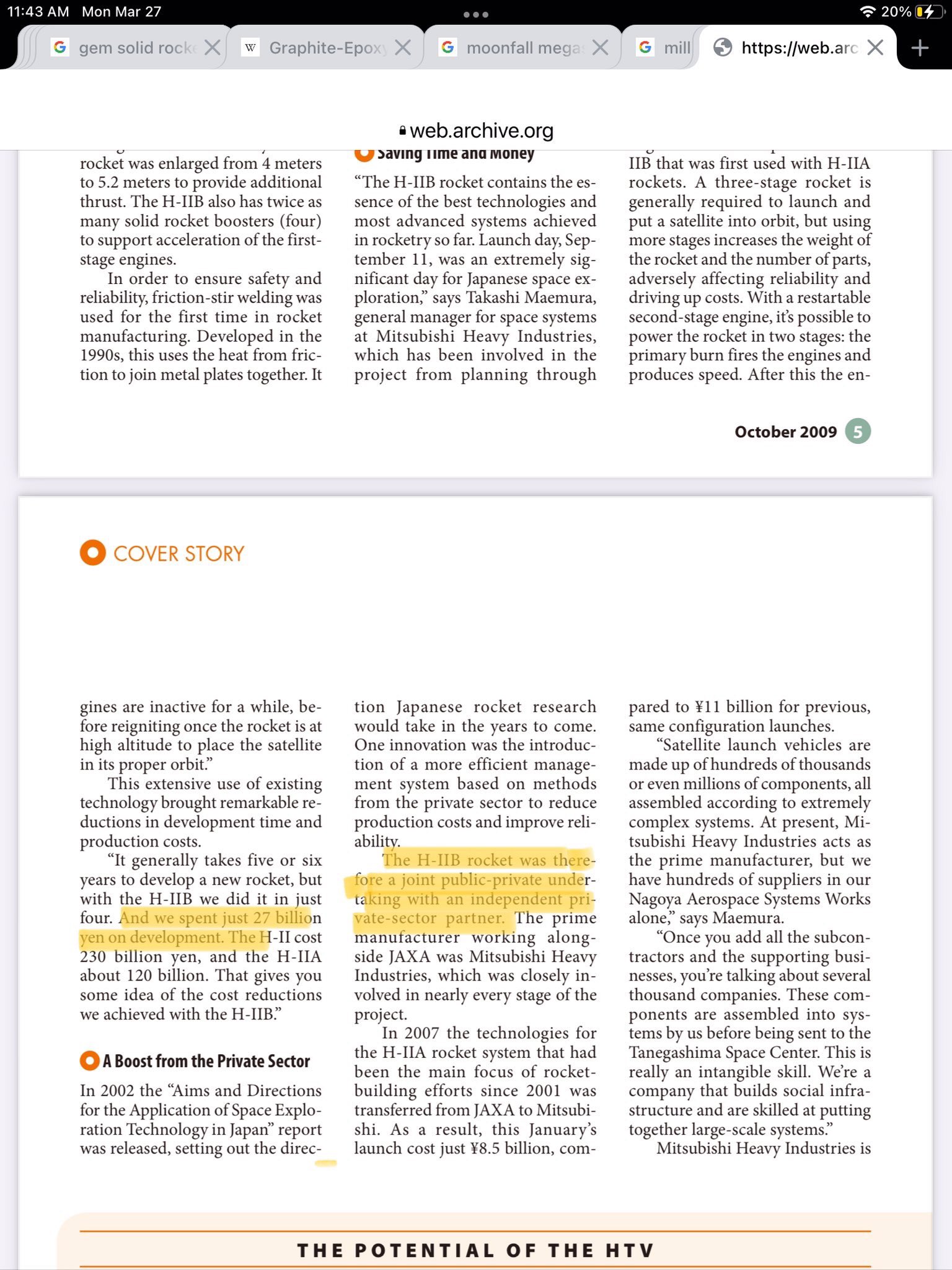
 No! I was quite startled to find JAXA was able to add an additional hydrolox engine to the H-II first stage for only an approx. $200 million development cost.

 See the highlighted passage in this article where the cost to add another engine to the H-II was only 27 billion Yen, about $200 million: 


 But that means instead of the multi-billion current development cost of the Ariane 6, the same could have been accomplished for just a few hundred million and would also have been reusable! I made this point here:


 Thus the importance of asking that impertinent question of ArianeSpace, "How much to add an additional Vulcain to the Ariane 5/6?"

WHY Are the Far More Expensive SRB's Used Rather then the Cheaper Liquid-fueled Engines? 

 Knowledgeable ESA observers have been aware for awhile now that the ESA policies for distributing funds and costs to the differing member states do not result in the most cost effective vehicles. It’s a policy called geographical-return that requires member states costs to be apportioned by some set proportion of the billion dollar development costs. So if some member states have been contributing some large proportion of the costs through solid side boosters, that cost continues to be part of the development for new rockets or upgrades.

 The governments of the member states regard this as a good thing because it helps to keep active, and paid, the space industries and space industry employees in their countries. But another key reason why some member states like the funds for the ESA to go to develop solid rocket side boosters is because those funds help also to develop solid rockets for their defense programs. So rather than those countries having to pay the entire cost of the solid rocket missiles in their defense programs on their own, some portion of that is actually paid for by the ESA in developing solid rocket side boosters for space launchers.

 You can see why there is a great incentive for those member states, which have great influence on the direction and funding choices for the ESA, to continue to want to use solid rocket boosters in all launchers produced by the ESA.

 But the stunning fact is how much more expensive the solids are for the Ariane 6 than just adding another Vulcain engine! The latest cost figures for the Ariane 6 are the €75M for the two SRB version and €115M for the four SRB version

 This suggests, as a first order estimate, that we can take the cost of two SRB’s as €40M. But the cost of a single Vulcan is only €10 million! So the two SRB’s on the Ariane 6 base version costs 4 times more than an additional Vulcain! Therefore, again as a first order estimate, we can take the cost of a two Vulcain Ariane 6 with no SRB’s as only €45 million, ~$50 million. This compares quite favorably to current $67 million cost of the Falcon 9.

 The reason why this isn’t done can not be attributed to some supposed multi-billion development cost to add an additional Vulcain to the Ariane core. Actually, it’s the current plan for the Ariane 6 with the newly developed solids, new upper stage, and new Vinci engine whose development cost is in the $4+ billion range. It’s really quite stunning to realize the same could have been accomplished at only a ~$200 development cost simply by adding another Vulcain to the Ariane 5 core, using the same original cryogenic upper stage. Nearly a factor of 20 times cheaper!

 But nobody knows this because nobody asks that one simple question, “How much would it cost to add a second Vulcain to the Ariane 5/6?”

 Now, once you have the all-liquid Ariane 6 that costs even cheaper than the Falcon 9, you can also keep up with SpaceX in reducing price by reusability by also reusing the core stage via powered landing a la the F9 booster. Again, the solids in the current Ariane 6 version would not save on reusing them as the Space Shuttle program abundantly showed. So that huge €40 million cost just for the SRB’s on the Ariane 6(more than the cost of the entire rest of the rocket!) out of the total  €75 million would be fixed no matter how many times you wanted to reuse the core.

 It might be argued that even a fully throttled down single Vulcain would have too much thrust for a hovering landing. Actually, this is the case also with the Falcon 9. It uses what SpaceX calls "hover-slam" for landing. The thrust is precisely timed so the booster just reaches 0 velocity as it touches down. Actually, I'm not a fan of "hover-slam". Much better for the Ariane case would be to use two Vinci engines for the landing only. It is designed to be air-startable and restartable. It weighs without the nozzle extension for vacuum use only 160 kg. So two would weigh only 320kg on the first stage. It's use would allow true hovering landing for the first stage.

Three Vulcains on the Ariane 5/6 Match the Falcon 9 in Payload at a Lower Price.

 The two Vulcain Ariane 5/6 would have lower payload than the Falcon 9. But it would be quite competitive for the lucrative geosynchronous transfer orbit(GTO) used by many communications satellites, at ~6,000 kg to GTO at lower price than the F9. The F9 is at about 8,000 kg to GTO. But most satellites don't need this full capacity anyway.

 However, if we used three Vulcains we could then match the Falcon 9 in payload and still be at lower price. This comes from again using the first order estimate of €40 million for the two SRB's. So the Ariane 6 with no SRB's would be €35 million, as a first order estimate. So adding on two Vulcains would be €55 million, as a first order estimate. But this is still less than the $67 million price for the Falcon 9.

 In an upcoming blog post I'll discuss further the three Vulcain case showing it can match the Falcon 9 in payload. Intriguingly, by using multiple copies of such 3 Vulcain cores, I estimate 4 to 6, you can also get a 'superheavy' lift vehicle capable of 100-tons to LEO, a 'moon rocket'. Using multiple copies  of already existing cores allows you to get the 'superheavy' lift at far less development cost than the $20 billion of the SLS, or the $10 billion of the ill-conceived Superheavy/Starship.

 Manned Launchers.

 Finally, in regards to manned launchers, just use the all-liquid Ariane 6 since you no longer have the safety issues of using SRB’s on manned launchers.

 
  Robert Clark


Friday, October 21, 2022

Possibilities for a single launch architecture of the Artemis missions.

 Copyright 2022 Robert Clark


 In the blog post ESA Needs to Save NASA's Moon Plans I noted that the original plan SpaceX submitted to NASA for a lunar lander required 16 launches due to multiple refueling flights, with the refueling flights to orbit requiring a time of 6 months to accomplish. I argued in the blog that if instead NASA used an Ariane 5/6 as the upper stage of the SLS rocket replacing the current Interim Cryogenic Propulsion Stage(ICPS) then it could be done in just a single launch of the SLS, with no launches of the Starship required at all.

 After their proposal was submitted by SpaceX and accepted by NASA, Elon Musk, stung by the criticism it would take so many launches, suggested it probably could be done in only 4 refuelings since a stripped down Starship for a lunar lander mission would weigh much less.

 SpaceX needs to be open about what the mass would be for such a stripped down Starship since that would directly affect how much NASA, and the U.S. taxpayers, would have to pay to SpaceX for refueling launches. See discussion here, 

The nature of the true dry mass of the Starship. 

 My suggestion to use the Ariane 5/6 as an SLS upper stage was critiqued on political acceptability grounds for a such a large contract to be taken from a U.S. company and given to a European company. 

 Here I'll propose a solution using existing, pretty much, American upper stages for the SLS. It's the ULA Centaur V upper stage coming into service next year. I considered using the Delta IV common core stage but at a 40 meter height it might be too tall for this use.


Architecture.
 The Centaur V has a 54 ton propellant load. Following the approx. 10 to 1 gross mass to dry mass ratio of the original Centaur, I'll take the dry mass to be ~5 tons. Then I'll examine  two options: 1.)2 Centaur V's combined into a single stage, and 2.)2 separate Centaur V's.

 The current Block 1 version of the SLS gets about 27 tons to trans-lunar injection(TLI). This is the speed needed to get a spacecraft once in orbit to reach the Moon. The 27 tons is just enough to get the Orion capsule and its service module to TLI

 However, the current approach is not to put the Orion in low lunar orbit around the Moon. Instead, it will be placed in a higher altitude orbit of Earth-lunar space called a near-rectilinear halo orbit(NRHO). The reason is the current version of the SLS did not have enough power to put the Orion in low lunar orbit and for it to be able to escape again.

 Our plan then is to first increase the payload capacity of the SLS so that enough additional propellant can be given the Orion service module so the Orion can actually reach and leave low lunar orbit. 

 The Orion with its fully fueled service module has a mass of 26.5 tons. The propellant load of the service module is ~10 tons, with 16.5 total tons dry mass of the Orion and service module. We'll add an additional 10 tons propellant to the service module to bring the total mass to 36.5 tons, including 20 tons of propellant.

 The AJ-10 engine used has a vacuum ISP of 319s. We'll assume a lunar lander of size ~15 tons, comparable in size to the Apollo missions lunar lander. In a following blog post we'll describe it in more detail. So, 16.5 + 15 = 31.5 tons dry mass needs to be put in low lunar orbit.

 For the delta-v calculation, after the SLS places the Orion/Service Module/lunar lander stack in trans-lunar injection(TLI) towards the Moon, we need .9 km/s to put the stack into low lunar orbit. This requires 13 tons of propellant, leaving 7 tons remaining:
319*9.81Ln(1 + 13/(31.5 +7)) = .910 km/s. The lunar lander will then be launched to land on the Moon while the Orion and service module remain in lunar orbit.

 After the lander mission is completed, the lander returns the astronauts to the Orion in lunar orbit, and the lander is then jettisoned. The Orion's service module is then fired to bring the Orion back to Earth. After lander jettison, the dry mass of the Orion and service module will be 16.5 tons. Then the 7 tons of remaining propellant is sufficient to perform the trans-Earth injection(TEI) burn of 900 m/s to escape lunar orbit and place the spacecraft back onto the free return trajectory back to Earth:

319*9.81Ln(1 + 7/16.5) = 1,100 m/s.

Calculations for Earth escape stage to TLI.
 That's the plan if we can upgrade the SLS to carry sufficient payload to give the Orion service module that extra 10 tons of propellant. The total mass that needs to be put into TLI is 36.5 + 15 = 51.5 tons. Here's a calculation for the first approach of two Centaur V's combined into a single stage. I'll use the payload performance calculator of Dr. John Schilling, on Silverbirdastronautics.com. The specifications for the 5-segment SRB's are taken by scaling up the numbers from the 4-segment SRB's used on the Space Shuttle system.

 I'll give this stage 4 RL10 engines instead of the Centaur V's 2 because of the larger size, in effect just transferring two of the RL10's from the second Centaur's to the first. The input page looks like this:


 The payload estimator then gives the payload to LEO of ~127 tons:
 

  And the for the payload to TLI we'll use a C3 of -1.00km2/s2.

 This gives a payload to TLI of about ~52 tons:


  It is notable though the Schilling payload estimator has rather large error bars. These numbers need to be confirmed by more accurate payload estimators.

 The payload can be increased by using instead of the RL10's, a single Blue Origin BE-3U, the vacuum optimized version of the BE-3 engine used on the New Shepard. This engine has a vacuum optimized thrust of 710 kilonewtons. Placing this in for the upper stage thrust gives a payload to LEO of 136 tons, and to TLI of 54.7 tons. Again this needs to be confirmed by more accurate payload calculators.

 The intent here is to find a low cost approach to an upper stage that would allow a single launch architecture for the Artemis lunar lander missions. A combination of adding additional engines and also combining two tanks would ratchet up the costs.

  The second approach would use two separate Centaur V's. However, because of the large mass that needs to be carried by the either Centaur as payload we'll give both Centaurs 4 RL10's. The input screen looks like this on the Schilling calculator:


  And the LEO payload is ~129 tons:


 And the TLI payload is ~54.7 tons:


  Again, these payload estimates would have to be confirmed by more accurate payload estimators.

 This second approach would not incur the extra costs of combining two Centaur V's into a single stage, but it would require 4 additional RL10's. As before though we could get increased payload by replacing the RL10's by the BE-3U, and likely lower cost.

 We still need to come up with that lunar lander of comparable gross mass as the Apollo lander, ~15 tons. In a following blog post I'll show our European partners can come up with such a lander at low cost and at a relatively short time frame.


  Robert Clark
 

Wednesday, July 17, 2013

Budget Moon Flights: Ariane 5 as SLS upper stage.

Copyright 2013 Robert Clark

Delta IV Heavy Orion Circumlunar Test Flight.
I’m fairly sure looking at the capabilities of the Delta IV Heavy with the upgraded RS-68a engine, about 28 metric tons to LEO, that it could launch the Orion on that 2014 test launch on an actual circumlunar flight, not just to 3,600 miles out as currently planned. A circumlunar flight would result in a much more capable test of the Orion.

The Orion test is planned to only carry a dummy service module, so that will be much lighter. The flight is planned though to carry the launch abort system (LAS) so that detracts from the weight that can be launched.

Without the LAS the DIVH could definitely send the Orion on a circumlunar flight. With the LAS, it makes it a little more difficult to estimate since it is jettisoned before reaching orbit.

This makes the use of the SLS for that unmanned circumlunar test flight in 2017 even more dubious, since the DIVH could do that, even if removing the LAS is required. That is another reason why I argue NASA should be aiming for an actual unmanned lunar landing test with that 2017 SLS flight.

Low Cost Lunar Lander and Crew Module.
ULA has done studies on adapting the Centaur upper stage as a lunar lander stage so you would not need a huge, and hugely expensive, Altair lander. We already even have a crew module that could be used for such a lander in NASA’s SEV, which can be ready by 2017 for test flights:


Inside NASA’s New Spaceship for Asteroid Missions | Space.com.
by Clara Moskowitz, SPACE.com Assistant Managing Editor
Date: 12 November 2012 Time: 02:30 PM ET

If the current schedule holds, NASA could test-drive a version of the SEV at the International Space Station in 2017. http://www.space.com/18443-nasa-asteroid-spacecraft-sev.html

Ariane 5 Core as SLS Upper Stage.
NASA is considering a version of the upper stage to be used with the Block II version of the SLS that uses RL-10 engines instead of the J-2X:

SLS prepares for PDR – Evolution eyes Dual-Use Upper Stage.
June 1, 2013 by Chris Bergin
http://www.nasaspaceflight.com/2013/06/sls-pdr-evolved-rocket-dual-upper-stage/

This is expected to save on costs.

NASA also wants to encourage European participation in the proposed asteroid retrieval mission:

NASA Pitches Asteroid Capture To International Partners.
By Frank Morring, Jr.
Source: Aerospace Daily & Defense Report
June 28, 2013
http://www.aviationweek.com/Article.aspx?id=/article-xml/asd_06_28_2013_p01-01-592208.xml

Then a way to save further on development costs and to get European involvement would be to use the Ariane 5 core as the upper stage. It’s of common-bulkhead design to save mass. I recently learned it also uses the pressure-stabilized, “balloon tank”, method a la the Centaur to further save on tank mass.

The ESA also believes its Vulcain II engine can be made air-startable since this was planned for the Liberty rocket. The Vulcain uses a rather short nozzle since it is meant for ground launch, giving it a 432 s Isp. But simply giving it a nozzle extension would give it the ca. 462 s ISP of the RL-10.

Another key advantage is that because little additional development would be needed it might even be ready by the 2017 first launch of the SLS. Then this first 2017 launch of what was only to be a 70 mT interim version could have the 100+ mT capability of the later versions of the SLS. Such a version would clearly have the capability to do manned lunar lander missions.

You could also give this stage the RL-10 engines, instead of the Vulcain. The Vulcain weighs about 1,800 kg. Four RL-10′s would weigh 1,200 kg. So this would save 600 kg off the stage dry mass.

The NasaSpaceFlight.com article mentions the advantage of having different diameters for the hydrogen and oxygen tanks to maintain commonality with tooling of existing stages, and that is the reason for not having both tanks the same diameter. That would not be a problem of course with using the Ariane 5 core at a common 5.4 meter diamter. And someone noted on the Nasaspaceflight forum thread on this topic that for a uniform 8.4 m diameter, NASA could just use the same tooling for both that is used for the 8.4 meter SLS core stage tank.

For any of these possibilities it would be very good if NASA could use the composite tanks Boeing is investigating. Aerospace engineer Jon Goff on his blog noted ULA estimated their ACES proposed upgrade of the Centaur could get a 20 to 1 mass ratio by switching to aluminum-lithium for the tanks. And according to Boeing, an additional 40% can be saved off the Al-Li tank mass by using composites, resulting in an even larger mass ratio than 20 to 1:


NASA Sees Potential In Composite Cryotank.
By Frank Morring, Jr. morring@aviationweek.com
Source: AWIN First
July 01, 2013
http://www.aviationweek.com/Article.aspx?id=/article-xml/awx_07_01_2013_p0-592975.xml


Scaling up your stage mass, such as to the DUUS size, is also known to be able to improve your mass ratio. Imagine then all these mass ratio improving factors being applied. How high could the mass ratio get, perhaps to the 25 to 1, or even 30 to 1 range???

Imagine what you could do with a hydrolox stage with an ISP as high as ca. 462 s with a mass ratio as high as 30 to 1. (*)

Bob Clark


(*) By rocket equation, the delta-v is:  462*9.81ln(30) = 15,400 m/s.


Update, Sept. 28, 2013:

 Finally, NASA has acknowledged that the Block 1, first version of the SLS to launch in 2017 will have a 90+ mT payload capacity not the 70 mT always stated by NASA:

SLS Dual Use Upper Stage (DUUS).
http://ntrs.nasa.gov/archive/nasa/casi.ntrs.nasa.gov/20130013953_2013013757.pdf

 This is important since it means we will have the capability to do manned lunar landing missions by the 2017 first launch of the SLS:

SLS for Return to the Moon by the 50th Anniversary of Apollo 11, page 5: A 90+ metric ton first launch of the SLS.
http://exoscientist.blogspot.com/2013/09/sls-for-return-to-moon-by-50th.html

Could Blue Origin develop a lander for Artemis III?

Copyright 2025 Robert Clark SpaceX is coming under increasing criticism for its delay in developing the Starship lunar lander: U.S. Is Losin...