Showing posts with label Bigelow. Show all posts

Saturday, September 27, 2014

Falcon Heavy for Orbital Space Tourism.

Copyright 2014 Robert Clark


 A space tourism study concluded that in order for orbital tourism to take off, so to speak, the price would have to come down to $500,000 per person:

How the Space Tourism Business Could See Orbital Boom.
Mike Wall, SPACE.com Senior Writer   |   April 25, 2011 12:32pm ET
 To date, only seven people -- beginning with multimillionaire businessman Dennis Tito in April 2001-- have paid to launch into Earth orbit, and they've reportedly plunked down between $20 million and $35 million for the experience.
Those are not the numbers of a thriving industry. But things could change dramatically if prices drop significantly -- down to about $500,000 per seat or so. That reduced rate could lure in hundreds of thousands of customers for orbital tourist trips, potentially generating revenues in excess of $100 billion per year, according to the study.

 Note this is for flights to orbit, i.e., to LEO, not suborbital flights as with Virgin Galactic. Interestingly the Falcon Heavy might be able to make that price point by carrying airliner numbers of passengers. The Falcon Heavy is slated to cost $125 million for a flight to LEO. Then at a $500,000 price point it would have to carry 250 passengers.

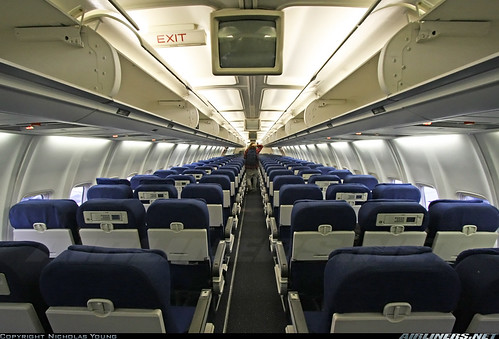
 You would need a passenger cabin to carry the passengers on the flight to orbit. As an estimate for a comfortable cabin size for a short travel time as with airliner flight we might compare this to the Boeing 757. In the 757-200 single-class configuration it can carry 239 passengers.

 It has a cabin width of 3.54 m and cabin length of 36.09 m, giving it a cabin volume of 355 m^3.

 
To carry the 250 passengers I suggest using the TransHab modified from carrying 4 to 6 crew for long space missions to having several rows and levels of seats for passengers on a 2 day or shorter trip to an orbital space station. The Bigelow space hotel BA 330 could also be used.
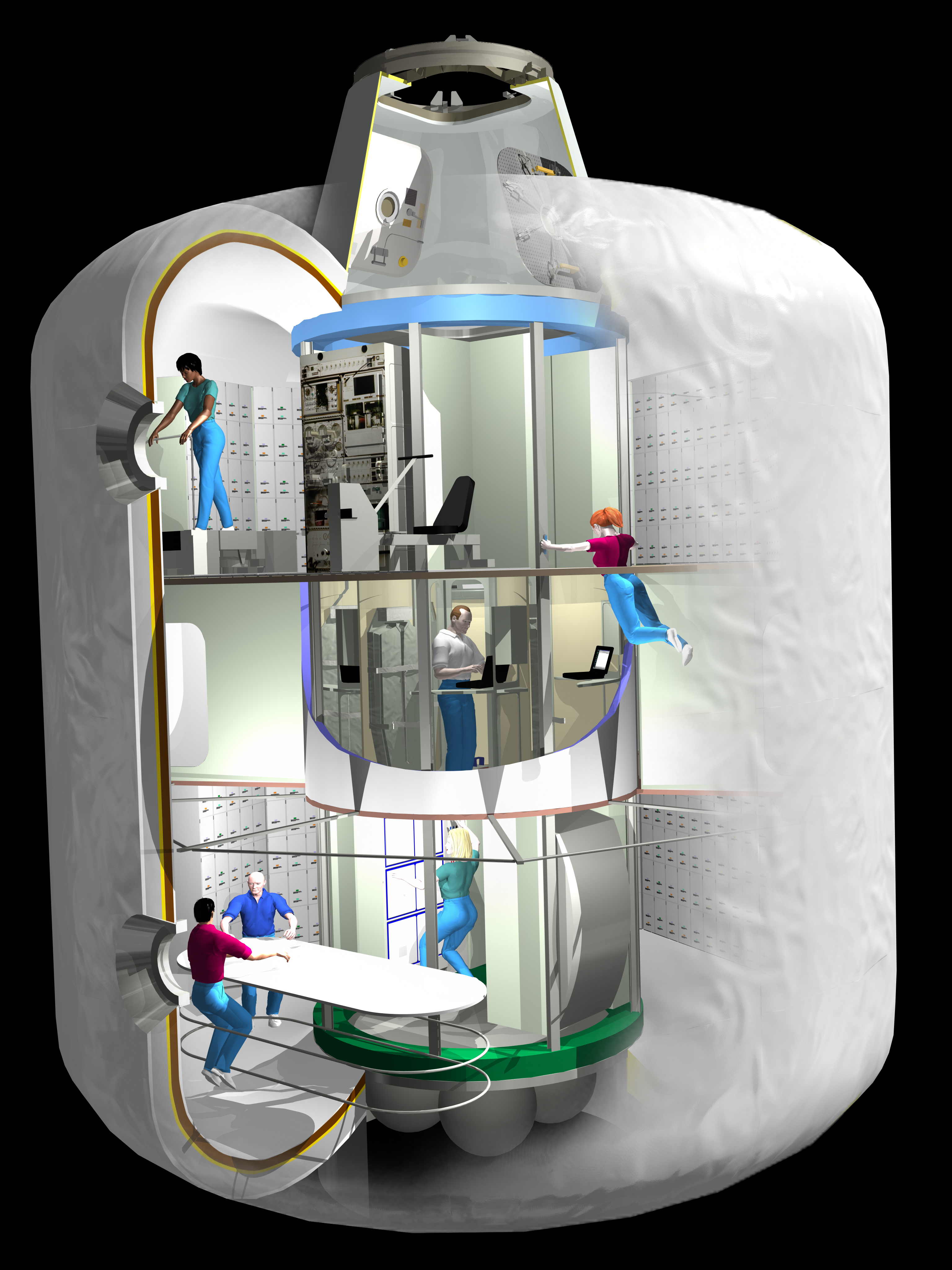
Transhab Module 
NASA's Johnson Space Center proposed a much larger and lighter inflatable 8-meter diameter "Transhab" module that also could be converted into crew quarters for future manned missions to the Moon and Mars. 
Credit: NASA via Marcus Lindroos.


 According to the NASA page on the TransHab it has a inflated volume of 340 m^3, about the same as the Boeing 757-200 cabin. Then slightly changing the seat sizes or aisle size we should be able to fit 250 passengers in the TransHab volume.

 For this many passengers we also need to calculate the amount of consumables needed, oxygen, food, and water. The book Expedition Mars estimates it as 5 to 10 kg  per person per day. Then this would be at most 2,500 kg for a 2 day flight. According to the NASA page on the TransHab, it weighs 13.2 metric tons. Allow also 100 kg per passenger and assume each passenger is allowed a space shuttle style orange flight suit at 12.7 kg and 10 kg for the seat. Then we're only up to 46.3 metric tons, within the 53 metric payload capacity of the Falcon Heavy.

 However, it would be rather uncomfortable in that cabin  for that many people for two days even if allowed to float around the cabin once reaching orbit. We may want instead to do the Soyuz flight method that is able to cut the flight time from launch to ISS docking to only 6 hours.

 But where to go once reaching orbit? We would need space hotels already in orbit. I'll estimate each passenger having his own 10 m^3 cubicle with shower. This would be about the size of a room 6ft x 8ft x 8ft. The TransHab at 350 m^3 could hold 35 of these cubicles. Eight of the TransHabs could hold enough cubicles to house the 250 passengers. In deflated form, the eight TransHabs could be launched in 2 flights of the Falcon Heavy.

 For the cost for these TransHabs, the Astronautix page on the TransHab gives a price in 1998 dollars of $100 million:

Encyclopedia Astronautica.
Transhab Module.
 American manned space station module. Cancelled 1998. Cost overruns soon forced NASA to consider other options for the International Space Station's habitation module. The space agency originally intended to use the same 8.2-meter long habitation module as the final 1991 Space Station Freedom design. In late 1998, NASA's Johnson Space Center proposed a much larger and lighter inflatable 8-meter diameter 'Transhab' module that also could be converted into crew quarters for future manned missions to the Moon and Mars. It was also possible that the module could be built and paid for by private industry and leased to NASA, although the exact configuration wasn't clear. Transhab and the 8.2-meter module appeared to be equally expensive ($100 million in 1998) and NASA had not made a final decision.
Article by Marcus Lindroos.
http://www.astronautix.com/craft/traodule.htm

 Keep in mind though this would be the price charged to the NASA, i.e., the government, for this module to be attached to the ISS. However, SpaceX and Orbital Sciences proved both with launchers and space capsules that development costs could be cut by as much as a factor of 10 by following the commercial space approach. Consider also the production cost for each vehicle is always a fraction of the development cost. Then the cost for each of the TransHabs as privately financed could be under $10 million each.

 However,  even at a price of $100 million for the TransHab this might be feasible. For each of the 35 cubicles that would be $3 million that would have to be made up. Say the space hotel owner charged $100,000 per week for each cubicle. Then, at full occupancy, a TransHab could be fully paid for in 8 months.

 That would be quite an expense though if the cost for each TransHab really were $100 million each, $800 million total for eight.


   Bob Clark


Update, Sept. 30, 2014: 
 
The inflatable habitats by ILC Dover designed for lunar habitats might also be used:

Camping on the Moon Will Be One Far Out Experience.
02.23.07

http://www.nasa.gov/exploration/home/inflatable-lunar-hab.html


2nd Update, Sept. 30, 2014:

Bigelow Aerospace has suggested a price for its proposed Space Station Alpha at about three times the price point I was suggesting on a per volume basis. The Alpha station consists of two BA-330 modules. Bigelow is offering a 110 cubic meter space for lease for 2 months for $25 million. That amounts to about $280,000 for a 10 cubic meters space for one week.


August 05, 2014
Bigelow Aerospace is hiring and targeting Inflatable Space Station Alpha to start launching in about 2017 or 2018.
http://nextbigfuture.com/2014/08/bigelow-aerospace-is-hiring-and.html

  These prices though will undoubtedly come down as time goes on.

3rd Update, Oct. 2, 2014:

 The estimates of hundreds of thousands of passengers and over a hundred billion dollars in revenues per year at a $500,000 price point is extraordinary. To put this in perspective note this would be more than an order of magnitude higher then current launch revenues. See the graph of the satellite launch market here:

Satellite launch industry revenue worldwide from 2001 to 2013 (in billion U.S. dollars).
Revenue in billion U.S. dollars33.73.22.832.73.23.94.74.43.85.85.42001200220032004200520062007200820092010201120122013
01234567
http://www.statista.com/statistics/185969/worldwide-revenues-of-the-satellite-launch-industry-since-2001/

 Even if the estimate of a proposed passenger market is off by a factor of ten it would still double the current launch revenues. Launch providers have been criticized by knowledgeable observers of the industry as lacking in the will towards innovation, such as reusability. Their critique was that the launch companies reason "Why should we try to cut launch costs by, for instance, reusability when this would just shrink our yearly revenues?"

 However, this survey shows, if valid, that in fact they would increase the launch market better than ten times by finding a new market, paying passengers. Every launch company in the world should conduct independent surveys to verify the results of this study. If true, than every launch company in the world should convert to reusability to cut their launch prices at least by a factor of 5 to bring it in the range of the approx. $2,000 per kg range SpaceX is proposing to offer for the Falcon heavy. For otherwise, they would be ceding a $100 billion a year market to SpaceX alone.


Monday, June 30, 2014

The Commercial Space Approach to Beyond Low Earth Orbit Spaceflight.

Copyright 2014 Robert Clark

 The National Research Council has released a report on NASA's plans for human spaceflight beyond low Earth orbit (BEO). It confirmed what many observers of the space program had already realized that NASA's current approach is unfocused and uninspiring, and most importantly unlikely to succeed:

NASA could not deliver humans to Mars, says new strategy report.
Published time: June 05, 2014 02:39
Landing humans on Mars is unattainable for NASA if the space agency’s current strategy and level of funding are not modified in the near future, according to a new congressionally-mandated report.

Of the three pathways to Mars that NRC suggested, two were associated with a return to the moon. A lunar landing and habitat would hone technologies that could later be employed on a Mars mission, the report said.
The Obama administration has publicly expressed distaste for continued, expensive moon landings. In outlining US space policy in 2010, President Barack Obama said, “I just have to say pretty bluntly here: We’ve been there before.”
The third option outlined by the report includes the Asteroid Redirect Mission, a plan still in the study phase but currently endorsed by the Obama administration.
Such a mission would send robotic spacecraft to essentially grab and re-orbit an asteroid passing near Earth, allowing astronauts to take samples of the rock.
That mission, though, is not preferred by authors of the report. Safety issues and development of “dead end” technologies render the asteroid mission inferior if NASA wants to reach Mars, it said.
The asteroid option “cannot provide the flight frequency required to maintain competence and safety,” the report posits.
http://rt.com/usa/163736-mars-nasa-funding-strategy/


 A major problem is that NASA is taking the Apollo approach to such missions, which required huge expenditures:

It’s time for NASA to abandon the Apollo mission model.
by John K. Strickland
Monday, June 23, 2014
What, then, is the opposite of the Apollo Mission model? It is the concept of a set of continuing missions designed to operate with a set of reusable space vehicles (both for crew and cargo), allowing the creation (and construction) of enduring infrastructure in specific locations in space and at surface destinations beyond low Earth orbit, using local materials, and making each subsequent mission easier, safer, and cheaper. One very critical aspect of this concept is the use of fully reusable spacecraft in an integrated cislunar transport system. Despite its name, such a cislunar system is not focused exclusively on access to the Moon, but to multiple cislunar and other inner solar system destinations. While at least one booster is about one year away from being operationally reusable, almost all spacecraft and other boosters are not, and according to some are in fact prohibited from being reused by NASA.
http://thespacereview.com/article/2537/1


  The Apollo program absorbed 5% of the federal budget at the time. This is compared to the 0.5% NASA currently gets. If NASA were funded to the same extent as during the Apollo era, it would be getting in the range of $180 billion per year(!) That's not happening.

 However, there is a way to get similar results without the huge payouts, and that is to follow the commercial space approach. Both SpaceX and Orbital Sciences were able to develop both launchers and capsules at 1/10th the cost of the usual fully-funded government projects. That's four separate systems able to cut 90% off the development costs. That is not just a coincidence.

 Detractors of commercial space have complained the name is a misnomer for they still get federal funding. However, the name you apply to it is irrelevant. What is important is the results you get for an order of magnitude lower cost. For the commercial space approach to work though the companies involved have to be convinced they can make a profit on the projects, for it involves a public and private partnership where the companies share part of the development cost, rather than it being fully government funded.

 But what BEO projects can be expected to make a profit? Well, SpaceX believes they can make a profit on making passenger flights to Mars, and the Golden Spike Company and Bigelow Aerospace believe they can make a profit by making crewed flights to the Moon. Also, Planetary Resources Inc. and Deep Space Industries believe they can make a profit on asteroid mining.

 This will be dependent though on these companies being willing and able to provide the needed funding for their part of the costs. For companies like SpaceX and Bigelow with wealthy, visionary leaders such as Elon Musk and Robert Bigelow this will likely be possible. But for the other start-up companies clearly this will depend on the size of the investment they need to make. Then a quite key fact to keep in mind is actually such missions can be accomplished at orders of magnitude lower costs than the amounts NASA estimates.

 The example of a lunar lander illuminates this quite clearly. NASA has said that we can't afford to return to the Moon because a manned lunar lander would cost $10 billion to develop. But the examples of the Masten XEUS lunar lander and the NASA Morpheus lunar lander show a manned lander actually can be developed for only a few ten's of millions of dollars in development cost. And the costs that need to be borne by the companies will be even less with the cost-sharing with government space agencies.

  I used the term "government space agencies" instead of NASA intentionally. The costs that needed to be borne by the companies would be reduced even further when more than one space agency contributed to the costs. For instance both NASA and ESA are contributing to the development of the Sierra Nevada Dream Chaser spacecraft. You could conceivably have all of NASA, ESA, JAXA, and Roscosmos contributing to the development cost of the BEO projects. Then the costs financed by the companies might only be 1/5th that of the already low commercial-space-approach development cost.


  Bob Clark

Sunday, September 22, 2013

SLS for Return to the Moon by the 50th Anniversary of Apollo 11, page 5: A 90+ metric ton first launch of the SLS.

Copyright 2013 Robert Clark

 Finally someone at NASA acknowledges that the Block 1, first version of the SLS to launch in 2017 will have a 90+ mT payload capacity not the 70 mT always cited by NASA:

SLS Dual Use Upper Stage (DUUS).
http://ntrs.nasa.gov/archive/nasa/casi.ntrs.nasa.gov/20130013953_2013013757.pdf

 This is important since it means we will have the capability to do manned lunar landing missions by the 2017 first launch of the SLS.
 As discussed in the blog post SLS for Return to the Moon by the 50th Anniversary of Apollo 11, page 2: Orion + SEV design, a 90+ metric ton launcher means we can even use the Orion as the crew capsule. This is important for political reasons since the great expense spent on it means there would be a great desire among its supporters to see it be used. 
 There also is a preference at NASA for the departure stages from the lunar surface and from lunar orbit to use hypergolics, which have the surety of igniting on contact. Then another advantage of a 90+ mT SLS is that the heavier hypergolics can be used for these stages rather than the lightweight hydrogen-fueled stages I suggested in that blog post. In an upcoming post I'll show using existing hypergolic stages how we can get a lunar landing mission at less than 90 mT to LEO.
  For any of these methods it is important to use currently existing stages rather than developing them from scratch. A big reason that NASA ruled out a return to the Moon was because of the assumption that it required the development of new Altair-sized lander at a $10 billion development cost. But the need for a 45 mT Altair-sized lander is provably false as shown by the Apollo lander at one-third the size. And simply adapting already existing stages reduces the cost to a fraction of that needed for an Altair.
 So NASA is making expensive policy decisions such that we can't return to the Moon based on provably wrong assumptions. One is that the Block 1 would only have a 70 mT payload capability and so would require an expensive upper stage to increase the payload to do lunar missions, and another is that a lunar lander would require an additional $10 billion development.
 In fact, once you recognize the, obvious, fact that a lunar mission does not require an Altair-sized lander then so many possibilities become apparent. We did not have the great variety of existing launchers back in the Apollo days that we have now. If you allow your lander to be at or smaller than the Apollo lander then there are a variety of launchers that could be used for lunar missions, not just the SLS. And since they are already existing, or will be soon such as the Falcon Heavy, there would be no huge, multi-billion dollar development cost to use them. 
 So likewise also is the case for the in-space stages needed. They are already currently existing and would require relatively minor adaptations to be used for a lunar lander, for example.
 Indeed we could do manned lunar missions for what NASA is currently paying the Russians to send a crew of 3 to the ISS. The implications of that are jarring: we could have regular manned flights to the Moon for the same amount as what we are currently paying to send regular manned flights to the ISS.  And since the cargo flights to the Moon would be similarly low cost and using Bigelow style lightweight habs would allow a habitation module to be sent to the Moon on a single flight, we could have a manned lunar base for the same amount as what we are paying to sustain the ISS.
 All this comes from simply the mental reset that a lunar mission does not require the $10 billion Altair.
 Free your mind, the rest will follow.

    Bob Clark

Note: thanks to M. Moleman for discussing the NASA report "SLS Dual Use Upper Stage (DUUS)" on his blog.

Tuesday, May 29, 2012

SSTO's would have made possible Arthur C. Clarke's vision of 2001.

                                                      Copyright 2012 Robert Clark


Space Travel: The Path to Human Immortality?
Space exploration might just be the key to human beings surviving mass
genocide, ecocide or omnicide.
July 24, 2009
On December 31st, 1999, National Public Radio interviewed the futurist and science fiction 
genius Arthur C. Clarke. Since the author had forecast so many of the 20th Century's most 
fundamental developments, the NPR correspondent asked Clarke if anything had happened 
in the preceding 100 years that he never could have anticipated. 'Yes, absolutely,' Clarke 
replied, without a moment's hesitation. 'The one thing I never would have expected is that, 
after centuries of wonder and imagination and aspiration, we would have gone to the moon ... 
and then stopped.'
http://www.alternet.org/news/141518/space_travel:_the_path_to_human_immortality/
  I remember thinking when I first saw 2001 as a teenager and could 
appreciate it more, I thought it was way too optimistic. We could
never have huge rotating space stations and passenger flights to orbit
and Moon bases and nuclear-powered interplanetary ships by then.
 That's what I thought and probably most people familiar with the space
program thought that. And I think I recall Clarke saying once that the
year 2001 was selected as more a rhetorical, artistic flourish rather
than being a prediction, 2001 being the year of the turn of the
millennium (no, it was NOT in the year 2000.)
 However, I've now come to the conclusion those could indeed have been 
possible by 2001. I don't mean the alien monolith or the intelligent computer, 
but the spaceflights shown in the film.
 It all comes down to SSTO's. As I argued previously [1] these could
have led and WILL lead to the price to orbit coming down to the $100
per kilo range. The required lightweight stages existed since the 60's
and 70's for kerosene with the Atlas and Delta stages, and for
hydrogen with the Saturn V upper stages. And the high efficiency
engines from sea level to vacuum have existed since the 70's with the
NK-33 for kerosene, and with the SSME for hydrogen.
 The kerosene SSTO's could be smaller and cheaper and would make
possible small orbital craft in the price range of business jets, at a
few tens of millions of dollars. These would be able to carry a few
number of passengers/crew, say of the size of the Dragon capsule. But
in analogy with history of aircraft these would soon be followed by
large passenger craft.
 However, the NK-33 was of Russian design, while the required
lightweight stages were of American design. But the 70's was the time
of detente, with the Apollo-Soyuz mission. With both sides realizing
that collaboration would lead to routine passenger spaceflight, it is
conceivable that they could have come together to make possible
commercial spaceflight.
 There is also the fact that for the hydrogen fueled SSTO's, the
Americans had both the required lightweight stages and high efficiency
engines, though these SSTO's would have been larger and more
expensive. So it would have been advantageous for the Russians to
share their engine if the American's shared their lightweight stages.
 For the space station, many have soured on the idea because of the ISS 
with the huge cost overruns. But Bigelow is planning on "space hotels"
derived from NASA's Transhab[2] concept. These provide large living
space at lightweight. At $100 per kilo launch costs we could form
large space stations from the Transhabs linked together in modular
fashion, financed purely from the tourism interests. Remember the low
price to orbit allows many average citizens to pay for the cost to LEO.
 The Transhab was developed in the late 90's so it might be
questionable that the space station could be built from them by 2001.
But remember in the film the space station was in the process of being
built. Also, with large numbers of passengers traveling to space it
seems likely that inflatable modules would have been thought of
earlier to house the large number of tourists who might want a longer
stay.
 For the extensive Moon base, judging from the Apollo missions it might
be thought any flight to the Moon would be hugely expensive. However,
Robert Heinlein once said: once you get to LEO you're half way to
anywhere in the Solar System. This is due to the delta-V requirements
for getting out of the Earth's gravitational well compared to reaching
escape velocity.
 It is important to note then SSTO's have the capability once refueled
in orbit to travel to the Moon, land, and return to Earth on that one
fuel load. Because of this there would be a large market for passenger
service to the Moon as well. So there would be a commercial
justification for Bigelow's Transhab motels to also be transported to
the Moon [3].
 Initially the propellant for the fuel depots would have to be lofted
from Earth. But we recently found there was water in the permanently
shadowed craters on the Moon [4]. Use of this for propellant would
reduce the cost to make the flights from LEO to the Moon since the
delta-V needed to bring the propellant to LEO from the lunar surface
is so much less than that needed to bring it from the Earth's surface
to LEO.
 This lunar derived propellant could also be placed in depots in lunar
orbit and at the Lagrange points. This would make easier flights to
the asteroids and the planets. The flights to the asteroids would be
especially important for commercial purposes because it is estimated
even a small sized asteroid could have trillions of dollars worth of
valuable minerals [5]. The availability of such resources would make
it financially profitable to develop large bases on the Moon for the
sake of the propellant.
 Another possible resource was recently discovered on the Moon: uranium
[6]. Though further analysis showed the surface abundance to be much
less than in Earth mines, it may be that there are localized
concentrations just as there are on Earth. Indeed this appears to be
the case with some heavy metals such as silver and possibly gold that
appear to be concentrated in some polar craters on the Moon [7].
 So even if the uranium is not as abundant as in Earth mines, it may be
sufficient to be used for nuclear-powered spacecraft. Then we wouldn't
have the problem of large amounts of nuclear material being lofted on
rockets on Earth. The physics and engineering of  nuclear powered
rockets have been understood since the 60's [8]. The main impediment
has been the opposition to launching large amounts of radioactive
material from Earth into orbit above Earth. Then we very well could
have had nuclear-powered spacecraft launching from the Moon for
interplanetary missions, especially when you consider the financial
incentive provided by minerals in the asteroids of the asteroid belt.


    Bob Clark

REFERENCES

1.)The Coming SSTO's. http://exoscientist.blogspot.com/2012/05/coming-sstos.html 2.)TransHab. http://en.wikipedia.org/wiki/TransHab 3.)Private Moon Bases a Hot Idea for Space Pioneer. by Leonard David, SPACE.com's Space Insider Columnist Date: 14 April 2010 Time: 02:23 PM ET http://www.space.com/8217-private-moon-bases-hot-idea-space-pioneer.html 4.)Mining the Moon's Water: Q & A with Shackleton Energy's Bill Stone. by Mike Wall, SPACE.com Senior WriterDate: 13 January 2011 Time: 03:57 PM ET http://www.space.com/10619-mining-moon-water-bill-stone-110114.html 5.)Riches in the Sky: The Promise of Asteroid Mining. Mark Whittington, Nov 15, 2005 http://www.associatedcontent.com/article/11560/riches_in_the_sky_the_promise_of_asteroid_pg2.html?cat=58 6.)Uranium could be mined on the Moon. Uranium could one day be mined on the Moon after a Japanese spacecraft discovered the element on its surface. By Julian Ryall in Tokyo 4:58PM BST 01 Jul 2009 http://www.telegraph.co.uk/science/space/5711129/Uranium-could-be-mined-on-the-Moon.html 7.)Silver, Gold, Mercury and Water Found in Moon Crater Soil by LCROSS Project. Catherine Dagger, Oct 22, 2010 http://www.associatedcontent.com/article/5922906/silver_gold_mercury_and_water_found_pg2.html?cat=15 8.)NERVA. http://en.wikipedia.org/wiki/NERVA

Could Blue Origin develop a lander for Artemis III?

Copyright 2025 Robert Clark SpaceX is coming under increasing criticism for its delay in developing the Starship lunar lander: U.S. Is Losin...