Showing posts with label aerocapture. Show all posts

Thursday, February 16, 2023

Clamshell wings for hypersonic reentry of rocket stages. UPDATED, May 4, 2023.

 Copyright 2023 Robert Clark

(Patent pending)

 It is known that large wings can reduce the speed and therefore aerodynamic heating a stage can experience during reentry. But such wings would induce high drag on ascent in addition to their high weight.

 A proposal to solve both of these issues: wings that open up from the stage sides or from the fairing for the upper stage, clamshell wings.


An overview of research on waverider design methodology

  • August 2017
  • Acta Astronautica 140
  •    The curved shape of the wings around the cylindrical rocket when opened up would provide both high lift and drags, important for the hypersonic reentry.

     For a reusable lower stage, though it would be difficult to maintain the structural integrity of the tanks for reuse when they open up to be wings, especially for maintaining a leakproof seal for the next flight. If this is to be used for a lower stage, the clamshell wings would have to be added around the stage. This would reduce the weight efficiency of the stage. However, quite likely they would still weigh quite a bit less than the propellant that has to be kept on reserve, unused, during ascent, for use for return to launch site.

     For the SuperHeavy it’s to be 7% of the propellant mass or 250 tons being kept on reserve for return to launch site. This high amount of propellant kept on reserve is a large part of the reason why the reusable versions of the Starship/SuperHeavy, just as with the Falcon 9 lose so much on reusability, 30% for partial reusability, and 50% for full reusability. 

    The clamshell wings around the tanks likely can be designed to be well less than the mass of the tanks, which for the SuperHeavy is in the range of 80 tons. Wings in general commonly weigh in the range of 5% to 10% of the aircraft weight to be carried. This would be quite heavy if they had to support the fully fueled weight of the vehicle, as is normally the case with aircraft. Note though the wings would be closed around the tanks on ascent and would only open up to support the dry mass on return. Elon has estimated the dry mass of the SuperHeavy as less than 200 tons, so only at most 10 to 20 tons would be added to the stage weight, far less than the 250 tons of propellant needing to be carried now as “deadweight” during ascent. 

     For this to work you would want the clamshell wings to have high lift and drag at hypersonic speeds. The Space Shuttle for example has been described as a flying brick at hypersonic speeds having a hypersonic L/D at about 1, though its subsonic L/D was better at about 4.5. The clamshell wings will quite likely have high hypersonic L/D because of the prior research done on caret-wing hypersonic waveriders:

       The clamshell wings would be analogous in shape to the caret-shaped waveriders able to achieve high hypersonic L/D. During the return flight, we can also imagine achieving high levels of control by varying the angle on each side of the wing.


        Falcon 9 opened up fairing as clam-shell wings.
        Renders Credit Caspar Stanley 


      Starship fairing opened up as clam-shell wings.
      Renders Credit Caspar Stanley

           In this case though the fairings are returned, in separate halves, with the convex outer side downwards facing the airstream. We are proposing instead having the concave inner side facing the airstream. This will provide greater L/D drag ratio and also greater drag in that at high altitude hypersonic speed the clam-shell wings will be analogous to hypersonic waverider caret-shaped wings and then at low altitude, slow speed they can act as a parachute.

           This second mode is rather analogous to the Rogallo wing concept that had been proposed for capsule return from space:
      High Wing Area per Weight Gives Lower Reentry Heating.

         If you can make this extra surface be lightweight then you would get low wing loading. The importance of low wing loading for reentry for spaceplanes is discussed here:

      Wings in space.

      by James C. McLane III
      Monday, July 11, 2011
      http://www.thespacereview.com/article/1880/1

      At the end of the article there is this passage:

      Wing loading (the vehicle’s weight divided by its wing surface area) is a prime parameter affecting flight. The antique aluminum Douglas DC-3 airliner had a big wing with a low loading of about 25 psf (pounds per square foot of wing surface). At the other end of the spectrum, the Space Shuttle orbiter has a high wing loading of about 120 psf. This loading, combined with an inefficient delta-shaped wing, makes the orbiter glide like a brick. A little Cessna 152 private plane features a wing loading of about 11 psf and modern gliders operate down around 7 psf. A space plane with huge lifting surfaces and a very low wing loading might not require any external thermal insulation at all. Building a space plane with a wing loading of, say, 10 psf should not be an impossible proposition. Perhaps some day it will be done.

      {emphasis added}

      Moreover, because of their curved shape they should be even more effective at slowing down the descent during reentry at high angles of attack, like a parachute.

      I estimated the wing loading using this clamshell wing idea for the new Falcon 9 FT first stage, assuming they added a proportionally small amount to the weight. I used the specifications here:

      Falcon 9 FT (Falcon 9 v1.2).
      http://spaceflight101.com/spacerockets/falcon-9-ft

      The dimensions given there are listed as 42.6 meters long and 3.66 meters in diameter, at a dry mass of 22,200 kg.

        Regarding the stage horizontally, you would have to put the swing points along the sides, rather than at the top, so that the clamshell wing on each side could open without blocking the opening of the clamshell wing on the other side. This means the wing area would be half that of the full surface area. So the surface area is (1/2)*Pi*3.66*42.6 = 244.9 m^2, 244.9*3.28^2 = 2634.86 ft^2.

      The dry mass is 22,200 kg, 22,200*2.2 = 48,840 lbs. So the wing loading is 48,840/ 2634.86 = 18.5 pounds per square foot(psf). This is not 10 psf, but it is significantly better than the shuttle, and with the reduction in descent due to the curved surface this might still be enough to require minimal thermal shielding.

      Also, we might be able to get additional wing area by putting clamshell wings on the upper surface, though not the same size as the lower ones so that all can open fully. This would essentially be a hypersonic biplane. It is known biplanes increase left at subsonic speeds. Recent research shows this also happens at hypersonic speeds.

      The hypersonic I Plane has a unique biplane configuration to increase its payload and reduce drag. China Science Press


       For attitude control we allow the swing points to be moved up or down.

      For making upper stages reusable.

       SpaceX has wanted to make the Falcon 9 upper stage reusable but has been unable to do so. This method can allow the upper stage to be reusable as well as providing a simpler approach to recovering the fairing.

       The upper stage dry mass of the Falcon 9 is about 4 tons. Then a 5% wing mass using the clamshell approach would only be an additional 200 kg, a small reduction in the payload mass. Note also the high wing area afforded by a clamshell wing approach would reduce the reentry heating as well.

       For the fairing we could allow the fairing itself to open up to form the clamshell wings. Unlike the case for the propellant tanks, you don’t have the need for the high degree precision and accuracy for closing up the wings for reuse for just the fairing.

       Another possibility might not detach the fairing at all. The fairing would be carried to orbit along with the upper stage. It would open up like a clamshell to release the payload. Then it would remain in the open position for fly back to the launch site, serving as the wings for the upper stage as well. This has the advantage of not having to recover and reintegrate the fairing and upper stage separately, but more importantly it's a simpler task than attaching variable clamshell wings to propellant tanks without damaging the structural integrity of the tanks. At a mass of the fairing at about 2 tons for the Falcon 9, this would subtract about 300 kg from the payload instead of just 200 kg for the case where the fairing was detached and clamshell wings applied to the upper stage. Actually, it would be a little better than this since the fairing being jettisoned so high in the flight, it subtracts nearly it’s weight from the payload anyway.

       Aerobraking is the proposal to slow down at Mars aerodynamically only, not using thrusters which would require carrying extra propellant at arrival. For several years hypersonic waveriders have been proposed to accomplish it:

      •  This would be especially important if we want to reduce the travel time to Mars to limit the health effects due to high energy cosmic rays and long exposure to zero gravity, rather than the commonly proposed 6 to 8 months.
          Interestingly the SpaceX Starship upper stage if fully refueled in orbit could achieve a 12 km/s delta-v. This would be sufficient to get a small habitat for a small exploration team to Mars in 35 days.


      Fully aerodynamic landing at Mars, aerobraking.

           Such high departure speeds would result in high arrival speeds at Mars as well, in the range of 20 km/s. I’m proposing clamshell wings emulating caret-shaped waveriders perhaps in biplane format, by approaching at low altitude, “skimming the tree-tops” so to speak, can accomplish aerobraking at Mars to land without propellant burn.
           Further modeling needs to be done to confirm this.
            Robert Clark

    Sunday, May 7, 2017

    Test flights of the Falcon Heavy for missions to the moons of Earth and Mars, Page 1.

    Copyright 2017 Robert Clark

      The SpaceX Red Dragon lander mission to Mars on the Falcon Heavy has been pushed back to 2020, perhaps to return a Mars surface sample. SpaceX though plans for two Falcon Heavy test flights for the latter part of this year, 2017.

      Elon has discussed testing recovery of the stages on these first test flights which will reduce payload. He has also discussed putting a "fun" payload on one of them, like his cheese wheel on the first Dragon test flight.

      I suggest instead missions be undertaken of great scientific and practical importance, missions to the moons of Earth and Mars. 

    Flight to a Permanently Shadowed Crater on the Moon.
     Abundant evidence suggest ice water deposits in the permanently shadowed craters on the Moon. This has been proposed to be used to produce orbital propellant depots. This would radically reduce the mass that would need to be launched to orbit for a Mars mission since most of this mass is just propellant. 

     There have also been some tantalizing indications from the LCROSS mission of valuable metals in the shadowed craters. Then the first space mining missions may be to the Moon rather than the asteroids.
     I'll estimate the delta-v to land on the Moon using this diagram:


     The delta-v to GTO (geosynchronous transfer orbit) is 2.5 km/sec. Then after that according to the delta-v diagram we need an additional 3.2 km/sec to land on the Moon. We wish to use the cargo version of the Dragon to land on the Moon. This weighs about 5.5 metric tons (mT) fueled with its own propellant, while the FH can get 26.7 mT to GTO. 

     So the idea would be to get extra delta-v by using the smaller mass of the Dragon capsule. To estimate this we'll need the specs for the upper stage of the Falcon Heavy, same as for the Falcon 9's upper stage, 348 s Isp for the Merlin 1D FT, approx. 107.5 mT propellant load, and approx. 4 mT dry mass. Then the delta-V this upper stage achieves with the 26.7 mT payload is 348*9.81*Ln(1 + 107.5/(4 + 26.7)) = 5,136 m/s.

     So by reducing the payload mass from 26.7 mT to 5.5 mT we want this upper stage to achieve a delta-v of:

    5.1(to reach GTO) + 3.2(to land on the Moon) = 8.3 km/sec .

     And calculating the delta-v of the stage with the reduced payload we get:

    348*9.81*Ln(1 + 107.5/(4 + 5.5)) = 8,572 m/s.

     This is above the needed 8.3 km/s, though close. Actually we'll get somewhat better than this because the lower stages having to loft a lighter payload will be able to provide more delta-v than before.

     Also, we actually will use the Draco thrusters on the Dragon to do the actual landing since the FH upper stage would put the capsule to high up if it were to land vertically, and it's thrust is so high achieving the stable landing is made difficult.

     That raises another difficulty because of the low thrust of the Draco thrusters. There are 18 Dracos of the cargo Dragon each of thrust level 400 N, for a total of 7,200 N. This can lift 7,200/9.81 =  734 kg in Earth's gravity. In the lunar gravity at 1/6th g, the Dracos could lift, 4,404 kg. But the fueled mass is 5,500 kg.

     There are a couple of things we can do to lighten the Dragon. We could remove both the parachute and thermal protection systems since the capsule won't be returning to Earth in this mission.  These weigh about 5% each of the landed mass, so about 10% all together. So this shaves 420 kg off the landed mass.

     Another possibility would be to replace the Dracos with Superdracos, which have many times greater thrust. But I'm not sure how well these would fit in the same housing for the Dracos.

     We could also remove most of the pressure vessel for landing on the airless Moon. From images of the Dragon's pressure vessel, this could be a significant mass:


     For the rover, we might use a copy of the Mars Pathfinder mission. NASA often makes two or more copies of its spacecraft for testing purposes. Then we could use one of these copies. This weighed only 264 kg for the lander plus 10.5 kg for the Sojourner rover.

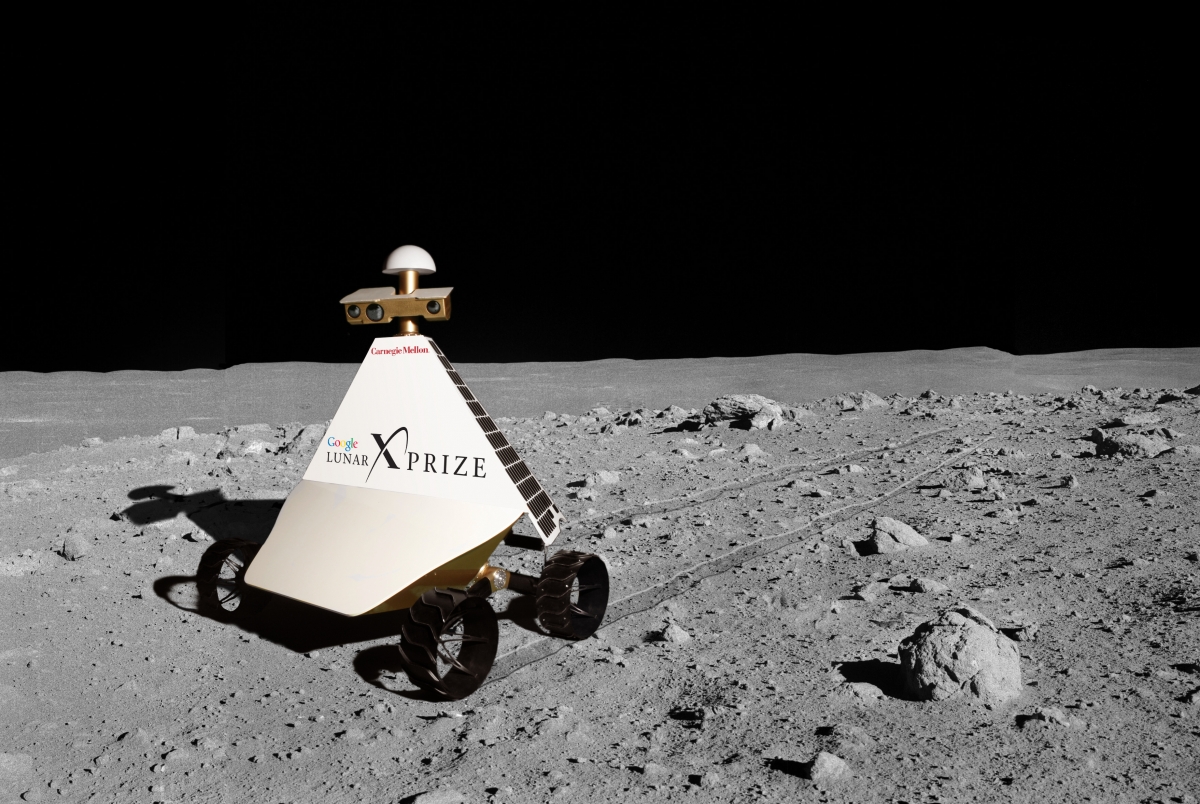
     Other possibilities for a lightweight rover might be those being developed independently by entrants to the Google Lunar X-prize:


    Flight to Phobos, the mysterious moon of Mars.
     A great scientific mystery also is the make-up of the Mars moon Phobos. Flyby missions showed it to have surprisingly low density. Serious scientific speculation included that it may actually be hollow. Current theories are though that it may be analogous to a "rubble-pile" type asteroid. This is not known for sure however. A lander mission may help to resolve the issue.

     Note also that key to Elon's plan for manned flights to Mars is getting the fuel for the return trip from Mars. Taking the fuel from the Martian moons instead would have advantages such as low gravity for getting the fuel to an orbiting propellant depot. Then these first flights to the Martian moons could serve as scout missions for water ice deposits.

      The Falcon Heavy test flights this year will be outside the optimal launch window in 2018. This means they will require higher delta-v to reach Mars, and higher delta-v to slow down on reaching the destination. This limits the mass that can be transported to and landed on Mars, in addition to the expense of the extra in-space stages required.

     Then I will suggest here a method that has long been proposed for arriving at Mars but never attempted, aerocapture. This slows down a craft arriving at Mars by plunging deep within the atmosphere so that minimal propellant burn is required. Note, that if these tests missions using aerocapture succeed then this will suggest it will work to solve the problem of landing large masses on Mars such as a crew habitat, a key enabling technology for manned flights to Mars.

     For the delta-v required to depart from Earth I'll use the orbital calculation program:

    Trajectory Planner.

     This provides the delta-v's required for the Hohmann tranfer orbits between the various planets. The program provides pork-chop plots that allow you to estimate departure and arrival delta-v's dependent on departure time.

     The program though uses Modified Julian Date format, which can be converted to standard date format here:

    http://www.csgnetwork.com/julianmodifdateconv.html

     For a Dec. 23, 2017 departure, which is given in Modified Julian Date format of 58110 in the "Trajectory Planner", the delta-v Hohmann transfer delta-v is 6.155 km/s. We then need to calculate the delta-v needed on leaving Earth orbit. On the Orbiter-Forum discussion forum for the Orbiter space simulation program this formula was provided by member Dgatsoulis:

     \Delta V = \sqrt{V_{\infty}^2 + V_{esc}^2} - V_{orb}

    where V_{\infty} is the hyperbolic excess velocity (departure deltaV from trajectory planner).

    V_{esc} is the local escape velocity, aka the escape velocity for the parking orbit altitude.

    V_{esc} = \sqrt{\frac{2GM_{planet}}{R_{planet}+alt}}

    where G is the gravitational constant, M_{planet} is the planet's mass, R_{planet} is the planet's radius and alt is the altitude of the parking orbit.

    V_{orb} is the parking orbit velocity.

    V_{orb} = \frac{V_{esc}}{\sqrt{2}} 


     Same applies for arrival. If you want to simply calculate the periapsis velocity and not the orbit insertion/injection dV, then don't use the V_{orb} term.

    Source: ORBITAL MECHANICS 

    http://orbiter-forum.com/showthread.php?p=556772&postcount=26

     So the  delta-v on leaving Earth orbit is:
     This 1.11 km/sec more than the usual delta-v to make a Trans Mars Injection during the optimal departure windows of 3.8 km/s.

     We need to calculate how much mass the FH upper stage could get to this higher delta-v of 4.89 km/s. By the FH specs it can get 16.8 mT to Trans Mars Injection.This FH upper stage with the 16.8 mT payload mass can do 348*9.81Ln(1 + 107.5/(4 + 16.8)) =  6,211 m/s delta-v. So with a smaller mass we want to achieve 6,211 + 1,110 = 7,321 m/s delta-v. This can be done with a 10 mT payload:

    338*9.81Ln(1 + 107.5/(4 + 10)) = 7,377 m/s.

     Now we have to calculate how much is the speed on arrival at Mars.  The Trajectory Planner gives the "arrival" speed as 4.275 km/s. However, again this is not the speed the spacecraft would have on entering Mars's atmosphere. This is instead the speed at which it arrives at Mars's position in its orbit around the Sun, i.e., the Hohmann orbit delta-v needed to be supplied to match Mars' solar orbital speed.

     To get the entry speed into Mars' atmosphere, use the Dgatsoulis formula above without the Vorb term. Using 5.0 km/s as the escape velocity for Mars we get:


     If all we wanted was to slow down to enter Mars orbit then we would subtract off from this by aerocapture to bring the speed down to Mars' orbital velocity of 3.56 km/s. However we also want to be put it on a trans Phobos insertion from Mars. By the delta-v chart above we need an additional .9 km/s, so to 4.46 km/s. So by the aerocapture we only need to slow it down by about 2.11 km/s.

     This should be well within the capabilities of aerocapture. However, the payload mass may be as high as 10 mT. The question is could the dragon's approx. 10 square meter base provide sufficient air drag to slow down that high mass, and would its heat shield be thick enough?

     In follow up posts I'll present some preliminary calculations that suggest that plunging deep into Mars atmosphere, skimming the tree-tops so to speak, should allow large masses such as this to be slowed at such high entry speeds.

     With the payload of the FH as high a 10 mT, the rovers and equipment that could be transported could be 4.5 mT above the 5.5 mT fueled weight of the cargo Dragon. But according to the delta-v chart we still need 0.5 km/s delta-v to land on Phobos. The cargo Dragon has a delta-v capability of about 600 m/s with its Draco thrusters for the Dragon capsule alone. So this should be sufficient, but it would not be if the extra cargo was several metric tons. So we could keep the cargo low as for a Mars Pathfinder sized rover or we could add additional propellant tanks to increase the landing capability.

     The possible cargo carried by the Dragon being as high as 4.5 mT suggests though we should try to make use of that cargo space. One possibility would be the processing equipment to produce ISRU (in situ resource utilization) propellant. Perhaps a rocket to do a sample return. Possibly orbiting imaging spacecraft for Phobos or Mars. Others?


        Bob Clark


    Note: thanks to members of Orbiter-Forum.com Keithth G and DGatsoulis for helpful discussions on this topic and member Piper, for writing the Trajectory Planner program.


    Could Blue Origin develop a lander for Artemis III?

    Copyright 2025 Robert Clark SpaceX is coming under increasing criticism for its delay in developing the Starship lunar lander: U.S. Is Losin...