Showing posts with label Ariane H10. Show all posts

Wednesday, May 22, 2019

ESA's Callisto reusability testbed as an *operational* TSTO and SSTO. UPDATE, 7/1/2019.

Copyright 2019 Robert Clark

 European space agencies have been working on developing a small, reusable stage called Callisto:

France, Germany studying reusability with a subscale flyback booster.
by Caleb Henry — January 8, 2018
"We are lacking an experience by operation of recovering a vehicle and reflying it. This is exactly what we would like to do with Callisto,” — Jean-Marc Astorg, head of Launch Vehicles Directorate, CNES. Credit: CNES

 The term "flyback"is used in the title of this article but both vertical, powered, and horizontal, winged approaches for return will be investigated.

 The plan is for this to be only a demonstrator. However, there is an emergent market for small satellites under 500 kg that is expected to reach $30 billion by 2026:

Global Small Satellite Market to Reach $30 Billion by 2026
February 28, 2019 | Business Wire

  The size of this market is expected to be helped by the upcoming megasatellite constellations consisting of thousands of satellites for broadband internet communication through space links.

 Callisto can be used as an operational first stage booster to launch such satellites, either as expendable or reusable.

 I think a mistake of the American X-33 program was that it was only envisioned as a testbed never to be put into service. Since it was testing SSTO capabilities for a much larger, operational SSTO, it had to use lightweighting methods on the tanks such as using carbon-composites that the operational SSTO vehicle called the VentureStar would have used. When the technology for the carbon-composite tanks was not mature enough to become operational the program was cancelled.

 However, SpaceX has shown that even having a reusable first stage booster can cut costs. The X-33 could have used aluminum-lithium for the tanks and would have been an operational, reusable first booster, cutting costs for small payloads. Since the X-33 would have then been its own source of revenue when completed, the program could have been continued:

DARPA's Spaceplane: an X-33 version.
Copyright 2013 Robert Clark

 Actually, some recent high strength metals are even better than carbon-composites in strength-to-weight ratio, so now even the SSTO VentureStar is now possible:

DARPA's Spaceplane: an X-33 version, Page 2.


The engine for Callisto.
 The engine now being considered for Callisto is to be hydrogen/oxygen at a 40 kilonewton(kN) thrust, about 4,000 kilogram-force: 

CALLISTO - Reusable VTVL launcher first stage demonstrator.
E. Dumont (1), T. Ecker (2), C. Chavagnac (3) , L. Witte (4), J. Windelberg (5) J. Klevanski (6),
S. Giagkozoglou (7)
(1) DLR - Institute of Space Systems - Space Launcher Systems Analysis - Bremen (Germany),
****@dlr.de (2)DLR - Institute of Aerodynamics and Flow Technology - Spacecraft - Göttingen (Germany) (3) CNES - Launcher directorate - Paris (France) (4) DLR - Institute of Space Systems – Landing and Exploration Systems - Bremen (Germany) (5)DLR - Institute of Flight Systems – Braunschweig (Germany) (6)DLR - Institute of Aerodynamics and Flow Technology - Supersonic and Hypersonic Technology - Cologne
(Germany) (7)DLR - Institute of Structures and Design – Space System Integration - Stuttgart (Germany)

 However, for the role of being a first stage booster I suggest a larger one would be better. In this case the Vinci engine to have its first launch as the upper stage engine on the Ariane 6 in 2020 would be ideal.

 The Vinci is to have a 180 kN vacuum thrust, about 18,000 kilogram-force. The Vinci is to be an upper stage engine with a vacuum-optimized nozzle:


 However, such large, vacuum-optimized nozzles can not operate at sea level, since they would be dangerously overexpanded. But another aspect of the Vinci makes it ideal for use as a engine for the Callisto, its use of a nozzle extension:


 The use of a nozzle extension would allow the engine to be operated with the nozzle retracted at sea level and extended for high altitude, near vacuum conditions.

 Nozzle extensions are used on a few other upper stage engines, notably on the American RL10-B2:


 But their purpose is to allow the long nozzle to fit within a shorter length when stowed. They are not extended while the engine firing, only prior to upper stage ignition after the lower stage is jettisoned. However, tests have been run which shows the engine does work even when the nozzle is in the process of being extended:

Telescoping nozzles (Henry Spencer).

 Another version of a nozzle extension has been known of since the 70's and was always intended to be extended while the engine is firing, an inflatable nozzle extension:
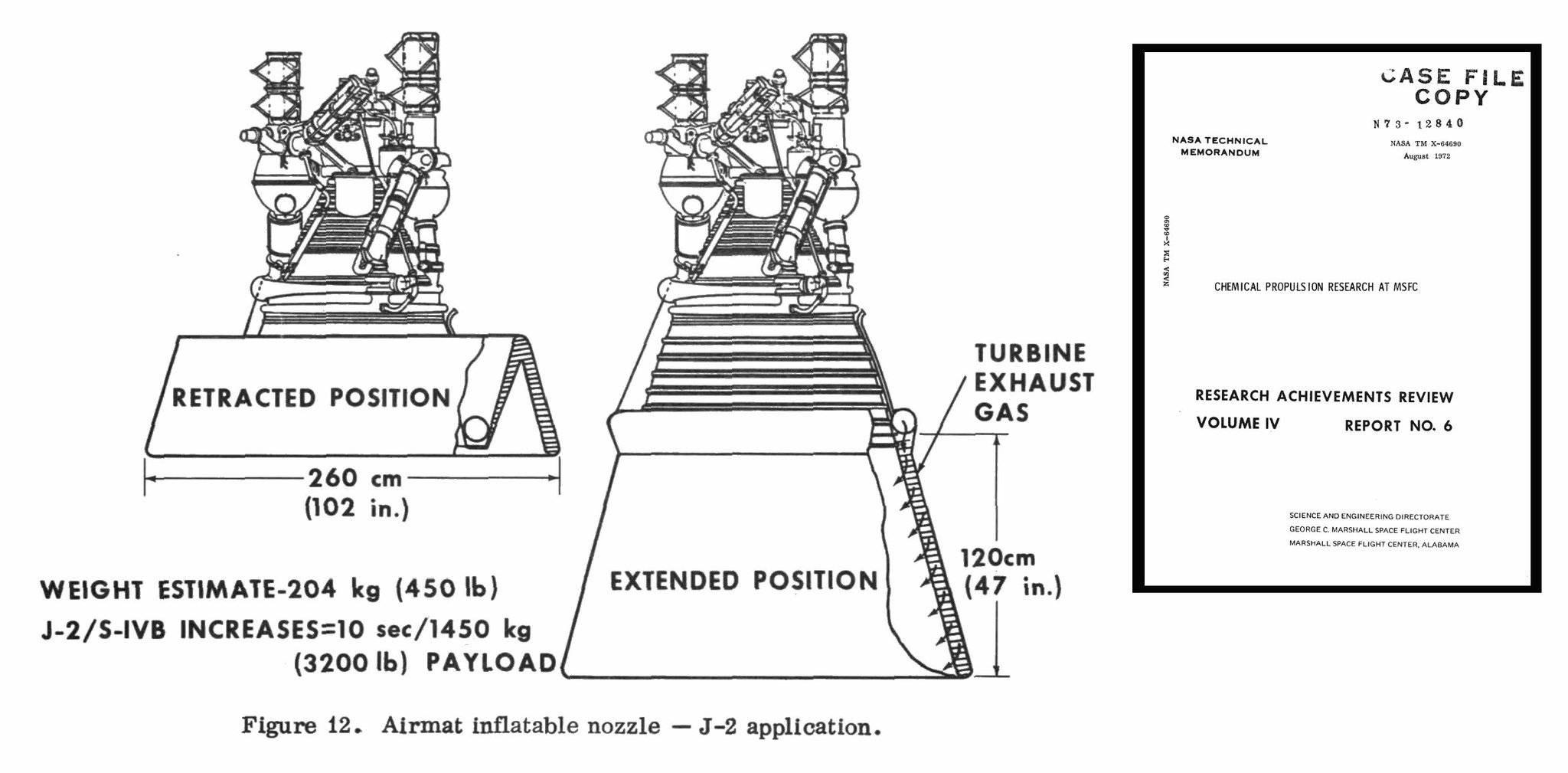

 Such nozzle extensions are methods of altitude compensation. This allows engines to have optimal performance both at sea level and at vacuum. 

The stage for the Callisto.
 The advantage of using the Vinci engine is that it will already be developed so most of the development cost for the engine will already be paid for. To reduce costs further, I suggest the same for Callisto's rocket stage: use the Ariane H10 upper stage at a 11.86 ton propellant mass and 1.24 ton dry mass. We'll swap out the HM7-B engine on the H10 though to be replaced with the Vinci engine.

 The Vinci vacuum Isp is given as 465 s with a vacuum thrust of 180 kN , but no sea level Isp or thrust is specified since it's not intended to operate at sea level.

 We can estimate a sea level thrust though for the case when the nozzle extension is in retracted position. In the RL10 version with the long nozzle extension, its vacuum Isp is the same as the Vinci at 465 s. So for the Vinci's sea level performance, we'll compare it to a sea level version of the RL10, the RL10-A5 engine. This was the version of the RL10 with a shortened nozzle, used for sea level operation on the DC-X rocket:

RL-10-A-5.

 Note how short the nozzle is compared to even the standard RL10, without the long version of the nozzle extension:


 The sea level thrust of the RL10-A5 was 6,500 kilogram-force. So given the vacuum thrust of the Vinci is about twice that of the RL10-B2, estimate the sea level thrust of the Vinci, with retracted nozzle, at twice that of the RL10-A5, so at 13,000 kilogram-force

Ideal delta-v to orbit.
 A problem with engines with altitude compensating nozzles is calculating the delta-v possible using them. Commonly, for fixed nozzles you can use the vacuum Isp to calculate the ideal delta-v for the rocket. This would be the delta-v if there were no losses for gravity drag, air drag, sea level Isp loss. When these losses are taken into account an ideal delta-v, larger than just orbital velocity, is used to estimate payload to orbit:

From Modern Engineering for Design of Liquid-Propellant Rocket Engines, p. 12.


 This takes the ideal delta-v for orbit as 30,000 ft/s, about 9,150 m/s while using the vacuum Isp in the rocket equation calculation.

 Another article uses another common method to estimate the payload to orbit, using an average Isp over the trajectory:

Towards Reusable Launchers - A Widening Perspective.
H. Pfeffer
Future Launchers Office, Directorate of Launchers, ESA, Paris.
Because rocket propulsion is mandatory to accelerate to orbital speed in vacuum, the most logical design option is to use rocket propulsion from take-off until orbit insertion. Both gravity and drag losses must be overcome on the trajectory to orbit. The ideal velocity increment, Delta V, required from an SSTO-RRL is then about 9000 m/s in order to reach a Low Earth Orbit (LEO). All further considerations concentrate on reaching LEO, because this is the most difficult part of gaining access to space and the major hurdle to be mastered in terms of reusability.
The mass that can be accelerated into orbit using rocket propulsion is given by the equation: M 1 /M 0 =exp ( -Delta V /V E ) where M 0 is the mass at take-off, M 1 is the mass which has received the ideal velocity increment Delta V, and V E is the ejection velocity of the rocket engine.
For a given Delta V, which is mission-imposed, the mass ratio M 1 /M 0 increases with increasing V E . The highest practical rocket ejection velocities are achieved by burning hydrogen with oxygen in a combustion chamber and ejecting the produced gases through a convergent/divergent nozzle. When averaged over the trajectory, the exhaust velocity V E is in the order of 4000 m/s. The corresponding mass ratio to reach LEO is: M 1 /M 0 =exp(Delta V /V E ) = exp ( 9000/4000) = 0.1054 = 10.54%

 In this case, using an average Isp, the ideal delta-v to orbit is taken somewhat lower at 9,000 m/s. In any case the delta-v to orbit depends on several factors such as T/W ratio, altitude and inclination of orbit, etc. 

 Commonly for rocket engineers the vacuum Isp is used. But that becomes doubtful with a non-fixed nozzle, such as when using altitude compensation.

 Lacking an average Isp in the alt.comp. scenario, I'll use the vacuum Isp in the calculation. 

However, a true trajectory simulation over the entire flight using altitude compensation needs to be done to calculate the average Isp in this scenario to get a more accurate estimate of the payload.

Calculation for the TSTO Callisto.
 I'll just calculate the expendable case here. Once it is seen how much payload is possible, the Callisto developers can determine the best ways to add reusability systems. 

 A problem at the start is the Ariane H10 stage with the Vinci engine added is at 13.1 tons gross mass, while the Vinci estimated sea level thrust is just in the 13 tons range.

We could ramp up our thrust above that of the nominal thrust. For instance the space shuttle main engines had their thrust increased 9%. And the Merlin engines had their thrust increased 15%. If we could ramp up the thrust 9%, the sea level thrust of the Vinci would be at 14.2 tons. One method for ramping up the thrust is varying the mixture ratio. Increasing the LOX content compared to the LH2 would give the exhaust more mass and more thrust, though at a loss of Isp.

 Then to get a two-stage-to-orbit(TSTO) launcher could add a small solid stage such as the Star 24 or a similar European small solid stage. The Star 24 is at a 220 kg propellant load, and 20 kg dry mass, and 282 s vacuum Isp.

 Then with a .76 ton payload the delta-v would be:

465*9.81*Ln(1 + 11.9/(1.2 + .240 + .76)) + 290*9.81*Ln(1 + .220/(.02 + .76)) = 9,160 m/s , sufficient for orbit. 

 But it must be noted this is under the simplification of just using the vacuum Isp of the Vinci. A more accurate, probably reduced, payload needs to be found under a more accurate calculation using the varying Isp for the altitude compensating nozzle.

Calculation for the SSTO Callisto.
 It is interesting to calculate the delta-v of the stage with no upper stage and no payload:

465*9.81*Ln(1 + 11.9/1.2) = 10,900 m/s. Note this is well above that needed for orbit, of 9,150 m/s. We could then add .65 tons, 650 kg, as payload and still make orbit as an SSTO:
 465*9.81*Ln(1 + 11.9/(1.2 + .65)) = 9,150 m/s.

 The payload as an SSTO is surprisingly close to that as a TSTO. This is undoubtedly because of the rather low thrust of the first stage compared to the stages gross mass, which limits the size of the second stage that can be used.

Calculation under a reduced propellant load.
 Because of the uncertainty of how much the thrust can be ramped up. We'll calculate the case under a reduced propellant load, keeping the regular sea level thrust of 13 tons.

 We'll reduce the propellant load to 10 tons. The reduced propellant load in the first stage allows us to carry a heavier upper stage. We'll use the Star 37X. It carries a 1,070 kg propellant load, at a 80 kg dry mass and 296 s vacuum Isp. Then we can get 690 kg to orbit under the TSTO case:

465*9.81*Ln(1 + 10/(1.2 + 1.15 + .690)) + 296*9.81*Ln(1 + 1.07/(.08 + .690)) = 9,170 m/s.

 And for the SSTO case, we can get 350 kg to orbit:

465*9.81*Ln(1 + 10/(1.2 +.350)) = 9,160 m/s.


    Bob Clark


UPDATE, 7/1/2019:

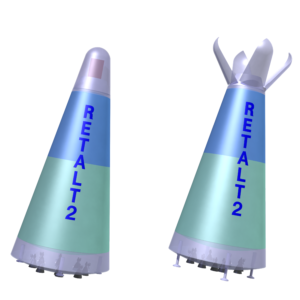
 European space agencies and industry have just announced they will be investigating reusable TSTO and SSTO launchers with the RETALT program: https://www.retalt.eu/project/#RETALT2

 For such an experimental program, it will be much easier and cheaper to add altitude compensating additions to existing engines rather than developing whole new engines from scratch.


Sunday, February 18, 2018

Multi-Vulcain Ariane 6.

Copyright 2018 Robert Clark

 The worldwide space community was amazed by the success at which SpaceX was able to launch the Falcon Heavy and land the two side boosters back at the launch site: 


 This led the current head of ESA Jan Woerner to suggest that ESA should promote reusability for future launchers. But, Woerner argues, the currently planned version of the Ariane 6 using two solid side boosters and with no reusability is so far along it should probably be completed:

EUROPE’S MOVE.
Posted on 11/02/2018 by Jan Woerner
http://blogs.esa.int/janwoerner/2018/02/11/europes-move/

EUROPE’S MOVE, PART 2.
Posted on 15/02/2018 by Jan Woerner
http://blogs.esa.int/janwoerner/2018/02/15/europes-move-part-2/

 However SpaceX is progressing so rapidly with reusability, and reduced costs, that by the time the Ariane 6 is expected to reach full operation in 2023 it's high cost may make it obsolete.

 But in fact a faster, and much cheaper alternative is possible for the Ariane 6 that would have also have the advantage it could be made reusable: and that is to give the Ariane 5 core an additional Vulcain 2 engine so it can lift off without needing the solid side boosters. 

  Based on how much it cost JAXA to add a second cryogenic engine to the H-IIA core this could be done for only a $200 million development cost:

On the lasting importance of the SpaceX accomplishment, Page 3: towards European human spaceflight.
https://exoscientist.blogspot.com/2013/05/on-lasting-importance-of-spacex.html

 This is compared to the multibillion dollar development cost for the Ariane 6 version with side boosters. 

 I had previously written about the possibility of giving the Ariane 5 a second Vulcain engine here:

The Coming SSTO's: multi-Vulcain Ariane.
https://exoscientist.blogspot.com/2013/03/the-coming-sstos-multi-vulcain-ariane.html

 However, that was in the context of producing a SSTO. But SSTO's are still controversial. And in any case it would have a lower payload capacity than the solid booster version of the Ariane 6, and couldn't, in itself, fulfill the important role of launching GEO satellites.

 So I'll discuss the case of giving the Ariane 5 core a second Vulcain engine while keeping an upper stage. I was surprised that my calculation showed this version without side boosters was able to get close to the 6.5 ton to GTO requirement ESA set for the Ariane 6 just with the two liquid stages, no solid side boosters.

 This article discussed the various options that were being considered for the Ariane 6 including a version that added a second Vulcain engine to the Ariane 5 core:

CNES, ASI Favor Solid-Rocket Design For Ariane 6.
By Amy Svitak
Source: Aviation Week & Space Technology
October 15, 2010

You see it only lists 2,200 kg to GTO with the two stage H2C all-liquid configuration of the Ariane 6.

 And even more surprisingly, my calculation shows my two-stage version could get the high GTO payload without using the expensive new upper stage being planned for the Ariane 6 with the new Vinci engine. It could do it with an already existing cryogenic Ariane H10 upper stage.

 This indicates why the development cost for this version would be so low: no new solids need be developed, already existing Vulcain 2 engines are used, no new expensive upper stage and Vinci upper stage engine need be developed, and already existing Ariane upper stages are used.

 I'll use Dr. John Schilling's launch performance calculator to estimate the payload possible:

Launch Vehicle Performance Calculator.
http://www.silverbirdastronautics.com/LVperform.html

 Use publicly available sources for the specifications of the Ariane 5G core, Vulcain 2 engine, and Ariane H10 upper stage to enter in data into the Schilling calculator. The calculator takes the vacuum values for the Isp and thrust even for first stage engines, since it already takes into account the diminution of these values at sea level. Then with two Vulcain engines the input page looks like this:


 Some quirks of the Schilling calculator you need to be aware of though if you use it. First, always select "No" for the "Restartable Upper Stage" option, otherwise the payload will be reduced. Second, always set the "Inclination" to match the launch site latitude otherwise the payload will be reduced.

 Note that while the thrust indicated for the first stage at 2,700 kilonewtons (vacuum) is well above the rocket gross mass, the sea level thrust for the two Vulcains is about 190,000 kilogram-force. With payload, this would not be enough to lift off. A couple of solutions. One would be to change the mixture ratio at lift off to increase the oxidizer to fuel ratio. This decreases Isp, but increases thrust. Another possibility is that liquid fuel engines can be run at some percentage above their rated values. For instance the space shuttle main engines could be run at 9% above their rated thrust values and the latest version of the SpaceX Merlin engines run at about 15% above the Merlins rated thrust value.   Another possibility would be to reduce the propellant load. I'll look at this last solution in a moment.

 In any case with these specifications the calculator gives this payload to LEO:


 Now to get the GTO payload, change the "Apogee" entry from 185 km to 35,000 km. Then the calculator gives the result:


Altitude Compensation case. 
 We can get even better performance by using altitude compensation on the Vulcains. As discussed on this blog various methods exist to give standard bell nozzle engines, altitude compensating nozzles. These new additions would not be heavy or expensive.

 As shown by the RL10-B2 engine, with a nozzle extension a hydrogen-fueled engine can get a vacuum Isp in the range of 465 s. So change the first and second stage Isp's to 465 s and increase the vacuum thrust proportionally. Then the payload for the LEO case would be:


  And the payload to GTO would be:


 This indicates the importance of altitude compensation even for multi-stage vehicles. The payload can be increased in the range of 25%. However, it could be argued the Schilling calculator was not formulated to deal with the altitude compensating case, so these estimates are less reliable. A legitimate concern. Accurate trajectory simulations need to be done to determine if altitude compensation can really increase payload to this extent even with multi-stage rockets.

Reduced Propellant Case.
 As mentioned above another method to deal with the lift off thrust not being able to loft the rocket with payload, is to reduce the propellant load. In fact the currently adopted version of the Ariane 6 is planned to reduce the propellant on the core down to 140,000 kg.

 If we do this to our all liquid version, this brings the LEO payload to 10,430 kg  and the GTO payload to 4,890 kg.
 And with the altitude compensation, the LEO payload comes to 12,800 kg and alt. comp. GTO payload to 6,370 kg.

And Yet Even More.
 Beyond the importance of giving Europe a reusable, low cost launcher, there is also the fact that being all liquid-fueled, no solid motor boosters, Europe now would have an orbital launcher that could be used for manned spaceflight. Europe would finally have its own independent manned spaceflight capability.

   Bob Clark

Saturday, October 5, 2013

DARPA's Spaceplane: an X-33 version.

Copyright 2013 Robert Clark


 DARPA has announced that it will be funding research into a reusable first stage booster to carry an orbital upper stage. But looking at the specifications of the cancelled programs the DC-X's suborbital follow-on, the DC-X2, and on the X-33 you'll note that they each could have performed this role. This would have led to greatly reduced orbital costs. Then both programs were cancelled prematurely.

 Part of the problem is that they were viewed as purely demonstration or experimental programs, without any potential profitability of their own. The profitability would have come with the full, and expensive, SSTO programs to follow. However, if it had been noted these could have been used as fully reusuable first stages, then their value would have been seen on their own. So that they would have been understood as deserving of funding whether or not the SSTO's were to follow.

 The story of the X-33 is well-known now among space advocates:

X-33/VentureStar – What really happened.
January 4, 2006 by Chris Bergin
http://www.nasaspaceflight.com/2006/01/x-33venturestar-what-really-happened/

 It was to be a suborbital experimental test vehicle for a larger SSTO called the VentureStar. For the VentureStar to have been SSTO with significant payload would have required aggressive weight saving techniques such as composite tanks. Such composite tanks were to be tested on the X-33 before committing to the full VentureStar.

 However, the composite tanks failed on the X-33. Since it was felt the SSTO version could not succeed with regular metal tanks, the program was cancelled. However, in point of fact even if you replaced the failed composite tanks with aluminum-lithium ones the X-33 could still be used as a reusable first stage.

 The problem with the tanks is that their unusual conformal shape required them to use greater tank mass compared to the mass of propellant carried than by usual cylindrically shaped tanks:

Space Access Update #91 2/7/00.
The Last Five Years: NASA Gets Handed The Ball, And Drops It.
...part of L-M X-33's weight growth was the "multi-
lobed" propellant tanks growing considerably heavier than promised.
Neither Rockwell nor McDonnell-Douglas bid these; both used proven
circular-section tanks. X-33's graphite-epoxy "multi-lobed" liquid
hydrogen tanks have ended up over twice as heavy relative to the
weight of propellant carried as the Shuttle's 70's vintage aluminum
circular-section tanks - yet an X-33 tank still split open in test
last fall. Going over to aluminum will make the problem worse; X-
33's aluminum multi-lobed liquid oxygen tank is nearly four times as
heavy relative to the weight of propellant carried as Shuttle's
aluminum circular-section equivalent.
http://www.space-access.org/updates/sau91.html

  However, ironically it turned out that the hydrogen tank weight for the X-33 actually went down when replaced by aluminum:

From "X-33/VentureStar – What really happened" :
Faced with a project failure, Lockheed Martin and X-33 NASA managers gave the green light to proceed with the fabrication of the new tank. Ironically this new tank weighed in less than the composite tank – disproving one of the reasons for going with a composite tank in the first place.
While the aluminium LH2 tank was much heavier than the composite tank in the skins, the joints were much lighter, which was where all the weight in the composite tank was, due to the multi-lobed shape of the tank requiring a large amount of surrounding structure, such as the joints. Ironically, the original design of the X-33 on the drawing board had the tanks made out of aluminium for this reason – but the cost played a factor for the potential customer base.
Then on replacing the composite hydrogen tanks with Al-Li the dry mass should be less. So I'll use the same numbers for the dry mass and gross mass, 75,000 lbs for the dry mass and 285,000 lbs for the gross.

 The X-33 was to use two aerospike XRS-2200 engines. According to Wikipedia, the XRS-2200 produces 204,420 lbf (909,300 N) thrust with an Isp of 339 seconds at sea level, and 266,230 lbf (1,184,300 N) thrust with an Isp of 436.5 seconds in a vacuum. So two will have a vacuum thrust of 2,368,600 N.

 Now choose for the upper stage an efficient cryogenic stage such as the Centaur or the Ariane H10. We'll use Dr. John Schilling's Launch Performance Calculator to estimate the payload possible. Take the specifications for the Centaur rounded off as 2,000 kg dry mass, 21,000 kg propellant mass, 100 kN vacuum thrust and 451 s vacuum Isp. Then the Calculator gives a payload of 5,275 kg to orbit:

Mission Performance:
Launch Vehicle:  User-Defined Launch Vehicle
Launch Site:  Cape Canaveral / KSC
Destination Orbit:  185 x 185 km, 28 deg
Estimated Payload:  5275 kg
95% Confidence Interval:  4252 - 6507 kg

 The cost of a Centaur upper stage is in the range of $30 million. But how much for a reusable X-33? This article gives the cost to build a X-33 as $360 million in 1998 dollars:

Adventure star  
12:00 18 Nov 1998  Source:  Flight.
By:  Graham Warwick/WASHINGTON DC

 Even taking into account inflation the cost should not be terribly much more than that when you also take into account the decrease in price for composites because of their more common use. 

 The launch preparation costs should also be low since the X-33 was expected to be operated by only a 50 man ground crew compared to the 18,000 required for the shuttle system:

Lockheed Secret Projects: Inside the Skunk Works.

 Say the builder expected a 25% profit over cost of the vehicle over 100 flights. That would be a charge of $4.5 million per flight. With the Centaur upper stage that would be $34.5 million per flight for 5,275 kg to orbit, about $6,500 per kilo. This is a significant saving over the ca. $10,000 per kilo for launchers in the West. It is still well above DARPA's desired price point of $5 million per flight, but it is for a larger payload than the DARPA required 3,000 to 5,000 pounds.

 A lower cost launcher could be obtained using a cheaper upper stage, such as the Ariane H10 stage. This is about 12 mT in propellant load and 1.2 mT in dry mass at 445 s vacuum  Isp and 63 kN vacuum thrust. The Calculator gives a payload mass of 3,762 kg.

 The cost for the H10 stage according to Astronautix is $12 million. Then the total would be $16.5 million. At a payload of 3,672 kg, this is $4,500 per kilo. This would be a great cut in cost for small size payloads, but the total cost is still too high for the DARPA price requirements.

 Another possibility for a cheaper upper stage would be the Falcon 1's first stage. This has a dry mass of 1,450 kg and propellant mass of 27,100. We'll use for it though the upgraded Merlin 1D Vacuum at 800 kN vacuum thrust and 340 s Isp. Then the Calculator gives a payload mass of 5,238 kg. 

 The latest listed price for the Falcon 1 in 2008 was about $8 million. But we only need the first stage. Elon Musk has said for the Falcon 9 the cost of the first stage is 3/4ths the cost. If also true for the Falcon 1, that would put the cost at $6 million for the first stage. Then the total cost would be $10.5 million, $2,000 per kilo. This is a quite low cost per kilo and it would be a significant advance to have payload this size launched at such low cost, whether or not it would qualify under the DARPA program.
  
 We can get closer though to the DARPA total cost requirement by taking instead the Falcon 1's upper stage. This has a 360 kg dry mass and 3,385 kg propellant mass. The vacuum thrust is 31 kN and vacuum Isp, 330 s. Then the Calculator gives a payload of 959 kg. Taking the cost of the Falcon 1 upper stage as 1/4th that of the $8 million cost of the Falcon 1, this puts the total cost as $6.5 million

 This is a little below the DARPA requirement to LEO of at least 3,000 lbs and at a cost a bit above the $5 million limit, but likely tweaking the sizes of the lower and upper stages can get them within the required range.

 In regards to changing the size, an ideal solution would be to get an upper stage from a scaled down X-33. This would in fact allow us to get a fully reusable two-stage system. Say we scaled down the size of the X-33 by a half in the linear dimensions. This would give us a vehicle 1/8th as large in mass. Then the dry mass would be 4,000 kg with 12,000 kg propellant mass. Take the thrust as 1/8th as large as well at 300 kN, while using the same Isp 436.5 s. Then the Calculator gives us a payload of 1,902 kg.

 Given its 1/8th as large mass, we may estimate the cost to build this half-scale X-33 as $45 million. Using again a 25% price markup over 100 flights, that would be $560,000 per flight. This then would be quite close to the total cost range requirement for the DARPA program.


   Bob Clark

Could Blue Origin develop a lander for Artemis III?

Copyright 2025 Robert Clark SpaceX is coming under increasing criticism for its delay in developing the Starship lunar lander: U.S. Is Losin...