Showing posts with label laminar flow. Show all posts

Sunday, January 5, 2020

Pumping pressurized fluids to high altitude for the space tower and for fighting forest fires, Page 5: further on laminar flow.

Copyright 2020 Robert Clark
(Patents Pending)

 In the blog post, Pumping pressurized fluids to high altitude for the space tower and for fighting forest fires, Page 3: achieving ultimate laminar flow, I discussed using laminar flow to achieve long distance water streams, either with piping or without. 

 If we are to achieve it without piping over kilometer distances then we can use the staging idea to have laminar flow inducing devices along the flow path along with the staged pumps. This would reduce the length the water had to remain laminar while not constrained within a pipe.

 For the method that does use piping, some notable recent research is that flow that has turned turbulent can be converted back in laminar flow:

New approach can save up to 95 percent of energy used for pipelines.
Study proves that turbulent flow can be destabilized so that it turns to an energy-saving laminar flow
Date: January 8, 2018
https://www.sciencedaily.com/releases/2018/01/180108121612.htm

 Also, notable is that flow in microfluidic channels are commonly laminar:

CHEM-ENG 590E: Microfluidics and Microscale Analysis in Materials and Biology

 Then you would use large numbers of the microchannels bundled together to get the needed water flow.


   Bob Clark

UPDATE, 1/11/2020:

 The possibility of raising the pipe or the free water stream to high altitude in stages, also raises the possibility of covering the needed horizontal distance in stages. This is important because of having to keep a pipe aloft horizontally over kilometer distances raises a significant weight issue.

Saturday, September 8, 2018

Pumping pressurized fluids to high altitude for the space tower and for fighting forest fires, Page 4: water packets solution.

Copyright 2018 Robert Clark
(patents pending)

 In the blog post Pumping pressurized fluids to high altitude for the space tower and for fighting forest fires, Page 2: high volume, high head, single pump solution, I speculated on laminar flow to achieve kilometers-long water streams without using piping. And in the blog post Pumping pressurized fluids to high altitude for the space tower and for fighting forest fires, Page 3: achieving ultimate laminar flow, I proposed some methods of maximizing the laminar flow effect. However, in the absence of experimental or theoretical evidence we should remain doubtful that even laminar flows could achieve kilometer-long water streams without piping.

 Then I'll propose an alternative solution to achieving the long-distance water flow. In the high volume, high head "mud pumps" discussed in the Page 2 blog post, the pumps necessarily had to have both high volume and high head because in their dredging, mining, drilling use they have to pump both mud and rocks in addition to just water.

 The problem with sending water streams long distance is that the water streams will disperse into droplets due to air drag under the high speeds or pressures needed to send them the long distances. However, rocks certainly can be sent such long distances even acting under air drag. So the idea would be to have the water contained as some percentage within mud or rock. Depending on the relative proportion of the mud/rock to the water, the individual packets would be sufficiently cohesive to be sent the required distance.

 Another possibility would be to send the water as frozen blocks or balls. There would be the question then of how to get the water rapidly frozen while being sent out at high pressure or speed. One possibility would be to first use snow making machines that can make snow using up to 107 gallons per minute of water. The water is sent out in the form of a fine mist so that it will rapidly freeze. You would also need a compartment of refrigerated air kept below freezing so that the water will rapidly freeze like in the Winter conditions on a ski slope:


 The snow is made in the form of small ice crystals though. The snow/ice would then have to be compressed into balls or cubes so it would have longer range when then sent to the high pressure pumps.

 Still another possibility is the water could be encased in a biodegradable plastic bag or shell before being sent to the high pressure pumps. 

 To minimize drag we might want to put the encased or frozen water into a tear drop shape. We might also want to give it fins and use spin stabilization for a straight-line flight kilometers long.

 A gliding approach to long range.
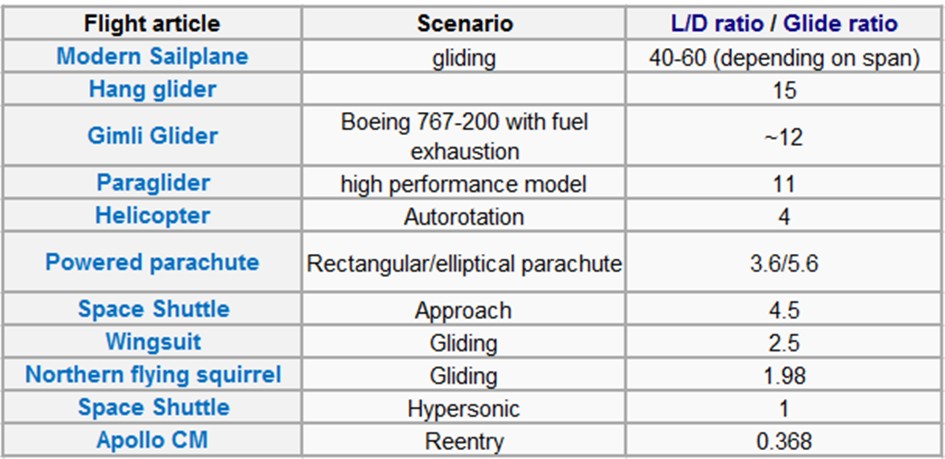
 To get even longer range, we could also shape the mud packs, ice packets, or plastic shells into aerodynamic lifting surfaces. Gliders for example can have lift/drag ratios in the range of 40 to 60.


 The glide ratio which is the ratio of the horizontal length traveled divided by the vertical drop is equal to the lift/drag ratio. 

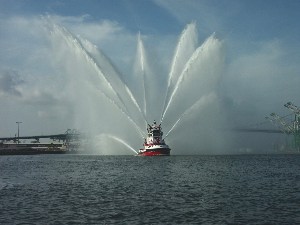
 So in the originally proposed scenario in this series of blog posts of using a high volume fireboat such as the Warner Lawrence, we could first send the high volume of 38,000 gallons per minute to 400 feet. 

 Then encasing the water into a gliding aerodynamic shape with a ca. 60 to 1 lift drag ratio, we could cover 24,000 feet horizontally as it fell 400 feet.  

 This would have the advantage in that you would not need to convert this high volume pumping capacity into lower volume, but higher head.

 The disadvantage is the high lift/drag ratio shape of a sailplane would be highly subjected to winds. 


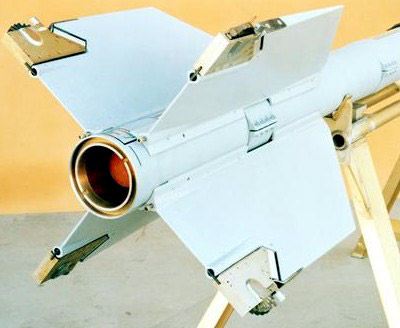
 So we likely would need some method of automated control surface maneuvering to ensure straight and true flight. One possibility might be the rolleron fins used on rockets:

A rolleron is a type of aileron used for rockets, placed at the trailing end of each fin, and used for passive stabilization against rotation.[1] Inherent to the rolleron is a metal wheel with notches along the circumference. On one side, the notches protrude into the airflow. During flight, this will spin the wheels up to a substantial speed. The wheels then act as gyroscopes. Any tendency of the rocket to rotate around its major axis will be counteracted by the rollerons: the gyroscopic precession acts to move the rolleron in the opposite direction to the rotation.[2]

   Bob Clark

Pumping pressurized fluids to high altitude for the space tower and for fighting forest fires, Page 3: achieving ultimate laminar flow.

Copyright 2018 Robert Clark
(patents pending)


  In the blog post Pumping pressurized fluids to high altitude for the space tower and for fighting forest fires, Page 2: high volume, high head, single pump solution, I speculated that we might be able to send water streams long distances, kilometers long, without piping by using laminar flow. As shown in the videos, on that page laminar flows displays surprising cohesiveness in the water streams, and extends the distances possibile over standard streams.

 Studies on the flow distance of non-laminar water streams show their distance is dependent on where the break-up distance occurs, [1]. This is known to be dependent of turbulence within the piping. Laminar flow achieves longer distance because of reduced turbulence. Then the natural question to ask is how much we can reduce turbulence. 

 Certainly, a rough surface within a pipe induces high turbulences. Then the best we could do to reduce that is to use an atomically flat surface. A report shows at least in helium gases shows atomically flat surfaces can reduce drag by orders of magnitude:

Gas flow through tiny atomically flat walls: Atomic-scale ping-pong.
Date: June 20, 2018
Source: University of Manchester
Published in Nature, this new research shows that the channels allow gas through them at rates that are orders of magnitude faster than expected from theory. This will not only be important for fundamental studies on molecular flows at nanoscale but also for applications such as desalination and filtration.
The reported anomalously-high flow is due to a phenomenon called 'specular surface scattering', which allows a gas to pass through the channel as if it were not there at all.
https://www.sciencedaily.com/releases/2018/06/180620150200.htm

  Note this would be important not just for inducing low turbulence and laminar flow for a pipe-free approach but also for the approach using piping to reduce drag and pressure loss.

 Actually, there are two effects involved in this report that need to be investigated separately. One, is that the surface is atomically flat, the other is that the channels are at nanoscopic widths.

 The flatness at atomic scales would likely reduce drag and turbulence for macroscale pipes, and therefore also improve the laminar flow effect on exiting the pipe.

 But an aspect of how laminar flow streams are produced suggests the nanoscale piping in itself would also improve laminar flow. In the case of laminar flows in amateur experimenters, they were produced by using multiple small straws placed within the pipe to produce multiple small streams. The experimenters noted the effect is much better for small straws as for example coffee stirrers compared to larger straws as used for example sodas. Then the natural question that needs to be investigated is how much better would the effect be for microscale and nanoscale piping.

 In extending the results of the published report on helium gases to water another effect needs to be taken into account, the stickiness of water on surfaces. Materials low in this measure are called hydrophobic. Recent research has been on materials extremely low on this measure called superhydrophobic. In this case simulations and experiments show the drag can be reduced 50%, [2].


  Bob Clark

REFERENCES.
1.)Theoretical Range and Trajectory of a Water Jet.
http://trettel.org/pubs/2015/Trettel-2015-Theoretical-range-and-trajectory-of-a-water-jet.pdf

2.)An analysis of superhydrophobic turbulent drag reduction mechanisms using direct numerical simulation.
Physics of Fluids 22, 065102 (2010);
Michael B. Martell, Jonathan P. Rothstein, and J. Blair Perota
https://aip.scitation.org/doi/10.1063/1.3432514


Friday, August 17, 2018

Pumping pressurized fluids to high altitude for the space tower and for fighting forest fires, Page 2: high volume, high head, single pump solution.

Copyright 2018 Robert Clark
(patents pending)

 In the blog post "Pumping pressurized fluids to high altitude for the space tower and for fighting forest fires," I mentioned high volume pumps such as used on fireboats to send kilometers-long water streams from lakes or rivers to fight wildfires.

 However, the water turrets on fireboats would not have the "head", i.e., altitude capability, to send the water streams kilometers in the air on their own. In fact, I didn't think such pumps existed. So instead I suggested adding an additional pump that would trade flow rate for altitude. A pump that could do it would be the famous ram or hydraulic ram pump.

 I was surprised though after doing a web search that there do exist pumps that do have both high volume and high head. These are so-called "mud pumps" that are used for dredging the sea floor and for pumping out mud and debris deep within mines. In addition to the high volume for dredging and mining purposes, they need the high head since they will also be pumping up mud and rocks, which are denser, so heavier, than just water.

 One is the 14-P-220 mud pump. It is capable of 7,500 psi at 375 gpm.


  Another thing I didn't realize is such pumps themselves have the capability to vary their psi vs. flow rate values, i.e., they are already able to trade flow rate for head. See for example the table here:


   But there is a limit to which a pump's pressure values can be varied. Going beyond that limits the pumps lifetime or can damage it. A psi value of 7,500 psi is 500 bar. This corresponds to a vertical head of 5,000 m. Using the analogy of the ball thrown at a 45 degree angle, the horizontal distance possible would be twice that or 10,000 m, 10 km. It's likely the pump's head can be increased beyond the rated value somewhat at the cost of reduced lifetime, but in any case we can still use the ram pump or other methods to further trade flow rate for distance.

 Note, actually for a ball or a water stream, because of air drag or frictional drag in a pipe, the angle for maximum horizontal distance will actually be less than 45 degrees and the distance will be less than twice the vertical height.

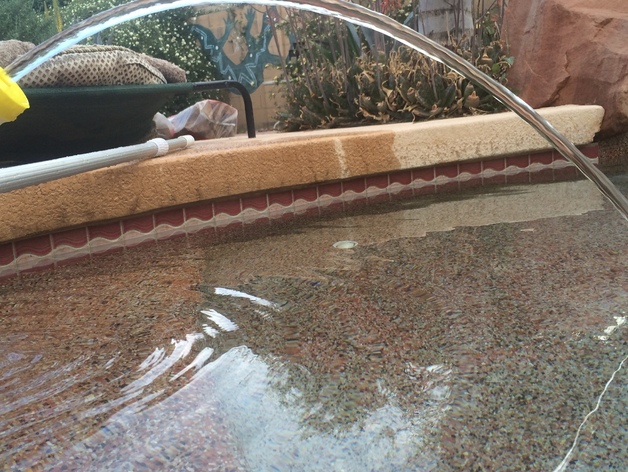
 In a correspondence, Giottis Motsanos suggested I look into laminar flow to maximize distance. This is when the water flow is in a uniform, parallel stream. I had been assuming the flow had to be within a pipe to maximize distance. But some remarkable instances of laminar flow raise the possibility we can achieve these long distances without using a pipe:

Making a Laminar Flow Nozzle.


AMAZING Under $300.00 Home Made Laminar Water Jet.

 And this video specifically mentions laminar flow allows longer water streams for firefighting:


Digitally Controlled laminar Fountain in Burj Al Arab Building


 If so, this would eliminate the problem of how to support the weight of the pipe over kilometers-long distances.

  Bob Clark

Could Blue Origin develop a lander for Artemis III?

Copyright 2025 Robert Clark SpaceX is coming under increasing criticism for its delay in developing the Starship lunar lander: U.S. Is Losin...