ESA head Josef Aschbacher made the remarkable statement that the Ariane 6 can not be guaranteed to be the launcher of choice in the European launch market:
In the blog post, "Towards Every European Country's Own Crewed Spaceflight", I suggested any European country could build their own manned spaceflight capable launcher by buying an Ariane 5 or 6, disposing of the side boosters, and adding 1 or 2 additional Vulcain engines to the core. ArianeSpace might raise a squawk however since it would be using their tech to build a direct competitor to the Ariane 6 and at a cheaper price in not using the large, expensive side boosters.
Another approach might be to design their own launcher designed around the Vulcain engine. The Vulcain engine developer Snecma, now Safran Aircraft Engines, is independent of ArianeSpace so likely the Vulcain could also be purchased from Safran. Purchasing an already developed and operational engine would save on costs since engine development is typically the biggest development cost for a new launcher. See for example this breakdown on the costs of the Ariane 5:
Development budget
Again, Ariane 5, from 'Europäische Tragerraketen, band 2', Bernd Leitenberger:
Studies and tests 125 solid boosters 355 H120 first stage 270 HM60 (Vulcain) engine and test stands 738 other elements of the first stage and boosters 95 upper stage and VEB 200 ground support in Europe 80 Buildings and other structures in Kourou (launch pad) 450 Test flights 185 Total 2498 ESA and CNES management 102
For our scenario we would not be using solid rockets. So that rather large cost would be saved. Note also in our scenario using the already developed and fully operational Vulcain, the engine development costs and test stand costs would also be saved. For the Ariane 5, the ESA also built entire new launch facilities in Kourou, Guyana in equatorial Africa. For this new launcher we'll assume it will use the already constructed launch facilities at Kourou, or the country where the new launcher is being developed would construct an independent launch facility for their nascent space industry.
To sure, we'll assume this new launcher would be developed using the commercial space approach spearheaded by SpaceX. SpaceX demonstrated development costs could be cut by a factor of 10 following this approach:
In 2011, SpaceX estimated that Falcon 9 v1.0 development costs were on the order of US$300 million.[39] NASA estimated development costs of US$3.6 billion had a traditional cost-plus contract approach been used.[40] A 2011 NASA report "estimated that it would have cost the agency about US$4 billion to develop a rocket like the Falcon 9 booster based upon NASA's traditional contracting processes" while "a more commercial development" approach might have allowed the agency to pay only US$1.7 billion".[41]
Now, several companies world-wide have also shown that following the commercial space approach of using private financing can cut development costs by a factor of 10.
The total development cost of the Ariane 5 was $2.5 billion in 1990's dollars. Now take into account the costs that wouldn't need to be included, solid booster development, engine development, and launch facilities. This reduces the development cost to $955 million in 1990's dollars. Now consider by following the commercial space approach this could be cut by a factor of 10 to ca. $95 million, or about $200 million in 2024 dollars. Quite remarkable also in particular is the development of the core stage without engines could be done for only about $54 million.
So an approx. 10 ton payload capacity all-liquid launcher could be developed for approx. $200 million, by using already developed and operational engines. This launcher would have the advantages, by not using solid rocket boosters, of being capable of reusability and being made manned flight capable.
Quite surprising also is how quickly such a manned-flight capable launcher might be developed. ArianeSpace could develop it the most quickly, probably in less than a year. All it would have to do is acknowledge large solid side boosters are not price competitive. As I discussed previously, JAXA showed with its H-II rocket, an additional engine can be added to a core stage for less than $200 million. And SpaceX showed with its Raptor engine that additional Raptors can be added to a core stage on a time scale of just months, not years, even if a new thrust structure is required to accommodate the new engines.
But even for those countries making the new launcher from scratch quite surprisingly it could also be done quite rapidly, assuming it used an already developed and operational engine. A fact not generally appreciated is how rapidly SpaceX was able to develop the Falcon 9 rocket by using the already developed and operational Merlin engine. After the first successful flight of the Falcon 1 in 2008, SpaceX built and successfully launched the Falcon 9 in only two years in 2010. Note because the Falcon 9 had a larger diameter and used 9 engines instead of just one, SpaceX had to use completely different tooling in constructing the Falcon 9.
Then following the SpaceX example, and the SpaceX commercial space approach, a company could build and launch a 10-ton payload capable launcher in only 2 years by using already developed and operational engines.
Methane-fueled Prometheus-based launchers.
ESA has received much criticism in not keeping up with SpaceX on reusability. The Ariane 6 in fact won't be reusable and it is now acknowledged it won't be competitive to the SpaceX Falcon 9 in price, necessitating hundred million dollar subsidies yearly to stay afloat.
Recognizing the need for reusability in future launchers, ESA has begun the development of the methane-fueled, reusable Prometheus engine. And through its subsidiary Maiaspace, ArianeSpace is developing an all-liquid reusable launcher using the Prometheus engine for launch:
ArianeGroup to Increase MaiaSpace Investment to €125M
The MaiaSpace launcher will be capable of about 1,500 kg payload to LEO as an expendable rocket, using three Prometheus engines at ca. 100-ton thrust capability. It is expected to make its first launch in 2025.
It is illuminating to make a comparison to the early development of SpaceX. The Falcon 1 had an approx. 600 kg to LEO capability using a single ~100-ton thrust Merlin engine. It had its first successful launch in 2008. Remarkably just 2 years later in 2010, SpaceX had the 9 Merlin-engine Falcon 9 rocket make a successful launch at a ca. 10-ton payload to LEO capacity.
Then following the SpaceX example, MaiaSpace using 9 Prometheus engines could have a 10-ton to LEO capable launcher available in 2027. This could be man-rated to be manned flight capable.
Then going by the SpaceX example of the $300 million development cost of Falcon 9, and considering engine development cost makes up the bulk of launcher development cost, any European country using an already developed and operational Prometheus engine could have a 10-ton to LEO capable launcher at less than $150 million development cost following the commercial space approach.
And again following the SpaceX example such a launcher could be built and launched within 2 years.
Manned Space Capsules.
ESA has announced opening a competition among European companies for cargo capsules to deliver supplies to the ISS, with manned capsules to follow in development:
SpaceX and Orbital Sciences, now a subsidiary of Northrup Grumman, with their Dragon and Cygnus cargo capsules, showed space capsules like launchers also could be developed at costs 1/10 that of the usual government-financed ones following the private financing approach of commercial space.
Then I advise the European companies entering the competition follow the commercial space approach in developing their space capsules. They could accept seed funding from ESA to get started, but the bulk of the development costs should come from private funding. Note that winning these seed dollars from the ESA could be used as a selling point in acquiring the private funding.
According to the SpaceNews article the cargo capsules are expected to be ready by 2027 or 2028. It is notable that this is around the same time MaiaSpace might be able to have a 10-ton to LEO capable launcher ready.
Because of this I advise the cargo capsules and manned capsules be developed concurrently. It is my thesis that manned capsules can also be developed at costs in the few hundred million dollars cost range by following the commercial space approach as found with cargo space capsules.
It is notable in this regard that when SpaceX accepted NASA funding for the development of the manned version of the Dragon capsule, costs ballooned to the billion dollar range. I'm arguing the costs were that high because NASA was paying for it.
Most orbital rockets have payload fractions in the range of 3% to 4%. The Ariane 6 using 2 and 4 SRB’s, because of the large size of the SRB’s and because solids are so inefficient on both mass ratio and ISP, the two key components of the rocket equation, it will count among the worst rockets in history at a payload fraction of only 2%.
In contrast a two Vulcain Ariane 6 could have a payload fraction of 7% and a three Vulcain Ariane 6 could have a payload fraction of 7.5%. This is well-above what any other rocket has ever achieved in the history of space flight.
So how is an all-liquid Ariane 6 able to accomplish this? First, this version is based on the Ariane 5 core. The mass ratio for the Ariane 5 it turns out is quite extraordinary for a hydrogen+liquid oxygen(called “hydrolox”) stage at 16.3 to 1. This is in the range commonly seen by dense propellants. To use a colorful analogy, it’s like the ArianeSpace engineers in designing the Ariane 5 core found a way to make liquid hydrogen as dense as kerosene!
Obviously, this is not what happened. But they must have found a way to achieve extreme lightweighting of a hydrolox stage. To put this in perspective, the mass ratio of the famous Centaur hydrolox upper stage is at 10 to 1, achieved back in the 1960’s. And the Delta IV hydrolox core is at a quite ordinary 8.7 to 1 mass ratio. So the Ariane 5 core is about twice as good as the Delta IV core on this key mass ratio scale.
Because the Ariane 5 core has the high Isp of a hydrolox stage while achieving (somehow!) the high mass ratio of a dense propellant stage, it calculates out to have the highest delta-v of any rocket stage in the history of spaceflight.
Since delta-v is the single most important parameter for orbital rockets, you can legitimately argue the Ariane 5 core is the greatest rocket stage ever produced in the history of spaceflight.
The high 7.5% payload fraction of the all-liquid Ariane 6 would mean SpaceX would have to be chasing ArianeSpace rather than the other way around.
To put this advance in perspective, it would be like SpaceX using the very same Merlin engines and the very same propellant tanks, and the very same size Falcon 9, suddenly being able to change the Falcon 9 payload from 22 tons to 40 tons.
It will represent a paradigm shift in terms of the payloads that rockets will be expected to deliver to orbit.
Usually, when we think of a radical shift in rocket capability we imagine some great advance in engines such as nuclear, or some great advance in materials to greatly reduce tank weight.
Quite extraordinary is the the fact this radical increase in rocket capability can come from using currently existing engines and tanks.
Introduction.
Mitchell Burnside Clapp is an engineer and former Air Force officer who had been prominent in programs back-in-the-day to find low cost space access, such as the DC-X. Here, he was calculating some existent or previous space stages that just on the ideal delta-v parameter would have SSTO capability:
Propellant density, scale, and lightweight structure
.
Mitchell Burnside Clapp
Jul 19, 1995, 3:00:00 AM
There has been some speculation about Atlas being one of the lightest aerospace structures ever built. The thing that keeps it from being a single stage to orbit machine is its relatively heavy and low performance engines.
I decided to examine the historical record on this issue and developed the table you see below. All the weights are in thousands of pounds; the Ideal DV colum is in kft/sec. Prop wt refers to the weight of propellants. The Isp numbers are referenced as far as possible to vacuum Isp. The engine data are from CPIA Revised Liquid Propellant Engine Manual (1972), and Rocketdyne, SEP, Aerojet, and Pratt and Whitney product information sheets. The vehicle weight data are from Isakowitz’ Space Launch Systems, 1st Ed. Ideal DV is calculated from the rocket equation [DV = Isp * g * ln (gross/(gross-prop))]. The column labeled PMSMF refers to the Propulsion-Free Structural Mass Fraction, which refers to the weight of the stage after the engine is removed, divided by the gross weight. This residual weight includes the electronics, tankage, and so forth.
7. There are several stages that have SSTO-class delta-V figures (anything over 30000 fps). The Titan II first stage can itself deliver 1400 pounds to low earth orbit as it sits, with no modifications to engine or structure. That’s pretty impressive, even if a load of propellant for it costs $2.5 miilion.
However, since the SSTO was dismissed as not worth-while an important implication of such high delta-v stages was missed: when the first stage gets such high delta-v, the upper stage can be much smaller to get the same payload to orbit.
Or said another way, a high delta-v first stage gets high payload to orbit with just a small size upper stage.
Of those high delta-v stages Burnside Clapp listed as of 1995, the Ariane 5 is the only one yet existent. And in actuality its even much better than listed in the table.
You see, the Ariane 5 core had a forward skirt called the JAVE("Jupe AVant Equipée") that transmitted the thrust of the two side boosters to the core. Without the side boosters, this would be removed in our version. The JAVE weighed 1,700 kg. So lets calculate again the ideal delta-v without the JAVE. Note I'm using the lighter Ariane 5 "G" stage here, rather than the later "E" version, at a 158 ton propellant load and 12 ton dry mass. Removing the JAVE brings down the dry mass to 10.3 tons. I'll use the slightly better 434s vacuum Isp for the Vulcain now rather than the 430s Mitchell Burnside Clapp used in his 1995 calculation. Then the ideal delta-v is:
434*9.81Ln(1 + 158/10.3) = 11,900 m/s, or 39,000 ft/sec.
This is by far the best ideal delta-v ever produced by any single rocket stage in the entire history of spaceflight, exceeding also the delta-v's for the separate rocket stages on the Falcon 9.
How were the Europeans able to produce such an extraordinary rocket stage? Firstly, they used hydrogen/oxygen(hydrolox) propellant on the core; this is known to produce the highest efficiency on the ISP scale of any chemical propellant. But this is well known and you see several stages among the highest listed used hydrolox. What's really extraordinary is the mass ratio, i.e., propellant fraction of the stage.
The mass ratio is gross mass divided by dry mass and it is important for a rocket stage for it is used in the rocket equation to determine what is the delta-v it could achieve:
The total mass of the stage would be 158 + 10.3 = 168.3 tons. Then the mass ratio would 168.3/10.3 = 16.3. As a point of comparison the famous Centaur upper stage was able to get a 10 to 1 mass ratio and this was considered a remarkable engineering achievement for a hydrolox rocket stage.
Hydrolox stages are able to get high ISP, but because hydrogen is such low density, the mass ratio is usually comparatively low. Dense propellant combinations such kerosene/oxygen(kerolox) are usually higher. For instance the mass ratio for the Atlas 5 kerolox first stage is about 16 to 1, and the Falcon 9 first stage is somewhat higher at about 20 to 1. But kerolox is about 3 times denser than hydrolox. So conceivably a kerolox stage such as the Atlas 5 or Falcon 9 using the same lightweighting methods as the Ariane 5 could get a mass ratio of 50 to 1!
The mass ratio of the Ariane 5 core for a hydrogen stage is so remarkable that it should be used as a model for any stage hydrolox or kerolox.
Cost of the side SRB's is the source of the high Ariane 6 pricing.
That parameter of ideal delta-v that the Ariane 5 core has superiority on over any other rocket ever built suggests that that should be built upon and not disregarded. Instead what has been used on the Ariane 5 and Ariane 6 are solid stages that are among the worst on this key parameter. Because solids are pressure-fed meaning the entire propellant tank has to operate as the combustion chamber requiring thick tank walls, they usually have poor mass ratio, despite the solids propellants higher density. Worse, the other key parameter in the rocket equation ISP is also among the worst with solids.
If it were only small solid side boosters used with the Ariane 5 and Ariane 6 then this would not have the severe reducing effect on the rocket efficiency that they did have. But instead the side rockets used on the Ariane 5 and 6 were huge in comparison to other side boosters used for example with the Atlas 5 and Delta IV, which were commonly only ~1/10th the size of the booster core stage.
My speculation here, but I think the Space Shuttle design is what influenced ArianeSpace to use such large solid side boosters. Perhaps it was not known at the time when the Ariane 5 was first being designed but the Space Shuttle was a financial disaster. Such large side boosters are also used on the SLS which is also a financial disaster. The huge solid boosters used in both contributed to that.
The newly designed solids on the Ariane 6 make the situation worse. Their size is about the size of the entire core stage of the Ariane 6, and the fact they use carbon-fiber make them more expensive. To understand how expensive is that use of carbon-fiber for the solids note the reason SpaceX decided to move away from carbon-fiber to steel for the StarShip:
Why SpaceX Abandoned Carbon Fiber. … The other concern was cost. SpaceX determined that it would spend upwards of $130,000 per ton to use carbon fiber as the primary rocket body material. On the other hand, it would spend just $2,500 per ton for stainless steel. It doesn’t take a mathematician to figure out that spending 50 times as much on carbon fiber would put considerable strain on the Starship project. https://markets.rockwestcomposites.com/we-now-know-why-spacex-abandoned-carbon-fiber
To provide an estimate of how bad is the cost issue against the Ariane 6 solids in comparison to just using an additional Vulcain, note the €75 million cost of the two SRB version of the Ariane 6 compared to the €115 million of the four SRB version. Then, as a first order estimate, we can take the cost of two SRB’s as €40 million. But the cost of a single Vulcan is only €10 million! So the two SRB’s planned for the base version costs 4 times as much as just adding a second Vulcain!
Therefore, again as a first order estimate, we can take the cost of a Ariane 6 with no SRB’s by subtracting off the estimated €40 million for the two SRB’s to get a no SRB price of only €35 million.Then the price of the two SRB's is more than the price of the entire rest of the rocket. So adding on a Vulcain at €10 million would give a price of €45 million, about $50 million. Note this compares quite favorably with the current $67 million cost of the Falcon 9 new.
Further indication of how expensive are the Ariane 6 SRB's is found by comparing to other carbon-fiber, also called graphite-fiber, SRB's. The GEM 63 are carbon-fiber solid side boosters have about a 50 ton propellant load and cost estimated in the range $5 to $7 million.Then we can estimate the Ariane 6 SRB's to cost three times more to bring them to $15 to $21 million each, in the price range of the estimate you get from comparing the Ariane 6 two SRB and Ariane 6 four SRB pricing.
In the blog post, "Multi-Vulcain Ariane 6", I estimated about 11 tons to LEO using a two Vulcain, no SRB version for the Ariane 6. Note though I was originally trying to find a lower cost approach to the Ariane 6, so I actually used the Ariane 5 core. BUT because of my thrust constraints I chose to use the original, somewhat smaller version the Ariane 5 "G" core, rather than the later "E" version, at 12 ton dry mass and 158 propellant mass.
For the upper stage, again because of limited take off thrust constraints I did not use the current ESC-A cryogenic upper stage of the Ariane 5 at ~19 ton gross mass, nor the ~30 ton cryogenic upper stage of the Ariane 6. I also did not like that the ESC-A had such a poor mass ratio at only 5 to 1. I used instead the Ariane 4's H10 cryogenic upper stage:
ARIANE 4 STAGE 3 Specifications are given in H10/H10+/H10-3 order. Designation: H10/H10+/H10-3 Engine: single cryogenic open cycle SEP HM-7B Length: 10.73 m/11.05 m/11.05 m Diameter: 2.60 m Dry mass: 1,200 kg/1,240 kg/1,240 kg, excluding interstage 2/3 Oxidizer: liquid oxygen Fuel: liquid hydrogen Propellant mass: 10,800 kg/11,140 kg/11,860 kg Thrust: 63 kN vac/63.2 kN vac/64.8 kN vac http://www.braeunig.us/space/specs/ariane.htm
Note that in addition to being lighter this has a much better mass ratio at over 10 to 1, rivaling the famous Centaur upper stage. I also assumed the Vulcain thrust could be ramped up ca. 9% as was shown possible with the SSME's and the RS-68 engine on the Delta IV rocket. Then I asserted for the Vulcain likely the same would hold, as they are all hydrolox engines.
But a commenter to my blog cited a report giving estimated Ariane 6 values that estimated a 104 tons sea level thrust, so 208 tons for two, already held for the latest version:
No 638719. Launcher analysis and cost benefits. Max Calabro (TIA). Emmanuella Gizzi (AVIO). Ref. Ares(2018)1042920 - 23/02/2018
If that is the case then I don't have to assume the Vulcain 2.1 thrust ramped up.
But even without a higher thrust level Vulcain, we could take a smaller propellant load of ca. 140 tons for the Ariane 6 core so it could still have sufficient thrust for takeoff. Since this is only about a 10% reduced propellant load for the first stage it would be a relatively small reduction in payload.
While I used the smaller, earlier Ariane 4 H10 upper stage because of my reduced thrust, we can now use the higher efficiency and thrust Vinci engine rather than the original HM-7B on this upper stage. The Vinci has a 180 kiloNewton vacuum thrust and 457s vacuum Isp. But using a slightly longer nozzle we can give it the 465.5 vacuum Isp of the RL10-B2. Remarkably with a sufficiently long nozzle we can give an upper stage hydrolox engine a vacuum Isp in the 480+s range.However, we'll use in our calculations the Isp number proven possible with currently in use engines of a 465.5s vacuum Isp.
As for the dry mass of the core with a second Vulcain, we removed the JAVE subtracting off 1,700 kg from the dry mass. Adding on a second Vulcain adds on 1,800 kg, bringing the dry mass back to about the original 12 tons.
However, another consideration is the doubled thrust might require thickened tank walls. I estimated in an earlier blog post that the increased thrust might require an additional 1,000 kg for the thicker tank walls. However, it should be noted the supported weight that needs to be carried above the core with a smaller upper stage and smaller payload mass is half as big as that of the Ariane 5. So advanced structural analysis programs need to be applied to find the needed degree of tank strengthening and added weight to the dry mass.
Still at most 1,000 kg needs to be added to the dry mass according to my prior estimate and this results in a proportionally small reduction in the payload mass. Then for this first order estimate we'll take simply 12,000 kg as the dry mass.
Now use the payload estimator at SilverbirdAstronautics.com giving the results:
The payload to LEO calculated is 14,000 kg, exceeding the ~10 ton LEO payload of the Ariane 6 version with two SRB's by 40%.
For the payload to geosynchronous transfer orbit, change the apogee to 35,700 km. The result is:
The calculated payload to GTO of 6,652 kg is nearly 50% higher than the 4,500 kg GTO payload of the Ariane 6 version with two SRB's.
Payload Calculation for a Three Vulcain Ariane 6.
A three Vulcain format for an all-liquid Ariane 6 is actually preferred. The reason is you don't have such a thrust limitation as the two Vulcain case.This allows you to choose a larger upper stage resulting in a higher payload.
I have presented the two Vulcain case here and in some previous postings because of the low development cost, less than $200 million. Indeed, it most likely could be done for less than $100 million.
However, adding two additional Vulcains will require a higher development cost. It still likely will be in the few hundred million dollars range, well less than the multi-billion dollar development cost of the current version of the Ariane 6.
Again a key consideration is added tank wall thickness needed for the tripled thrust. In a prior blog post, I discussed a rocket that had been proposed by Northrup Grumman, the Liberty rocket that would use a shuttle derived SRB as a first stage, a la the Ares I rocket, and an Ariane 5 core as an upper stage.
As described in this video, the SRB to be used would have had a thrust 12 times that of the Vulcain yet the increased thickness of the tanks on the Ariane 5 core would only need to be 50%:
As the tank mass of the Ariane 5 core is in the range of 4 tons, this would mean the increased tank mass would have needed to be in the range of 2 tons. Since the three Vulcain format would mean far less less thrust than that of the Liberty rocket, the increased tank mass would be less than this. So we'll take the additional core mass as a max of 2,000 beyond that of the additional 3,600 kg for the added two Vulcains.
Since we have higher thrust we'll use the larger Ariane 5 "E" core at 170 propellant load and 14 dry mass. Subtracting off again the 1,700 kg for the JAVE, while adding on 3,600 for the two added Vulcains and 2,000 kg for the thickened tank walls brings the dry mass to about 18,000 kg. But because we have much more liftoff thrust with three Vulcains we can use much larger upper stages, such as the currently planned 30 ton hydrolox upper stage of the Ariane 6, or even larger 40 ton or 50 ton hydrolox stages.
We'll take our upper stage as 50 tons propellant load with a Centaur-like 10 to 1 mass ratio, so a 5 ton dry mass, a la the ULA Centaur V. We'll use three Vinci engines on the upper stage to give a thrust of 540 kN and assume a RL10-like 465.5s Isp. Then the input page on the SilverbirdAstonautics.com payload estimator appears as:
The payload to LEO is estimated as:
And the GTO payload is:
This is slightly less than the LEO payload of the Falcon 9, but about the same payload of the Falcon 9 for the lucrative GTO market.
It is likely cheaper also than the Falcon 9 new. The reason is the Ariane 6 core and upper stagewithout SRB's is about €35 million, and the bulk of this price would be the core since the upper stage is such small relative size. For instance the price of the Falcon 9 is 3/4ths due to the first stage compared to the second stage.
Then using a 50% larger upper stage for the Ariane 6 might add another €5 million to the price, bringing it to €40 million. Then the two additional Vulcains would bring the price to €60 million, a bit less than the $67 million price of the Falcon 9 new.
The All-Liquid Ariane 6 as a Revolutionary Advance in Spaceflight.
A key parameter for rocket efficiency that rocket engineers always use is payload fraction. For almost all rockets this is in the range of 3% to 4%. But because of those huge SRB’s the Ariane 6 uses, its payload fraction counts as among the worst in history at only in the range of 2%. But the two Vulcainno SRBversion of the Ariane 6 would be in the range of 7%! And the three Vulcain no SBR version would be in the range of 7.5%.
On this key parameter rocket engineers use to rate orbital rockets the all-liquid Arianes would literally be the best rockets in the history of space flight with no other rocket even coming close.
They would literally be a paradigm shift in rocket efficiency. Other launch companies would have to strive to reach their level of efficiency. And most simply could not.
To put this advance in perspective, it would be like SpaceX using the very same Merlin engine and the very same propellant tanks, and the very same size Falcon 9, suddenly being able to change the Falcon 9 payload from 22 tons to 40 tons.
Plus, while being nearly twice as good as the Falcon 9 on this key parameter the all-liquid Ariane 6 would also be cheaper!
In my blog post, "Who in European space will ask the impertinent question: How much would it cost to add a second Vulcain to the Ariane 5/6?", I noted the reason why ESA is using the more expensive solid rocket boosters rather than just adding another Vulcain is political. The majority of the development funds and therevenues from launches go to those ESA member states producing the solids, more than the amount going to all the other member states combined. If those solids were no longer used that majority of funds would drop down to nearly nothing.
So that‘s a severe political problem for the other member states who might want to go to an all-liquid propulsion form for the Ariane 6. But there may be a way to get there anyway. If a member state wanted to spend their own money to build a prototype Ariane 6 core using two Vulcains how could other member states prevent it? It’s their own money. They can spend it anyway they want. Remember quite key to why this is approach is preferable is because how low cost the development costs would be. The example of JAXA adding a second hydrolox engine to the H-II core for ca. $200 million(27 billion Yen) demonstrates this:
In point of fact it’s probably even cheaper than this just to add the second engine. The transition from the H-IIa to the H-IIb actually involved multiple systems:
Then conceivably the development cost just for adding the engine only might be only $100 million or less. But when there is no multi-billion dollar development cost, any of the ESA member states could afford to add an additional engine to an Ariane 5/6 core on their own. It’s so low that even the member states that already spent billions developing the solids could also adapt a Ariane core to have two Vulcains at this low cost.
At such a low development cost and each per rocket cost being even lower than the Falcon 9 each ESA member state could have their own independent all-liquid Ariane launchers. And each ESA member state could have their own independent manned flight capable rockets.
ArianeSpace Needs to Transition to Reusability to Survive.
European space advocates have been lamenting that there seems to be no near term route to keeping up with SpaceX, getting reusable launchers, and towards achieving manned space flight. However, in point of fact ESA already has the components to form a launcher comparable to the Falcon 9 and at lower price, while keeping pace with SpaceX in reusability, and in manned spaceflight.
All it would require is someone, anyone in the Europeans space community to ask the impertinent question, "How much would it cost to add a 2nd Vulcain to the Ariane 5/6?"
For once that question is asked, and ArianeSpace forced to answer honestly, they would have to admit it could be done for only a development cost in the range of only ~$200 million. But then it would become obvious how to proceed.
First, note that the Ariane 6 that was planned to compete with the SpaceX Falcon 9 has been pushed back to 2024, when its original launch date was in 2020, extending the time where SpaceX is cornering the market. Note also the Ariane 6 will not be reusable. In fact ArianeSpace has admitted they won't be fielding a reusable launcher until the 2030's.
ULA was driven to the brink of bankruptcy by denying the importance of reusability. There is little doubt the same will happen to ArianeSpace if they wait a decade to field a reusable vehicle. Independent European space observers have also made this point about the choice of the non-reusable Ariane 6:
Europe’s lack of rocket ‘audacity’ leaves it scrambling in the space race European policymakers want to stop SpaceX from dominating the launch market. BY JOSHUA POSANER JANUARY 15, 2021 12:28 PM CET 6 MINUTES READ That 2014 decision haunts French Economy Minister Bruno Le Maire, who keeps a warning of that moment on his desk. “The European space adventure is magnificent, but in 2014 there was a fork in the road, and we didn’t take the right path,” Le Maire told a conference last September. “We should have made the choice of the reusable launcher. We should have had this audacity.” https://www.politico.eu/article/europe-arianespace-rocket-space-race/
The Fast Route to Reusability.
The problem with reusability for the Ariane 5 and 6 is they use solids for a large portion of their takeoff thrust. These large side boosters also make up a large portion of the cost. In fact, the situation has actually gotten worse with the Ariane 6. But the Space Shuttle program demonstrated you don't save on reuse with solid side boosters. By the time you fish the SRB's out of the ocean, tow them to port, transport them from port back to the manufacturing facility, clean them out from all the burnt on combustion products, and then finally refill them with propellant, the cost is no better than just using new ones to begin with. A little thought makes it easy to see why. Solid side boosters are just a filled in metal pipe. The cost of that metal pipe is small compared to all the processing involved in making the SRB. Keeping the same metal pipe but increasing all the needed steps for processing does not reduce the cost of the SRB.
So to get the low cost reusable rocket you have to dispense with the SRB's. Necessarily that means you have to use additional liquid-fueled core engines. Then is adding an additional core engine a multi-billion dollar, or euro, development?
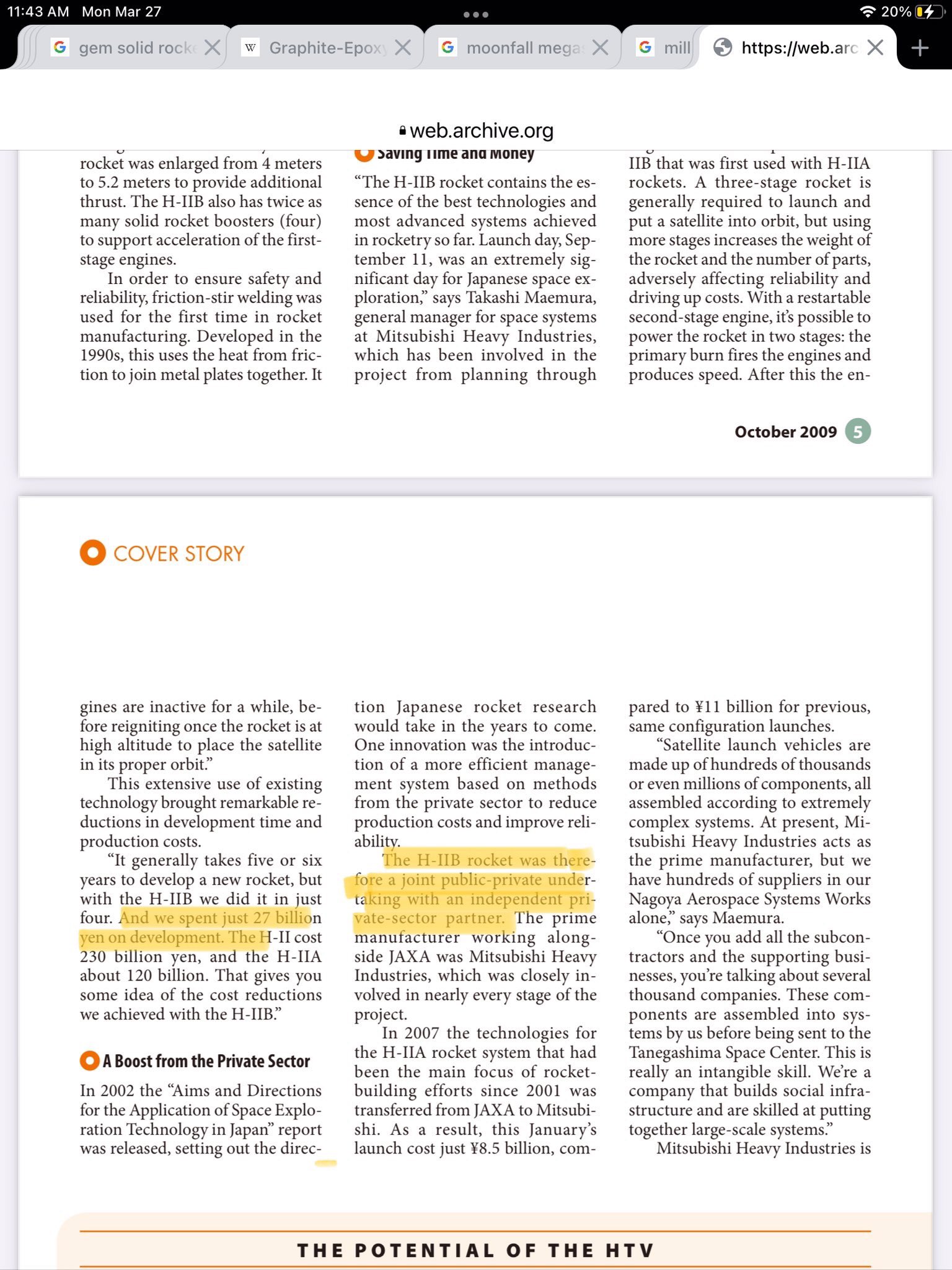
No! I was quite startled to find JAXA was able to add an additional hydrolox engine to the H-II first stage for only an approx. $200 million development cost.
See the highlighted passage in this article where the cost to add another engine to the H-II was only 27 billion Yen, about $200 million:
But that means instead of the multi-billion current development cost of the Ariane 6, the same could have been accomplished for just a few hundred million and would also have been reusable! I made this point here:
Thus the importance of asking that impertinent question of ArianeSpace, "How much to add an additional Vulcain to the Ariane 5/6?"
WHY Are the Far More Expensive SRB's Used Rather then the Cheaper Liquid-fueled Engines?
Knowledgeable ESA observers have been aware for awhile now that the ESA policies for distributing funds and costs to the differing member states do not result in the most cost effective vehicles. It’s a policy called geographical-return that requires member states costs to be apportioned by some set proportion of the billion dollar development costs. So if some member states have been contributing some large proportion of the costs through solid side boosters, that cost continues to be part of the development for new rockets or upgrades.
The governments of the member states regard this as a good thing because it helps to keep active, and paid, the space industries and space industry employees in their countries. But another key reason why some member states like the funds for the ESA to go to develop solid rocket side boosters is because those funds help also to develop solid rockets for their defense programs. So rather than those countries having to pay the entire cost of the solid rocket missiles in their defense programs on their own, some portion of that is actually paid for by the ESA in developing solid rocket side boosters for space launchers.
You can see why there is a great incentive for those member states, which have great influence on the direction and funding choices for the ESA, to continue to want to use solid rocket boosters in all launchers produced by the ESA.
This suggests, as a first order estimate, that we can take the cost of two SRB’s as €40M. But the cost of a single Vulcan is only €10 million! So the two SRB’s on the Ariane 6 base version costs 4 times more than an additional Vulcain! Therefore, again as a first order estimate, we can take the cost of a two Vulcain Ariane 6 with no SRB’s as only €45 million, ~$50 million. This compares quite favorably to current $67 million cost of the Falcon 9.
The reason why this isn’t done can not be attributed to some supposed multi-billion development cost to add an additional Vulcain to the Ariane core. Actually, it’s the current plan for the Ariane 6 with the newly developed solids, new upper stage, and new Vinci engine whose development cost is in the $4+ billion range. It’s really quite stunning to realize the same could have been accomplished at only a ~$200 development cost simply by adding another Vulcain to the Ariane 5 core, using the same original cryogenic upper stage. Nearly a factor of 20 times cheaper!
But nobody knows this because nobody asks that one simple question, “How much would it cost to add a second Vulcain to the Ariane 5/6?”
Now, once you have the all-liquid Ariane 6 that costs even cheaper than the Falcon 9, you can also keep up with SpaceX in reducing price by reusability by also reusing the core stage via powered landing a la the F9 booster. Again, the solids in the current Ariane 6 version would not save on reusing them as the Space Shuttle program abundantly showed. So that huge €40 million cost just for the SRB’s on the Ariane 6(more than the cost of the entire rest of the rocket!) out of the total €75 million would be fixed no matter how many times you wanted to reuse the core.
It might be argued that even a fully throttled down single Vulcain would have too much thrust for a hovering landing. Actually, this is the case also with the Falcon 9. It uses what SpaceX calls "hover-slam" for landing. The thrust is precisely timed so the booster just reaches 0 velocity as it touches down. Actually, I'm not a fan of "hover-slam". Much better for the Ariane case would be to use two Vinci engines for the landing only. It is designed to be air-startable and restartable. It weighs without the nozzle extension for vacuum use only 160 kg. So two would weigh only 320kg on the first stage. It's use would allow true hovering landing for the first stage.
Three Vulcains on the Ariane 5/6 Match the Falcon 9 in Payload at a Lower Price.
The two Vulcain Ariane 5/6 would have lower payload than the Falcon 9. But it would be quite competitive for the lucrative geosynchronous transfer orbit(GTO) used by many communications satellites, at ~6,000 kg to GTO at lower price than the F9. The F9 is at about 8,000 kg to GTO. But most satellites don't need this full capacity anyway.
However, if we used three Vulcains we could then match the Falcon 9 in payload and still be at lower price. This comes from again using the first order estimate of€40 million for the two SRB's. So the Ariane 6 with no SRB's would be €35 million, as a first order estimate. So adding on two Vulcains would be €55 million, as a first order estimate. But this is still less than the $67 million price for the Falcon 9.
In an upcoming blog post I'll discuss further the three Vulcain case showing it can match the Falcon 9 in payload. Intriguingly, by using multiple copies of such 3 Vulcain cores, I estimate 4 to 6, you can also get a 'superheavy' lift vehicle capable of 100-tons to LEO, a 'moon rocket'. Using multiple copies of already existing cores allows you to get the 'superheavy' lift at far less development cost than the $20 billion of the SLS, or the $10 billion of the ill-conceived Superheavy/Starship.
Manned Launchers.
Finally, in regards to manned launchers, just use the all-liquid Ariane 6 since you no longer have the safety issues of using SRB’s on manned launchers.
In the blog post "A smaller, faster version of the SpaceX Interplanetary Transport System to Mars", I suggested using just the upper stage of the ITS to get a booster for a Mars rocket, using an existing Ariane 5 core as an upper stage. This would be much cheaper and faster than the 7,000 metric ton, 42 engine booster that SpaceX was planning.
Elon Musk says SpaceX plans to have the smaller upper stage built by 2020. So we could possibly have a Mars transport system by then since the Ariane 5 as an upper stage already exists. However, by using triple cores of the ITS upper stage we could also get a system of the larger size SpaceX is proposing.
We'll input the data into Dr. John Schillings payload estimation program. In the calculator, select "No" for the "Restartable Upper Stage" option, rather than the default "Yes", otherwise the payload will be reduced. Select Cape Canaveral as the launch site, and input 28.5 degrees for the launch inclination to match the latitude of Cape Canaveral, otherwise the payload will be reduced.
We'll also use the 382 s Isp of the vacuum version of the Raptor. Altitude compensation allows even engines used on first stage boosters to have the same vacuum Isp as upper stages engines.
We'll use also crossfeed fueling. As I have argued before this is a well-known technique having been used for decades on jet airliners. To emulate crossfeed fueling with the Schilling calculator, enter in 2/3rds the actual propellant load in the field for the sideboosters, and enter in (1 + 2/3) times the actual propellant load in for the first stage propellant load.
So in the side boosters propellant field enter in (2/3) * 2,500,000 kg = 1,667,000 kg. And in the first stage propellant field enter in (1 + 2/3) * 2,500,000 = 4,167,000 kg.
For the thrust fields, enter in the vacuum thrust for 9 vacuum Raptors, since the calculator always takes as input the vacuum values, even for first stages and side boosters. The vacuum thrust for the 382 Isp vacuum Raptor is 3.5 meganewtons, 3,500 kN. So 9 would be 31,500 kN. Enter in also the vacuum Isp 382 s.
For the second stage, we'll increase the vacuum thrust of the Vulcain engine on the Ariane 5 to 1,450 kN in accordance with an increased vacuum Isp of 465 s, since we can get this higher vacuum Isp by just using a nozzle extension. For the dry mass input 12,000 kg and propellant 158,000 kg. Inputting these specs in the calculator results in:
Mission Performance:
Launch Vehicle:
User-Defined Launch Vehicle
Launch Site:
Cape Canaveral / KSC
Destination Orbit:
185 x 185 km, 28 deg
Estimated Payload:
504575 kg
95% Confidence Interval:
426107 - 597674 kg
"Payload" refers to complete payload system weight, including any necessary payload attachment fittings or multiple payload adapters
This is an estimate based on the best publicly-available engineering and performance data, and should not be used for detailed mission planning. Operational constraints may reduce performance or preclude this mission.
This is comparable to the payload mass of the expendable version of SpaceX's ITS. This would save greatly on development costs when not having to develop the larger booster. The launch cost would also be greatly reduced since judging by the Falcon Heavy, using triple cores only increased the price 50% over that of the single core rocket.


.JPG)
.JPG)