Showing posts with label Launch Performance Calculator. Show all posts

Tuesday, October 4, 2016

A smaller, faster version of the SpaceX Interplanetary Transport System to Mars, UPDATED, 10/15/2016.

Copyright 2016 Robert Clark


 In the blog post "A SpaceX Heavy Lift Methane Rocket, Page 2", I proposed some architectures for a Mars transport rocket. This was based on a quite large 1,800,000 lb. vacuum thrust of the methane-powered Raptor.

 However, recently Elon Musk discussed the current version of the SpaceX Mars transport model called the Interplanetary Transport System (ITS). Here they are going back to a smaller version of the Raptor, at ca. 660,000 lb. vacuum thrust. In this version however, their booster will be quite large at ca. 7,000 metric tons (mT) gross weight.

 Because of the reduced size of the Raptor this will require 42 engines on the booster. However, interestingly the size of the upper stage will be similar to the size of the booster I discussed in "A SpaceX Heavy Lift Methane Rocket, Page 2". So you could get a Mars launch booster by using this upper stage instead as a booster.


But because of the smaller engines in the SpaceX formulation they will use nine of the Raptors on the upper stage. I stated in the earlier blog post I wanted to use at most 5 of the larger Raptor engines to emulate the safety record of the 5 large engines on the Saturn V booster. However, SpaceX seems to have gotten the 9 engines on the Falcon 9 to work, and in any case you could just use the booster to send the cargo and habitats to space and use high safety rockets to launch the crew to meet up with the transport craft in space.

 The objection could be made however, that this is supposed to be just an upper stage, not a booster stage. However, at his IAC presentation of this Mars transport system he stated that the upper stage in both the spaceship and tanker form could be SSTO. Furthermore, the tanker he said could be used a fast intercontinental transport craft. This means necessarily they would have to be able to launch from the ground. So it is not too much of stretch to assume they could be used as a first stage.


An advantage of making this smaller upper stage the actual booster is that Elon has said they will have a development craft within 4 years. So if we make now a smaller upper stage to go with it, we could have a valid Mars transport craft at that early date. If we made this new upper stage correspondingly 1/3rd size, then we would be able to get 1/3rd the crew size to Mars, so a crew of ca. 35 to Mars.

 However, interestingly we might be able to use already existing upper stages on existing rockets for the upper stage, for instance possibly the famous Centaur upper stage used on the Atlas V or the Ariane 5 core itself used here as an upper stage.

 We can estimate how much we could get to LEO using the ITS tanker as the booster and the Ariane 5 core as the upper stage. The required delta-v to LEO is 30,000 ft/sec about 9,100 m/s:

Modern Engineering for Design of Liquid-Propellant Rocket Engines, p.12
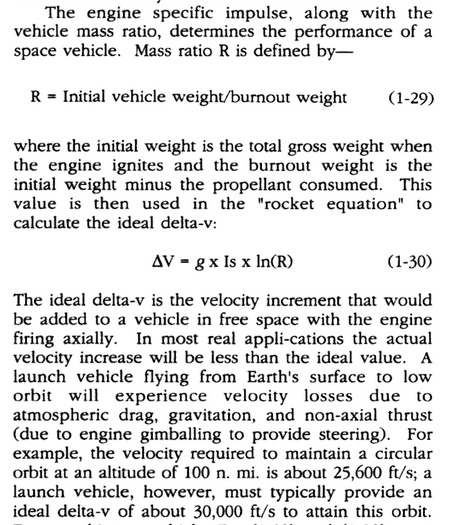
 Since we can get a high 465 s vacuum Isp for a hydrolox engine just by using a nozzle extension we'll assume that value for the Ariane 5 engine. Also we'll assume we can get a vacuum 382 s Isp for the ITS tanker by using altitude compensation.

 Then for the propellant and dry mass values for the ITS tanker and Ariane 5 core we could get 225 metric tons to LEO:

382*9.81ln(1 + 2500/(90 + 170 + 225)) + 465*9.81ln(1 + 158/(12 + 225)) = 9,140 m/s.

 This makes clear another key advantage of this architecture: whereas the original SpaceX ITS would require five flights of the ITS to refuel the upper stage spaceship, with this smaller version a single flight would be able to carry the spaceship to orbit as well as its fuel for its flight towards Mars.

 But what would be the crew size for this smaller upper stage? We can estimate it by making a comparison to the delta-v possible in accordance with the stats of the ITS spaceship:

382*9.81ln(1 + 1950/(150 + 450)) = 5,400 m/s.

 So we want the Ariane 5 case to be able to reach a delta-v of 5,400 m/s when fully refueled and firing in space headed towards Mars:

465*9.81ln(1 +158/(12 +55)) = 5,500 m/s.

 So this is a payload of about 55 metric tons. This is about 1/8th the mass for the ITS case, so we can estimate the crew size to be 1/8th also, so to a crew of 12.

  Elon in his IAC presentation says the ITS carrying its 100 member crew might be able to reach Mars in 80 days at a particular close Mars opposition. This is dependent on the departure delta-v however. In the blog post "Propellant depots for interplanetary flight". I noted that at a higher departure delta-v possible by using a smaller 6 metric ton habitat for only a crew of 3, the Ariane 5 used as the in space propulsion stage might be able to make it to Mars in only 35 days, when leaving at such a particularly close Mars opposition.


  Bob Clark

UPDATE, 10/15/2016:

 Dr. John Schilling's launch performance calculator is back up. This allows us to produce a more accurate payload estimate. The vacuum thrust for the 382 Isp Raptor is 3.5 meganewtons, 3,500 kN. So 9 would be 31,500 kN. We'll also increase the vacuum thrust of the Vulcain engine on the Ariane 5 to 1,450 kN in accordance with the increased vacuum Isp of 465 s. Inputting these and the other specs in the calculator results in:

Mission Performance:
Launch Vehicle:  User-Defined Launch Vehicle
Launch Site:  Cape Canaveral / KSC
Destination Orbit:  185 x 185 km, 28 deg
Estimated Payload:  177767 kg
95% Confidence Interval:  150063 - 210818 kg

"Payload" refers to complete payload system weight, including any necessary payload attachment fittings or multiple payload adapters

This is an estimate based on the best publicly-available engineering and performance data, and should not be used for detailed mission planning. Operational constraints may reduce performance or preclude this mission.


 So the calculator estimates 178 metric tons. This is less than the 225 metric ton estimate using just the rocket equation, but it still means a single flight could carry enough payload to fully refuel an Ariane 5 core upper stage for a flight to Mars.

  Bob Clark

Monday, January 11, 2016

Altitude Compensation Improves Payload for All Launchers.

Copyright 2016 Robert Clark

 It is unfortunate that SSTO's have been, incorrectly, deemed unviable. Since altitude compensation has only been thought of in terms of improving the payload of SSTO's, little research has gone into these methods, as SSTO's were not considered worthwhile.

  However, in point of fact altitude compensation improves the payload even for multistage rockets. In the blog post "The Coming SSTO's: Falcon 9 v1.1 first stage as SSTO, Page 2", I showed using the payload estimator by Dr. John Schilling altitude compensation improved the payload of the two-stage Falcon 9 by 25%. 

 Interestingly, the increase for the case of a rocket with side boosters can be as high as 40%. This is the case for the Delta IV Heavy. 

 According to this page the payload to LEO of the Delta IV Heavy is 25,980 kg:

Delta IV Heavy – RS-68A Upgrade.

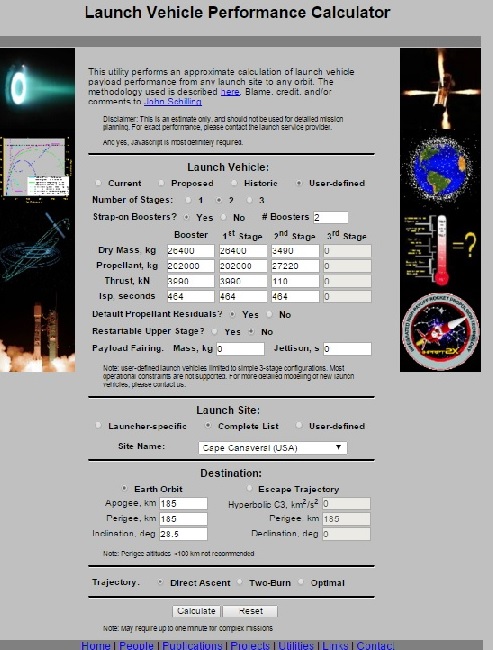
 Using the specifications from this page and inputting the vacuum values for the thrust and Isp, since the Schilling calculator requires inputting the vacuum values as it takes into account the diminution at sea level, the calculator appears as:


 And the results are:

Mission Performance:
Launch Vehicle:  User-Defined Launch Vehicle
Launch Site:  Cape Canaveral / KSC
Destination Orbit:  185 x 185 km, 28 deg
Estimated Payload:  23979 kg
95% Confidence Interval:  19412 - 29682 kg

"Payload" refers to complete payload system weight, including any necessary payload attachment fittings or multiple payload adapters

This is an estimate based on the best publicly-available engineering and performance data, and should not be used for detailed mission planning. Operational constraints may reduce performance or preclude this mission.


 A rather close approximation to the actual payload. 

 Now we'll consider the result when altitude compensating nozzles are used. First, note that there are numerous low cost methods of accomplishing altitude compensation. For instance the RL-10 engine increases its vacuum Isp to ca. 464 s simply by attaching a nozzle extension. Other low cost methods are discussed in "Altitude compensation attachments for standard rocket engines, and applications."

  Increasing the vacuum Isp to 464 s increases the thrust proportionally to (464/414)*3560 = 3,990 N. Then the inputs to the calculator now appear as:


 This gives the result:

Mission Performance:
Launch Vehicle:  User-Defined Launch Vehicle
Launch Site:  Cape Canaveral / KSC
Destination Orbit:  185 x 185 km, 28 deg
Estimated Payload:  33410 kg
95% Confidence Interval:  27137 - 41212 kg

"Payload" refers to complete payload system weight, including any necessary payload attachment fittings or multiple payload adapters

This is an estimate based on the best publicly-available engineering and performance data, and should not be used for detailed mission planning. Operational constraints may reduce performance or preclude this mission.


 About 40% higher than the case without altitude compensation. The reason why it should be expected the increase is higher than in the standard two-stage case is the center core stage in a triple-core launcher spends more of the time at high altitude where the vacuum Isp would obtain.

Altitude Compensation plus Cross-feed Fueling.
 This effect should be even more pronounced with cross-feed fueling. Cross-feed means the center core stage would have its full propellant load after the side boosters are jettisoned so it spends even more time at vacuum conditions.

 The Schilling calculator emulates cross-feed by inputting 2/3rds of the actual propellant load in the field for the side boosters, but increases the value input for the center core propellant to (1 +2/3) times the actual value (See discussion here for an explanation of how the calculator emulates cross-feed.)


 The results are:

Mission Performance:
Launch Vehicle:  User-Defined Launch Vehicle
Launch Site:  Cape Canaveral / KSC
Destination Orbit:  185 x 185 km, 28 deg
Estimated Payload:  48961 kg
95% Confidence Interval:  41112 - 58206 kg

"Payload" refers to complete payload system weight, including any necessary payload attachment fittings or multiple payload adapters

This is an estimate based on the best publicly-available engineering and performance data, and should not be used for detailed mission planning. Operational constraints may reduce performance or preclude this mission.


This is double the initial payload capability without cross-feed and altitude compensation. Note also Cross-feed fueling is not an unknown technology having been used on jet aircraft such as the Concorde for decades and also on the Space Shuttle's OMS engines.

And For the Falcon Heavy? 
 This payload for the upgraded Delta IV Heavy would rival the announced 53 metric tons(mT) LEO payload of the Falcon Heavy with cross-feed fueling and exceed that of the FH without it. But the increase in thrust of the Merlin 1D and increase of propellant load should increase the LEO payload of the Falcon 9 and Falcon Heavy. If the payload to geostationary for the F9 is increased by 30% as announced by SpaceX, then we expect the payload to LEO for the F9 and Falcon Heavy also to be increased a similar amount.  

 Then the current upgraded Falcon Heavy with cross-feed may now be in the 70 mT range. And if altitude compensation also gives this triple-cored launcher a 40% increase in payload that would bring it to the 100 mT range. This is important because this is the range estimated to be required for a manned lunar lander mission by a single launcher, and would be one in a cost range of only $120 million.

  Bob Clark

Thursday, August 13, 2015

Orbital rockets are now easy.

Copyright 2015 Robert Clark


Falcon 1 Upper Stage Based Orbital Launcher.
 In the blog post "On the lasting importance of the SpaceX accomplishment" I suggested that SpaceX's low cost, commercial approach to developing the Falcon 9 will lead to this being emulated by other launch providers and then, eventually, to spaceflight becoming routine. However, ironically, it might turn out their simplest development and one they dispensed with will have the fastest effect towards making orbital access routine.

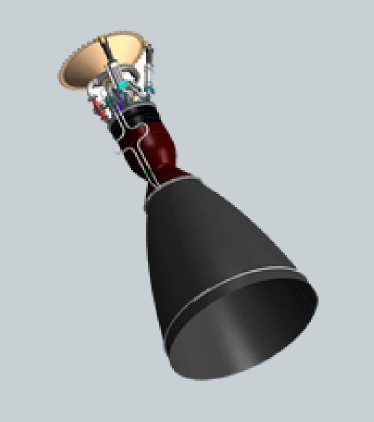
  It's the Falcon 1 upper stage. Compared to the first stage and certainly compared to the Falcon 9, it's a rather simple stage only using a pressure-fed engine, the Kestrel


Kestrel engine

  Pressure-fed engines and stages are much easier to develop than pump-fed ones. For instance there are the rockets developed by Armadillo AerospaceMasten Space Systems, and Garvey Spacecraft Corporation

 And this was also the case for the Project Morpheus lunar lander stage. In the blog post "The Morpheus lunar lander as a manned lander for the Moon", I discussed the NASA's Project Morpheus emulating a low-cost commercial space approach was able to develop two Morpheus landers for only $14 million. And actually the parts only costs were in the range of $750,000 per lander.

 The construction costs for pressure-fed engines can also be low cost. For instance Project Morpheus was able to produce their engines at a cost of only $60,000:

NASA dreams of future Morpheus project templates.
March 14, 2015 by Chris Bergin
The main engine – which was also tested at the Stennis Space Center – could throttle at a ratio of 4 to 1, ranging between 1,400 and 5,400 pounds thrust. All Morpheus engines were custom designed and built specifically for Morpheus and only cost $60,000 each.

 The specifications for the Falcon 1 upper stage are given here:

Falcon 1.

 It has a 360 kg dry mass and 3,385 kg propellant mass, and a 3,175 kilogram-force vacuum thrust and 327 s vacuum Isp using the Kestrel engine. This is an upper stage engine however with a long nozzle that can't be used at sea level. In the post "Altitude compensation attachments for standard rocket engines, and applications" I described various attachments to be made to existing engines to give them altitude compensation ability. 

 However, since pressure-fed engines are so comparatively low-cost they could be designed from the beginning to have aerospike nozzles. There is for instance the aerospike engine of Garvey Spacecraft. And Firefly Space Systems  will construct an aerospike nozzle by using numerous small engines arranged around a central spike.

 The question though is how much thrust could be developed with the Kestrels at sea level using altitude compensation. I'll estimate from the formula for Isp for a rocket engine:

The ideal exhaust velocity is given by

where k is the specific heat ratio, R* is the universal gas constant (8,314.4621 J/kmol-K in SI units, or 49,720 ft-lb/(slug-mol)-oR in U.S. units), Tc is the combustion temperature, Mis the average molecular weight of the exhaust gases, Pc is the combustion chamber pressure, and Pe is the pressure at the nozzle exit.
http://www.braeunig.us/space/propuls.htm#Isp


 The pressure factor at the end reduces the Isp at sea level. The specific heat ratio k is about 1.24 for kerolox. The Kestrel operates at a chamber pressure of 135 psi. Then the pressure factor is:
sqrt(1-(14.7/135)^(.24/1.24)) =  .591. So the Isp at sea level is 327*.591 = 193 s and the sea level thrust is .591*3,175 = 1,876 kilogram-force. 

 Note for this estimate to be valid you have to have altitude compensation so that the engine has optimal performance at sea level, i.e., you don't have the back-pressure loss that results from non-optimal expansion.

 Because of the 3,745 kg gross mass of the stage though, we need to reduce the propellant load to be loftable by the single Kestrel at the 1,876 kilogram-force sea level thrust. We'll reduce the propellant load by a factor of .45, so to .45*3,385 = 1,520 kg. We want also to maintain the relatively high mass ratio for the stage so we'll reduce the tank size. The tank mass is proportional to the propellant mass. Subtracting off the 52 kg mass of the Kestrel leaves us 308 kg in the stage dry mass. Multiplying this by .45 gives .45*308 = 138.6 kg. Adding on the 52 kg mass of the Kestrel gives a dry mass of 190 kg. 

 Other elements of a rocket stage such as the insulation, wiring, avionics do not scale linearly with propellant mass as does tank mass. However, since for pressure-fed stages the dry mass is so dominated by the tank mass this gives an approximate value of the stage mass when you scale down the stage size. 

 Moreover we can further reduce the dry mass by using composite propellant tanks. Microcosm, Inc. is making small-sized composite tanks that could be used for the purpose. NASA research has shown composite tanks can save 30% off the mass of aluminum-lithium tanks. Since Al-Li tanks save about 25% off the weight of standard aluminum tanks, this means composites can save about 50% off the weight of standard aluminum propellant tanks. 

 To estimate the mass this could save for this application, historically the propellant mass to tank mass ratio for kerolox for standard aluminum tanks is about 100 to 1. Note though this is for pump-fed engines that only need their stages at about 2 bar, about 30 psi. When the tank pressure is increased for pressure-fed engines the tank mass is correspondingly increased. The Falcon 1 upper stage tanks are kept at 200 psi pressure. So for our propellant mass of 1,520 kg, the tank mass assuming standard aluminum might be (1,520 kg/100)*(200 psi/30 psi) = 101 kg. Then a  reduction of 50% in the tank mass would cut 50 kg from the dry mass to bring it to 140 kg. However, we'll calculate here the payload using 190 kg dry mass number, as the dry mass here is approximate since some components of the stage won't actually scale proportionally with the stage size.

Cross-Feed Fueling for Multiple Cores.
 To increase payload we'll use cross-feed fueling. Note that cross-feed fueling is actually a well-understood technology, having been used on the Space Shuttle OMS engines:

Propellant Storage and Distribution.
"The propellant storage and distribution system consists of one fuel tank and one oxidizer tank in each pod. It also contains propellant feed lines, interconnect lines, isolation valves and crossfeed valves.
"The OMS propellant tanks of both pods enable the orbiter to reach a 1,000-foot- per-second velocity change with a 65,000-pound payload in the payload bay. An OMS pod crossfeed line allows the propellants in the pods to be used to operate either OMS engine."

 And it has also been used for decades for jet airliners:

Concorde.
Balancing by Fuel-Pumping.
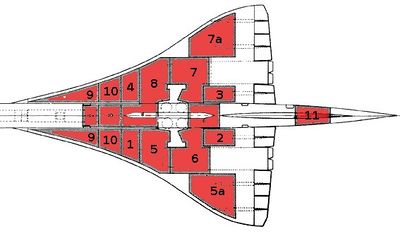
The Concorde Tank-Schematic:

"1 + 2 + 3 + 4 are the Collector-Tanks, feeding the engines directly. Usually they feed there counterpart engines – but they can be cross-switched to feed more and/or other engines at the same time.
5 + 7 and 8 + 6 are the Main-Transfer Tanks, feeding the 4 Collector-Tanks. Initially 5 + 7 are active. If those are empty 6 + 8 take over (or must be activated from the Engineering Panel!).
5a + 7a are Auxiliary-Tanks (to 5 and 7).
9 + 10 are the Trim-Tanks for balancing forward
11 is the Trim-Tank for balancing afterward"

 To emulate rocket cross-feed fueling with the Schilling Launch Performance Calculator, note that during the parallel burn portion of the flight the propellant for the center core engines is coming from the side booster stage(s). This ensures that the center core will have a full propellant load during its solo burn portion of the flight, after the side booster(s) are jettisoned. 

 So the total amount of propellant burned during the parallel burn portion is that of the side booster(s) only. But the Schilling Calculator assumes the amount of propellant burned in the center core during the parallel burn is the same as the amount burned in each side booster. So enter in the Calculator for the booster propellant load a fraction of the actual propellant load of a core equal to the number of side boosters divided by the number of cores. So if you're using 2 cores with one used as a side booster enter in the Calculator booster column 1/2 the amount of the actual core propellant load. And if using 3 cores with 2 used as side boosters, enter in 2/3rds the actual core propellant load in the booster section. This will ensure the Calculator interprets the total propellant burned during the parallel burn portion is that of the actual side booster(s) only.

 But you also want the Calculator to take the amount of propellant burned during the center core's solo burn portion of the flight as that of a full propellant load. Since it is already taking it to have burned the same amount as what the side boosters have burned during the parallel burn portion, add this amount onto the actual propellant load of a core and enter this into a first stage column of the Calculator. For the other specifications for both booster(s) and center core such as Isp, dry mass, and thrust enter in the actual values.

 We'll calculate here the case for using two side booster of same size as the central core. Enter in the Schilling calculator the dry mass of 190 kg for the boosters and the first stage, which is the central core. For the thrust and Isp for the boosters and the first stage, enter in the vacuum Isp of 327 s and vacuum thrust of 31.1 kN in the calculator. However, to emulate cross-field fueling, for the propellant fields enter in (2/3)*1,520 kg = 1,013 kg in the booster section and 1,013 kg + 1,520 kg = 2,533 kg in the first stage section. Choose Cape Canaveral as the launch site and 28.5 degrees as the launch inclination to match the latitude for the launch site. For the "Restartable Upper Stage" select "No", otherwise the payload will be reduced. Then the calculator gives the result:

Mission Performance:
Launch Vehicle:  User-Defined Launch Vehicle
Launch Site:  Cape Canaveral / KSC
Destination Orbit:  185 x 185 km, 28 deg
Estimated Payload:  63 kg
95% Confidence Interval:  19 - 116 kg

"Payload" refers to complete payload system weight, including any necessary payload attachment fittings or multiple payload adapters
This is an estimate based on the best publicly-available engineering and performance data, and should not be used for detailed mission planning. Operational constraints may reduce performance or preclude this mission.


 We could get over 100 kg if we used three side cores. 

Methane for Improved Performance.
 We could also increase the payload using methane instead of kerosene as the fuel. For booster stages, methane has about the same performance as kerosene since the greater density for kerosene makes up for its lower Isp. But for upper stages methane offers better performance since it would give a lighter stage that had to be lofted by the lower stages. So if you wanted to use identical stages for simplicity and cost, methane would be the preferred fuel.

 There is also a key practical reason why methane might be preferred. NASA has developed the methane-fueled engine for the Morpheus rocket stage. With NASA's Technology Transfer program the technical info on the engine would also be shared at least for American companies. Then you would only have to pay the ca. $60,000 construction costs for the engine. 

 Considering that both the Kestrel and Morpheus engines are reusable this already low cost launcher can cut the cost to space considerably. It then could be used for DARPA's proposed reusable launchers discussed here: "NASA Technology Transfer for suborbital and air-launched orbital launchers." In an upcoming blog post I'll also show that using a single one of these cores, it can be used as either the reusable first stage booster, or the air-launched orbital stage for these DARPA programs.

Scale-up to Large Launchers. 
 Note this is a 5,130 gross mass launcher to launch a 63 kg payload. Pressure-fed stages scale up more easily than pump-fed ones since you don't have the complexity of creating a turbopump for the larger size engines. The Mercury spacecraft that carried John Glenn massed 1,300 kg. Using modern materials we could probably make a one-man capsule for 500 kg. Then we would only have to scale up our 3 core launcher by a factor of 8 to launch a one-man capsule to orbit. This would be a 41,000 kg gross mass launcher compared to the 120,000 kg gross mass Atlas rocket that launched John Glenn to space.

  Bob Clark


Sunday, December 28, 2014

A liquid-fueled Indian manned launcher. UPDATED.

Copyright 2014 Robert Clark


 India is progressing towards manned spaceflight:

India debuts GSLV Mk.III with prototype crew capsule.
December 17, 2014 by William Graham


 The current plan is for a 2021 launch for the manned system. However, the most recently developed rocket the GSLV Mk. III uses two large solid side boosters. Space engineers in general do not like solid rockets for manned launchers since they can not be shut down. However, there is an all liquid alternative for India for a manned launcher that actually would be cheaper than the GSLV Mk. III.

 It would use 4 of the liquid-fueled strap on boosters used on the earlier design the GSLV Mk. II attached to the GSLV Mk. III core stage. We'll use the specifications on the GSLV Mk. II and GSLV Mk. III on Ed Kyle's SpaceLaunchReport.com page. The strap-ons for the GSLV Mk. II have a gross mass of 48.2 metric tons (mT) and propellant mass of 42.6 mT so a dry mass of 5.6 mT. The vacuum thrust of the single Vikas 2 engine is 70,360 kgf, 690 kN, with a vacuum Isp of  281 s. 

 The gross mass of the GSLV Mk. III is 125 mT with a propellant load of 110 mT, so a dry mass of 15 mT. The vacuum thrust of the two Vikas 2 used is 140,720 kgf, 1380 kN. The cryogenic upper stage has a gross mass of 30 mT, with a propellant load of 25 mT, so a dry mass of 5 mT. It's engine CE-20 engine has a thrust of 20,000 kgf, 196 kN, with an Isp of 450 s.
  
 Input this data into Dr. John Schilling's Launch Performance Calculator. Select the Satish Dhawan launch site and a launch inclination of 13.9 degrees to match the latitude of the launch site. Then the calculator gives a payload to LEO of:

Mission Performance:
Launch Vehicle:  User-Defined Launch Vehicle
Launch Site:  Satish Dhawan Space Center
Destination Orbit:  185 x 185 km, 14 deg
Estimated Payload:  6493 kg
95% Confidence Interval:  4829 - 8498 kg

"Payload" refers to complete payload system weight, including any necessary payload attachment fittings or multiple payload adapters
This is an estimate based on the best publicly-available engineering and performance data, and should not be used for detailed mission planning. Operational constraints may reduce performance or preclude this mission.


 About 6,500 kg. It is notable though reading the description of the failed launches of the GSLV on the SpaceLaunchReport.com page that some involved engine failures. There would need to be multiple successful unmanned launches of this configuration before it is certified for manned launches.


  Bob Clark

UPDATE, January 15, 2015:

 I found that the www.spaceflight101.com site provides more accurate info on the GSLV Mk. II and GSLV Mk. III launchers than the Spacelaunchreport.com page. Using these values gives an even better performance for this proposed all-liquid launcher.

 The GSLV Mk. II side boosters have specifications listed as:

                                 Boosters

# Boosters4
TypeLH40
Length19.7m
Diameter2.1m
Inert Mass~5,600kg
Launch Mass47,600kg
Tank MaterialAluminium Alloy
FuelUH25 - 75% UMDH, 25% Diazane
OxidizerNitrogen Tetroxide
Propulsion1 Vikas 2
Thrust763kN
Impulse293 sec
Engine Dry Weight900kg
Engine Length2.87m
Engine Diameter0.99m
Burn Time148sec
Chamber Pressure58.5bar
Mixture Ratio1.7 (Ox/Fuel)
Attitude ControlSingle-Plane Engine Gimbaling
Stage SeparationWith Core Stage

 The GSLV Mk. III core stage has specifications listed as:

Core Stage

TypeL-110
Length21.26m
Diameter4.0m
FuelUnsymmetrical Dimethylhydrazine
OxidizerNitrogen Tetroxide
Inert Mass10,600kg
Propellant Mass115,000kg
Launch Mass125,600kg
Propellant TanksAluminum Alloy
FuelUH25 - 75% UDMH, 25% Diazane
OxidizerNitrogen Tetroxide
Propulsion2 Vikas 2
Thrust (SL)677kN
Thrust (Vac)766kN
Specific Impulse293 sec
Engine Dry Weight900kg
Engine Length2.87m
Engine Diameter0.99m
Chamber Pressure58.5bar
Mixture Ratio1.7 (Ox/Fuel)
Turbopump Speed10,000rpm
Flow Rate275kg/s
Area Ratio13.88
Attitude ControlEngine Gimbaling
IgnitionT+110s
Burn Time200s
Stage SeparationActive/Passive Collets

 The cryogenic upper stage has specifications listed as:


Cryogenic Upper Stage

TypeC-25 Cryogenic Upper Stage
Length13.32m
Diameter4.0m
FuelLiquid Hydrogen
OxidizerLiquid Oxygen
Inert Mass~4,000kg
Propellant Mass25,000kg
Launch Mass~29,000kg
Propellant TanksAluminum Alloy
PropulsionCE-20
Engine TypeGas Generator
Thrust - Vacuum200kN
Operational Range180-220kN
Specific Impulse Vac443s
Engine Mass588kg
Chamber Pressure60bar
Mixture Ratio5.05
Area Ratio100
Thrust to Weight34.7
Burn Time580s
GuidanceInertial Platform, Closed Loop
Attitude Control2 Vernier Engines
Restart CapabilityRCS for Coast Phase

  Plugging these dry mass, propellant mass, and Isp values into the Schilling calculator gives these results:

Mission Performance:
Launch Vehicle:  User-Defined Launch Vehicle
Launch Site:  Satish Dhawan Space Center
Destination Orbit:  185 x 185 km, 14 deg
Estimated Payload:  9005 kg
95% Confidence Interval:  7106 - 11299 kg

"Payload" refers to complete payload system weight, including any necessary payload attachment fittings or multiple payload adapters

This is an estimate based on the best publicly-available engineering and performance data, and should not be used for detailed mission planning. Operational constraints may reduce performance or preclude this mission.


 A payload of 9,000 kg is quite high. It's close to the 10,000 kg payload of the GSLV Mk. III without needing the two huge, expensive solid side boosters the Mk. III uses. Note also this all-liquid configuration with 4 liquid side boosters is similar to that of the venerable Soyuz launcher used for decades for manned launches.

 To get a faster operational manned rocket we might use the smaller cryogenic upper stage already used on the GSLV Mk. II. On the December 2014 test flight of the GSLV Mk. III, its cryogenic stage was still in development and was not part of the test. So to use all operational stages instead we could use the Mk. II's cryogenic stage. It's specifications are listed as:

                                  Third Stage

TypeGS3 - C15
Inert Mass~2,500kg
Launch Mass~15,300kg
Length8.7m
Diameter2.8m
Tank MaterialAluminium Alloy
FuelLiquid Hydrogen
OxidizerLiquid Oxygen
Propellant Mass12,800kg
GuidanceInertial Platform, Closed-Loop
Propulsion1 ICE (CE-7.5)
CycleStaged Combustion
Thrust (Vacuum)73.5 to 93.1kN
Impulse454sec
Engine Dry Weight435kg
Engine Length2.14m
Engine Diameter1.56m
Burn TimeUp to 1,000sec
Chamber Pressure58bar
Attitude Control2 vernier Jets, each 2kN
RCS for Coast Phases
Stage SeparationMerman Band, Hot Staging

   Inputting these specifications instead into the Schilling calculator gives:

Mission Performance:
Launch Vehicle:  User-Defined Launch Vehicle
Launch Site:  Satish Dhawan Space Center
Destination Orbit:  185 x 185 km, 14 deg
Estimated Payload:  6810 kg
95% Confidence Interval:  5373 - 8577 kg

"Payload" refers to complete payload system weight, including any necessary payload attachment fittings or multiple payload adapters

This is an estimate based on the best publicly-available engineering and performance data, and should not be used for detailed mission planning. Operational constraints may reduce performance or preclude this mission.


  The 6,800 kg payload is still high, sufficient for a manned launcher.

   Bob Clark
 

Could Blue Origin develop a lander for Artemis III?

Copyright 2025 Robert Clark SpaceX is coming under increasing criticism for its delay in developing the Starship lunar lander: U.S. Is Losin...