Showing posts with label Delta IV Heavy. Show all posts

Monday, June 21, 2021

SSME based SSTO’s. UPDATED, 6/28/2021 - Extension to the Delta IV Heavy

 Copyright 2021 Robert Clark


 The SSME makes possible *practical* SSTO’s, that is, with significant payloads. Need to use known lightweight materials, such as carbon fiber. As discussed in the blog post,


DARPA's Spaceplane: an X-33 version, Page 2

https://exoscientist.blogspot.com/2018/06/darpas-spaceplane-x-33-version-page-2.html , 


some ultra high strength metals would also work:


 The standard aluminum the Delta IV used for its propellant tanks had about a 25 to 1 propellant to tank mass ratio. At 200 ton propellant mass, this gives a tank mass of 8 tons. So using light weight materials we can get this down to 4 tons.


 To estimate payload possible we need the required delta-v to low Earth orbit(LEO). Various estimates are given for this depending on altitude and orbital inclination. I’ll use the estimate give in this report of 9,000 m/s:


Towards Reusable Launchers - A Widening Perspective.

https://www.esa.int/esapub/bulletin/bullet87/pfeffe87.htm


 The Delta IV launch vehicle used the low cost, RS-68, an engine designed for low cost, but only at mid level performance. But for an SSTO you need both high performance engines and weight optimized structures. So we’ll replace the RS-68 with two SSME’s. The two SSME’s will have about the same mass as the RS-68 with slightly more thrust. But most importantly they have a much better vacuum Isp at 452.3 s compared to 412 s.


 The dry mass of the Delta IV first stage is about 26 tons. By light weighting the tank, we cut 4 tons from the tank mass to bring the dry mass to 22 tons. Then we can get a payload of 8 tons to orbit. By the rocket equation:


452.3*9.81ln(1 + 200/(22 + 8.2)) = 9,012 m/s.


 The Delta-IV TSTO, with no side boosters, has about the same payload to LEO using a Centaur upper stage:


https://en.m.wikipedia.org/wiki/Delta_IV#RS-68A_booster_engine_upgrade


The higher Isp of the SSME’s explains why the SSTO can match the performance of the TSTO to LEO.


 It is true that most launches now are for satellites actually to go to GEO, geosynchronous orbit. For this you can use the current Centaur upper stage. But firstly the use of the Centaur would allow higher payload to LEO than the current TSTO. The Centaur has about a 21 ton propellant load and 2 ton dry mass for a 23 ton gross mass with an Isp of 462 s. Then the TSTO could now get 21 tons to LEO:

452.3*9.81ln(1 + 200/(22 + 23 + 21.5)) + 462*9.81ln(1 + 21/(2 + 21.5)) = 9,050 m/s. 


 This is well above the 8 tons or so of the current TSTO version and is close to the payload of the Falcon 9 full thrust version.


 This TSTO does get more than the SSTO, but in point of fact you don’t need the maximal payload for most launches, so why use the upper stage if it is unneeded? 


 The additional delta-v required to GEO is about 3,800 m/s. Then a total of 12,800 m/s would be required to get the payload to GEO. This TSTO version could get 6 tons to GEO:


452.3*9.81ln(1 + 200/(22 + 23 + 6)) + 462*9.81ln(1 + 21/(2 + 6)) = 12,900 m/s. 


 This is multiple times higher than the current version:


http://spacelaunchreport.com/delta4.html#config


However, the SSME’s are expensive engines. To get the full usefulness of an SSTO you really need reusability. In point of fact by using lightweight thermal protection and landing legs, and lightweight wings or propellant storage for final approach, the additional mass for reusability can be less than 10% of the landed mass. So the SSTO would still get significant mass to LEO.


 Reusables do get their most usefulness at high launch rates. Then to serve various markets we would also want a smaller vehicle than this SSTO. We could get this by cutting down the tank size and using a single SSME: 


 We’ll cut down the propellant size to 150 tons, 3/4ths the usual size, and again we’ll use light-weighting on the tank of the Delta IV first stage. Subtracting off the 8 tons for the standard tank the dry mass is 18 tons. The tank mass at 3/4ths size would be 6 tons. But we’re lightweighting it so it’ll be 3 tons. That brings the dry mass to 21 tons.


 But the SSME at 3.2 tons is also a lighter engine than the RS-68, at 6.6 tons. So we’ll subtract off an additional 3.4 tons from the dry mass to bring it to 17.6 tons. There will be additional reductions in the dry mass due to smaller thrust structure for the lower thrust of the single SSME, and smaller insulation and wiring for the smaller vehicle, but not as large as the other reductions. 

 So for the first estimate take the dry mass as 17.6 tons. Then we can get 5 tons to LEO with this smaller SSTO:


452.3*9.81ln(1 + 150/(17.6 + 5)) = 9,020 m/s.


 Since less than 10% would be needed for reusability we can still get ca. 3 tons to LEO as a reusable SSTO.


   Robert Clark


UPDATED, 6/28/2021.

 The advantage of using high performance engines and lightweight tanks is not just for getting a SSTO. As mentioned above using this, the two-stage-to-orbit(TSTO) Delta IV can double its LEO payload to ca. 20 tons to match that of the Falcon 9 Full Thrust. Its payload capacity to the lucrative GEO satellite market would also match that of the Falcon 9 FT.


 ULA could then be competitive with SpaceX for the largest current market for commercial launches. Note that ULA could also match SpaceX in it's partially reusable approach of returning only the first stage. ULA head Tory Bruno has said the SpaceX approach of boosting back the first stage to the launch site requires too much fuel, and loses too much payload.


 Instead what ULA has proposed doing is returning the engine package only, catching it in midair on return by parachute. The rest of the first stage would be thrown away. This is a kludge, an inelegant solution just to get by. A kludge never provides a long lasting solution. The Space Shuttle was a kludge, which explains why it never reached its goal of fast and low cost reusability. However, by increasing the Delta IV's payload capacity in the described manner, ULA can also boost back to the launch site and match SpaceX in reusable payload capacity.


 The startling increase in payload would also apply to the Delta IV Heavy, with the addition of cross-feed fueling. This is where for a parallel staged vehicle the fuel for the central core is taking from the side boosters during the parallel burn portion of the flight. This allows the central core to be fully fueled when the side boosters are jettisoned.


55th International Astronautical Congress 2004 - Vancouver, Canada 

1 IAC-04-V.4.03 

DELTA IV LAUNCH VEHICLE GROWTH OPTIONS TO SUPPORT NASA’S SPACE EXPLORATION VISION

https://www.ulalaunch.com/docs/default-source/evolution/delta-iv-launch-vehicle-growth-options-to-support-nasas-space-exploration-vision.pdf

 We'll use the rocket equation to again estimate the payload possible for the Delta IV Heavy. Because of how cross-feed fueling works, the calculation works as if the it were a three stage vehicle with the fuel only being from the side-boosters during the "first stage":

452.3*9.81ln(1 + 400/(44 + 220 + 23 + 68)) + 452.3*9.81ln(1 + 200/(22 + 23 + 68)) +462*9.81ln(1 + 21/(2 + 68)) = 9,060 m/s.

 This payload of 68 tons nearly triples the payload of the current version of the Delta IV Heavy, and now matches the payload of the Falcon Heavy.


 This is still using the expensive SSME's however. But the point of the matter is this is doable for the current engine RS-68 used on the Delta IV as well if given altitude compensating nozzles.


 There are various means of adding altitude compensating nozzles to existing engines. They could be like the RL-10B with extendible nozzles, or flexible, expandable nozzles, or mechanically moving "petal" arrangements as with variable area nozzles on jet engines, or several other ways. 


 This last is interesting in that this method of achieving variable area nozzles has been in existence since the 70's. As a total WAG it might improve the performance for jets by, say, 10%. But for rockets using variable nozzles could improve performance by 100% or more and it still has not been used for rockets. 


 In such a way, a midlevel performance engine such as the RS-68 could be upgraded to achieve comparable performance of the high performance SSME's. I won't offer a calculation here using the rocket equation for this case. The reason is while such estimates frequently take the vacuum Isp for a fixed nozzle engine, this may or not be accurate for the case of an altitude compensating nozzle. On the one hand you can give the RS-68 a higher vacuum Isp than SSME, even at 470+ s, but the higher chamber pressure of the SSME, suggests it should have better performance at ground level than the RS-68 given alt.comp.  


 The calculation of the delta-v possible through altitude compensation is one that should be made by the launch companies.


Regular Manned Lunar Flights.

 The use of the higher performance engines gives us the capability of SSTO's with the Delta IV and also heavy lift with the Delta IV Heavy, with payload comparable to the first planned version of the SLS at ca. 70 tons. With this we have the possibility of routine manned flights to the Moon and beyond. Robert Zubrin has written a proposal for a low cost architecture for setting up a Moon base with regular flights to the Moon. Remarkable all it would need beyond the current capability is a reusable lunar lander.

 In the Zubrin proposal it would take only 3 flights of the Falcon Heavy and one flight of a manned Falcon 9 to set up the manned lunar base:


Op-ed | Moon Direct: How to build a moonbase in four years.

by Robert Zubrin — March 30, 2018

https://spacenews.com/op-ed-moon-direct-how-to-build-a-moonbase-in-four-years/


 But with the extra capabilities of the Delta IV Heavy, the three Falcon Heavy launches could be replaced by three launches of the Delta IV Heavy.


 Recall I said Zubrins plan only needed a lunar lander. ULA is planning the upper stage of its upcoming Vulcan lander, the Centaur V, to have in-space reusability. Then this upper stage could also be used as a reusable lunar lander. See discussion here:


Robust Lunar Exploration Using an Efficient Lunar

Lander Derived from Existing Upper Stages

AIAA 2009-6566

Bernard F. Kutter et al.

https://www.ulalaunch.com/docs/default-source/exploration/dual-thrust-axis-lander-(dtal)-2009.pdf


 In regards to adapting the Centaur V or a currently in use Centaur to a horizontal landing lunar lander, I advise the landing rockets be just pressure-fed thrusters fueled from the regular tanks of the hydrolox tanks of the Centaur.


Thursday, June 13, 2019

Reentry of orbital stages without thermal protection? UPDATE: 7/1/2019

Copyright 2019 Robert Clark


   In this tweet I speculated on the possibility that the SpaceX's BFR upper stage, or BFS for Starship, when given wings might need no thermal protection at all:

______________________________________________________________________
_______________________________________________________________________
https://twitter.com/RGregoryClark/status/1117752403946889216

 The idea behind it was an article that suggested with sufficiently low wing loading, weight per wing area, an orbital stage might need no thermal protection at all on reentry:

Wings in space.
by James C. McLane III
Monday, July 11, 2011
Wing loading (the vehicle’s weight divided by its wing surface area) is a prime parameter affecting flight. The antique aluminum Douglas DC-3 airliner had a big wing with a low loading of about 25 psf (pounds per square foot of wing surface). At the other end of the spectrum, the Space Shuttle orbiter has a high wing loading of about 120 psf. This loading, combined with an inefficient delta-shaped wing, makes the orbiter glide like a brick. A little Cessna 152 private plane features a wing loading of about 11 psf and modern gliders operate down around 7 psf. A space plane with huge lifting surfaces and a very low wing loading might not require any external thermal insulation at all. Building a space plane with a wing loading of, say, 10 psf should not be an impossible proposition. Perhaps some day it will be done.

 The stage intended as the Mars colony ship with the passenger quarters and provisions for 100 colonists on a 6 month trip to Mars, the BFS, gave a pounds per square foot at above twice the 10 psf level:

 According to Wiki it has a dry mass of 85 tons, with a diameter of 9 m and length of 55 m. The lateral surface area of a cylinder is the circumference times the height (by imagining it sliced down the middle and flattened out.) The circumference is Pi times the diameter. However, the surface presented to the area stream when reentering broadside would be half the full area. So this area would be 0.5*Pi*9*55 = 777.5 sq.m. = 8,365.1 sq.ft. 

 The mass of 85,000 kg is 187,000 pounds, giving a pounds per square foot of 187,000/8,365.1 = 22.4 psf.

 Elon Musk may or may not have been raising the possibility (it's not always clear when Elon is being serious) of giving the BFS wings to get it below the 10 psf value with this tweet:

https://twitter.com/elonmusk/status/1117581094415503360

 However, the tanker version, with no passenger quarters and just an empty fairing, might only weigh ca. 50 tons, based on a comparison of its size to the earlier, larger Interplanetary Transport System. This is a weight in pounds of 110,000 lbs. Using the same size for the tanker, the area presented to the air stream would still be 8,365.1 sq.ft, and the pounds per square foot would be 110,000/8,365.1 = 13.1 psf.

  This might be workable to only need a small additional wing area to get it beneath the 10 psf. number.

 However, it is interesting that some existing upper stages are below or close to the 10 psf number. For instance the Delta IV Medium upper stage:

TypeDelta Cryogenic Second Stage
Diameter4m
Length12.2m
Inert Mass2,850kg
PropellantLiquid Hydrogen
OxidizerLiquid Oxygen
Fuel&Oxidizer Mass21,320kg
GuidanceInertial
Propulsion1 RL-10B-2
Thrust110kN
Engine Length4.14m
Engine Diameter2.13m
Engine Dry Weight277kg
Specific Impulse465.5sec
Nozzle Ratio250:1
Nozzle ExtensionYes
Burn TimeUp to 850sec
Engine StartRestartable
......

 Converting the weight to pounds and the lenghts to feet, the psf is:

2.2*2,850/(.5*Pi*4*12.2*3.28^2) = 7.6 psf, less than the 10 psf requirement.

 The larger upper stage used on the Delta IV Heavy would also satisfy the 10 psf requirement:

TypeDelta Cryogenic Upper Stage
Diameter5m
Length13.7m
Inert Mass3,490kg
PropellantLiquid Hydrogen
OxidizerLiquid Oxygen
Fuel&Oxidizer Mass27,220kg
Tank StructureAl-Isogrid, Separate Bulkheads
LOX Tank Length4.0m
LH2 Tank Length4.8m
Tank PressurizationGasified Propellants
GuidanceInertial from RIFCA
Propulsion1 RL-10B-2
Thrust110kN
Engine Length4.14m
Engine Diameter2.21m
Engine Dry Weight277kg
Specific Impulse464sec
Nozzle Ratio250:1
Nozzle ExtensionYes
Ox. To Fuel Ratio5.88:1
LOX Flowrate20.6kg/sec
LH2 Flowrate3.5kg/sec
Burn TimeVariable (1,125sec)
Engine StartSpark Igniter, Restartable
......

  The psf is:

2.2*3,490/(.5*Pi*5*13.7*3.28^2) = 6.6 psf. 

 The Atlas V's Centaur upper stage also satisfies the 10 psf requirement:

TypeCentaur
Diameter3.05m
Length12.68m
Inert Mass2,243kg
PropellantLiquid Hydrogen
OxidizerLiquid Oxygen
Fuel&Oxidizer Mass20,830kg
GuidanceInertial
Propulsion1 RL 10A-4-2 (until 2014)
Thrust99.2kN
Isp Vac451s
Engine Length2.29m
Engine Diameter1.53m
Engine Dry Weight167kg
Chamber Pressure39bar
Thrust to Weight61
Area Ratio84
Mixture Ratio5.5:1
Propulsion1 RL-10C-1 (Starting in 2014)
Thrust101.8kN
Isp Vac449.7s
Engine Length2.18m
Engine Diameter1.45m
Engine Dry Weight190kg
Chamber Pressure24bar
Thrust to Weight57
Area Ratio130
Mixture Ratio5.5:1
Burn TimeVariable
Engine StartRestartable
......

The psf is then:

2.2*2,243/(0.5*Pi*3.05*12.68*3.28^2) = 7.55 psf.

 Note that the RL10 engine used on the Delta IV Medium, Delta IV Heavy, and Atlas V is both restartable and highly throttleable to be used for a vertical, propulsive landing:


In fact the degree of throttleability is such that it can do a hovering landing. 

 This is important for propellant saving on landing. SpaceX does a hoverslam approach to vertical landing because of the low degree of throttleability of the Merlin engines. This wastes a significant amount of fuel because the thrust has to be so much larger than the nearly empty weight of the stage.

 In fact for powered landing of a stage the required fuel reserve mass is commonly taken to be only in the range of 10% of the landed, i.e., dry mass of the stage. See for example the discussion here:


 It's because even without wings a stage reentering broadside would burn off almost all the orbital velocity by atmospheric drag alone. The result is the stage would only be at terminal velocity at 100 m/s as it approached landing which would have to be cancelled by out by the engines. With deep throttling the required thrust, and so propellant burned, would be much reduced so as to only cancel the nearly dry weight of the stage. 

 The Falcon 9 also nearly reaches the 10 psf number:

TypeFalcon 9 FT Stage 2
Length12.6m (Separated Length)
Diameter3.66 m
Inert Mass4,000 kg (est.)
Propellant Mass107,500 kg (est.)
FuelRocket Propellant 1
OxidizerLiquid Oxygen
LOX Mass75,200 kg (est.)
RP-1 Mass32,300 kg (est.)
LOX TankMonocoque
RP-1 TankMonocoque
MaterialAluminum-Lithium
GuidanceInertial
Tank PressurizationHeated Helium
Propulsion1 x Merlin 1D Vac
Engine TypeGas Generator
Propellant FeedTurbopump
Thrust934kN
Engine Dry Weight~490kg
Burn Time397 s
Specific Impulse348s
Chamber Pressure>9.7MPa (M1D Standard)
Expansion Ratio165
Throttle CapabilityYes
Restart CapabilityYes
IgnitionTEA-TEB, Redundant
Pitch, Yaw ControlGimbaled Engine
,,,...


 The psf is:

2.2*4,000/(0.5*Pi*3.66*12.6*3.28^2) = 11.3 psf.

 Then so small wings or fins could be used to bring it under the 10 psf range. However, a bigger problem is the vacuum Merlin engine does not have high throttleability and being vacuum optimized, it can not operate at sea level for the landing. In upcoming posts I'll discuss methods to solve these problems.

 Actually, small movable fins might be needed in any case, for the other cases as well. This is because upper stages tumble and break-up when they reenter. They would have to be actively controlled to maintain the same attitude presenting their lateral side to the airstream to burn off the orbital velocity and to reduce stresses that would cause them to break up.

 The planned movable fins on the BFS might be used:


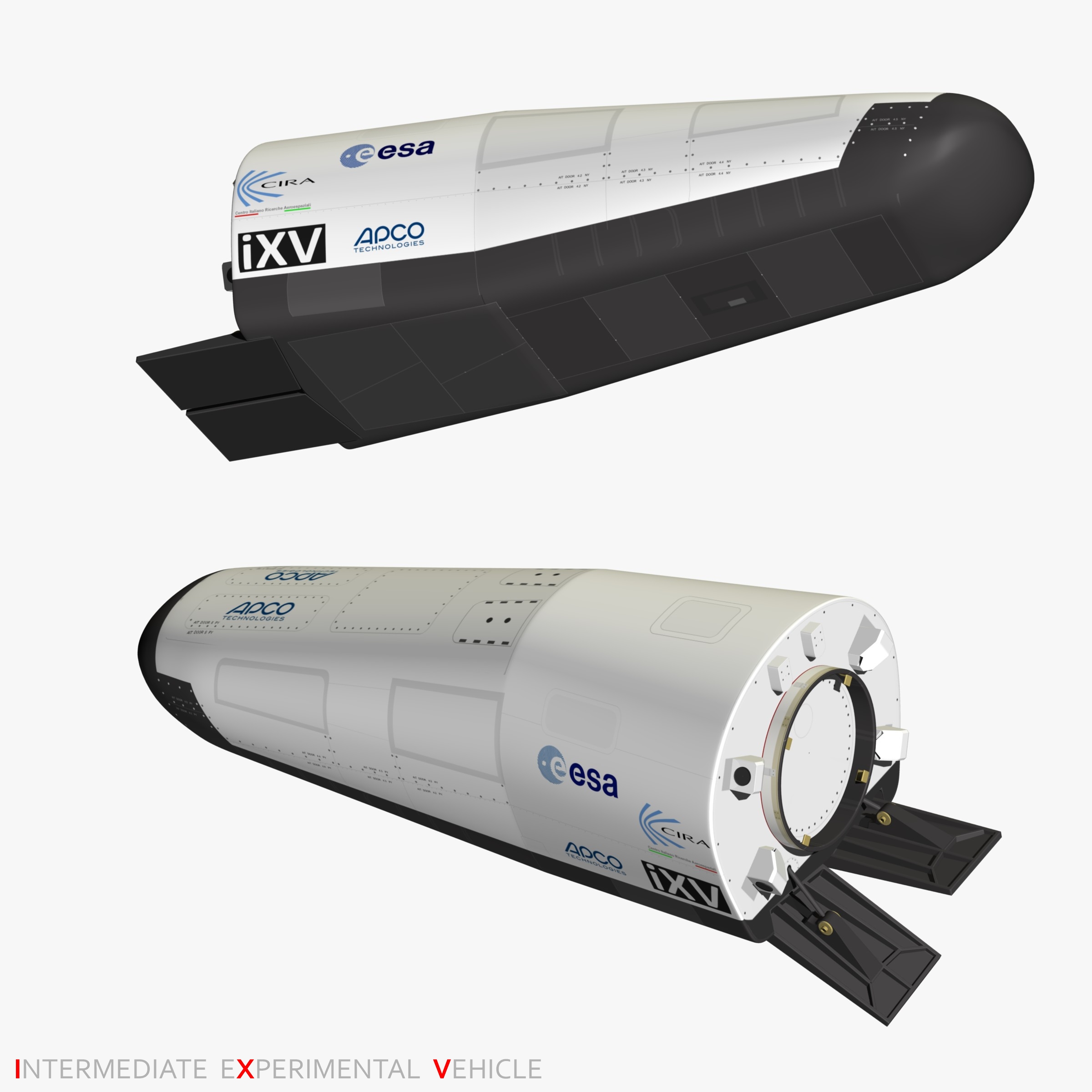
 Another possibility is the variable flaps at the rear of the ESA's IXV vehicle:


       Bob Clark

UPDATE, 7/1/2019:

 In the blog post "ESA's Callisto reusability testbed as an *operational* TSTO and SSTO", I suggested the Ariane 4 H10 upper stage be used for the Callisto reusability testbed, with its engine swapped out for the Vinci engine. It turns out this stage as well satisfies the 10 psf requirement for reentry without thermal protection. It had a 1,240 kg dry mass, 2.60 m diameter, and 11.05 m length. So the psf is:

2.2*1,240/(0.5*π*2.60*11.05*3.282) = 5.6 psf .


Could Blue Origin develop a lander for Artemis III?

Copyright 2025 Robert Clark SpaceX is coming under increasing criticism for its delay in developing the Starship lunar lander: U.S. Is Losin...