Showing posts with label cross-feed. Show all posts

Monday, June 21, 2021

SSME based SSTO’s. UPDATED, 6/28/2021 - Extension to the Delta IV Heavy

 Copyright 2021 Robert Clark


 The SSME makes possible *practical* SSTO’s, that is, with significant payloads. Need to use known lightweight materials, such as carbon fiber. As discussed in the blog post,


DARPA's Spaceplane: an X-33 version, Page 2

https://exoscientist.blogspot.com/2018/06/darpas-spaceplane-x-33-version-page-2.html 


some ultra high strength metals would also work:


 The standard aluminum the Delta IV used for its propellant tanks had about a 25 to 1 propellant to tank mass ratio. At 200 ton propellant mass, this gives a tank mass of 8 tons. So using light weight materials we can get this down to 4 tons.


 To estimate payload possible we need the required delta-v to low Earth orbit(LEO). Various estimates are given for this depending on altitude and orbital inclination. I’ll use the estimate give in this report of 9,000 m/s:


Towards Reusable Launchers - A Widening Perspective.

https://www.esa.int/esapub/bulletin/bullet87/pfeffe87.htm


 The Delta IV launch vehicle used the low cost, RS-68, an engine designed for low cost, but only at mid level performance. But for an SSTO you need both high performance engines and weight optimized structures. So we’ll replace the RS-68 with two SSME’s. The two SSME’s will have about the same mass as the RS-68 with slightly more thrust. But most importantly they have a much better vacuum Isp at 452.3 s compared to 412 s.


 The dry mass of the Delta IV first stage is about 26 tons. By light weighting the tank, we cut 4 tons from the tank mass to bring the dry mass to 22 tons. Then we can get a payload of 8 tons to orbit. By the rocket equation:


452.3*9.81ln(1 + 200/(22 + 8.2)) = 9,012 m/s.


 The Delta-IV TSTO, with no side boosters, has about the same payload to LEO using a Centaur upper stage:


https://en.m.wikipedia.org/wiki/Delta_IV#RS-68A_booster_engine_upgrade


The higher Isp of the SSME’s explains why the SSTO can match the performance of the TSTO to LEO.


 It is true that most launches now are for satellites actually to go to GEO, geosynchronous orbit. For this you can use the current Centaur upper stage. But firstly the use of the Centaur would allow higher payload to LEO than the current TSTO. The Centaur has about a 21 ton propellant load and 2 ton dry mass for a 23 ton gross mass with an Isp of 462 s. Then the TSTO could now get 21 tons to LEO:

452.3*9.81ln(1 + 200/(22 + 23 + 21.5)) + 462*9.81ln(1 + 21/(2 + 21.5)) = 9,050 m/s. 


 This is well above the 8 tons or so of the current TSTO version and is close to the payload of the Falcon 9 full thrust version.


 This TSTO does get more than the SSTO, but in point of fact you don’t need the maximal payload for most launches, so why use the upper stage if it is unneeded? 


 The additional delta-v required to GEO is about 3,800 m/s. Then a total of 12,800 m/s would be required to get the payload to GEO. This TSTO version could get 6 tons to GEO:


452.3*9.81ln(1 + 200/(22 + 23 + 6)) + 462*9.81ln(1 + 21/(2 + 6)) = 12,900 m/s. 


 This is multiple times higher than the current version:


http://spacelaunchreport.com/delta4.html#config


However, the SSME’s are expensive engines. To get the full usefulness of an SSTO you really need reusability. In point of fact by using lightweight thermal protection and landing legs, and lightweight wings or propellant storage for final approach, the additional mass for reusability can be less than 10% of the landed mass. So the SSTO would still get significant mass to LEO.


 Reusables do get their most usefulness at high launch rates. Then to serve various markets we would also want a smaller vehicle than this SSTO. We could get this by cutting down the tank size and using a single SSME: 


 We’ll cut down the propellant size to 150 tons, 3/4ths the usual size, and again we’ll use light-weighting on the tank of the Delta IV first stage. Subtracting off the 8 tons for the standard tank the dry mass is 18 tons. The tank mass at 3/4ths size would be 6 tons. But we’re lightweighting it so it’ll be 3 tons. That brings the dry mass to 21 tons.


 But the SSME at 3.2 tons is also a lighter engine than the RS-68, at 6.6 tons. So we’ll subtract off an additional 3.4 tons from the dry mass to bring it to 17.6 tons. There will be additional reductions in the dry mass due to smaller thrust structure for the lower thrust of the single SSME, and smaller insulation and wiring for the smaller vehicle, but not as large as the other reductions. 

 So for the first estimate take the dry mass as 17.6 tons. Then we can get 5 tons to LEO with this smaller SSTO:


452.3*9.81ln(1 + 150/(17.6 + 5)) = 9,020 m/s.


 Since less than 10% would be needed for reusability we can still get ca. 3 tons to LEO as a reusable SSTO.


   Robert Clark


UPDATED, 6/28/2021.

 The advantage of using high performance engines and lightweight tanks is not just for getting a SSTO. As mentioned above using this, the two-stage-to-orbit(TSTO) Delta IV can double its LEO payload to ca. 20 tons to match that of the Falcon 9 Full Thrust. Its payload capacity to the lucrative GEO satellite market would also match that of the Falcon 9 FT.


 ULA could then be competitive with SpaceX for the largest current market for commercial launches. Note that ULA could also match SpaceX in it's partially reusable approach of returning only the first stage. ULA head Tory Bruno has said the SpaceX approach of boosting back the first stage to the launch site requires too much fuel, and loses too much payload.


 Instead what ULA has proposed doing is returning the engine package only, catching it in midair on return by parachute. The rest of the first stage would be thrown away. This is a kludge, an inelegant solution just to get by. A kludge never provides a long lasting solution. The Space Shuttle was a kludge, which explains why it never reached its goal of fast and low cost reusability. However, by increasing the Delta IV's payload capacity in the described manner, ULA can also boost back to the launch site and match SpaceX in reusable payload capacity.


 The startling increase in payload would also apply to the Delta IV Heavy, with the addition of cross-feed fueling. This is where for a parallel staged vehicle the fuel for the central core is taking from the side boosters during the parallel burn portion of the flight. This allows the central core to be fully fueled when the side boosters are jettisoned.


55th International Astronautical Congress 2004 - Vancouver, Canada 

1 IAC-04-V.4.03 

DELTA IV LAUNCH VEHICLE GROWTH OPTIONS TO SUPPORT NASA’S SPACE EXPLORATION VISION

https://www.ulalaunch.com/docs/default-source/evolution/delta-iv-launch-vehicle-growth-options-to-support-nasas-space-exploration-vision.pdf

 We'll use the rocket equation to again estimate the payload possible for the Delta IV Heavy. Because of how cross-feed fueling works, the calculation works as if the it were a three stage vehicle with the fuel only being from the side-boosters during the "first stage":

452.3*9.81ln(1 + 400/(44 + 220 + 23 + 68)) + 452.3*9.81ln(1 + 200/(22 + 23 + 68)) +462*9.81ln(1 + 21/(2 + 68)) = 9,060 m/s.

 This payload of 68 tons nearly triples the payload of the current version of the Delta IV Heavy, and now matches the payload of the Falcon Heavy.


 This is still using the expensive SSME's however. But the point of the matter is this is doable for the current engine RS-68 used on the Delta IV as well if given altitude compensating nozzles.


 There are various means of adding altitude compensating nozzles to existing engines. They could be like the RL-10B with extendible nozzles, or flexible, expandable nozzles, or mechanically moving "petal" arrangements as with variable area nozzles on jet engines, or several other ways. 


 This last is interesting in that this method of achieving variable area nozzles has been in existence since the 70's. As a total WAG it might improve the performance for jets by, say, 10%. But for rockets using variable nozzles could improve performance by 100% or more and it still has not been used for rockets. 


 In such a way, a midlevel performance engine such as the RS-68 could be upgraded to achieve comparable performance of the high performance SSME's. I won't offer a calculation here using the rocket equation for this case. The reason is while such estimates frequently take the vacuum Isp for a fixed nozzle engine, this may or not be accurate for the case of an altitude compensating nozzle. On the one hand you can give the RS-68 a higher vacuum Isp than SSME, even at 470+ s, but the higher chamber pressure of the SSME, suggests it should have better performance at ground level than the RS-68 given alt.comp.  


 The calculation of the delta-v possible through altitude compensation is one that should be made by the launch companies.


Regular Manned Lunar Flights.

 The use of the higher performance engines gives us the capability of SSTO's with the Delta IV and also heavy lift with the Delta IV Heavy, with payload comparable to the first planned version of the SLS at ca. 70 tons. With this we have the possibility of routine manned flights to the Moon and beyond. Robert Zubrin has written a proposal for a low cost architecture for setting up a Moon base with regular flights to the Moon. Remarkable all it would need beyond the current capability is a reusable lunar lander.

 In the Zubrin proposal it would take only 3 flights of the Falcon Heavy and one flight of a manned Falcon 9 to set up the manned lunar base:


Op-ed | Moon Direct: How to build a moonbase in four years.

by Robert Zubrin — March 30, 2018

https://spacenews.com/op-ed-moon-direct-how-to-build-a-moonbase-in-four-years/


 But with the extra capabilities of the Delta IV Heavy, the three Falcon Heavy launches could be replaced by three launches of the Delta IV Heavy.


 Recall I said Zubrins plan only needed a lunar lander. ULA is planning the upper stage of its upcoming Vulcan lander, the Centaur V, to have in-space reusability. Then this upper stage could also be used as a reusable lunar lander. See discussion here:


Robust Lunar Exploration Using an Efficient Lunar

Lander Derived from Existing Upper Stages

AIAA 2009-6566

Bernard F. Kutter et al.

https://www.ulalaunch.com/docs/default-source/exploration/dual-thrust-axis-lander-(dtal)-2009.pdf


 In regards to adapting the Centaur V or a currently in use Centaur to a horizontal landing lunar lander, I advise the landing rockets be just pressure-fed thrusters fueled from the regular tanks of the hydrolox tanks of the Centaur.

Thursday, August 13, 2015

Orbital rockets are now easy.

Copyright 2015 Robert Clark


Falcon 1 Upper Stage Based Orbital Launcher.
 In the blog post "On the lasting importance of the SpaceX accomplishment" I suggested that SpaceX's low cost, commercial approach to developing the Falcon 9 will lead to this being emulated by other launch providers and then, eventually, to spaceflight becoming routine. However, ironically, it might turn out their simplest development and one they dispensed with will have the fastest effect towards making orbital access routine.

  It's the Falcon 1 upper stage. Compared to the first stage and certainly compared to the Falcon 9, it's a rather simple stage only using a pressure-fed engine, the Kestrel


Kestrel engine

  Pressure-fed engines and stages are much easier to develop than pump-fed ones. For instance there are the rockets developed by Armadillo AerospaceMasten Space Systems, and Garvey Spacecraft Corporation

 And this was also the case for the Project Morpheus lunar lander stage. In the blog post "The Morpheus lunar lander as a manned lander for the Moon", I discussed the NASA's Project Morpheus emulating a low-cost commercial space approach was able to develop two Morpheus landers for only $14 million. And actually the parts only costs were in the range of $750,000 per lander.

 The construction costs for pressure-fed engines can also be low cost. For instance Project Morpheus was able to produce their engines at a cost of only $60,000:

NASA dreams of future Morpheus project templates.
March 14, 2015 by Chris Bergin
The main engine – which was also tested at the Stennis Space Center – could throttle at a ratio of 4 to 1, ranging between 1,400 and 5,400 pounds thrust. All Morpheus engines were custom designed and built specifically for Morpheus and only cost $60,000 each.

 The specifications for the Falcon 1 upper stage are given here:

Falcon 1.

 It has a 360 kg dry mass and 3,385 kg propellant mass, and a 3,175 kilogram-force vacuum thrust and 327 s vacuum Isp using the Kestrel engine. This is an upper stage engine however with a long nozzle that can't be used at sea level. In the post "Altitude compensation attachments for standard rocket engines, and applications" I described various attachments to be made to existing engines to give them altitude compensation ability. 

 However, since pressure-fed engines are so comparatively low-cost they could be designed from the beginning to have aerospike nozzles. There is for instance the aerospike engine of Garvey Spacecraft. And Firefly Space Systems  will construct an aerospike nozzle by using numerous small engines arranged around a central spike.

 The question though is how much thrust could be developed with the Kestrels at sea level using altitude compensation. I'll estimate from the formula for Isp for a rocket engine:

The ideal exhaust velocity is given by

where k is the specific heat ratio, R* is the universal gas constant (8,314.4621 J/kmol-K in SI units, or 49,720 ft-lb/(slug-mol)-oR in U.S. units), Tc is the combustion temperature, Mis the average molecular weight of the exhaust gases, Pc is the combustion chamber pressure, and Pe is the pressure at the nozzle exit.
http://www.braeunig.us/space/propuls.htm#Isp


 The pressure factor at the end reduces the Isp at sea level. The specific heat ratio k is about 1.24 for kerolox. The Kestrel operates at a chamber pressure of 135 psi. Then the pressure factor is:
sqrt(1-(14.7/135)^(.24/1.24)) =  .591. So the Isp at sea level is 327*.591 = 193 s and the sea level thrust is .591*3,175 = 1,876 kilogram-force. 

 Note for this estimate to be valid you have to have altitude compensation so that the engine has optimal performance at sea level, i.e., you don't have the back-pressure loss that results from non-optimal expansion.

 Because of the 3,745 kg gross mass of the stage though, we need to reduce the propellant load to be loftable by the single Kestrel at the 1,876 kilogram-force sea level thrust. We'll reduce the propellant load by a factor of .45, so to .45*3,385 = 1,520 kg. We want also to maintain the relatively high mass ratio for the stage so we'll reduce the tank size. The tank mass is proportional to the propellant mass. Subtracting off the 52 kg mass of the Kestrel leaves us 308 kg in the stage dry mass. Multiplying this by .45 gives .45*308 = 138.6 kg. Adding on the 52 kg mass of the Kestrel gives a dry mass of 190 kg. 

 Other elements of a rocket stage such as the insulation, wiring, avionics do not scale linearly with propellant mass as does tank mass. However, since for pressure-fed stages the dry mass is so dominated by the tank mass this gives an approximate value of the stage mass when you scale down the stage size. 

 Moreover we can further reduce the dry mass by using composite propellant tanks. Microcosm, Inc. is making small-sized composite tanks that could be used for the purpose. NASA research has shown composite tanks can save 30% off the mass of aluminum-lithium tanks. Since Al-Li tanks save about 25% off the weight of standard aluminum tanks, this means composites can save about 50% off the weight of standard aluminum propellant tanks. 

 To estimate the mass this could save for this application, historically the propellant mass to tank mass ratio for kerolox for standard aluminum tanks is about 100 to 1. Note though this is for pump-fed engines that only need their stages at about 2 bar, about 30 psi. When the tank pressure is increased for pressure-fed engines the tank mass is correspondingly increased. The Falcon 1 upper stage tanks are kept at 200 psi pressure. So for our propellant mass of 1,520 kg, the tank mass assuming standard aluminum might be (1,520 kg/100)*(200 psi/30 psi) = 101 kg. Then a  reduction of 50% in the tank mass would cut 50 kg from the dry mass to bring it to 140 kg. However, we'll calculate here the payload using 190 kg dry mass number, as the dry mass here is approximate since some components of the stage won't actually scale proportionally with the stage size.

Cross-Feed Fueling for Multiple Cores.
 To increase payload we'll use cross-feed fueling. Note that cross-feed fueling is actually a well-understood technology, having been used on the Space Shuttle OMS engines:

Propellant Storage and Distribution.
"The propellant storage and distribution system consists of one fuel tank and one oxidizer tank in each pod. It also contains propellant feed lines, interconnect lines, isolation valves and crossfeed valves.
"The OMS propellant tanks of both pods enable the orbiter to reach a 1,000-foot- per-second velocity change with a 65,000-pound payload in the payload bay. An OMS pod crossfeed line allows the propellants in the pods to be used to operate either OMS engine."

 And it has also been used for decades for jet airliners:

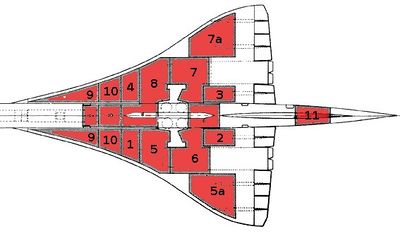
Concorde.
Balancing by Fuel-Pumping.
The Concorde Tank-Schematic:

"1 + 2 + 3 + 4 are the Collector-Tanks, feeding the engines directly. Usually they feed there counterpart engines – but they can be cross-switched to feed more and/or other engines at the same time.
5 + 7 and 8 + 6 are the Main-Transfer Tanks, feeding the 4 Collector-Tanks. Initially 5 + 7 are active. If those are empty 6 + 8 take over (or must be activated from the Engineering Panel!).
5a + 7a are Auxiliary-Tanks (to 5 and 7).
9 + 10 are the Trim-Tanks for balancing forward
11 is the Trim-Tank for balancing afterward"

 To emulate rocket cross-feed fueling with the Schilling Launch Performance Calculator, note that during the parallel burn portion of the flight the propellant for the center core engines is coming from the side booster stage(s). This ensures that the center core will have a full propellant load during its solo burn portion of the flight, after the side booster(s) are jettisoned. 

 So the total amount of propellant burned during the parallel burn portion is that of the side booster(s) only. But the Schilling Calculator assumes the amount of propellant burned in the center core during the parallel burn is the same as the amount burned in each side booster. So enter in the Calculator for the booster propellant load a fraction of the actual propellant load of a core equal to the number of side boosters divided by the number of cores. So if you're using 2 cores with one used as a side booster enter in the Calculator booster column 1/2 the amount of the actual core propellant load. And if using 3 cores with 2 used as side boosters, enter in 2/3rds the actual core propellant load in the booster section. This will ensure the Calculator interprets the total propellant burned during the parallel burn portion is that of the actual side booster(s) only.

 But you also want the Calculator to take the amount of propellant burned during the center core's solo burn portion of the flight as that of a full propellant load. Since it is already taking it to have burned the same amount as what the side boosters have burned during the parallel burn portion, add this amount onto the actual propellant load of a core and enter this into a first stage column of the Calculator. For the other specifications for both booster(s) and center core such as Isp, dry mass, and thrust enter in the actual values.

 We'll calculate here the case for using two side booster of same size as the central core. Enter in the Schilling calculator the dry mass of 190 kg for the boosters and the first stage, which is the central core. For the thrust and Isp for the boosters and the first stage, enter in the vacuum Isp of 327 s and vacuum thrust of 31.1 kN in the calculator. However, to emulate cross-field fueling, for the propellant fields enter in (2/3)*1,520 kg = 1,013 kg in the booster section and 1,013 kg + 1,520 kg = 2,533 kg in the first stage section. Choose Cape Canaveral as the launch site and 28.5 degrees as the launch inclination to match the latitude for the launch site. For the "Restartable Upper Stage" select "No", otherwise the payload will be reduced. Then the calculator gives the result:

Mission Performance:
Launch Vehicle:  User-Defined Launch Vehicle
Launch Site:  Cape Canaveral / KSC
Destination Orbit:  185 x 185 km, 28 deg
Estimated Payload:  63 kg
95% Confidence Interval:  19 - 116 kg

"Payload" refers to complete payload system weight, including any necessary payload attachment fittings or multiple payload adapters
This is an estimate based on the best publicly-available engineering and performance data, and should not be used for detailed mission planning. Operational constraints may reduce performance or preclude this mission.


 We could get over 100 kg if we used three side cores. 

Methane for Improved Performance.
 We could also increase the payload using methane instead of kerosene as the fuel. For booster stages, methane has about the same performance as kerosene since the greater density for kerosene makes up for its lower Isp. But for upper stages methane offers better performance since it would give a lighter stage that had to be lofted by the lower stages. So if you wanted to use identical stages for simplicity and cost, methane would be the preferred fuel.

 There is also a key practical reason why methane might be preferred. NASA has developed the methane-fueled engine for the Morpheus rocket stage. With NASA's Technology Transfer program the technical info on the engine would also be shared at least for American companies. Then you would only have to pay the ca. $60,000 construction costs for the engine. 

 Considering that both the Kestrel and Morpheus engines are reusable this already low cost launcher can cut the cost to space considerably. It then could be used for DARPA's proposed reusable launchers discussed here: "NASA Technology Transfer for suborbital and air-launched orbital launchers." In an upcoming blog post I'll also show that using a single one of these cores, it can be used as either the reusable first stage booster, or the air-launched orbital stage for these DARPA programs.

Scale-up to Large Launchers. 
 Note this is a 5,130 gross mass launcher to launch a 63 kg payload. Pressure-fed stages scale up more easily than pump-fed ones since you don't have the complexity of creating a turbopump for the larger size engines. The Mercury spacecraft that carried John Glenn massed 1,300 kg. Using modern materials we could probably make a one-man capsule for 500 kg. Then we would only have to scale up our 3 core launcher by a factor of 8 to launch a one-man capsule to orbit. This would be a 41,000 kg gross mass launcher compared to the 120,000 kg gross mass Atlas rocket that launched John Glenn to space.

  Bob Clark


Could Blue Origin develop a lander for Artemis III?

Copyright 2025 Robert Clark SpaceX is coming under increasing criticism for its delay in developing the Starship lunar lander: U.S. Is Losin...