Showing posts with label Block 1. Show all posts

Sunday, September 22, 2013

SLS for Return to the Moon by the 50th Anniversary of Apollo 11, page 5: A 90+ metric ton first launch of the SLS.

Copyright 2013 Robert Clark

 Finally someone at NASA acknowledges that the Block 1, first version of the SLS to launch in 2017 will have a 90+ mT payload capacity not the 70 mT always cited by NASA:

SLS Dual Use Upper Stage (DUUS).
http://ntrs.nasa.gov/archive/nasa/casi.ntrs.nasa.gov/20130013953_2013013757.pdf

 This is important since it means we will have the capability to do manned lunar landing missions by the 2017 first launch of the SLS.
 As discussed in the blog post SLS for Return to the Moon by the 50th Anniversary of Apollo 11, page 2: Orion + SEV design, a 90+ metric ton launcher means we can even use the Orion as the crew capsule. This is important for political reasons since the great expense spent on it means there would be a great desire among its supporters to see it be used. 
 There also is a preference at NASA for the departure stages from the lunar surface and from lunar orbit to use hypergolics, which have the surety of igniting on contact. Then another advantage of a 90+ mT SLS is that the heavier hypergolics can be used for these stages rather than the lightweight hydrogen-fueled stages I suggested in that blog post. In an upcoming post I'll show using existing hypergolic stages how we can get a lunar landing mission at less than 90 mT to LEO.
  For any of these methods it is important to use currently existing stages rather than developing them from scratch. A big reason that NASA ruled out a return to the Moon was because of the assumption that it required the development of new Altair-sized lander at a $10 billion development cost. But the need for a 45 mT Altair-sized lander is provably false as shown by the Apollo lander at one-third the size. And simply adapting already existing stages reduces the cost to a fraction of that needed for an Altair.
 So NASA is making expensive policy decisions such that we can't return to the Moon based on provably wrong assumptions. One is that the Block 1 would only have a 70 mT payload capability and so would require an expensive upper stage to increase the payload to do lunar missions, and another is that a lunar lander would require an additional $10 billion development.
 In fact, once you recognize the, obvious, fact that a lunar mission does not require an Altair-sized lander then so many possibilities become apparent. We did not have the great variety of existing launchers back in the Apollo days that we have now. If you allow your lander to be at or smaller than the Apollo lander then there are a variety of launchers that could be used for lunar missions, not just the SLS. And since they are already existing, or will be soon such as the Falcon Heavy, there would be no huge, multi-billion dollar development cost to use them. 
 So likewise also is the case for the in-space stages needed. They are already currently existing and would require relatively minor adaptations to be used for a lunar lander, for example.
 Indeed we could do manned lunar missions for what NASA is currently paying the Russians to send a crew of 3 to the ISS. The implications of that are jarring: we could have regular manned flights to the Moon for the same amount as what we are currently paying to send regular manned flights to the ISS.  And since the cargo flights to the Moon would be similarly low cost and using Bigelow style lightweight habs would allow a habitation module to be sent to the Moon on a single flight, we could have a manned lunar base for the same amount as what we are paying to sustain the ISS.
 All this comes from simply the mental reset that a lunar mission does not require the $10 billion Altair.
 Free your mind, the rest will follow.

    Bob Clark

Note: thanks to M. Moleman for discussing the NASA report "SLS Dual Use Upper Stage (DUUS)" on his blog.

Wednesday, December 26, 2012

SLS for Return to the Moon by the 50th Anniversary of Apollo 11, page 2: Orion + SEV design.


Copyright 2012 Robert Clark


 It is generally acknowledged that the SLS is based on the DIRECT teams "Jupiter" launcher. Then their respective launchers closely mirror each other in their payload capabilities for versions with similar components. The Block 0 SLS was initially planned to have a 70 mT payload capability, as mirrored by the corresponding DIRECT launcher:


http://www.directlauncher.org/documents/Baseball_Cards/J130-41.4000.08100_CLV_100x100nmi_29.0deg_090606.jpg


 In reports on the Block 0 SLS, NASA discussed the option of it using 4 or 5 segment SRB's as if it were no big deal. But I was surprised when I looked at the 5 segment version on the DIRECT teams site, that the payload jumped to ca. 95 metric tons:


http://www.directlauncher.org/documents/Baseball_Cards/J130H-41.5000.08100_CLV_30x100nmi_29.0deg_090608.jpg


  Ed Kyle who operates the SpaceLaunchReport.com site also estimates this first SLS version will have a payload to LEO of 95 mT. A jump in payload of 25,000 kg is a big deal. It's the difference in payload for instance between the 105 metric ton Block 1A version, and the 130 metric ton Block 2 version of the SLS. It would also mean the Block 0 given 5-segment SRB's would be close to the "magic" 100 metric ton payload number. And with just the interim upper stage, it would certainly exceed that.

 Judging by this Chris Bergin article, we would expect the 5 segment SRB's to be ready by the 2017 first flight of the SLS:

ATK and NASA ground test their SLS-bound five segment motor.

September 8th, 2011 by Chris Bergin
    As far as ATK’s role in SLS, documentation (L2) shows the Utah-
based company have proposed a Firm Fixed Price (FFP) contract for 10
boosters, available between 2012-2015, whilst noting available assets
that can support up to 11 SLS missions prior to asset depletion in
2020.
http://www.nasaspaceflight.com/2011/09/atk-and-nasa-ground-test-five-segment-motor/

The current plan now is to go directly to a Block 1 launcher, scheduled for a 2017 flight date. This will use 5-segment SRB's instead of the regular 4-segment ones planned for the Block 0. But the DIRECT teams 5-segment version of their Jupiter rocket has nearly a 95 mT capability. Moreover, NASA wants to give the Block 1 an additional SSME core engine and stretch the tank. Then it will have even greater payload than the 95 mT of the corresponding DIRECT teams launcher.


So NASA is still using the 70 mT payload number of the Block 0 in discussing this initial flight of the SLS when the actual payload capability will be 95+ mT. I think NASA should be more clear about what the actual capabilities of that first version of the SLS to fly will actually be. Saying it will do 70 metric tons to LEO is misleading as to what that first version can actually do.


According to the reports that first version to fly will even have an interim cryogenic upper stage, and at quite low cost by the reports if the Delta IV derived one is used. Presumably, this will improve the LEO capability, perhaps to the 100 to 105 metric ton range.


A launch capability this high raises the possibility of even doing lander missions not just lunar flyby's. This is important because it means we will have the capability of doing lunar lander missions not just in 2030 when the full SLS comes on line but just in 5 years.


This becomes even more important when you realize the necessary stages, the Centaurs, already exist to make the Earth departure/lander stages. ULA has written numerous reports on markedly reducing boiloff in the Centaurs so that we can consider that to be well understood, and essentially solved.


It has been complained that the SLS has no mission. NASA being direct, so to speak, about what the actual capabilities of that first version of the SLS to fly will make clear that the SLS does have an important mission, and in the very near term and at (comparatively) low cost: Return to the Moon.


CALCULATIONS


A Simple, Low Cost Upgrade.

 A question asked about the SLS is that if the Block 0 is derived from the space shuttle system that could lift 100+ mT to orbit when you include both the orbiter and payload, then why could the Block 0 only lift 70 mT to orbit? The answer is that for the shuttle the SSME engines only took the orbiter to a highly elliptical orbit whose perigee lied well within the Earth's atmosphere. This ensured the external tank after being jettisoned would reenter the atmosphere and break up on return.

 The shuttle would then use one or two OMS burns to raise the perigee and circularize the orbit. These OMS burns typically only totaled 90 m/s or less. Note that the total thrust of these OMS engines for the 100 mT+ shuttle was only about 6,000 kgf. This thrust is less than that of a single RL-10 engine. Then a way to recover the full mass to orbit of that of the shuttle system is by using a small propulsive stage to provide the same low amount of extra delta-v as provided by the shuttle's OMS engines.


 The shuttle orbiter with payload and with OMS fully fueled can mass 120 mT. An OMS burn of 90 m/s is less than 1/3rd the total OMS delta-v available of 305 m/s. So much of the OMS propellant of 12.8 mT will remain, with the remaining gross mass of the orbiter at the end of the OMS burn being above 100 mT.


 This delta-v change for a 100 mT payload can be done by just a cryogenic stage at only 1/10th the size of a Centaur upper stage, one of only 2 mT size. The Centaur has better than 10 to 1 mass ratio. But mass ratio gets better as you scale up or said another way gets worse as you scale down.


 The 'Golden Spike' paper on a commercial return to the Moon plan gives estimated sizes for some smaller cryogenic stages than the Centaur in a table on page 13. One at a 2,172 kg propellant load is given a dry mass of 445 kg. This could provide a 90 m/s delta-v to a 105 mT payload with a RL-10 engine at 451 s Isp:


451*9.81ln(1 + 2.172/(.445 + 105) = 90 m/s.


 Note this is just for Block 0. But the actual first version to be launched will be the Block 1 with 25% greater size and thrust on the SRB's and 33% greater size and thrust on the core stage. Then also using a small cryogenic stage the payload would be at least 25% greater than the 105 mT amount and probably closer to 30% greater since the upper stage that actually reaches orbit has a greater influence on payload than a lower stage.


 Even 25% greater would put the payload at 130 mT. This matches the payload of the expensive Block 2 SLS but only requiring a small cryogenic stage a fraction of the size  of a Centaur, and would be available by the 2017 first launch of the SLS.


Return to the Moon Architecture.

 In the post "SLS for Return to the Moon by the 50th Anniversary of Apollo 11" I suggested the Space Exploration Vehicle(SEV) be used alone as the single crew module for a lunar mission following the Early Lunar Access architecture. However, the Orion capsule has had billions of dollars spent on it and therefore has a lot of political capital attached to it. So I'll show we can also have a design that uses the Orion for the traverse from Earth orbit to lunar orbit and the return, with the SEV just for the trip from lunar orbit to the lunar surface. Using all cryogenic propulsion this will be doable using the likely 95 mT or higher payload first version of the SLS scheduled to launch in 2017. Using both the Orion and the SEV is in the plan NASA is considering for asteroid missions. I'm suggesting it also be used for lunar missions to get a lightweight architecture, rather than using some analogue of the quite heavy Altair lander (45 metric tons, really??).

 Use the delta-v's for the Earth-Moon system shown here:


Delta-V budget.
Earth–Moon space.


Currently existing cryogenic stages for simplicity and low cost: for the SEV lander use the Ariane H8 LH2/LOX upper stage. It had a 9,687 kg gross mass and 1,457 dry mass, and 443 s Isp. I'll round off the H8 mass values to 9,700 kg and 1,500 kg in the calculation. Use 4 mT for the crewed mass of the SEV, then:

 443*9.81ln(1 + 8.2/(1.5 + 4)) = 3,970 m/s, sufficient for the flight to and from the lunar surface from low lunar orbit.


 For a stage to insert the Orion+SEV lander into lunar orbit and return the Orion to Earth from lunar orbit, use the Ariane H10-3 LH2/LOX upper stage. This stage has a gross mass of 12,310 kg and dry mass of 1,570 kg, at a 445 s Isp. I'll round off the mass values to 12,300 kg and 1,600 kg, so 10,700 kg of propellant.


 The delta-v to insert into lunar orbit is 900 m/s, and the translunar injection(TLI) delta-v is 3,140 m/s making up the 4,040 m/s delta-v to go from LEO to low lunar orbit(LLO), as shown in the table above.


 Use 9 mT for the crewed mass of the Orion, and 13.7 mT for the SEV plus lander. Now burn only 6.9 mT of propellant for the lunar insertion, retaining 3.8 mT of the propellant after the lunar orbit insertion in order to be able to return Orion back to Earth. Then:


445*9.81ln(1 + 6.9/(1.6 + 9 + 13.7 + 3.8)) = 960 m/s, sufficient for lunar orbit insertion.


 Now for the return of the Orion, we have:


445*9.81ln(1 + 3.8/(1.6 + 9)) = 1,340 m/s, sufficient to go from low lunar orbit back to LEO, according to the table above. (Actually other sources give the required delta-v to break lunar orbit as only 900 m/s, same as to enter orbit, so it may be possible to make this stage even smaller.)


  Now we need a stage to do the translunar injection(TLI), requiring 3,140 m/s delta-v. The Centaurs have the best Isp and mass ratio of any upper stages so we'll use those. You could use two of them firing together in parallel or get better mass to TLI by firing them serially.  For simplicity I'll use the twin, parallel Centaur format. Rounding off, the Centaur has 21 mT propellant and 2 mT dry mass, with 451 s Isp. So two together would be 42 mT propellant and 4 mT dry mass. The Orion, SEV, and cryogenic stages together mass 35 mT. Then:


451*9.81ln(1 + 42/(4 + 35)) = 3,230 m/s, sufficient for TLI.


 Then the total mass that needed to be lofted to orbit would be 81 mT. The leeway between this and the 95 mT, and likely higher, payload capacity of the SLS would probably allow even hypergolics to be used at least for the departure stages, both from the lunar surface and from lunar orbit.


Increasing Mass Ratio to Improve Performance.  

 An even better option than the twin Centaurs would be to use the proposals of ULA (United Launch Alliance) to scale the Centaurs up larger, widen their diameters, and use lightweight aluminum-lithium instead of the steel now used. ULA suggests by doing this their mass ratio can be increased from 10 to 1 to 20 to 1. This is discussed by Jon Goff on his site, Selenian Boondocks.

 Scaling a rocket stage up is known to increase mass ratio. Widening them improves mass ratio because the closer a tank is to sphere the better the storage efficiency, a sphere having the best mass efficiency. And in regards to strength compared to weight, Al-Li can be as much as twice as good as steel. 


 These weight saving methods should also be applied to the smaller cryogenic stages to improve their performance. For instance the Ariane cryogenic stages I used above may be able to reach 10 to 1 mass ratios by following this. ULA has discussed improving mass ratio as the best way to improve performance at the NewSpace 2012 conference.


 A Centaur-style stage with these weight saving techniques applied at a 40 mT propellant load and 2 mT dry mass using the best vacuum Isp for a RL-10 series engine at 465.5 s can transport 5 mT from LEO to the Moon and back as a single stage:


465.5*9.81ln(1 + 40/(2 + 5)) = 8,700 m/s, sufficient for the round-trip according to the table above.


  Actually since the delta-v of a launch to LEO is just a little more than this delta-v for a round-trip lunar mission, I like to think of this example as a stealth SSTO. ULA in maximizing the mass ratio of a Centaur-style stage while at the same time using the highest Isp engine would unwittingly also create a SSTO, capable of significant payload to orbit.


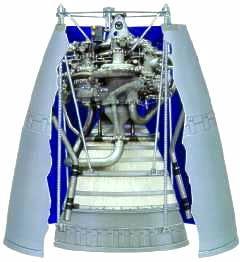
 For this SSTO to have an engine that can operate at sea level, the nozzle extension would have to be retracted at launch and extend while the engine is firing. According to Henry Spencer, this has already been successfully tested.


RL-10-B2 with nozzle retracted.


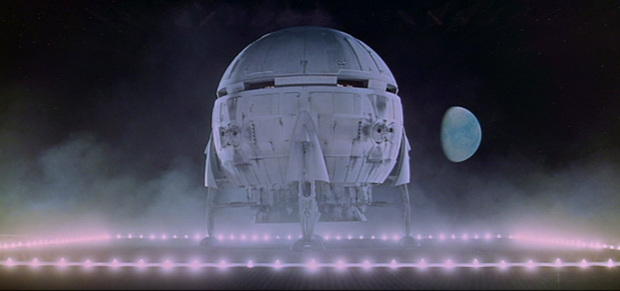
2001: A Space Odyssey.

 Another version of this high mass ratio upper stage would put it in the from of a sphere. Since a sphere has the best mass efficiency for a tank this would get an even better mass ratio, and could carry more payload. This would be most useful for the lunar transport case since you would not have to worry about the high air drag of a spherical launcher as in the ground launched case.


 This would be interesting since it could serve as an homage to 2001: A Space Odyssey.


Aries lunar shuttle.

    
Bob Clark


Update, Sept. 28, 2013:

 Finally, NASA has acknowledged that the Block 1, first version of the SLS to launch in 2017 will have a 90+ mT payload capacity not the 70 mT always stated by NASA:

SLS Dual Use Upper Stage (DUUS).
http://ntrs.nasa.gov/archive/nasa/casi.ntrs.nasa.gov/20130013953_2013013757.pdf

 This is important since it means we will have the capability to do manned lunar landing missions by the 2017 first launch of the SLS:

SLS for Return to the Moon by the 50th Anniversary of Apollo 11, page 5: A 90+ metric ton first launch of the SLS.
http://exoscientist.blogspot.com/2013/09/sls-for-return-to-moon-by-50th.html


Monday, October 29, 2012

SLS for Return to the Moon by the 50th Anniversary of Apollo 11.

Copyright 2012 Robert Clark


Very interesting report about using NASA's proposed Space Exploration Vehicle for cislunar space exploration:

Lunar Surface Access from Earth-Moon L2.
A novel lander design and study of alternative solutions.
1 October 2012 | Washington, DC
http://www.sei.aero/eng/papers/uploads/archive/SEV-L2-Lander-Presentation_1Oct2012.pdf

 The report proposes using the lightweight SEV, at only a 3 mT empty weight, and all cryogenic propulsion as a shuttle between the L2 space station NASA has recently discussed and the lunar surface. However it could also be used as the crew capsule between LEO and the Moon's surface.
 The architecture discussed is very interesting in that the SEV would be used as the single crew module to carry the crew all the way from the L2 station to the lunar surface and back again, i.e., no separate lander crew module. There would also only be a single propulsive stage to carry the SEV from low lunar orbit to the lunar surface and back to lunar orbit, i.e., no separate lunar descent and ascent stages.
 This has similarities to the architecture for the Early Lunar Access(ELA)[1] proposal of the early 90's. This also used all cryogenic space stages to save weight, only 52 mT required to LEO. ELA also saved weight and cost by using a single crew capsule for the entire flight from LEO to the lunar surface and back again. It also used a single propulsive stage for lunar descent and ascent. But instead of linking up with a stage waiting in lunar orbit for the return, the ELA proposal was to have this single lander stage return all the way back to LEO.
 An alternative architecture discussed on page 23 in this report on using the SEV for cislunar travel does not use the method of first stopping in lunar orbit, then having a separate lunar lander stage. Instead it uses the "direct descent" method of descending directly to the lunar surface. This landing method is analogous to that used in the ELA proposal to save propellant. Interestingly the SEV report on page 23 gives the delta-V for the direct descent method as 2,610 m/s. This compares to the 760 m/s + 2,150 m/s = 2,950 m/s for the method that first stops in lunar orbit, then descends to the surface as indicated in the image above. So according to this report a savings of 300 m/s in delta-V for the trip from L2 to the Moon is possible using direct descent, a significant savings.
 I had wondered if it was possible to save delta-V and propellant in this blog post 'Delta-V for "direct descent" to the lunar surface?'[2]. The SEV report suggests it may be possible to save in the range of 300 m/s by the direct descent method.
 The only technical complaint raised against the feasibility of the ELA proposal back in the 90's was the suggestion of getting a 2-man crew capsule at only a 3 mT empty weight. So the fact the SEV is expected to have this low an empty weight is important, since it suggests the possibility with just the 70 mT first version of the SLS of a manned lunar lander mission using currently existing cryogenic stages.
 Actually the 70 mT payload of the SLS is so much better than the 52 mT needed for ELA that likely we could even use a heavier hypergolic stage for the lunar ascent stage. During the early planning of the Apollo program when the possibility an engine might not ignite was regarded as a definite possibility, it was decided to use hypergolics, which ignite on contact, for the lunar ascent stage. At this point though the cryogenic RL10 engines have had decades of use and are regarded as highly reliable.
 Still for these first versions of these new lunar landers we might still want the certainty of using hypergolics for the ascent stage. I suggest using the engine and propellant tanks of the shuttle orbiter OMS pods for the purpose. This would be quite appropriate actually since the OMS pod engines were derived from the Apollo lunar lander engines. By the Astronautix page on the OMS pods[3], they are each about 10 mT propellant mass and 1.8 mT dry mass. Then using its 316s Isp, one of them would suffice for the ca. 2,740 m/s delta-V to go from lunar surface to LEO even with a 4 mT crewed and supplied mass for the SEV with plenty of margin: 316*9.81ln(1 + 10/(1.8 + 4)) =  3,100 m/s.
 The first version of the SLS, called Block 1, is expected to launch by 2017. I would expect a test lunar lander mission, especially if using all cryogenic in-space propulsion, to be done first before a crewed mission is sent. But certainly by 2019, the 50th anniversary of Apollo 11, a crewed mission could be sent. This is in contrast to a post-2030 proposed time frame for a crewed lunar landing using the full 130 mT version of the SLS when it first becomes available.
 There is the cost issue of mounting a manned lander mission. Oddly, the high cost of the SLS might be helpful in this regard. The cryogenic Centaur-like upper stages are already available at a cost in the range of $30 million [4], so the modifications there would be comparatively low cost, compared to the already high cost of the SLS. As for the development cost of the SEV, I suggest use of NASA's commercial crew program's financing procedures. SpaceX was able to develop the Dragon as largely privately financed for reportedly $300 million. And Boeing is paying much of the cost of the development of the CST-100 capsule. It is highly dubious they would be spending a billion dollars of their own money for its development. Then likely its total development cost is in the few hundred million dollar range. Therefore it is likely the development cost of the smaller SEV under commercial crew procedures would also be in the few hundred million dollars range, again comparatively low cost compared to the SLS.
 As I discussed in the blog post "SpaceX Dragon spacecraft for low cost trips to the Moon", SpaceX will also be able to mount a manned lunar landing mission using the 53 mT Falcon Heavy by following, it turns out, the ELA architecture. This will be much cheaper than using the SLS launcher, perhaps only in the few hundred million dollars range cost. But you would have to get private financing for that, since NASA would not fund it as it would undercut NASA's own program.
 In contrast, NASA using the SLS in such an early time frame for a manned return to the Moon would provide further support for continuing the SLS funding. No longer would the SLS be referred to as "a rocket to nowhere".


  Bob Clark

Update, Sept. 28, 2013:

 Finally, NASA has acknowledged that the Block 1, first version of the SLS to launch in 2017 will have a 90+ mT payload capacity not the 70 mT always stated by NASA:

SLS Dual Use Upper Stage (DUUS).
http://ntrs.nasa.gov/archive/nasa/casi.ntrs.nasa.gov/20130013953_2013013757.pdf

 This is important since it means we will have the capability to do manned lunar landing missions by the 2017 first launch of the SLS:

SLS for Return to the Moon by the 50th Anniversary of Apollo 11, page 5: A 90+ metric ton first launch of the SLS.
http://exoscientist.blogspot.com/2013/09/sls-for-return-to-moon-by-50th.html

REFERENCES.

1.)Lunar Base Studies in the 1990s. 
1993:  Early Lunar Access (ELA). 
by Marcus Lindroos 
http://www.nss.org/settlement/moon/ELA.html 
(Note a typo on this page: the payload adapter mass should 
be 2,000 kg instead of 6,000 kg.) 

2.)Delta-V for "direct descent" to the lunar surface?
SATURDAY, SEPTEMBER 15, 2012
http://exoscientist.blogspot.com/2012/09/delta-v-for-direct-descent-to-lunar.html 

3.)Encyclopedia Astronautica.
Shuttle Orbiter OMS.
http://www.astronautix.com/stages/shueroms.htm

4.)Encyclopedia Astronautica.
Centaur IIA.
http://www.astronautix.com/craft/cenuriia.htm

Could Blue Origin develop a lander for Artemis III?

Copyright 2025 Robert Clark SpaceX is coming under increasing criticism for its delay in developing the Starship lunar lander: U.S. Is Losin...