Showing posts with label Boeing. Show all posts

Sunday, June 10, 2018

DARPA's Spaceplane: an X-33 version, Page 2.

Copyright 2018 Robert Clark

 The OldSpace companies had always discounted the viability of reusable launchers on the grounds that the launch market was not enough to pay for it. However, a new market will soon be opening up for hundreds to thousands of launches required for the impending satellite megaconstellations. Now even the OldSpace company ArianeSpace is speaking of transitioning to reusability.

 So with reusability soon to become prevalent we have now further justification for resurrecting the X-33. Boeing supported by a DARPA grant is developing a reusable, spaceplane first stage, the XS-1, then Lockheed with the X-33 would have a competing reusable launcher.

 In the blog post DARPA's Spaceplane:an X-33 version, I discussed that the X-33 used as a reusable first stage has importance beyond that of just a test stage of an operational SSTO, the VentureStar. For the X-33 could be its own operational vehicle, cutting costs in its own right as a reusable first stage.  But intriguingly the problems that originally doomed the X-33 and its SSTO follow-on the VentureStar may also be solvable.

 As discussed in that earlier post, it was the failure of the composite tanks that caused the X-33 program to be cancelled. But some new high strength aluminum alloys may have the comparable lightweight characteristics as carbon composite tanks.

 Carbon composite propellant tanks are a pretty well developed technology, as long as they are cylindrically shaped. But the unusual conformal shape of the composite tanks on the X-33 caused them to fail.

 Carbon composite saves about half-off the weight of standard aluminum tanks. But interestingly some new aluminum alloys have comparable high strength at lightweight as carbon composite and therefore could be used to give the lightweight tanks needed. 

 See for example the graphic:


  The 7075 T6 alloy has nearly twice the strength per weight as the standard 6061 T6 alloy, and the 7068 T6 was nearly 2.5 times better. 

 A consideration as described on that page is that 7075 is 2 to 3 times more expensive than the standard 6061 and the 7068 is 3 to 4 times more expensive. But considering that because of their higher strength, smaller amounts of the material by a factor of 2 to 2.5 would be needed the price difference in practice would not be as great.

 Note also since it was the inability to produce the composite tanks in the X-33 at the needed lightweight that caused the program to be cancelled, existence of the high strength aluminum alloys make the SSTO VentureStar once again viable.

 Development Cost.

 The cost of carbon fiber is about twice that of standard aluminum, so the cost of the tanks with high strength aluminum would not be much more than the cost of the carbon fiber X-33. Since Lockheed would be paying this itself, it might want first to do a smaller version of the X-33.

 In the earlier "DARPA's SpacePlane" post, I suggested a smaller version half-size in linear dimensions of the X-33 might cost ca. $45 million to build. This would test the technology and moreover using it as an upper stage of the X-33 would give a fully reusable system.

   Bob Clark

UPDATE 7/4/2018: 

 I've been informed of other other high strength, lightweight metal alloys that could also allow VentureStar to achieve its goal of a being a reusable SSTO, and allow the X-33 to be able to serve as a low cost reusable first stage.

 The alloys have various strengths and weaknesses. For example some are are just now being experimented with but their measured strength-to-weight ratio is more than 3 times better than standard aluminum. Some are steel alloys which have better weldability than the aluminum alloys, etc.

 For instance in the graphic above, the titanium 6Al-4V alloy is a little better than the 7075 and is already used in rockets for example for solid motor casings.

 There is also a high strength steel alloy, the 17-7 PH stainless steel CH 900:

Re: SpaceX second stage secret sauce?
https://forum.nasaspaceflight.com/index.php?topic=41906.msg1626634#msg1626634

 It has comparable strength-to-weight as the 7068, i.e., nearly 2.5 times better than standard aluminum. It also has better weldability than the aluminum alloys.

 A recent report shows some high strength aluminum alloys such as the 7075 can be 3D-printed:

Engineers Have Found a Way to 3D Print Super Strong Aluminum.
B. Ferguson/HRL Laboratories
by Dom Galeon September 22, 2017 Hard Science
https://futurism.com/engineers-have-found-a-way-to-3d-print-super-strong-aluminum/

 This is useful since the high strength aluminum alloys such as the 7075 have poor weldability. But the conformal shapes of the X-33/VentureStar tanks would be difficult to make without welding.

 Ti 5553 alloy is another ultra strong titanium alloy, even better than the Ti 6Al-4V. It has a max tensile strength in the range of 1,400 MPa. At a density of 4.64 gm/cc, this puts it in strength-to-weight ratio at even better than the 7068 alloy, and nearly 3 times better than standard aluminum:

Processing of a metastable titanium alloy (Ti-5553) by selective laser melting.
November 2016Ain Shams Engineering Journal 8(3)
https://www.researchgate.net/public...nium_alloy_Ti-5553_by_selective_laser_melting

Finally, a titanium alloy known as the Ti185 was long known but it was difficult to produce it so it had uniform strength throughout. A new method of producing it using titanium hydride powder can produce it so it is uniformly strong:

Low-cost and lightweight: Strongest titanium alloy aims at improving vehicle fuel economy and reducing CO2 emissions
April 1, 2016, Pacific Northwest National Laboratory

https://phys.org/news/2016-04-low-cost-lightweight-strongest-titanium-alloy.html

 Approaching 1,700 MPa in tensile strength, it would be 3.5 times better on strength-to-weight than standard aluminum. Because it is made of titanium hydride powder, it may also be possible to make it by 3D-printing, which would solve the problem of producing a conformal shape for the tanks of the X-33/VentureStar.



Friday, August 15, 2014

Dave Masten's DARPA Spaceplane, page 2: an Air Launched System.

Copyright 2014 Robert Clark

 In the blog post Dave Masten's DARPA Spaceplane, I discussed using SpaceX Falcon 1 or Falcon 9 stages to achieve DARPA's XS-1 reusable first-stage spaceplane. Another DARPA program ALASA seeks to send smaller payloads of 45 kg to orbit for $1 million using air-launch. 

 DARPA has already awarded a contract to Boeing to produce the ALASA system:

Boeing Targets 66 Percent Launch Cost Reduction with ALASA.
By Mike Gruss | Mar. 28, 2014
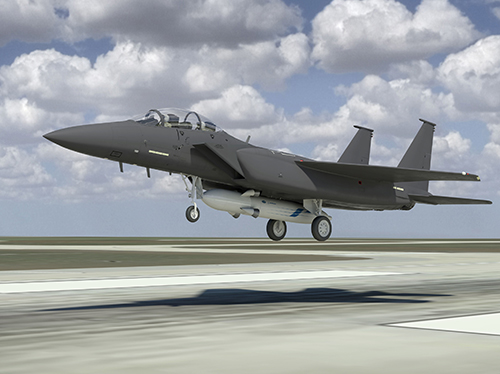
The ALASA rocket, measuring 7.3 meters long, would be attached to the underbelly of a Boeing-built F-15E fighter aircraft. DARPA says taking off from a standard airport runway would allow the Defense Department to launch from almost anywhere. Credit: Boeing artist's concept.
http://www.spacenews.com/article/military-space/40023boeing-targets-66-percent-launch-cost-reduction-with-alasa

 However, using the Falcon 1 upper stage may provide a fast, low cost means to produce such a system. Masten Space Systems could develop this as well since it would provide a much reduced cost proof-of-principle for their larger spaceplane that in itself would still be profitable.

 SpaceX has said the Falcon 9 first stage accounts for 3/4 of the cost and the upper stage, 1/4. If we assume a similar ratio for the $8 million Falcon 1, then we might estimate the cost of the upper stage as $2 million. However, unlike with the Falcon 9, the Falcon 1 upper stage uses a much smaller and simpler engine in the pressure-fed Kestrel and it is a much smaller stage in comparison to the first stage than is the case with the Falcon 9. Then I'll estimate its cost to be, say, $1 million. That would already be at the $1 million max cost DARPA wants per launch for the ALASA system.

Solid Rocket Motor Expendable Stage version.
 To get the launch cost below $1 million we would need reusability. If we got 10 launches from the Kestrel powered booster, that would be $100,000 per launch for just this lower stage. Then staying below the $1 million max cost would depend on the cost of the upper stage. There were some small solid rocket stages that were below $1 million in cost such as the Star 17 solid rocket motor:

Encyclopedia Astronautica.
Star 17
Solid propellant rocket stage. Loaded/empty mass 124/14 kg. Thrust 19.60 kN. Vacuum specific impulse 280 seconds.
Cost $ : 0.580 million.
Status: Out of production.
Gross mass: 124 kg (273 lb).
Unfuelled mass: 14 kg (30 lb).
Height: 0.98 m (3.21 ft).
Diameter: 0.44 m (1.44 ft).
Span: 0.44 m (1.44 ft).
Thrust: 19.60 kN (4,406 lbf).
Specific impulse: 280 s.
Specific impulse sea level: 220 s.
Burn time: 18 s.
Number: 25 .
http://www.astronautix.com/stages/star17.htm

 This is not currently in production but there are probably some remaining in storage or some of comparable size.

 According to Ed Kyle's page on the Falcon 1, the F1 upper stage had a 0.36 metric ton (mT) dry mass, 3.385 mT propellant mass and 327 sec Isp. However, the Kestrel engine used only had a 3,175 kgf (kilogram-force) thrust, i.e., less than the stage weight. So we'll cut down the propellant load to 2.5 mT.

 Now we'll use the fact that airlaunch actually can result in a significant reduction of the required delta-v that needs to be supplied by the rocket to reach orbit and therefore a significant increase in payload. This is described in some reports by Sarigul-Klijn et.al.:

Air Launching Earth-to-Orbit Vehicles: Delta V gains from Launch Conditions and Vehicle Aerodynamics.
Nesrin Sarigul-Klijn University of California, Davis, CA, UNITED STATES; Chris Noel University of California, Davis, CA, UNITED STATES; Marti Sarigul-Klijn University of California, Davis, CA, UNITED STATES
AIAA-2004-872
42nd AIAA Aerospace Sciences Meeting and Exhibit, Reno, Nevada, Jan. 5-8, 2004
http://pdf.aiaa.org/preview/CDReadyMASM04_665/PV2004_872.pdf  [first page only]

 The conclusions are summarized in this online lecture:

A.4.2.1 Launch Method Analysis (Air Launch).
For a launch from a carrier aircraft, the aircraft speed will directly reduce the Δv required to attain LEO. However, the majority of the Δv benefit from an air launch results
from the angle of attack of the vehicle during the release of the rocket. An
ideal angle is somewhere of the order of 25° to 30°.
A study by Klijn et al. concluded that at an altitude of 15250m, a rocket launch with the
carrier vehicle having a zero launch velocity at an angle of attack of 0° to
the horizontal experienced a Δv benefit of approximately 600 m/s while a launch
at a velocity of 340m/s at the same altitude and angle of attack resulted in a
Δv benefit of approximately 900m/s. The zero launch velocity situations can
be used to represent the launch from a balloon as it has no horizontal velocity.
Furthermore, by increasing the angle of attack of the carrier vehicle to
30° and launching at 340m/s, a Δv gain of approximately 1100m/s
was obtained. Increasing the launch velocity to 681m/s and 1021m/s produced a
Δv gain of 1600m/s and 2000m/s respectively.
From this comparison, it can be seen that in terms of the Δv gain, an airlaunch is 
superior to a ground launch. As the size of the vehicle decreases, this superiority 
will have a larger effect due to the increased effective drag on the vehicle.
https://web.archive.org/web/20120229141110/https://engineering.purdue.edu/AAE/Academics/Courses/aae450/2008/spring/report_archive/reportuploads/appendix/propulsion/A.4.2.1%20Launch%20Method%20Analysis%20(Air%20Launch).doc

 A speed of 340 m/s is a little more than Mach 1, while subsonic transport aircraft typically cruise slightly below Mach 1. So the delta-V saving could still be in the range of 1,000 m/s with air launch even using a standard subsonic jet, a significant savings by the rocket equation.

 And this study found by using a supersonic carrier aircraft you could double the payload of the Falcon 1:

Conceptual Design of a Supersonic Air-launch System.
43rd AIAA/ASME/SAE/ASEE Joint Propulsion Conference & Exhibit
8 - 11 July 2007, Cincinnati, OH
http://www.ae.illinois.edu/m-selig/pubs/ClarkeEtal-2007-AIAA-2007-5841-AirLaunch.pdf

 The idea had been that airlaunch can't result in much of an improvement in payload since jet transports typically cruise only around 300 m/s, so, it was thought, you would only subtract this off the delta-v needed to reach low Earth orbit (LEO), which is about 9,100 m/s. However, there is also the altitude the aircraft can achieve and another key factor is the high altitude launch means you can use the higher Isp and higher thrust vacuum versions of the engines. The Isp advantage can be quite significant. For instance the Merlin 1C only had a vacuum Isp of  304 sec, but the Merlin Vacuum, being optimized only to operate at near vacuum conditions, had an Isp of 340 sec.

 The Boeing version of the ALASA system will use the F-15E fighter jet for the airlaunch. This has a Mach 2.5 maximum speed at altitude and can carry 10,400 kg payload. So we'll use this also for our system. Following the Sarigul-Klijn et.al. paper, the Mach 2.5+ max speed of the F-15E  is above the 681 m/s air launch speed needed to reduce the delta-v to orbit by 1,600 m/s. This will bring the delta-v that needed to be delivered by the rocket down to about 7,500 m/s.

 Using the reduced propellant load for the Falcon 1 upper stage of 2.5 mT then with a 45 kg, 0.045 mT, payload, an (F1 upper stage + Star 17) rocket could get a delta-v of:

327*9.81ln(1 + 2.5/(0.36 + 0.124 + 0.045)) + 280*9.81ln(1 + 0.110/(0.014 + 0.045)) = 8,500 m/s.

 This is high enough that a cheaper subsonic carrier, which according to Sarigul-Klijn can still subtract off about 1,000 m/s from the required delta-v, could be used instead of the Mach 2.5 F-15E. 

 Let's also estimate how much higher payload we could get using the reduction of delta-v to 7,500 m/s allowed by using the F-15E. Taking the payload to be 80 kg, 0.08 mT, we get:

327*9.81ln(1 + 2.5/(0.36 + 0.124 + 0.08)) + 280*9.81ln(1 + 0.110/(0.014 + 0.08)) = 7,560 m/s.

 So we could actually exceed the DARPA requirements to get 80 kg to LEO.

Two Falcon 1 Upper Stage Version.
 Instead of using an expendable solid rocket as the upper stage, we could use instead a second Falcon 1 upper stage. This will allow the possibility of getting a fully reusable system. We'll have both stages firing in parallel to be able to get a T/W greater than 1. We'll also use cross-feed fueling to maximize payload. For the upper stage that reaches orbit, we'll give it the full 3.385 mT propellant load since this stage doesn't have to have a T/W greater than 1. Then using the reduced 7,500 m/s required delta-v to orbit, we could transport 240 kg to LEO:

327*9.81ln(1 + 2.5/(0.36 + 3.745 + 0.240)) + 327*9.81ln(1 + 3.385/(0.36 + 0.240)) =7,530 m/s.

 We could also improve the mass ratio of these stages and increase the payload by switching to lightweight aluminum-lithium alloy for the propellant tanks. This could save as much as 25% off the tank weight. 


  Bob Clark


Wednesday, April 30, 2014

A contingency plan for a fast return of the U.S. to space.

Copyright 2014 Robert Clark


Why NASA and Congress Spent Four Hours Shouting At Each Other About Russia.
April 8, 2014 // 04:17 PM EST
http://motherboard.vice.com/read/why-nasa-and-congress-spent-four-hours-shouting-at-each-other-about-russia

 The congressmen kept asking for a short-term contingency plan to return America to space in case of seriously deteriorating U.S/Russia relations and Bolden kept responding with the three-year plan to have commercial crew flying. But there is a shorter term plan. BOTH SpaceX and Boeing have said they could be flying crew by next year with funding. So if the congressmen want a shorter term contingency plan, provide that required extra funding.

 At the Humans 2 Mars 2014 conference I asked Bolden about such a contingency plan. It's about at the 15 minute mark in this video:


 He responded that SpaceX has not been selected yet as the crew launch provider. OK, then also fund Boeing so they can also return crew to the ISS by 2015.

 There has been talk in Congress of only having one crew launch provider. I strongly disagree with that plan. We all saw what can happen when you only have one launch provider and that one goes down, as happened with the shuttle. SpaceX is furthest along so they should be one of the providers. But on the other hand the Boeing capsule would be carried on the Atlas V which has had a remarkable string of successful launches, which SpaceX is nowhere near to matching yet.

 Russian Deputy Prime Minister Dmitry Rogozin mocked the U.S. space sanctions against Russia saying NASA would need to get a trampoline to get its astronauts to the ISS. This led Elon Musk to state through his twitter account that SpaceX would be revealing its man-rated Dragon 2 at the end of May:


 Now, if SpaceX is flying their own crews to LEO in 2015 and there is still a strained relationship between the U.S. and Russia then, then it would be extremely embarrassing for NASA to still be paying Russia to ferry NASA astronauts to the ISS when SpaceX will already be flying American crews to LEO.

 A solution would be for NASA to at least draw up a contingency plan including cost estimates of how much extra funding it would take to also take NASA astronauts to the ISS. Then the onus would be on Congress to decide if they want to provide NASA with the extra funding to do so.

   Bob Clark

Wednesday, July 17, 2013

Budget Moon Flights: Ariane 5 as SLS upper stage.

Copyright 2013 Robert Clark

Delta IV Heavy Orion Circumlunar Test Flight.
I’m fairly sure looking at the capabilities of the Delta IV Heavy with the upgraded RS-68a engine, about 28 metric tons to LEO, that it could launch the Orion on that 2014 test launch on an actual circumlunar flight, not just to 3,600 miles out as currently planned. A circumlunar flight would result in a much more capable test of the Orion.

The Orion test is planned to only carry a dummy service module, so that will be much lighter. The flight is planned though to carry the launch abort system (LAS) so that detracts from the weight that can be launched.

Without the LAS the DIVH could definitely send the Orion on a circumlunar flight. With the LAS, it makes it a little more difficult to estimate since it is jettisoned before reaching orbit.

This makes the use of the SLS for that unmanned circumlunar test flight in 2017 even more dubious, since the DIVH could do that, even if removing the LAS is required. That is another reason why I argue NASA should be aiming for an actual unmanned lunar landing test with that 2017 SLS flight.

Low Cost Lunar Lander and Crew Module.
ULA has done studies on adapting the Centaur upper stage as a lunar lander stage so you would not need a huge, and hugely expensive, Altair lander. We already even have a crew module that could be used for such a lander in NASA’s SEV, which can be ready by 2017 for test flights:


Inside NASA’s New Spaceship for Asteroid Missions | Space.com.
by Clara Moskowitz, SPACE.com Assistant Managing Editor
Date: 12 November 2012 Time: 02:30 PM ET

If the current schedule holds, NASA could test-drive a version of the SEV at the International Space Station in 2017. http://www.space.com/18443-nasa-asteroid-spacecraft-sev.html

Ariane 5 Core as SLS Upper Stage.
NASA is considering a version of the upper stage to be used with the Block II version of the SLS that uses RL-10 engines instead of the J-2X:

SLS prepares for PDR – Evolution eyes Dual-Use Upper Stage.
June 1, 2013 by Chris Bergin
http://www.nasaspaceflight.com/2013/06/sls-pdr-evolved-rocket-dual-upper-stage/

This is expected to save on costs.

NASA also wants to encourage European participation in the proposed asteroid retrieval mission:

NASA Pitches Asteroid Capture To International Partners.
By Frank Morring, Jr.
Source: Aerospace Daily & Defense Report
June 28, 2013
http://www.aviationweek.com/Article.aspx?id=/article-xml/asd_06_28_2013_p01-01-592208.xml

Then a way to save further on development costs and to get European involvement would be to use the Ariane 5 core as the upper stage. It’s of common-bulkhead design to save mass. I recently learned it also uses the pressure-stabilized, “balloon tank”, method a la the Centaur to further save on tank mass.

The ESA also believes its Vulcain II engine can be made air-startable since this was planned for the Liberty rocket. The Vulcain uses a rather short nozzle since it is meant for ground launch, giving it a 432 s Isp. But simply giving it a nozzle extension would give it the ca. 462 s ISP of the RL-10.

Another key advantage is that because little additional development would be needed it might even be ready by the 2017 first launch of the SLS. Then this first 2017 launch of what was only to be a 70 mT interim version could have the 100+ mT capability of the later versions of the SLS. Such a version would clearly have the capability to do manned lunar lander missions.

You could also give this stage the RL-10 engines, instead of the Vulcain. The Vulcain weighs about 1,800 kg. Four RL-10′s would weigh 1,200 kg. So this would save 600 kg off the stage dry mass.

The NasaSpaceFlight.com article mentions the advantage of having different diameters for the hydrogen and oxygen tanks to maintain commonality with tooling of existing stages, and that is the reason for not having both tanks the same diameter. That would not be a problem of course with using the Ariane 5 core at a common 5.4 meter diamter. And someone noted on the Nasaspaceflight forum thread on this topic that for a uniform 8.4 m diameter, NASA could just use the same tooling for both that is used for the 8.4 meter SLS core stage tank.

For any of these possibilities it would be very good if NASA could use the composite tanks Boeing is investigating. Aerospace engineer Jon Goff on his blog noted ULA estimated their ACES proposed upgrade of the Centaur could get a 20 to 1 mass ratio by switching to aluminum-lithium for the tanks. And according to Boeing, an additional 40% can be saved off the Al-Li tank mass by using composites, resulting in an even larger mass ratio than 20 to 1:


NASA Sees Potential In Composite Cryotank.
By Frank Morring, Jr. morring@aviationweek.com
Source: AWIN First
July 01, 2013
http://www.aviationweek.com/Article.aspx?id=/article-xml/awx_07_01_2013_p0-592975.xml


Scaling up your stage mass, such as to the DUUS size, is also known to be able to improve your mass ratio. Imagine then all these mass ratio improving factors being applied. How high could the mass ratio get, perhaps to the 25 to 1, or even 30 to 1 range???

Imagine what you could do with a hydrolox stage with an ISP as high as ca. 462 s with a mass ratio as high as 30 to 1. (*)

Bob Clark


(*) By rocket equation, the delta-v is:  462*9.81ln(30) = 15,400 m/s.


Update, Sept. 28, 2013:

 Finally, NASA has acknowledged that the Block 1, first version of the SLS to launch in 2017 will have a 90+ mT payload capacity not the 70 mT always stated by NASA:

SLS Dual Use Upper Stage (DUUS).
http://ntrs.nasa.gov/archive/nasa/casi.ntrs.nasa.gov/20130013953_2013013757.pdf

 This is important since it means we will have the capability to do manned lunar landing missions by the 2017 first launch of the SLS:

SLS for Return to the Moon by the 50th Anniversary of Apollo 11, page 5: A 90+ metric ton first launch of the SLS.
http://exoscientist.blogspot.com/2013/09/sls-for-return-to-moon-by-50th.html

Could Blue Origin develop a lander for Artemis III?

Copyright 2025 Robert Clark SpaceX is coming under increasing criticism for its delay in developing the Starship lunar lander: U.S. Is Losin...