Showing posts with label Dr. John Schilling. Show all posts

Tuesday, October 4, 2016

A smaller, faster version of the SpaceX Interplanetary Transport System to Mars, UPDATED, 10/15/2016.

Copyright 2016 Robert Clark


 In the blog post "A SpaceX Heavy Lift Methane Rocket, Page 2", I proposed some architectures for a Mars transport rocket. This was based on a quite large 1,800,000 lb. vacuum thrust of the methane-powered Raptor.

 However, recently Elon Musk discussed the current version of the SpaceX Mars transport model called the Interplanetary Transport System (ITS). Here they are going back to a smaller version of the Raptor, at ca. 660,000 lb. vacuum thrust. In this version however, their booster will be quite large at ca. 7,000 metric tons (mT) gross weight.

 Because of the reduced size of the Raptor this will require 42 engines on the booster. However, interestingly the size of the upper stage will be similar to the size of the booster I discussed in "A SpaceX Heavy Lift Methane Rocket, Page 2". So you could get a Mars launch booster by using this upper stage instead as a booster.


But because of the smaller engines in the SpaceX formulation they will use nine of the Raptors on the upper stage. I stated in the earlier blog post I wanted to use at most 5 of the larger Raptor engines to emulate the safety record of the 5 large engines on the Saturn V booster. However, SpaceX seems to have gotten the 9 engines on the Falcon 9 to work, and in any case you could just use the booster to send the cargo and habitats to space and use high safety rockets to launch the crew to meet up with the transport craft in space.

 The objection could be made however, that this is supposed to be just an upper stage, not a booster stage. However, at his IAC presentation of this Mars transport system he stated that the upper stage in both the spaceship and tanker form could be SSTO. Furthermore, the tanker he said could be used a fast intercontinental transport craft. This means necessarily they would have to be able to launch from the ground. So it is not too much of stretch to assume they could be used as a first stage.


An advantage of making this smaller upper stage the actual booster is that Elon has said they will have a development craft within 4 years. So if we make now a smaller upper stage to go with it, we could have a valid Mars transport craft at that early date. If we made this new upper stage correspondingly 1/3rd size, then we would be able to get 1/3rd the crew size to Mars, so a crew of ca. 35 to Mars.

 However, interestingly we might be able to use already existing upper stages on existing rockets for the upper stage, for instance possibly the famous Centaur upper stage used on the Atlas V or the Ariane 5 core itself used here as an upper stage.

 We can estimate how much we could get to LEO using the ITS tanker as the booster and the Ariane 5 core as the upper stage. The required delta-v to LEO is 30,000 ft/sec about 9,100 m/s:

Modern Engineering for Design of Liquid-Propellant Rocket Engines, p.12
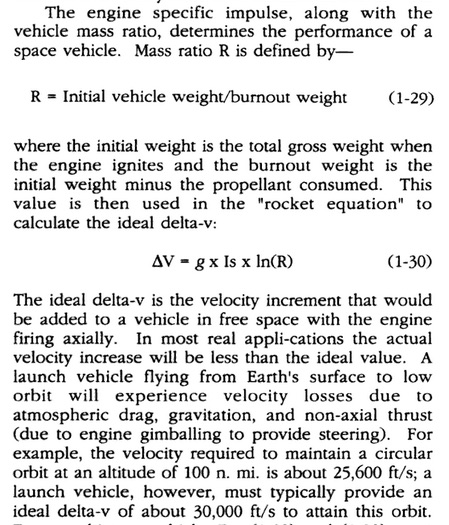
 Since we can get a high 465 s vacuum Isp for a hydrolox engine just by using a nozzle extension we'll assume that value for the Ariane 5 engine. Also we'll assume we can get a vacuum 382 s Isp for the ITS tanker by using altitude compensation.

 Then for the propellant and dry mass values for the ITS tanker and Ariane 5 core we could get 225 metric tons to LEO:

382*9.81ln(1 + 2500/(90 + 170 + 225)) + 465*9.81ln(1 + 158/(12 + 225)) = 9,140 m/s.

 This makes clear another key advantage of this architecture: whereas the original SpaceX ITS would require five flights of the ITS to refuel the upper stage spaceship, with this smaller version a single flight would be able to carry the spaceship to orbit as well as its fuel for its flight towards Mars.

 But what would be the crew size for this smaller upper stage? We can estimate it by making a comparison to the delta-v possible in accordance with the stats of the ITS spaceship:

382*9.81ln(1 + 1950/(150 + 450)) = 5,400 m/s.

 So we want the Ariane 5 case to be able to reach a delta-v of 5,400 m/s when fully refueled and firing in space headed towards Mars:

465*9.81ln(1 +158/(12 +55)) = 5,500 m/s.

 So this is a payload of about 55 metric tons. This is about 1/8th the mass for the ITS case, so we can estimate the crew size to be 1/8th also, so to a crew of 12.

  Elon in his IAC presentation says the ITS carrying its 100 member crew might be able to reach Mars in 80 days at a particular close Mars opposition. This is dependent on the departure delta-v however. In the blog post "Propellant depots for interplanetary flight". I noted that at a higher departure delta-v possible by using a smaller 6 metric ton habitat for only a crew of 3, the Ariane 5 used as the in space propulsion stage might be able to make it to Mars in only 35 days, when leaving at such a particularly close Mars opposition.


  Bob Clark

UPDATE, 10/15/2016:

 Dr. John Schilling's launch performance calculator is back up. This allows us to produce a more accurate payload estimate. The vacuum thrust for the 382 Isp Raptor is 3.5 meganewtons, 3,500 kN. So 9 would be 31,500 kN. We'll also increase the vacuum thrust of the Vulcain engine on the Ariane 5 to 1,450 kN in accordance with the increased vacuum Isp of 465 s. Inputting these and the other specs in the calculator results in:

Mission Performance:
Launch Vehicle:  User-Defined Launch Vehicle
Launch Site:  Cape Canaveral / KSC
Destination Orbit:  185 x 185 km, 28 deg
Estimated Payload:  177767 kg
95% Confidence Interval:  150063 - 210818 kg

"Payload" refers to complete payload system weight, including any necessary payload attachment fittings or multiple payload adapters

This is an estimate based on the best publicly-available engineering and performance data, and should not be used for detailed mission planning. Operational constraints may reduce performance or preclude this mission.


 So the calculator estimates 178 metric tons. This is less than the 225 metric ton estimate using just the rocket equation, but it still means a single flight could carry enough payload to fully refuel an Ariane 5 core upper stage for a flight to Mars.

  Bob Clark

Sunday, January 24, 2016

New Shepard as a booster for an orbital launcher.

Copyright 2016 Robert Clark


 Blue Origin scored another first by successfully relaunching their vertical landing New Shepard suborbital rocket:


 In the blog post "Triple Cored New Shepard as an orbital vehicle", I suggested using three cores of the New Shepard rocket with a small upper stage could form an orbital launcher. However Jonathan Goff on his blog page SelenianBoondocks raised the possibility a single New Shepard could serve as the first stage booster of an orbital rocket:

Random Thoughts: New Shepard for Pop-Up TSTO NanoSat Launch.
http://selenianboondocks.com/2016/01/random-thoughts-new-shepard-for-pop-up-tsto-nanosat-launch/

  I think it should be doable using a similar small cryogenic upper stage as for the triple-cored case. The stage I suggested there was the cryogenic upper stage of the Ariane 4, the Ariane H10-3, or one developed by Blue Origin similar to it. It had a dry mass of 1,240 kg and a propellant mass of 11,860 kg. The Isp was 445 s with a vacuum thrust of 64.8 kN. However, simply using a nozzle extension as on the RL-10B-2 can give it likewise an Isp of 462 s and vacuum thrust of 110 kN. So we'll use these values.

 To make the estimate of the payload we need the vacuum values for the Isp and thrust of the BE-3 engine. In the "Triple Cored New Shepard as an orbital vehicle" blog post I estimated these to be 360 s and 568.8 kN respectively.

 However, to loft the vehicle with the additional weight of the upper stage we'll need to increase the BE-3 thrust slightly. This should doable. For instance the SSME’s could operate at 109% of their originally rated thrust, and the Merlin 1D had a 15% thrust upgrade. So say the BE-3 vacuum thrust is increased 9% to 620 kN, keeping the same Isp.

 Now use Dr. John Schilling's payload estimator program. For the "Restartable upper stage" option check "No", otherwise the payload will be reduced. Select Cape Canaveral as the launch site and enter 28.5 for the launch inclination in degrees to match the latitude of the launch site. Then the calculator gives the result:

Mission Performance:
Launch Vehicle:  User-Defined Launch Vehicle
Launch Site:  Cape Canaveral / KSC
Destination Orbit:  185 x 185 km, 28 deg
Estimated Payload:  1690 kg
95% Confidence Interval:  1298 - 2153 kg

"Payload" refers to complete payload system weight, including any necessary payload attachment fittings or multiple payload adapters

This is an estimate based on the best publicly-available engineering and performance data, and should not be used for detailed mission planning. Operational constraints may reduce performance or preclude this mission.


 Altitude Compensation to Increase Payload.
  As I discussed in the "Triple Cored New Shepard as an orbital vehicle" blog post, altitude compensation provides a simple, low cost method of improving payload.  For instance by attaching a nozzle extension the vacuum Isp of the BE-3 can be increased to the 462 s range of the RL-10B-2 engine. The vacuum thrust will then be increased proportionally to (462/360)*620 = 796 kN.

 Then the Schilling calculator gives the result:

Mission Performance:
Launch Vehicle:  User-Defined Launch Vehicle
Launch Site:  Cape Canaveral / KSC
Destination Orbit:  185 x 185 km, 28 deg
Estimated Payload:  2324 kg
95% Confidence Interval:  1841 - 2895 kg

"Payload" refers to complete payload system weight, including any necessary payload attachment fittings or multiple payload adapters

This is an estimate based on the best publicly-available engineering and performance data, and should not be used for detailed mission planning. Operational constraints may reduce performance or preclude this mission.


  Bob Clark

UPDATE, Feb. 28, 2016:

 This considered an Ariane hydrolox upper stage as the upper stage for this New Shepard launcher. This would be problematical since it would be a direct competitor to Arianespace's Vega rocket at a much lower cost than the Vega's $35 million.

 Blue Origin very likely could develop a hydrolox upper stage that would be cheaper than the Ariane one. But that would take time and significant development cost. Instead of that, Blue Origin could produce a New Shepard derived launcher for cubesats at minimal extra development cost since the required small upper stages already exist.

 Existing upper stages that could work would be the large Star solid rocket upper stages such as the Star 63F:

Star 63F:
http://www.astronautix.com/engines/star63f.htm

 Using this for the upper stage, Schillings launch performance calculator gives:

Mission Performance:
Launch Vehicle:  User-Defined Launch Vehicle
Launch Site:  Cape Canaveral / KSC
Destination Orbit:  185 x 185 km, 28 deg
Estimated Payload:  293 kg
95% Confidence Interval:  174 - 443 kg

 This is in the range being considered for the cubesat launchers that NASA has already awarded million dollar contracts to:

Firefly, Rocket Lab and Virgin Galactic Win CubeSat Launch Contracts from NASA.
By Caleb Henry | October 15, 2015 | Feature, Government, Launch, North America, Regional, Satellite TODAY News Feed
http://www.satellitetoday.com/launch/2015/10/15/firefly-rocket-lab-and-virgin-galactic-win-cubesat-launch-contracts-from-nasa/

 Considering the quoted prices there, this New Shepard based launcher very likely could beat these prices especially using the reusable New Shepard.

 And since the upper stage already exists, it very likely would also beat to launch these other systems still in development.

 About the quick route to operational status of this orbital rocket, I think it is significant that Blue Origin was able to beat SpaceX on a relaunch of its returned booster. The argument has been made that New Shepard is not an orbital launcher. But if Blue Origin developed this orbital launcher from New Shepard then they would be able to beat SpaceX at reusing a booster for a true orbital launcher as well.

 My opinion is SpaceX will have difficulty with getting their booster to land in reliable fashion as long as it does not have hovering ability. And because the New Shepard does have hovering ability it will be more reliable as a reusable booster.

 BTW, as Blue Origin develops its large high performance dense propellant engines, it will have the same problem as SpaceX it getting its booster to be able to hover, resulting in the same problem of reduced reliability on landing. For this reason I think Blue Origin should investigate methods of giving its large planned boosters hovering ability such as discussed here:

Hovering capability for the reusable Falcon 9, page 3: hovering ability can increase the payload of a RLV.
http://exoscientist.blogspot.com/2015/12/hovering-capability-for-reusable-falcon.html

 Surprisingly, it turns out that hovering ability when properly implemented can actually improve the the payload for a reusable rocket.

Sunday, December 28, 2014

A liquid-fueled Indian manned launcher. UPDATED.

Copyright 2014 Robert Clark


 India is progressing towards manned spaceflight:

India debuts GSLV Mk.III with prototype crew capsule.
December 17, 2014 by William Graham


 The current plan is for a 2021 launch for the manned system. However, the most recently developed rocket the GSLV Mk. III uses two large solid side boosters. Space engineers in general do not like solid rockets for manned launchers since they can not be shut down. However, there is an all liquid alternative for India for a manned launcher that actually would be cheaper than the GSLV Mk. III.

 It would use 4 of the liquid-fueled strap on boosters used on the earlier design the GSLV Mk. II attached to the GSLV Mk. III core stage. We'll use the specifications on the GSLV Mk. II and GSLV Mk. III on Ed Kyle's SpaceLaunchReport.com page. The strap-ons for the GSLV Mk. II have a gross mass of 48.2 metric tons (mT) and propellant mass of 42.6 mT so a dry mass of 5.6 mT. The vacuum thrust of the single Vikas 2 engine is 70,360 kgf, 690 kN, with a vacuum Isp of  281 s. 

 The gross mass of the GSLV Mk. III is 125 mT with a propellant load of 110 mT, so a dry mass of 15 mT. The vacuum thrust of the two Vikas 2 used is 140,720 kgf, 1380 kN. The cryogenic upper stage has a gross mass of 30 mT, with a propellant load of 25 mT, so a dry mass of 5 mT. It's engine CE-20 engine has a thrust of 20,000 kgf, 196 kN, with an Isp of 450 s.
  
 Input this data into Dr. John Schilling's Launch Performance Calculator. Select the Satish Dhawan launch site and a launch inclination of 13.9 degrees to match the latitude of the launch site. Then the calculator gives a payload to LEO of:

Mission Performance:
Launch Vehicle:  User-Defined Launch Vehicle
Launch Site:  Satish Dhawan Space Center
Destination Orbit:  185 x 185 km, 14 deg
Estimated Payload:  6493 kg
95% Confidence Interval:  4829 - 8498 kg

"Payload" refers to complete payload system weight, including any necessary payload attachment fittings or multiple payload adapters
This is an estimate based on the best publicly-available engineering and performance data, and should not be used for detailed mission planning. Operational constraints may reduce performance or preclude this mission.


 About 6,500 kg. It is notable though reading the description of the failed launches of the GSLV on the SpaceLaunchReport.com page that some involved engine failures. There would need to be multiple successful unmanned launches of this configuration before it is certified for manned launches.


  Bob Clark

UPDATE, January 15, 2015:

 I found that the www.spaceflight101.com site provides more accurate info on the GSLV Mk. II and GSLV Mk. III launchers than the Spacelaunchreport.com page. Using these values gives an even better performance for this proposed all-liquid launcher.

 The GSLV Mk. II side boosters have specifications listed as:

                                 Boosters

# Boosters4
TypeLH40
Length19.7m
Diameter2.1m
Inert Mass~5,600kg
Launch Mass47,600kg
Tank MaterialAluminium Alloy
FuelUH25 - 75% UMDH, 25% Diazane
OxidizerNitrogen Tetroxide
Propulsion1 Vikas 2
Thrust763kN
Impulse293 sec
Engine Dry Weight900kg
Engine Length2.87m
Engine Diameter0.99m
Burn Time148sec
Chamber Pressure58.5bar
Mixture Ratio1.7 (Ox/Fuel)
Attitude ControlSingle-Plane Engine Gimbaling
Stage SeparationWith Core Stage

 The GSLV Mk. III core stage has specifications listed as:

Core Stage

TypeL-110
Length21.26m
Diameter4.0m
FuelUnsymmetrical Dimethylhydrazine
OxidizerNitrogen Tetroxide
Inert Mass10,600kg
Propellant Mass115,000kg
Launch Mass125,600kg
Propellant TanksAluminum Alloy
FuelUH25 - 75% UDMH, 25% Diazane
OxidizerNitrogen Tetroxide
Propulsion2 Vikas 2
Thrust (SL)677kN
Thrust (Vac)766kN
Specific Impulse293 sec
Engine Dry Weight900kg
Engine Length2.87m
Engine Diameter0.99m
Chamber Pressure58.5bar
Mixture Ratio1.7 (Ox/Fuel)
Turbopump Speed10,000rpm
Flow Rate275kg/s
Area Ratio13.88
Attitude ControlEngine Gimbaling
IgnitionT+110s
Burn Time200s
Stage SeparationActive/Passive Collets

 The cryogenic upper stage has specifications listed as:


Cryogenic Upper Stage

TypeC-25 Cryogenic Upper Stage
Length13.32m
Diameter4.0m
FuelLiquid Hydrogen
OxidizerLiquid Oxygen
Inert Mass~4,000kg
Propellant Mass25,000kg
Launch Mass~29,000kg
Propellant TanksAluminum Alloy
PropulsionCE-20
Engine TypeGas Generator
Thrust - Vacuum200kN
Operational Range180-220kN
Specific Impulse Vac443s
Engine Mass588kg
Chamber Pressure60bar
Mixture Ratio5.05
Area Ratio100
Thrust to Weight34.7
Burn Time580s
GuidanceInertial Platform, Closed Loop
Attitude Control2 Vernier Engines
Restart CapabilityRCS for Coast Phase

  Plugging these dry mass, propellant mass, and Isp values into the Schilling calculator gives these results:

Mission Performance:
Launch Vehicle:  User-Defined Launch Vehicle
Launch Site:  Satish Dhawan Space Center
Destination Orbit:  185 x 185 km, 14 deg
Estimated Payload:  9005 kg
95% Confidence Interval:  7106 - 11299 kg

"Payload" refers to complete payload system weight, including any necessary payload attachment fittings or multiple payload adapters

This is an estimate based on the best publicly-available engineering and performance data, and should not be used for detailed mission planning. Operational constraints may reduce performance or preclude this mission.


 A payload of 9,000 kg is quite high. It's close to the 10,000 kg payload of the GSLV Mk. III without needing the two huge, expensive solid side boosters the Mk. III uses. Note also this all-liquid configuration with 4 liquid side boosters is similar to that of the venerable Soyuz launcher used for decades for manned launches.

 To get a faster operational manned rocket we might use the smaller cryogenic upper stage already used on the GSLV Mk. II. On the December 2014 test flight of the GSLV Mk. III, its cryogenic stage was still in development and was not part of the test. So to use all operational stages instead we could use the Mk. II's cryogenic stage. It's specifications are listed as:

                                  Third Stage

TypeGS3 - C15
Inert Mass~2,500kg
Launch Mass~15,300kg
Length8.7m
Diameter2.8m
Tank MaterialAluminium Alloy
FuelLiquid Hydrogen
OxidizerLiquid Oxygen
Propellant Mass12,800kg
GuidanceInertial Platform, Closed-Loop
Propulsion1 ICE (CE-7.5)
CycleStaged Combustion
Thrust (Vacuum)73.5 to 93.1kN
Impulse454sec
Engine Dry Weight435kg
Engine Length2.14m
Engine Diameter1.56m
Burn TimeUp to 1,000sec
Chamber Pressure58bar
Attitude Control2 vernier Jets, each 2kN
RCS for Coast Phases
Stage SeparationMerman Band, Hot Staging

   Inputting these specifications instead into the Schilling calculator gives:

Mission Performance:
Launch Vehicle:  User-Defined Launch Vehicle
Launch Site:  Satish Dhawan Space Center
Destination Orbit:  185 x 185 km, 14 deg
Estimated Payload:  6810 kg
95% Confidence Interval:  5373 - 8577 kg

"Payload" refers to complete payload system weight, including any necessary payload attachment fittings or multiple payload adapters

This is an estimate based on the best publicly-available engineering and performance data, and should not be used for detailed mission planning. Operational constraints may reduce performance or preclude this mission.


  The 6,800 kg payload is still high, sufficient for a manned launcher.

   Bob Clark
 

Could Blue Origin develop a lander for Artemis III?

Copyright 2025 Robert Clark SpaceX is coming under increasing criticism for its delay in developing the Starship lunar lander: U.S. Is Losin...