Showing posts with label XS-1. Show all posts

Sunday, June 10, 2018

DARPA's Spaceplane: an X-33 version, Page 2.

Copyright 2018 Robert Clark

 The OldSpace companies had always discounted the viability of reusable launchers on the grounds that the launch market was not enough to pay for it. However, a new market will soon be opening up for hundreds to thousands of launches required for the impending satellite megaconstellations. Now even the OldSpace company ArianeSpace is speaking of transitioning to reusability.

 So with reusability soon to become prevalent we have now further justification for resurrecting the X-33. Boeing supported by a DARPA grant is developing a reusable, spaceplane first stage, the XS-1, then Lockheed with the X-33 would have a competing reusable launcher.

 In the blog post DARPA's Spaceplane:an X-33 version, I discussed that the X-33 used as a reusable first stage has importance beyond that of just a test stage of an operational SSTO, the VentureStar. For the X-33 could be its own operational vehicle, cutting costs in its own right as a reusable first stage.  But intriguingly the problems that originally doomed the X-33 and its SSTO follow-on the VentureStar may also be solvable.

 As discussed in that earlier post, it was the failure of the composite tanks that caused the X-33 program to be cancelled. But some new high strength aluminum alloys may have the comparable lightweight characteristics as carbon composite tanks.

 Carbon composite propellant tanks are a pretty well developed technology, as long as they are cylindrically shaped. But the unusual conformal shape of the composite tanks on the X-33 caused them to fail.

 Carbon composite saves about half-off the weight of standard aluminum tanks. But interestingly some new aluminum alloys have comparable high strength at lightweight as carbon composite and therefore could be used to give the lightweight tanks needed. 

 See for example the graphic:


  The 7075 T6 alloy has nearly twice the strength per weight as the standard 6061 T6 alloy, and the 7068 T6 was nearly 2.5 times better. 

 A consideration as described on that page is that 7075 is 2 to 3 times more expensive than the standard 6061 and the 7068 is 3 to 4 times more expensive. But considering that because of their higher strength, smaller amounts of the material by a factor of 2 to 2.5 would be needed the price difference in practice would not be as great.

 Note also since it was the inability to produce the composite tanks in the X-33 at the needed lightweight that caused the program to be cancelled, existence of the high strength aluminum alloys make the SSTO VentureStar once again viable.

 Development Cost.

 The cost of carbon fiber is about twice that of standard aluminum, so the cost of the tanks with high strength aluminum would not be much more than the cost of the carbon fiber X-33. Since Lockheed would be paying this itself, it might want first to do a smaller version of the X-33.

 In the earlier "DARPA's SpacePlane" post, I suggested a smaller version half-size in linear dimensions of the X-33 might cost ca. $45 million to build. This would test the technology and moreover using it as an upper stage of the X-33 would give a fully reusable system.

   Bob Clark

UPDATE 7/4/2018: 

 I've been informed of other other high strength, lightweight metal alloys that could also allow VentureStar to achieve its goal of a being a reusable SSTO, and allow the X-33 to be able to serve as a low cost reusable first stage.

 The alloys have various strengths and weaknesses. For example some are are just now being experimented with but their measured strength-to-weight ratio is more than 3 times better than standard aluminum. Some are steel alloys which have better weldability than the aluminum alloys, etc.

 For instance in the graphic above, the titanium 6Al-4V alloy is a little better than the 7075 and is already used in rockets for example for solid motor casings.

 There is also a high strength steel alloy, the 17-7 PH stainless steel CH 900:

Re: SpaceX second stage secret sauce?
https://forum.nasaspaceflight.com/index.php?topic=41906.msg1626634#msg1626634

 It has comparable strength-to-weight as the 7068, i.e., nearly 2.5 times better than standard aluminum. It also has better weldability than the aluminum alloys.

 A recent report shows some high strength aluminum alloys such as the 7075 can be 3D-printed:

Engineers Have Found a Way to 3D Print Super Strong Aluminum.
B. Ferguson/HRL Laboratories
by Dom Galeon September 22, 2017 Hard Science
https://futurism.com/engineers-have-found-a-way-to-3d-print-super-strong-aluminum/

 This is useful since the high strength aluminum alloys such as the 7075 have poor weldability. But the conformal shapes of the X-33/VentureStar tanks would be difficult to make without welding.

 Ti 5553 alloy is another ultra strong titanium alloy, even better than the Ti 6Al-4V. It has a max tensile strength in the range of 1,400 MPa. At a density of 4.64 gm/cc, this puts it in strength-to-weight ratio at even better than the 7068 alloy, and nearly 3 times better than standard aluminum:

Processing of a metastable titanium alloy (Ti-5553) by selective laser melting.
November 2016Ain Shams Engineering Journal 8(3)
https://www.researchgate.net/public...nium_alloy_Ti-5553_by_selective_laser_melting

Finally, a titanium alloy known as the Ti185 was long known but it was difficult to produce it so it had uniform strength throughout. A new method of producing it using titanium hydride powder can produce it so it is uniformly strong:

Low-cost and lightweight: Strongest titanium alloy aims at improving vehicle fuel economy and reducing CO2 emissions
April 1, 2016, Pacific Northwest National Laboratory

https://phys.org/news/2016-04-low-cost-lightweight-strongest-titanium-alloy.html

 Approaching 1,700 MPa in tensile strength, it would be 3.5 times better on strength-to-weight than standard aluminum. Because it is made of titanium hydride powder, it may also be possible to make it by 3D-printing, which would solve the problem of producing a conformal shape for the tanks of the X-33/VentureStar.



Friday, August 15, 2014

Dave Masten's DARPA Spaceplane, page 2: an Air Launched System.

Copyright 2014 Robert Clark

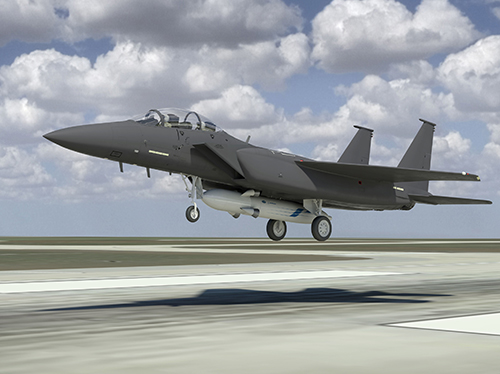
 In the blog post Dave Masten's DARPA Spaceplane, I discussed using SpaceX Falcon 1 or Falcon 9 stages to achieve DARPA's XS-1 reusable first-stage spaceplane. Another DARPA program ALASA seeks to send smaller payloads of 45 kg to orbit for $1 million using air-launch. 

 DARPA has already awarded a contract to Boeing to produce the ALASA system:

Boeing Targets 66 Percent Launch Cost Reduction with ALASA.
By Mike Gruss | Mar. 28, 2014
The ALASA rocket, measuring 7.3 meters long, would be attached to the underbelly of a Boeing-built F-15E fighter aircraft. DARPA says taking off from a standard airport runway would allow the Defense Department to launch from almost anywhere. Credit: Boeing artist's concept.
http://www.spacenews.com/article/military-space/40023boeing-targets-66-percent-launch-cost-reduction-with-alasa

 However, using the Falcon 1 upper stage may provide a fast, low cost means to produce such a system. Masten Space Systems could develop this as well since it would provide a much reduced cost proof-of-principle for their larger spaceplane that in itself would still be profitable.

 SpaceX has said the Falcon 9 first stage accounts for 3/4 of the cost and the upper stage, 1/4. If we assume a similar ratio for the $8 million Falcon 1, then we might estimate the cost of the upper stage as $2 million. However, unlike with the Falcon 9, the Falcon 1 upper stage uses a much smaller and simpler engine in the pressure-fed Kestrel and it is a much smaller stage in comparison to the first stage than is the case with the Falcon 9. Then I'll estimate its cost to be, say, $1 million. That would already be at the $1 million max cost DARPA wants per launch for the ALASA system.

Solid Rocket Motor Expendable Stage version.
 To get the launch cost below $1 million we would need reusability. If we got 10 launches from the Kestrel powered booster, that would be $100,000 per launch for just this lower stage. Then staying below the $1 million max cost would depend on the cost of the upper stage. There were some small solid rocket stages that were below $1 million in cost such as the Star 17 solid rocket motor:

Encyclopedia Astronautica.
Star 17
Solid propellant rocket stage. Loaded/empty mass 124/14 kg. Thrust 19.60 kN. Vacuum specific impulse 280 seconds.
Cost $ : 0.580 million.
Status: Out of production.
Gross mass: 124 kg (273 lb).
Unfuelled mass: 14 kg (30 lb).
Height: 0.98 m (3.21 ft).
Diameter: 0.44 m (1.44 ft).
Span: 0.44 m (1.44 ft).
Thrust: 19.60 kN (4,406 lbf).
Specific impulse: 280 s.
Specific impulse sea level: 220 s.
Burn time: 18 s.
Number: 25 .
http://www.astronautix.com/stages/star17.htm

 This is not currently in production but there are probably some remaining in storage or some of comparable size.

 According to Ed Kyle's page on the Falcon 1, the F1 upper stage had a 0.36 metric ton (mT) dry mass, 3.385 mT propellant mass and 327 sec Isp. However, the Kestrel engine used only had a 3,175 kgf (kilogram-force) thrust, i.e., less than the stage weight. So we'll cut down the propellant load to 2.5 mT.

 Now we'll use the fact that airlaunch actually can result in a significant reduction of the required delta-v that needs to be supplied by the rocket to reach orbit and therefore a significant increase in payload. This is described in some reports by Sarigul-Klijn et.al.:

Air Launching Earth-to-Orbit Vehicles: Delta V gains from Launch Conditions and Vehicle Aerodynamics.
Nesrin Sarigul-Klijn University of California, Davis, CA, UNITED STATES; Chris Noel University of California, Davis, CA, UNITED STATES; Marti Sarigul-Klijn University of California, Davis, CA, UNITED STATES
AIAA-2004-872
42nd AIAA Aerospace Sciences Meeting and Exhibit, Reno, Nevada, Jan. 5-8, 2004
http://pdf.aiaa.org/preview/CDReadyMASM04_665/PV2004_872.pdf  [first page only]

 The conclusions are summarized in this online lecture:

A.4.2.1 Launch Method Analysis (Air Launch).
For a launch from a carrier aircraft, the aircraft speed will directly reduce the Δv required to attain LEO. However, the majority of the Δv benefit from an air launch results
from the angle of attack of the vehicle during the release of the rocket. An
ideal angle is somewhere of the order of 25° to 30°.
A study by Klijn et al. concluded that at an altitude of 15250m, a rocket launch with the
carrier vehicle having a zero launch velocity at an angle of attack of 0° to
the horizontal experienced a Δv benefit of approximately 600 m/s while a launch
at a velocity of 340m/s at the same altitude and angle of attack resulted in a
Δv benefit of approximately 900m/s. The zero launch velocity situations can
be used to represent the launch from a balloon as it has no horizontal velocity.
Furthermore, by increasing the angle of attack of the carrier vehicle to
30° and launching at 340m/s, a Δv gain of approximately 1100m/s
was obtained. Increasing the launch velocity to 681m/s and 1021m/s produced a
Δv gain of 1600m/s and 2000m/s respectively.
From this comparison, it can be seen that in terms of the Δv gain, an airlaunch is 
superior to a ground launch. As the size of the vehicle decreases, this superiority 
will have a larger effect due to the increased effective drag on the vehicle.
https://web.archive.org/web/20120229141110/https://engineering.purdue.edu/AAE/Academics/Courses/aae450/2008/spring/report_archive/reportuploads/appendix/propulsion/A.4.2.1%20Launch%20Method%20Analysis%20(Air%20Launch).doc

 A speed of 340 m/s is a little more than Mach 1, while subsonic transport aircraft typically cruise slightly below Mach 1. So the delta-V saving could still be in the range of 1,000 m/s with air launch even using a standard subsonic jet, a significant savings by the rocket equation.

 And this study found by using a supersonic carrier aircraft you could double the payload of the Falcon 1:

Conceptual Design of a Supersonic Air-launch System.
43rd AIAA/ASME/SAE/ASEE Joint Propulsion Conference & Exhibit
8 - 11 July 2007, Cincinnati, OH
http://www.ae.illinois.edu/m-selig/pubs/ClarkeEtal-2007-AIAA-2007-5841-AirLaunch.pdf

 The idea had been that airlaunch can't result in much of an improvement in payload since jet transports typically cruise only around 300 m/s, so, it was thought, you would only subtract this off the delta-v needed to reach low Earth orbit (LEO), which is about 9,100 m/s. However, there is also the altitude the aircraft can achieve and another key factor is the high altitude launch means you can use the higher Isp and higher thrust vacuum versions of the engines. The Isp advantage can be quite significant. For instance the Merlin 1C only had a vacuum Isp of  304 sec, but the Merlin Vacuum, being optimized only to operate at near vacuum conditions, had an Isp of 340 sec.

 The Boeing version of the ALASA system will use the F-15E fighter jet for the airlaunch. This has a Mach 2.5 maximum speed at altitude and can carry 10,400 kg payload. So we'll use this also for our system. Following the Sarigul-Klijn et.al. paper, the Mach 2.5+ max speed of the F-15E  is above the 681 m/s air launch speed needed to reduce the delta-v to orbit by 1,600 m/s. This will bring the delta-v that needed to be delivered by the rocket down to about 7,500 m/s.

 Using the reduced propellant load for the Falcon 1 upper stage of 2.5 mT then with a 45 kg, 0.045 mT, payload, an (F1 upper stage + Star 17) rocket could get a delta-v of:

327*9.81ln(1 + 2.5/(0.36 + 0.124 + 0.045)) + 280*9.81ln(1 + 0.110/(0.014 + 0.045)) = 8,500 m/s.

 This is high enough that a cheaper subsonic carrier, which according to Sarigul-Klijn can still subtract off about 1,000 m/s from the required delta-v, could be used instead of the Mach 2.5 F-15E. 

 Let's also estimate how much higher payload we could get using the reduction of delta-v to 7,500 m/s allowed by using the F-15E. Taking the payload to be 80 kg, 0.08 mT, we get:

327*9.81ln(1 + 2.5/(0.36 + 0.124 + 0.08)) + 280*9.81ln(1 + 0.110/(0.014 + 0.08)) = 7,560 m/s.

 So we could actually exceed the DARPA requirements to get 80 kg to LEO.

Two Falcon 1 Upper Stage Version.
 Instead of using an expendable solid rocket as the upper stage, we could use instead a second Falcon 1 upper stage. This will allow the possibility of getting a fully reusable system. We'll have both stages firing in parallel to be able to get a T/W greater than 1. We'll also use cross-feed fueling to maximize payload. For the upper stage that reaches orbit, we'll give it the full 3.385 mT propellant load since this stage doesn't have to have a T/W greater than 1. Then using the reduced 7,500 m/s required delta-v to orbit, we could transport 240 kg to LEO:

327*9.81ln(1 + 2.5/(0.36 + 3.745 + 0.240)) + 327*9.81ln(1 + 3.385/(0.36 + 0.240)) =7,530 m/s.

 We could also improve the mass ratio of these stages and increase the payload by switching to lightweight aluminum-lithium alloy for the propellant tanks. This could save as much as 25% off the tank weight. 


  Bob Clark


Monday, August 11, 2014

Dave Masten's DARPA Spaceplane.

Copyright 2014 Robert Clark

 Dave Masten's Masten Space Systems was recently announced as a winner of an award from DARPA to produce a reusable first-stage booster for a small orbital system:

Masten Space Systems selected by Defense Advanced Research Projects Agency for XS-1 Program.

 It is notable their version will be a winged booster. Previously Masten had worked on VTVL, i.e., vertical, propulsive landing vehicles. Masten describes the decision to go with a winged VTHL, i.e., horizontal landing, vehicle in a video interview on SpaceVidcast:


 At about the 41 minute mark Masten describes the fact that the need to return to the launch site to maintain low cost reusability after a high Mach flight, suggests high lift/drag ratio design and therefore wings.

 However, it would also work to use a lifting body. I discussed resurrecting the X-33 for this purpose in the post DARPA's Spaceplane: an X-33 version. It turns out the problem of getting conformally-shaped composite tanks, which doomed the X-33, becomes a non-issue if the vehicle is only to be used as a first stage booster. The reason is a first stage does not have to be as mass-ratio optimized so you can just use metal tanks. Still, despite that, in an up coming post I'll describe how it IS possible to get the lightweight tanks originally envisioned for the X-33 so in fact it is to possible to produce a SSTO VentureStar.

 In the interview, Masten also discusses a key difficulty is getting low cost engines that would be reusable that fit within DARPA's low cost requirements. He mentioned possibly using the engines XCOR is developing. I want to suggest the possibility also of using the Merlin engines as used on the SpaceX Falcon 1 first stage.

 The last quoted price for the entire Falcon 1 according to Ed Kyle's SpaceLaunchReport.com page on the Falcon 1 was $7.9 million from 2008. Based on that one would expect the cost of the engine alone would be less than that. Actually rather than developing a whole new first stage from scratch on this high risk project, as a preliminary development Masten might want to base a first version of his booster on the Falcon 1 first stage. By the specifications on Ed Kyle's page the Falcon 1 using the Merlin 1C only had a 470 kg payload to LEO, well less than the 1,400+ kg DARPA wants. Still this would lead to a faster and cheaper development to a reusable winged booster rather than creating everything from scratch. There is also the fact SpaceX is committed to launcher reusability and might even donate surplus Falcon 1's now in storage to the project. And Masten himself said during the SpaceVidcast interview he is spending much of his time working on the aerodynamics of such a winged booster rather than such questions as the propulsion.

  If SpaceX ever constructed the Falcon 1e, then Masten possibly might be able to use the Falcon 1e, which was to have double the size of the Falcon 1's first stage. According to Ed Kyle's page this was to have about a 1,000 kg LEO payload, closer to the DARPA requirements.

 Another possibility might be to use the Falcon 9 v1.1 upper stage. According to Elon Musk in discussing reusability, the first stage of the F9 is 3/4ths the cost and the upper stage 1/4th. So the cost of the upper stage would be in the range of $14 million. With 20 to 30 reuses this would be well within the $5 million per flight DARPA requirement for the program.

 A problem though is that as is usually the case with an upper stage the thrust is less than the full stage weight. We would have to cut down the tank size. According to Ed Kyle's page on the F9 v1.1 the propellant mass for the upper stage is estimated to be 93 metric tons (mT) and the dry mass 6 mT. Cutting the stage to be half size, take the propellant mass as 46 mT and the dry mass 3 mT.

 We need also to replace the Merlin Vacuum which can not operate at sea level with the Merlin 1D. By Ed Kyle's page the total thrust of the 9 engines on the F9v1.1 first stage is 600,000 kgf (kilogram-force). So one Merlin 1D would have sea level thrust of  67,000 kgf. Then using the 311 sec vacuum Isp of the Merlin 1D,  this could carry 12 mT to 4,280 m/s delta-v:

311*9.81ln(1 + 46/(3 + 12)) = 4,280 m/s.

 With approx. 1,200 m/s losses due to gravity and air drag this should be close to the Mach 10 DARPA requirement for the reusuable first stage, carrying a 12 mT total load for the upper stage and payload.


  Bob Clark


Saturday, October 5, 2013

DARPA's Spaceplane: an X-33 version.

Copyright 2013 Robert Clark


 DARPA has announced that it will be funding research into a reusable first stage booster to carry an orbital upper stage. But looking at the specifications of the cancelled programs the DC-X's suborbital follow-on, the DC-X2, and on the X-33 you'll note that they each could have performed this role. This would have led to greatly reduced orbital costs. Then both programs were cancelled prematurely.

 Part of the problem is that they were viewed as purely demonstration or experimental programs, without any potential profitability of their own. The profitability would have come with the full, and expensive, SSTO programs to follow. However, if it had been noted these could have been used as fully reusuable first stages, then their value would have been seen on their own. So that they would have been understood as deserving of funding whether or not the SSTO's were to follow.

 The story of the X-33 is well-known now among space advocates:

X-33/VentureStar – What really happened.
January 4, 2006 by Chris Bergin
http://www.nasaspaceflight.com/2006/01/x-33venturestar-what-really-happened/

 It was to be a suborbital experimental test vehicle for a larger SSTO called the VentureStar. For the VentureStar to have been SSTO with significant payload would have required aggressive weight saving techniques such as composite tanks. Such composite tanks were to be tested on the X-33 before committing to the full VentureStar.

 However, the composite tanks failed on the X-33. Since it was felt the SSTO version could not succeed with regular metal tanks, the program was cancelled. However, in point of fact even if you replaced the failed composite tanks with aluminum-lithium ones the X-33 could still be used as a reusable first stage.

 The problem with the tanks is that their unusual conformal shape required them to use greater tank mass compared to the mass of propellant carried than by usual cylindrically shaped tanks:

Space Access Update #91 2/7/00.
The Last Five Years: NASA Gets Handed The Ball, And Drops It.
...part of L-M X-33's weight growth was the "multi-
lobed" propellant tanks growing considerably heavier than promised.
Neither Rockwell nor McDonnell-Douglas bid these; both used proven
circular-section tanks. X-33's graphite-epoxy "multi-lobed" liquid
hydrogen tanks have ended up over twice as heavy relative to the
weight of propellant carried as the Shuttle's 70's vintage aluminum
circular-section tanks - yet an X-33 tank still split open in test
last fall. Going over to aluminum will make the problem worse; X-
33's aluminum multi-lobed liquid oxygen tank is nearly four times as
heavy relative to the weight of propellant carried as Shuttle's
aluminum circular-section equivalent.
http://www.space-access.org/updates/sau91.html

  However, ironically it turned out that the hydrogen tank weight for the X-33 actually went down when replaced by aluminum:

From "X-33/VentureStar – What really happened" :
Faced with a project failure, Lockheed Martin and X-33 NASA managers gave the green light to proceed with the fabrication of the new tank. Ironically this new tank weighed in less than the composite tank – disproving one of the reasons for going with a composite tank in the first place.
While the aluminium LH2 tank was much heavier than the composite tank in the skins, the joints were much lighter, which was where all the weight in the composite tank was, due to the multi-lobed shape of the tank requiring a large amount of surrounding structure, such as the joints. Ironically, the original design of the X-33 on the drawing board had the tanks made out of aluminium for this reason – but the cost played a factor for the potential customer base.
Then on replacing the composite hydrogen tanks with Al-Li the dry mass should be less. So I'll use the same numbers for the dry mass and gross mass, 75,000 lbs for the dry mass and 285,000 lbs for the gross.

 The X-33 was to use two aerospike XRS-2200 engines. According to Wikipedia, the XRS-2200 produces 204,420 lbf (909,300 N) thrust with an Isp of 339 seconds at sea level, and 266,230 lbf (1,184,300 N) thrust with an Isp of 436.5 seconds in a vacuum. So two will have a vacuum thrust of 2,368,600 N.

 Now choose for the upper stage an efficient cryogenic stage such as the Centaur or the Ariane H10. We'll use Dr. John Schilling's Launch Performance Calculator to estimate the payload possible. Take the specifications for the Centaur rounded off as 2,000 kg dry mass, 21,000 kg propellant mass, 100 kN vacuum thrust and 451 s vacuum Isp. Then the Calculator gives a payload of 5,275 kg to orbit:

Mission Performance:
Launch Vehicle:  User-Defined Launch Vehicle
Launch Site:  Cape Canaveral / KSC
Destination Orbit:  185 x 185 km, 28 deg
Estimated Payload:  5275 kg
95% Confidence Interval:  4252 - 6507 kg

 The cost of a Centaur upper stage is in the range of $30 million. But how much for a reusable X-33? This article gives the cost to build a X-33 as $360 million in 1998 dollars:

Adventure star  
12:00 18 Nov 1998  Source:  Flight.
By:  Graham Warwick/WASHINGTON DC

 Even taking into account inflation the cost should not be terribly much more than that when you also take into account the decrease in price for composites because of their more common use. 

 The launch preparation costs should also be low since the X-33 was expected to be operated by only a 50 man ground crew compared to the 18,000 required for the shuttle system:

Lockheed Secret Projects: Inside the Skunk Works.

 Say the builder expected a 25% profit over cost of the vehicle over 100 flights. That would be a charge of $4.5 million per flight. With the Centaur upper stage that would be $34.5 million per flight for 5,275 kg to orbit, about $6,500 per kilo. This is a significant saving over the ca. $10,000 per kilo for launchers in the West. It is still well above DARPA's desired price point of $5 million per flight, but it is for a larger payload than the DARPA required 3,000 to 5,000 pounds.

 A lower cost launcher could be obtained using a cheaper upper stage, such as the Ariane H10 stage. This is about 12 mT in propellant load and 1.2 mT in dry mass at 445 s vacuum  Isp and 63 kN vacuum thrust. The Calculator gives a payload mass of 3,762 kg.

 The cost for the H10 stage according to Astronautix is $12 million. Then the total would be $16.5 million. At a payload of 3,672 kg, this is $4,500 per kilo. This would be a great cut in cost for small size payloads, but the total cost is still too high for the DARPA price requirements.

 Another possibility for a cheaper upper stage would be the Falcon 1's first stage. This has a dry mass of 1,450 kg and propellant mass of 27,100. We'll use for it though the upgraded Merlin 1D Vacuum at 800 kN vacuum thrust and 340 s Isp. Then the Calculator gives a payload mass of 5,238 kg. 

 The latest listed price for the Falcon 1 in 2008 was about $8 million. But we only need the first stage. Elon Musk has said for the Falcon 9 the cost of the first stage is 3/4ths the cost. If also true for the Falcon 1, that would put the cost at $6 million for the first stage. Then the total cost would be $10.5 million, $2,000 per kilo. This is a quite low cost per kilo and it would be a significant advance to have payload this size launched at such low cost, whether or not it would qualify under the DARPA program.
  
 We can get closer though to the DARPA total cost requirement by taking instead the Falcon 1's upper stage. This has a 360 kg dry mass and 3,385 kg propellant mass. The vacuum thrust is 31 kN and vacuum Isp, 330 s. Then the Calculator gives a payload of 959 kg. Taking the cost of the Falcon 1 upper stage as 1/4th that of the $8 million cost of the Falcon 1, this puts the total cost as $6.5 million

 This is a little below the DARPA requirement to LEO of at least 3,000 lbs and at a cost a bit above the $5 million limit, but likely tweaking the sizes of the lower and upper stages can get them within the required range.

 In regards to changing the size, an ideal solution would be to get an upper stage from a scaled down X-33. This would in fact allow us to get a fully reusable two-stage system. Say we scaled down the size of the X-33 by a half in the linear dimensions. This would give us a vehicle 1/8th as large in mass. Then the dry mass would be 4,000 kg with 12,000 kg propellant mass. Take the thrust as 1/8th as large as well at 300 kN, while using the same Isp 436.5 s. Then the Calculator gives us a payload of 1,902 kg.

 Given its 1/8th as large mass, we may estimate the cost to build this half-scale X-33 as $45 million. Using again a 25% price markup over 100 flights, that would be $560,000 per flight. This then would be quite close to the total cost range requirement for the DARPA program.


   Bob Clark

Could Blue Origin develop a lander for Artemis III?

Copyright 2025 Robert Clark SpaceX is coming under increasing criticism for its delay in developing the Starship lunar lander: U.S. Is Losin...