Thursday, September 14, 2023

Could ‘Oumuamua be a spent rocket stage?

Copyright 2023 Robert Clark


 I was interested to read of a supposed asteroid passing near Earth turning out to be a Centaur upper stage launched in 1966. Because of the oddities of 'Oumuamua I wondered if the same could be true of 'Oumuamua as well.


 This occurred to me in reading Avi Loeb discussing 'Oumuamua in his book, Extraterrestrial. He noted it had some small changing acceleration as if by outgassing. This would be the case if say a rocket stage developed a small hole and was outgassing the residual propellant left in the rocket after burnout even years later.


 Because the Centaur rocket stage is bright white I wondered if such a stage could be visible in asteroid surveys at such a distance as 'Oumuamua was seen, about 25 million km at closest approach to Earth. The Centaur is only 3 meters wide by 12 meters long. 'Oumuamua's cylindrical shape is also notable. Also notable is Spitzer space telescope could not detect it in the infrared. The explanation given was a bright, i.e., reflective, object would heat up less, as it reflects much of the incident light, and so it was concluded Oumuamua was among the brightest of comets, assumed a comet because of the outgassing:


NEWS | November 14, 2018
NASA Learns More About Interstellar Visitor 'Oumuamua
Small but Reflective
The new study also suggests that 'Oumuamua may be up to 10 times more reflective than the comets that reside in our solar system — a surprising result, according to the paper's authors. Because infrared light is largely heat radiation produced by "warm" objects, it can be used to determine the temperature of a comet or asteroid; in turn, this can be used to determine the reflectivity of the object's surface — what scientists call albedo. Just as a dark T-shirt in sunlight heats up more quickly than a light one, an object with low reflectivity retains more heat than an object with high reflectivity. So a lower temperature means a higher albedo.
https://solarsystem.nasa.gov/news/759/nasa-learns-more-about-interstellar-visitor-oumuamua/


But this would also be the case for a rocket stage painted white. Could the Centaur stage be visible at 25 million km distance by optical telescopes in being bright white?


 But there is also the issue of the fact 'Oumuamua was on a trajectory suggesting escape velocity. In Loebs book he discusses that asteroids can be ejected from their parent systems by interactions with other planets in their systems. Then what occurred to me is whether a spent rocket stage could reach solar system escape velocity by the slingshot effect used on some of our spacecraft to get additional speed.


 The possibility I was thinking about was the New Horizons mission. The spacecraft was given high initial speed by the stages sending it to the outer solar system but then additionally to that it was first directed towards Jupiter for a Jupiter slingshot effect.


 The NH spacecraft was given escape velocity at Jupiter after the gravity assist though actually aimed at Pluto.


 But suppose the Centaur, which was the upper stage to the Atlas V launcher, was also aimed at Jupiter in order to get NH there. There was an additional solid 3rd stage carrying the NH that got a slingshot effect from Jupiter. But it may have been the Centaur was aimed at Jupiter as well.


 Now suppose the Centaur on reaching Jupiter happened to be so aimed, unintentionally perhaps, that Jupiter's orbital motion around the Sun plus the slingshot effect would be sufficient to give the Centaur solar system escape velocity. 


 But the aiming, whether unintentional or not, would have to be that rather than heading directly out of the solar system it would be headed towards the inner solar system.


 But that’s where idea encounters problems. On calculating ‘Oumuamua’s trajectory backwards from its sighting near Earth, it appears to have had an incoming trajectory nearly perpendicular to the plane of the Solar System, at 123 degrees, as described by Adam Hibberd. 


 It doesn’t seem possible that the Centaur after it’s gravity assist at Jupiter would come into the inner solar system at such a high angle. 


 Another problem is the closeness of the flyby’s of Mercury, Venus, and Earth by ‘Oumuamua. 


 See discussion here:


Further strangeness of 'Oumuamua.


http://exoscientist.blogspot.com/2023/09/further-strangeness-of-oumuamua.html


 It doesn’t seem reasonable that a rocket  stage after doing a close flyby of Jupiter would subsequently also do ones of Mercury, Venus, and Earth. 


 So here’s another possibility. The Messenger spacecraft did multiple flybys of Mercury, Venus, and Earth on its trip to Mercury.


 Then the upper stage that delivered Messenger on its trajectory to escape Earth may also have followed Messenger in its encounters with the inner solar system planets. The rocket that launched Messenger was the Delta II. 


 The upper stage had white fairings around it. But it seems likely these fairings are jettisoned like are the fairings making up the nose cone around the spacecraft. Then we’ll look at the second stage under the fairing.

 It was the Delta K stage. It was smaller than the Centaur stage at 2.4 meters wide and 6 meters long. There is also the issue of it, likely, not having bright white sides like the Centaur. So the question of whether it would be visible at the 25 million km closest approach of ‘Oumuamua becomes even more relevant. 


The Color of ‘Oumuamua.

 The color of ‘Oumuamua has been described as red. This was taken as supportive of it being like the outer solar system objects that are also red. The inference was of it either acquiring a similar coating from long periods in the outer solar system or of it being a similar object in the outer stellar system of its origin.

 On the issue of ‘Oumuamua being uniformly red however there is some debate. At least one observational report describes it as “neutral” colored:

Col-OSSOS: Colors of the Interstellar Planetesimal 1I/'Oumuamua

Michele T. Bannister, et al.

The Astrophysical Journal Letters, Volume 851, Number 2

Focus on the First Interstellar Small Body `Oumuamua

The grJ colors of 1I/'Oumuamua are at the neutral end of the solar system populations (Figure 3). About 15% of the TNOs have colors consistent with 1I/'Oumuamua, all in dynamically excited populations. 1I/'Oumuamua's color is also consistent with that of the less-red Jupiter Trojans, which are P type (Emery et al. 2011), and with Bus & Binzel (2002a) and DeMeo et al. (2009) X type in the asteroids, which encompasses the Tholen (1984) E, M, and P classifications. As its albedo is unknown, we do not describe 1I/'Oumuamua as consistent with the Tholen (1984) P type.

Notably, 1I/'Oumuamua does not share the distinctly redder colors of the cold classical TNOs (Tegler et al. 2003; Pike et al. 2017), which may be on primordial orbits. Nor is its color among the red or "ultra-red" colors of the larger TNOs on orbits that cross or are well exterior to the heliopause (Sheppard 2010; Trujillo & Sheppard 2014; Bannister et al. 2017). The cause of ultra-red coloration of these TNOs is unknown, but has been attributed to long-term cosmic-ray alteration of organic-rich surfaces (Jewitt 2002), such as would be expected during the long duration of interstellar travel.

https://iopscience.iop.org/article/10.3847/2041-8213/aaa07c/meta


 Still the detected red coloration of some observations could be due to the red engine nozzle of the Delta K stage.

 Escape velocity by gravity assists from inner planets? 

 The high velocity of ‘Oumuamua, well above Solar System escape velocity, has been much remarked upon, and it is the reason why it was taken to be an interstellar object. However, the New Horizons spacecraft was able to achieve escape velocity from a gravity assist, a “gravitational slingshot”, from Jupiter. And actually a surprising fact is that a close flyby of any of the planets can result in escape velocity being achieved by a spacecraft.

 See the discussion here:

Gravitational Slingshot

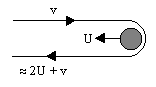
An extreme form of the maneuver would be to approach a planet head-on at a speed v while the planet is moving directly toward us at a speed U (both speeds defined relative to the "fixed" Solar frame). If we aim just right we can loop around behind the planet in an extremely eccentric hyperbolic orbit, making a virtual 180-degree turn, as illustrated below.


The net effect is almost as if we "bounced" off the front of the planet. From the planet's perspective we approached at the speed U+v, and therefore we will also recede at the speed U+v relative to the planet, but the planet is still moving at (virtually) the speed U, so we will be moving at speed 2U+v. This is just like a very small billiard ball bouncing off a very large one.

https://www.mathpages.com/home/kmath114/kmath114.htm


 You see the maximum added velocity due to the gravity assist is about twice the speed of the planets orbital velocity around the Sun. But the escape velocity at a planets distance from the Sun is square-root of 2 times its orbital velocity. So a spacecraft encountering the planet at sufficiently close distance and at the right angle could achieve escape velocity from a gravity assist.

 Then the Messenger launchers upper stage following Messenger’s trajectory, during one of the Messenger flyby’s, or even one years later, could due to small variations in the flight path be sent on an even closer encounter to the planet than Messenger and thus achieve escape velocity. 

 But if this is true how is it the simulations projecting backwards ‘Oumuamua’s trajectory show the closest approach to the inner planets millions of kilometers away not the hundreds to thousands of kilometers away needed for a gravitational slingshot? 
 
 Note that when you project back a trajectory you assume the object has not at some point flipped the direction it is traveling. But in the most extreme case that is exactly what can happen with a gravitational slingshot, as shown in the diagram above.

 This can be taken account in such trajectory simulations if you know a gravity assist did take place. That is to say, an alteration in the flight path in such a case can be taken into account, even if not necessarily to the most extreme case of reversing direction. 

 But there is a scenario where you did not know it. You see an object have a certain speed and a certain direction at a certain time, say, when it passes closest to Earth. You project backwards and note the distance at closest distance to, say, Venus is millions of kilometers away from that planet

 But IF that object at some earlier time than the time of the supposed Venus closest approach the object had a higher speed then the object could still have made a gravitational slingshot flyby of the planet with Venus being at a different location.

 Then to see if this did happen in the ‘Oumuamua case you would have to project back further then the supposed closest approaches of Venus and Mercury to see if at earlier times gravitational slingshots by these planets could have resulted in it appearing at the same location, speed, and direction as observed when it made its closest approach to Earth. The calculations are made more complicated though by the possibility of it having multiple flybys.

Detections by radio telescopes?

 The possibility that spent rocket stages can be mistaken for asteroids suggest additional observational techniques should be made when they are discovered. ‘Oumuamua was scanned to see if it was emanating radio transmissions, and none were found. But it still might have been detectable by radio telescopes or by radar. It might have been determined for example if it were more reflective than usual suggesting it was made of metal.


  Robert Clark


Friday, September 1, 2023

Further strangeness of 'Oumuamua.

 Copyright 2023 Robert Clark


  Harvard astronomer Avi Loeb listed 6 strange things about the interstellar object 'Oumuamua unexpected in a naturally occuring asteroid or comet:

6 Strange Facts about the Interstellar Visitor 'Oumuamua
By Abraham Loeb on November 20, 2018
https://blogs.scientificamerican.com/observations/6-strange-facts-about-the-interstellar-visitor-oumuamua/

 Software engineer Adam Hibberd of the Initiative for 4 Interstellar Studies(i4is) has also discussed the unusual aspects of the interstellar object in regards to its point of origin and perihelion distance:

‘Oumuamua: Some More Strangeness
16 June 2022
https://i4is.org/oumuamua-some-more-strangeness/

 Hibberd noted the trajectory parameters of 'Oumuamua were such they would only happen about 2.5% of the time. He also noted the unusal aspects of 'Oumuamua's trajectory made it more likely for it to be detected from Earth. But by that same token, wouldn't that also mean for a supposed craft observing Earth the trajectory characteristics would make the observations easier?

 In that regard, note some further odd properties of 'Oumuamua are described below.

1.)See the speeds of 'Oumuamua by distance from the Sun here:

Oumuamua speed relative to the Sun[63]
DistanceDateVelocity
km/s
2300 AU160526.34
1000 AU183926.35
100 AU200026.67
10 AU201629.50
1 AU9 August 201749.67
Perihelion9 September 201787.71[10]
1 AU10 October 201749.67[e]
10 AU201929.51
100 AU203426.65
1000 AU219626.36
2300 AU243026.32


 Notable is that the velocity of 'Oumuamua at 1 AU of 49.67 km/s is close to the escape velocity from the Sun at 1 AU, i.e., the escape velocity from the Sun at Earth's distance from the Sun, of 42 km/s.

 If you think of a natural interstellar asteroid then its speed passing 1 AU could be below escape velocity at that distance or above it. But for an artificial interstellar satellite, you don't want it to be below escape velocity from the Sun because you wouldn't want it captured in that system you are examining. So you would want it above the escape velocity, but not too far above it so as to allow accurate observations.

 Then it would be useful to examine the odds of 'Oumuamua having a speed at 1 AU so close to Earth's escape velocity.


2.)The closeness of 'Oumuamua to the Earth at closest approach of 0.16 AU was quite surprising considering it is an interstellar object. But also unexpected is the closeness it came to the other planets of the inner solar system:

This animation shows the trajectory of 'Oumuamua in relation to Mercury, Venus, and Earth:


 The video provides the distance of 'Oumuamua to those inner planets at closest approach. For Mercury and Venus, it's 0.285 AU and 0.605 AU respectively.


 And for the Earth. it's 0.163 AU at closest approach:


  While this image showing the closeness of the Earth approach is interesting, something else about it is  also interesting. It appears at this time of closest approach to the Earth, all three of Mercury, Venus, Mars would be visible in the sky at the same time from Earth. This is notable because this only happens about one day per year. So there is only about 1/365 chance of this happening. So this multiplies times the unlikelihood of it's trajectory as calculated by Hibberd.

 As to why this would happen, one could say this supposed artificial visitor wanted a nice picture of all the inner planets in the sky at the same time. But I think a likelier possibility is the intent was to have close approaches of all the inner planets. The parameters of such a trajectory necessitated at some point Mercury, Venus. and Mars would be visible in the sky at the same time from Earth.

 Given this fact, a calculation of the odds should be made of the trajectory parameters being such that 'Oumuamua made such close approaches to Mercury, Venus, and Earth.

  Robert Clark


Wednesday, August 16, 2023

Game changer for propellant generation on the Moon.

 Copyright 2023 Robert Clark


ABSTRACT

 Proponents of getting propellant from the Moon for spacecraft already in Earth orbit, as for orbital propellant depots, base this on using high power to separate hydrogen and oxygen by electrolysis applied to the water ice in the Moon's south polar region. However, quite surprisingly there may already be free hydrogen at the Moon's south pole or available in far more energy efficient way then by electrolysis. This hydrogen may be so easily obtainable then it may be it can be profitably shipped to Earth for a clean energy economy.


Free Propellant on Mars and the Moon.

 In the blog post "Potential Game-Changer for Generating Propellant on Mars," I suggested that getting free oxygen and carbon monoxide from the Martian atmosphere would provide a free means of producing propellant on Mars. This is important since rather than requiring several football fields of solar panels or a nuclear power plant to generate the megawatts of power needed to separate the CO2 or H2O into carbon, oxygen, and hydrogen by electrolysis, we could actually generate megawatts of power after collecting the free CO and O2 in the Martian air then combusting them together:

2CO+O2​→2CO2​;ΔH=−569kJ/mol

 This may may seem odd that we can generate power by collecting the natural resources already there but note this is exactly what we're doing when we collect the coal or petroleum or uranium from the ground on Earth. You get far more potential energy out than what you put in to collect it.

 And in fact we could also generate hydrogen in a way that at the same time generates power as well. This comes from the reaction:

1.)CO + H2O → CO2+ H2, ΔH = -41 kJ/mol 

 The H2O could come from the abundant ice in the Martian soil or in fact from the Martian air as well. The hydrogen(H2) would then come from what is called the water-gas shift reaction: 


The water–gas shift reaction (WGSR) describes the reaction of carbon monoxide and water vapor to form carbon dioxide and hydrogen:

CO + H2O ⇌ CO2 + H2

The water gas shift reaction was discovered by Italian physicist Felice Fontana in 1780. It was not until much later that the industrial value of this reaction was realized. Before the early 20th century, hydrogen was obtained by reacting steam under high pressure with iron to produce iron oxide and hydrogen. With the development of industrial processes that required hydrogen, such as the Haber–Bosch ammonia synthesis, a less expensive and more efficient method of hydrogen production was needed. As a resolution to this problem, the WGSR was combined with the gasification of coal to produce hydrogen. As the idea of hydrogen economy gains popularity, the focus on hydrogen as an energy storage medium when an alternative replacement energy source for hydrocarbons is used.

https://en.wikipedia.org/wiki/Water%E2%80%93gas_shift_reaction


 However, it may be this process can also work on the Moon. The LCROSS mission to my mind may have been one of the most significant planetary science missions ever conducted by NASA, as measured in relation to its cost. It was designed as a low cost "Discovery" class mission but what it returned was profoundly important. It had an ingenious design that sent a rocket stage to impact the Moon at the south polar region and observe spectroscopically the material sent up in the impact plume by a second spacecraft..

 The mission confirmed what was suspected that there was great amounts of water as ice in the Moon's south polar region. In fact LCROSS found an extensive list of volatiles concentrated at the south pole of the Moon:


Moon Blast Reveals Lunar Surface Rich With Compounds.
Science Oct 21, 2010 2:05 PM EDT.
There is water on the moon … along with a long list of other compounds, including, mercury, gold and silver. That’s according to a more detailed analysis of the chilled lunar soil near the moon’s South Pole, released as six papers by a large team of scientists in the journal, Science Thursday.
https://www.pbs.org/newshour/science/its-confirmed-there-is-water


 The amounts of volatiles found by LCROSS was extraordinary:


Lunar Impact Uncovered More Than Just Moon Water.

Oct. 21, 2010:  Nearly a year after announcing the discovery of water molecules on the moon, scientists have revealed new data uncovered by NASA's Lunar CRater Observation and Sensing Satellite, or LCROSS, and Lunar Reconnaissance Orbiter, or LRO—and it's more than just water.

In addition to water, the plume contained "volatiles." These are compounds that freeze in the cold lunar craters and vaporize easily when warmed by the sun. The suite of LCROSS and LRO instruments determined as much as 20 percent of the material kicked up by the LCROSS impact was volatiles, including methane, ammonia, hydrogen gas, carbon dioxide and carbon monoxide.

https://science.nasa.gov/science-news/science-at-nasa/2010/21oct_lcross2 


 These last three are quite important in regards to the lunar propellant issue. If the hydrogen is indeed free then that gives us a ready made source for the clean-energy hydrogen. However, I suspect the hydrogen seen from orbit after the rocket stage impact, was derived from the water-gas shift reaction. This reaction shown in eq. 1.) reacts carbon monoxide and water to produce hydrogen and carbon dioxide and is helped by high temperatures, as would have obtained after the rocket stage impact. So the carbon monoxide could have reacted with the water to generate hydrogen.

 Once we have hydrogen then we can send it back to Earth for clean energy. The gravity and required launch speed from the Moon is so low we could use continual launch methods such as railguns or even the space elevator, which is possible with current materials under the Moons low gravity.

 As in the case of the getting hydrogen or other propellants on Mars discussed in the prior blog post, we would need low energy separation methods.  A new method sounds quite promising:


Mechanochemical breakthrough unlocks cheap, safe, powdered hydrogen

By Loz Blain July 18, 2022

Australian scientists say they've made a "eureka moment" breakthrough in gas separation and storage that could radically reduce energy use in the petrochemical industry, while making hydrogen much easier and safer to store and transport in a powder.

https://newatlas.com/energy/mechanochemical-breakthrough-unlocks-cheap-safe-powdered-hydrogen/


 This proposed solution for low energy gas separation though still needs to be confirmed by other researchers. 


 Hydrogen on the Moon Cheaper and Cleaner than on Earth?

 The Department of Energy(DOE) set a goal in 2021 to reduce the cost of producing hydrogen in a clean fashion by 80% to $1 per kg in 1 decade. The chemical methods for producing hydrogen can already do it about a $1 per kg cost, but results in additional CO2 being added to the atmosphere. Using solar power for a clean energy hydrogen generation approach is more expensive. This described on this DOE page:


7.1. WHY HYDROGEN?

Clean hydrogen is of the greatest interest in addressing the climate crisis, with the recognition that hydrogen could play a crucial role in economy-wide decarbonization, particularly in the transportation and industrial sectors including sustainable fuels, iron & steel, ammonia and chemicals, and more.1 Hydrogen is an extremely clean energy carrier, as its consumption produces only water; it also has a high energy density by mass. Hydrogen can be used to power fuel cells or combusted in a hydrogen turbine to generate electricity, and could also serve as clean transportation fuel.

The first Energy Earthshot, the Hydrogen Shot launched in 2021, seeks to reduce the cost of clean hydrogen by 80% to $1 per kilogram in 1 decade. This is an ambitious initiative, since current costs of clean hydrogen are much higher. For example, electrolytic generation of hydrogen using renewable electricity costs at least $6 per kilogram.

Worldwide, about half of all hydrogen production is from reforming of natural gas (mainly steam methane reforming or SMR), with the remainder deriving from gasification of liquid and solid feedstocks such as coal, petcoke, and petroleum residuals, from oil as a byproduct, and with a few percent from electrolysis. Syngas from gasification already contains a significant amount of hydrogen, which can be increased through water gas shift (WGS) and separated into a pure hydrogen product meeting industry product quality standards. There are several conventional hydrogen separation processes, with the well-proven and moderate cost pressure swing adsorption (PSA) methods commonly chosen. PSA has the ability to produce high purity (99.9%) hydrogen at near feed pressure; however, relatively high hydrogen concentration in feed gases is required for its economics to remain favorable.

For either natural gas reforming or gasification routes, hydrogen production costs are lower than the electrolytic route, but the challenge is that the carbon footprint of conventional hydrogen production is large, as shown in the following table:


Hydrogen product (kg/h)

CO2 product (kg/h)

CO2 emitted in stack gas (kg/h)

Carbon intensity kg CO2/kg H2

SMR w/ 90% capture

25,700

227,600

25,300

1.0

Coal gasification w/ 90% capture

25,700

456,700

49,300

1.9

Carbon Intensities of SMR and Coal Gasification-based Hydrogen Production (with 90% capture)

If all CO2 produced in these processes is emitted, and CO2 footprint ranges from about 10 to 20 times the mass of the hydrogen produced. Only 0.7% of fossil fuel-based hydrogen production is currently performed in conjunction with carbon capture and storage.2

The gasification route to hydrogen presents an opportunity to use low-cost and liability feedstocks including biomass, solid wastes, and waste coal, which could help reduce the environmental costs and liabilities of solid waste disposal and legacy waste impoundments. Carbon-neutral biomass feedstocks significant reduce the carbon footprint of gasification, and combined with high levels of carbon capture facilitated by high syngas concentrations of CO2 and hydrogen characteristic of efficient gasification processes, production of clean hydrogen from gasification could be a compelling option in the emerging decarbonized economy.

__________________________________________________________________

https://www.netl.doe.gov/research/Coal/energy-systems/gasification/gasifipedia/hydrogen

  Note then on the Moon, either the hydrogen is already free, or it can be obtained by the water-gas shift reaction that obtains for the low cost chemical production methods used on Earth. But now this can be considered clean production, at least in regards to Earth, in that the CO2 released would be on the Moon.

 As for energy generation actually solar or nuclear generation would not be needed. The materials for energy generation would be available in the Moon's regolith, according to the LCROSS results. See here:.


 You see there are abundances listed for H2 and H2O and CO and CO2 but nothing for O2 for combustion. Oxygen could be obtained from high temperature burning of lunar rocks, but this is energy intensive. We want an energy production method that does not require high energy input in the first place.

 One possibility might be to use the free magnesium Mg seen in the LCROSS data. Magnesium can burn in CO2 without requiring oxygen:

The General Chemistry Demo Lab
Reaction Of Magnesium Metal With Carbon Dioxide.

  Another possibility would be to use the free sodium Na seen by LCROSS. Sodium reacts explosively with water releasing heat and also hydrogen, so this might provide an additional method of producing hydrogen.


 Robert Clark

Monday, August 14, 2023

SpaceX should withdraw its application for the Starship as an Artemis lunar lander.

 Copyright 2023 Robert Clark


 In the blog post, "SuperHeavy+Starship have the thermal energy of the Hiroshima bomb. UPDATED". I noted the thermal energy content of both stages is comparable to the explosive force of the Hiroshima bomb, ca. 15 kilotons of TNT. However, it is quite important to keep in mind that NASA uses estimates of the explosive force of a possible rocket explosion that is some fraction of what the total thermal energy might be. Based on this, I estimated the explosive force might actually be in the range of 3.4 to 5.4 kilotons. This is as much as 5 times higher than the explosive force attributed to the famous Soviet N-1 rocket failures at ca. 1.2 kilotons. 

 To get an idea of the enormity of 1.2 kilotons explosive force, and remembering also an SH/ST explosion might be as much as 5 times more powerful, look at the case of the Beirut explosion of 2020. This was not a rocket explosion but of ammonium nitrate but its estimated explosive force was about that of N-1 rocket at ca. 1.1 kilotons.


 In the explosion, homes as far away as 10 kilometers were damaged and the terminals at the Beirut airport 10 km away suffered moderate damage with some doors and windows blown out.

 Note now populated areas such as Port Isabel consisting of thousands of residents are within 10 km of the SH/ST launch site, and an explosion of this rocket might be 5 times more powerful than the Beirut explosion.

 In my blog post, I argued that not sufficient attention was being given to the possibility of an explosion by either the FAA or NASA. I wrote to one of NASA's safety offices and was told the safety of commercial launches is not the purview of NASA, but of the FAA. But when NASA is depending on that the commercial rocket to complete the planned flagship space program of NASA they have a responsibility to ensure that rocket is being developed safely as well.

 With the failure of the April 20th test flight of the Superheavy/Starship fortunately now both NASA and the FAA are giving closer scrutiny of the safety of the rocket as it should be.

The Superheavy/Starship actually is the N-1 rocket.

 The explosive force of the N-1 rocket, comparable to that of the devastating Beirut explosion, serves as a cautionary tale for those in the space industry. The comparison has been made of the SpaceX SuperHeavy/Starship approach to the Soviet multiple failed N-1 rocket in that they both wanted to test by actually flying the full rocket until it works, despite the number of failures. 

 This comparison was criticized on the grounds the N-1 engines were not tested individually. Instead, the engineers on the N-1 selected an engine at random from a batch to see if that worked. If it worked the entire batch was chosen. The engines could not be tested individually because the testing was destructive. That engine could not be used if it were first tested.

 The SpaceX Raptor engines on the other hand are tested individually. But here’s the major failing of the Raptor: even if the engine is tested successfully there is still a quite high chance the engine will still fail when used on a flight. That is a major flaw in a rocket engine. No rocket engine would be considered successfully developed with that flaw.

 Because of the numerous failures of the Raptor both on the test stand and in short test hops of the Starship landing methods prior to the April test flight, I estimated the chance of engine failures of the SuperHeavy/Starship test flight was 1 out of 3. SpaceX claimed prior to the April test flight their Raptor 2 was more reliable. The result? Only 1 in 4 of the engines failed. That is still a stunningly high percentage. As a point of comparison it would be like on every flight of the Falcon 9 the expectation would be at least two of the engines would fail during each flight.

 The upshot of this in a very real sense the Super/Starship is just like the failed Soviet N-1 in flying with engines with poor reliability.

 It is my contention the attempt of SpaceX trying to reach a 2025 deadline to have the SH/SS flying and with multiple successful test flights completed puts undue pressure on its normal safety procedures. For that reason my opinion is it should withdraw the Starship for consideration as a lander for the Artemis III lander mission.

   Robert Clark


Could Blue Origin develop a lander for Artemis III?

Copyright 2025 Robert Clark SpaceX is coming under increasing criticism for its delay in developing the Starship lunar lander: U.S. Is Losin...