Thursday, February 8, 2024

Alternative explanations for the CMB, universe expansion, and dark matter.

 Copyright 2024 Robert Clark


 James Webb was promised to provide revolutionary results in cosmology and has not disappointed. Several observations have shown well-developed galaxies that stem from the earliest time after the Big Bang, which current theories suggest should not be possible. 

 The observations have led some scientists to question the accuracy of the current models for the beginning of the universe. Further, the cosmological microwave background(CMB) had been regarded as strong confirmation of the Big Bang theory for the origin of the universe. But there is a discrepancy between the rate of expansion of the universe based on the CMB and measurements of galactic motion.

 This discrepancy has existed for several years now, but it was hoped with better instruments the discrepancy would be found due to measurement error. Instead, the JWST has provided further evidence the discrepancy is real. Then either the CMB estimate or the interpretation of the redshift measurements or both are wrong.


  Here I'll discuss the possibility there is a problem with the interpretation of the origin of the CMB. It seems to me there should be some contribution to the CMB due to highly red shifted infrared and optical radiation from galaxies at high red shifts, but I never see this mentioned. The CMB is only described by relic radiation of the intense heat at the beginning of time that gradually cooled as the universe expanded.

 An argument can be made that the CMB is seen in all directions but there are blank areas in some part of the sky. This does not support the idea of the CMB deriving from redshifted light from primordial galaxies. 

 But the Hubble Deep Field showed abundant galaxies in areas previous thought to be devoid of galaxies. It was a revolutionary advance in our knowledge of the extent of the universe. Hubble deep field images integration times ranged from 10 days to 23 days. But the JWST deep field image only went for a day:

STARTS WITH A BANG — APRIL 17, 2023
JWST surpasses, enhances Hubble’s deepest image ever
With infrared capabilities and image sharpness far beyond Hubble's limits, JWST looked at Hubble's deepest field, revealing so much more.
https://bigthink.com/starts-with-a-bang/jwst-surpasses-hubbles-deepest-image/

In view of the startling find of fully formed galaxies going back to near the time of the Big Bang by the JWST, such long integration times as for the Hubble must also be done for the JWST.

The estimate of the number of galaxies in the universe from the Hubble deep field was 170 billion. But numerical simulations put it at perhaps one hundred times more at 6 to 20 trillion galaxies:

STARTS WITH A BANG — JUNE 22, 2022
There are more galaxies in the Universe than even Carl Sagan ever imagined
Forget billions and billions. When it comes to the number of galaxies in the Universe, both theorists' and observers' estimates are too low.
https://bigthink.com/starts-with-a-bang/galaxies-in-universe/

By doing the longer integration times JWST may be able to confirm this larger number of galaxies. Such a large number of galaxies going back to near the time of the Big Bang may allow the CMB to be equally well explained by highly redshifted light, infrared and optical, from these earliest galaxies.

 However, there may be another even greater contributor to the observed CMB. A little known fact is that for most of the galaxies in the universe they are receding from us faster than the speed of light(!)


 This is explained as not being in conflict with relativity by the virtue of the fact that space itself is expanding. It is not the case that objects are moving through space as these superluminal speeds. 

 Nevertheless, this raises an interesting possibility. If it is the case that these galaxies are moving away from us at these apparent superluminal speeds, would we observe a luminal "boom" from these galaxies when they appear to cross the light-speed barrier relative to us? 

 The luminal boom is a concept that is analogous to the sonic boom for sound waves. This is actually seen for some subatomic particles traveling though matter, where the speed of light is reduced below that of the vacuum speed. In cases where the particles exceed that materials light speed, a phenomenon known as Cerenkov radiation is observed. Note that the particles are still not traveling faster than the vacuum speed of light, only the speed of light in the material. So relativity is still upheld.

 An analogous phenomenon is seen in cosmic ultra high energy gamma ray bursts, GRB's:

Faster-Than-Light Speeds Could Be Why Gamma-Ray Bursts Seem to Go Backwards in Time.
SPACE
30 September 2019
By MICHELLE STARR

https://www.sciencealert.com/faster-than-light-speed-in-jets-that-produce-gamma-ray-bursts


 This blog post contained the discussion of an alternative explanation for the CMB. Follow up posts will discuss alternative explanations for universe expansion and dark matter.

  Robert Clark


Thursday, January 25, 2024

Towards Every European Country's Own Crewed Spaceflight, Page 2: saved costs and time using already developed, operational engines.

 Copyright 2024 Robert Clark


Vulcain-based launchers.

 ESA head Josef Aschbacher made the remarkable statement that the Ariane 6 can not be guaranteed to be the launcher of choice in the European launch market:

“We are worried,” says European rocket chief at prospect of launch competition
On the continent, Ariane 6 may be the last launcher with a monopoly.
PEGGY HOLLINGER AND SYLVIA PFEIFER, FT - 1/9/2024, 9:18 AM
https://arstechnica.com/space/2024/01/we-are-worried-says-european-rocket-chief-at-prospect-of-launch-competition/

 In the blog post, "Towards Every European Country's Own Crewed Spaceflight", I suggested any European country could build their own manned spaceflight capable launcher by buying an Ariane 5 or 6, disposing of the side boosters, and adding 1 or 2 additional Vulcain engines to the core. ArianeSpace might raise a squawk however since it would be using their tech to build a direct competitor to the Ariane 6 and at a cheaper price in not using the large, expensive side boosters.

 Another approach might be to design their own launcher designed around the Vulcain engine. The Vulcain engine developer Snecma, now Safran Aircraft Engines, is independent of ArianeSpace so likely the Vulcain could also be purchased from Safran. Purchasing an already developed and operational engine would save on costs since engine development is typically the biggest development cost for a new launcher. See for example this breakdown on the costs of the Ariane 5:

Development budget

Again, Ariane 5, from 'Europäische Tragerraketen, band 2', Bernd Leitenberger:

Studies and tests 125
solid boosters 355
H120 first stage 270
HM60 (Vulcain) engine and test stands 738

other elements of the first stage and boosters 95
upper stage and VEB 200
ground support in Europe 80
Buildings and other structures in Kourou (launch pad) 450
Test flights 185
Total 2498
ESA and CNES management 102

https://space.stackexchange.com/questions/17777/what-is-the-rough-breakdown-of-rocket-costs

 For our scenario we would not be using solid rockets. So that rather large cost would be saved. Note also in our scenario using the already developed and fully operational Vulcain, the engine development costs and test stand costs would also be saved. For the Ariane 5, the ESA also built entire new launch facilities in Kourou, Guyana in equatorial Africa. For this new launcher we'll assume it will use the already constructed launch facilities at Kourou, or the country where the new launcher is being developed would construct an independent launch facility for their nascent space industry.

 To sure, we'll assume this new launcher would be developed using the commercial space approach spearheaded by SpaceX. SpaceX demonstrated development costs could be cut by a factor of 10 following this approach:

Falcon 9.
In 2011, SpaceX estimated that Falcon 9 v1.0 development costs were on the order of US$300 million.[39] NASA estimated development costs of US$3.6 billion had a traditional cost-plus contract approach been used.[40] A 2011 NASA report "estimated that it would have cost the agency about US$4 billion to develop a rocket like the Falcon 9 booster based upon NASA's traditional contracting processes" while "a more commercial development" approach might have allowed the agency to pay only US$1.7 billion".[41]

  Now, several companies world-wide have also shown that following the commercial space approach of using private financing can cut development costs by a factor of 10.

 The total development cost of the Ariane 5 was $2.5 billion in 1990's dollars. Now take into account the costs that wouldn't need to be included, solid booster development, engine development, and launch facilities. This reduces the development cost to $955 million in 1990's dollars. Now consider by following the commercial space approach this could be cut by a factor of 10 to ca. $95 million, or about $200 million in 2024 dollars. Quite remarkable also in particular is the development of the core stage without engines could be done for only about $54 million.

 So an approx. 10 ton payload capacity all-liquid launcher could be developed for approx. $200 million, by using already developed and operational engines. This launcher would have the advantages, by not using solid rocket boosters, of being capable of reusability and being made manned flight capable.

 Quite surprising also is how quickly such a manned-flight capable launcher might be developed. ArianeSpace could develop it the most quickly, probably in less than a year. All it would have to do is acknowledge large solid side boosters are not price competitive. As I discussed previously, JAXA showed with its H-II rocket, an additional engine can be added to a core stage for less than $200 million. And SpaceX showed with its Raptor engine that additional Raptors can be added to a core stage on a time scale of just months, not years, even if a new thrust structure is required to accommodate the new engines. 

 But even for those countries making the new launcher from scratch quite surprisingly it could also be done quite rapidly, assuming it used an already developed and operational engine. A fact not generally appreciated is how rapidly SpaceX was able to develop the Falcon 9 rocket by using the already developed and operational Merlin engine. After the first successful flight of the Falcon 1 in 2008, SpaceX built and successfully launched the Falcon 9 in only two years in 2010. Note because the Falcon 9 had a larger diameter and used 9 engines instead of just one, SpaceX had to use completely different tooling in constructing the Falcon 9.

 Then following the SpaceX example, and the SpaceX commercial space approach, a company could build and launch a 10-ton payload capable launcher in only 2 years by using already developed and operational engines.
 

Methane-fueled Prometheus-based launchers.

 ESA has received much criticism in not keeping up with SpaceX on reusability. The Ariane 6 in fact won't be reusable and it is now acknowledged it won't be competitive to the SpaceX Falcon 9 in price, necessitating hundred million dollar subsidies yearly to stay afloat. 

 Recognizing the need for reusability in future launchers, ESA has begun the development of the methane-fueled, reusable Prometheus engine. And through its subsidiary Maiaspace, ArianeSpace is developing an all-liquid reusable launcher using the Prometheus engine for launch:

ArianeGroup to Increase MaiaSpace Investment to €125M


 The MaiaSpace launcher will be capable of about 1,500 kg payload to LEO as an expendable rocket, using three Prometheus engines at ca. 100-ton thrust capability. It is expected to make its first launch in 2025.

 It is illuminating to make a comparison to the early development of SpaceX. The Falcon 1 had an approx. 600 kg to LEO capability using a single ~100-ton thrust Merlin engine. It had its first successful launch in 2008. Remarkably just 2 years later in 2010, SpaceX had the 9 Merlin-engine Falcon 9 rocket make a successful launch at a ca. 10-ton payload to LEO capacity.

 Then following the SpaceX example, MaiaSpace using 9 Prometheus engines could have a 10-ton to LEO capable launcher available in 2027. This could be man-rated to be manned flight capable.

 Then going by the SpaceX example of the $300 million development cost of  Falcon 9, and considering engine development cost makes up the bulk of launcher development cost, any European country using an already developed and operational Prometheus engine could have a 10-ton to LEO capable launcher at less than $150 million development cost following the commercial space approach.

 And again following the SpaceX example such a launcher could be built and launched within 2 years.

Manned Space Capsules.

 ESA has announced opening a competition among European companies for cargo capsules to deliver supplies to the ISS, with manned capsules to follow in development:

ESA to start commercial cargo program
Jeff Foust
November 6, 2023

 SpaceX and Orbital Sciences, now a subsidiary of Northrup Grumman, with their Dragon and Cygnus cargo capsules, showed space capsules like launchers also could be developed at costs 1/10 that of the usual government-financed ones following the private financing approach of commercial space. 

 Then I advise the European companies entering the competition follow the commercial space approach in developing their space capsules. They could accept seed funding from ESA to get started, but the bulk of the development costs should come from private funding. Note that winning these seed dollars from the ESA could be used as a selling point in acquiring the private funding.

 According to the SpaceNews article the cargo capsules are expected to be ready by 2027 or 2028. It is notable that this is around the same time MaiaSpace might be able to have a 10-ton to LEO capable launcher ready. 

 Because of this I advise the cargo capsules and manned capsules be developed concurrently. It is my thesis that manned capsules can also be developed at costs in the few hundred million dollars cost range by following the commercial space approach as found with cargo space capsules.

 It is notable in this regard that when SpaceX accepted NASA funding for the development of the manned version of the Dragon capsule, costs ballooned to the billion dollar range. I'm arguing the costs were that high because NASA was paying for it.


  Robert Clark

Tuesday, January 23, 2024

Possibilities for a single launch architecture of the Artemis missions, Page 4: lightweight landers from NRHO to the lunar surface.

 Copyright 2024 Robert Clark


 Congress is becoming increasingly concerned that with the continuing delays of the Artemis missions that China may beat the U.S. back to the Moon:

US must beat China back to the moon, Congress tells NASA.
By Mike Wall 
'It's no secret that China has a goal to surpass the United States by 2045 as global leaders in space. We can't allow this to happen.'
https://www.space.com/us-win-moon-race-china-congress-artemis-hearing

 I had previously proposed correcting an error in the design of Orion's service module that instead of making it larger than Apollo's service module because of Orion's twice larger size, instead made it 1/3rd smaller:

Possibilities for a single launch architecture of the Artemis missions, Page 2: using the Boeing Exploration Upper Stage.

https://exoscientist.blogspot.com/2023/08/possibilities-for-single-launch.html

 The proposal was to give an additional approx. 10 tons propellant to the service module. This would allow the Orion capsule/service module stack plus an Apollo-size lander to be carried all the way to low lunar orbit, not just to NRHO(near-rectilinear halo orbit). 

 This though because of the higher payload may require use of the higher thrust J-2X engine on the Boeing EUS(upper stage) rather than the 4 RL-10 engines now planned on the SLS Block 1B. It's higher thrust would result in a greater payload to LEO and TLI, perhaps to ca. 120 tons to LEO rather than the 105 tons planned to LEO.

This approach requires additional propellant tanks be added to the service module and a change in the EUS upper stage engine to the J-2X. As I discussed in that blog post, it may also require an additional Centaur V sized third stage be added atop the Boeing EUS. This is dependent on what is the TLI(trans lunar injection) payload for the Boeing EUS using the J-2X engine. It may be it can perform the needed TLI payload without an additional Centaur V 3rd stage.

 In any case, I'll propose here an alternative approach to a single launch Artemis architecture without increasing the service module propellant load. This again will use a light-weight Apollo-sized lander with all the components of Orion capsule/Service Module/lunar lander all carried on that one single SLS launch. Because of the lower propellant load on the service module though I'll also send it to NRHO instead of to low lunar orbit.

 Note the NRHO was chosen by NASA as the orbital location because it has a lower delta-v requirement to get there than going to low lunar orbit. Here’s the the delta-v requirements:

 The second group of delta-v’s shows the delta-v to NRHO as 0.45 km/s and the delta-v to and from the lunar surface from NRHO as 2.75 km/s, or 5.5 km/s round trip.

 I’ve seen various numbers for the Orion and service module dry mass and propellant mass. I’ll use 16.5 total dry mass for the Orion+service module together, and 9 tons of service module propellant mass, but only 8.6 tons of this as usable propellant because of residuals.

 Then we'll use 6 tons of Service module propellant to get the Orion/Service Module/lunar lander to NRHO after being placed on TLI trajectory by the EUS, for the 16.5 ton Orion/Service Module dry mass, and 15 tons gross mass Apollo-sized lander with 2.6 tons left over for the return trip.

 We'll need every bit of performance to accomplish the mission within these constraints. So we'll assume we can get a 324 s Isp out of the storable propellant engines on the service module. This is higher than specified for the Orion service modules engines but is doable because of the storable propellant Aestus engine on the Ariane 5 EPS storable propellant upper stage which gets this vacuum Isp. We'll assume we can get this increased Isp by using a larger expansion ratio nozzle or even by swapping out the engine on the service module to use the Aestus engine. Then we get:

324*9.81Ln(1 + 6/(16.5 + 15 + 2.6 + 0.4)) = 510 m/s, or 0.51 km/s, sufficient for placing the stack in the NRHO orbit, where the 0.4 in the equation is for the unburnt residuals.

 Then with the 2.6 tons usable propellant left over for the return trip, after the lander is jettisoned, we get:

324*9.81Ln(1 + 2.6/(16.5 + 0.4)) = 450 m/s, 0.45 km/s, sufficient for the Orion return.

 To increase performance even more we may want to switch even to the RS-72 engine. This is a turbopump-fed storable propellant engine with a vacuum Isp of 340s. It achieves this by using a higher chamber pressure of 60 bar and higher nozzle expansion ratio of 300 to 1 than the Aestus engine. A turbopump engine also has lower residuals, typically less than 1%. A disadvantage is that pressure-fed engines are simpler with fewer moving parts, and so higher reliability, important for an engine to place the spacecraft in orbit and for leaving orbit.

 Now for the ca. 15 ton gross mass lander, because of the higher delta- v needed from NRHO we’ll use hydrolox rather than storable propellant stage. The Ariane 4 H10 hydrolox upper stage had a 11.8 ton propellant mass and 1.2 ton dry mass. We’ll use a 2 ton dry mass of the crew module:

ORBITAL PROPOSES FUTURE DEEP SPACE APPLICATIONS FOR CYGNUS.
SPACEFLIGHT INSIDER
MAY 1ST, 2014
Orbital’s proposal, outlined in this PDF, involves docking a Cygnus spacecraft with Orion to serve as a habitation and logistics module on longer flights. For these missions, the re-purposed Cygnus would be called the Exploration Augmentation Module (EAM). With its current life support systems used to transport pressurized cargo and experiments to the ISS, Cygnus is stated as being already suitable for the long term support of a crew. While berthed to Orion, Cygnus could support a crew of four for up to 60 days. Cygnus also has the capability of storing food, water, oxygen, and waste and features its own power and propulsion systems. The EAM would utilize the enhanced configuration Cygnus, which will begin flying larger cargoes to the ISS beginning with CRS-4 in 2015. An even larger version is also being proposed, featuring a 4-segment pressurized cargo module.

https://www.spaceflightinsider.com/missions/commercial/orbital-proposes-future-deep-space-applications-cygnus/

 Note though the phrasing here is ambiguous. The Cygnus capsule as used as a cargo transport to the ISS contains air, as it would have to for the astronauts at the ISS opening it to retrieve the cargo, but not life support systems. I'm inclined to believe for the usage cited in this article it would be taking life support from the Orion capsule. Then the calculations need to be made for how much mass it would take for life support, thermal management, consumables for an independent crew module.

 Now for the delta-v calculation for our hydrolox lander, we'll assume we can match the max 465 s Isp of the RL-10 engine by giving the Ariane 4 upper stage engine a nozzle extension as used on the RL-10, then we get:

465*9.81Ln(1 + 11.8/(1.2 + 2)) = 7,000 m/s, 7 km/s. This is quite a bit higher than the 5.5 km/s needed for the round trip from NRHO to the lunar surface and back again. But it uses hydrolox propellant so needs extra mass for low-boiloff tech. 

 Low boiloff-tech and long duration hydrolox stages are an important enabling technology. ULA engineers and ULA CEO Tory Bruno have written about this extensively in regards to for example the proposed ACES derivative of the Centaur upper stage. Because of the prior research on low-boiloff tech, an operational version to be fielded in a short time frame to be used on the Artemis missions likely can be done. 

 This shows a single launch mission is doable if going to NRHO, but it is not my preferred plan. A complete orbit around the Moon at NRHO altitude takes about a week, and for the Orion capsule being at NRHO and not low lunar orbit, the lander's crew would have to remain on the Moon about a week before they could return to the Orion in the NRHO orbit. The landers crew module would have to be larger with heavier life support and consumables in this scenario.

 If instead the Orion was at low lunar orbit it takes two hours to complete an orbit and the lunar lander could launch every two hours to rendezvous with the Orion.

 Since the Orion's service module being given an insufficient propellant load is such an obvious design mistake, the preferred route to take would be to correct that error, thereby allowing the missions to take place from low lunar orbit instead of from NRHO.


  Robert Clark


Tuesday, January 16, 2024

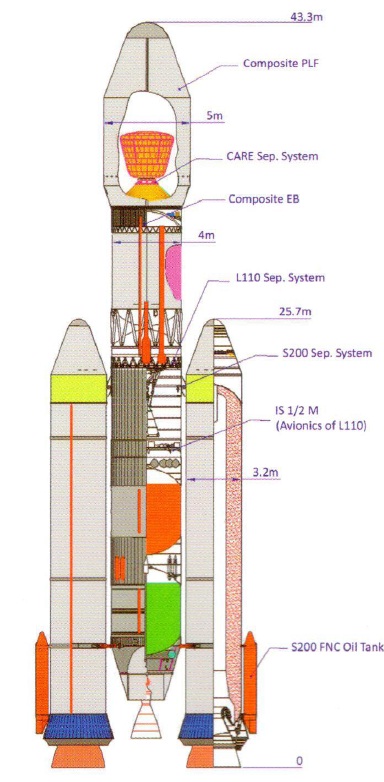
Towards a manned Indian launcher: an all-liquid LVM3.

 Copyright 2024 Robert Clark


 In the blog post, "A liquid-fueled Indian manned launcher. UPDATED", I suggested the launcher based on the liquid-fueled LVM3 core stage, but replacing the 2 solid side boosters by 4 of the liquid-fueled strap on boosters used on the earlier design, the GSLV Mk. II. Here I'll suggest instead a version using the LVM3 core but getting the added thrust needed for lift-off by adding a 3rd Vikas engine.

GSLV Mk. III Specifications


I have argued using such large SRB's are not price competitive:

It is very likely the same is true for the GSLV Mk  III. Then we'll replace the two SRB boosters by an additional core engine.

 The GSLV Mk. III core stage has specifications listed as:

Core Stage

TypeL-110
Length21.26m
Diameter4.0m
FuelUnsymmetrical Dimethylhydrazine
OxidizerNitrogen Tetroxide
Inert Mass10,600kg
Propellant Mass115,000kg
Launch Mass125,600kg
Propellant TanksAluminum Alloy
FuelUH25 - 75% UDMH, 25% Diazane
OxidizerNitrogen Tetroxide
Propulsion2 Vikas 2
Thrust (SL)677kN
Thrust (Vac)766kN
Specific Impulse293 sec
Engine Dry Weight900kg
Engine Length2.87m
Engine Diameter0.99m
Chamber Pressure58.5bar
Mixture Ratio1.7 (Ox/Fuel)
Turbopump Speed10,000rpm
Flow Rate275kg/s
Area Ratio13.88
Attitude ControlEngine Gimbaling
IgnitionT+110s
Burn Time200s
Stage SeparationActive/Passive Collets

 The Vikas 2 engine provides a thrust of 677 kN at sea level, 69 tons-force. The two on the core would be enough just to loft the core only. But we need enough thrust to liftoff a second stage and payload also. So we'll give the core a third Vikas engine.

 The weight of the Vikas is 900 kg. Then the dry mass of the stage with an additional Vikas will be 11,500 kg. 

The cryogenic upper stage has specifications listed as:

Cryogenic Upper Stage

TypeC-25 Cryogenic Upper Stage
Length13.32m
Diameter4.0m
FuelLiquid Hydrogen
OxidizerLiquid Oxygen
Inert Mass~4,000kg
Propellant Mass25,000kg
Launch Mass~29,000kg
Propellant TanksAluminum Alloy
PropulsionCE-20
Engine TypeGas Generator
Thrust - Vacuum200kN
Operational Range180-220kN
Specific Impulse Vac443s
Engine Mass588kg
Chamber Pressure60bar
Mixture Ratio5.05
Area Ratio100
Thrust to Weight34.7
Burn Time580s
GuidanceInertial Platform, Closed Loop
Attitude Control2 Vernier Engines
Restart CapabilityRCS for Coast Phase

  Now plug in the data for the Silverbirdastronautics.com payload estimator:


Where we assume by just using a nozzle extension the Isp can be raised from 443s to the 465s max Isp of the RL10 engine.

 The resulting payload to LEO is:


 This is half the 10 ton payload of the current version of the LVM3 with the large solid side boosters. However, it has the advantage of not using the problematical solid side boosters with their safety concerns for manned flights. 

 The all-liquid version is also likely to be significantly cheaper than the one with solid side boosters as large solid boosters are not price competitive to just using an additional liquid fueled engine.

It is notable a 5 ton class launcher is sufficient to launch a crewed capsule to orbit since the Gemini capsule had a toal mass of 3,800 kg:

GEMINI SPECIFICATIONS

First flight: 8-Apr-1964; first manned flight 23-Mar-1965 (Gemini 3)
Last flight: 11-Nov-1966 (Gemini 12)
Number of flights: 13 total; 10 manned
Principal uses: manned earth orbit rendezvous, docking, EVA tests
Unit cost: $13.00 million
Crew size: 2
Overall length: 5.7 m
Maximum diameter: 3.05 m
Habitable volume: 2.55 m3
Launch mass: 3,851 kg
Propellant mass: 455 kg total
RCS total impulse: 1,168 kNs
Primary engine thrust: 710 N
Main engine propellant: NTO/MMH
Total spacecraft delta v: 323 m/s
Power: fuel cells/batteries; 155.0 kWh total
https://www.braeunig.us/space/specs/gemini.htm

 The payload to LEO also can be increased by weight optimizing the first stage. The stage is similar to the first stage of the Titan II that launched the Gemini capsule to space, except the Titan II's first stage dry mass was 6,000 kg less. Reducing the first stage dry mass input in the SilverbirdAstronautics.com payload estimator by 6,000 kg increases the payload to ca. 6,000 kg. 


  Robert Clark


Could Blue Origin develop a lander for Artemis III?

Copyright 2025 Robert Clark SpaceX is coming under increasing criticism for its delay in developing the Starship lunar lander: U.S. Is Losin...