Showing posts with label Falcon 9. Show all posts

Saturday, April 19, 2025

Lightweight thermal protection for reentry of upper stages.

 Copyright 2025 Robert Clark


  In the blog post “Reentry of orbital stages without thermal protection, Page 2”, http://exoscientist.blogspot.com/2025/04/reentry-of-orbital-stages-without.html , I discussed some possibilities of thermal protection for the SpaceX Starship. Chief among them was the possibility that lightweight wings added might allow the stainless-steel Starship to survive reentry without added thermal protection at all. 

Other possible methods of thermal protection discussed there were a “parashield” of Dr. David Akin and inflatable conical shield experimented for the Cygnus capsule return.


  The method used there to estimate the temperature reached was calculation of the ballistic coefficient, 
β = (mass)/(drag coefficient*area). In a report by aerospace engineer Dr. David Akin, the estimated ballistic coefficient for the max temperature reached to be 800 C, so as not to need additional thermal protection, was ca. 20 kg/sq.m. 

 However, I calculated the ballistic coefficient for the Starship to be ca. 60 kg/sq.m. Note though this was using a much lower dry mass for the Starship than now obtains. The currently estimated dry mass of the reusable Starship is in the range 160+ tons. I believe this high mass for the reusable Starship is primary reason SpaceX is having difficulty getting effective TPS for it.

 My opinion is that SpaceX should first get an expendable Starship and then proceed to reusability. This approach worked spectacularly well for the Falcon 9.
 
 In this regard it is notable Elon Musk once estimated the dry mass of the expendable Starship as only 40 tons:

Elon Musk @ElonMusk
Probably no fairing either & just 3 Raptor Vacuum engines. Mass ratio of ~30 (1200 tons full, 40 tons empty) with Isp of 380. Then drop a few dozen modified Starlink satellites from empty engine bays with ~1600 Isp, MR 2. Spread out, see what’s there. Not impossible.
https://x.com/elonmusk/status/1111798912141017089?s=61

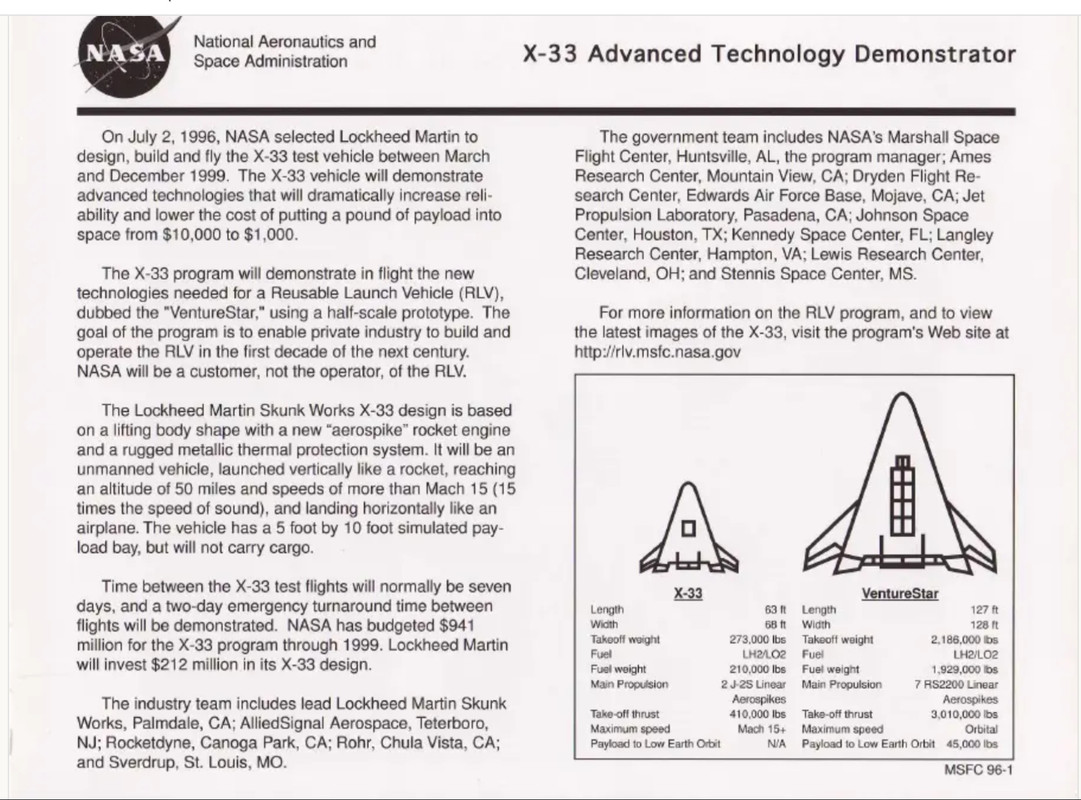
 Then in the following I’ll use the 40 ton value for the Starship dry mass. In this case, there might be an example that would give us a reusable thermal shield for a vehicle the size of Starship. I’m thinking of the X-33/Venturestar.

08287-C50-420-B-4-FDC-A69-B-37-A594-E87808.jpg

 The length in meters was 38.7m and width 39m. For the dry mass, the total gross weight was 2,186,000 lbs, propellant weight 1,929,000 lbs, and payload weight 45,000 lbs; giving a dry weight of 212,000 lbs, or 96,400 kg.

 Using a hypersonic drag coefficient of 2, and considering the triangular planform requires multiplying by 1/2 the length*width to get the area, the ballistic coefficient calculates out to be 96,400/(2*1/2*38.7*39) = 64 kg/sq.m.
 
 Remarkably close to the ballistic coefficient of the Starship at the 60,000 kg mass of the expendable’s dry mass + fairing mass.

 But the added weight of the metallic shingle TPS of the X-33/Venturestar can’t be too high to allow the ballistic coefficient to remain close to this value.
The areal density of the metallic shingle TPS was about 10 kg/sq.m:

REUSABLE METALLIC THERMAL PROTECTION SYSTEMS DEVELOPMENT
Max L. Blosser*, Carl J. Martin*, Kamran Daryabeigi*, Carl C. Poteet **
*NASA Langley Research Center, Hampton, VA, USA
** JIAFS, The George Washington University, Hampton, VA, USA
https://ntrs.nasa.gov/api/citations/200 … 095922.pdf

 The metallic tiles had better resistance to impact and rain than the ceramics at about the same weight.

04-A5-BF90-A019-4278-A5-CC-C3-F33-E7-AFF11.png
Fig.3 Layered metallic sheeting separated by insulation.


09-E4-AEC5-8-B96-424-E-A117-AC5-A11-E2-FC7-E.png

Fig.21 Metallic TPS at same weight of ceramic tiles, ~10kg/sq.m.

At a 10 kg/sq.m. areal density, the added weight covering just the lower half of the Starship would be (1/2)*Pi*9*50*(10 kg/sq.m.) = 7,060 kg, proportionally small enough that the ballistic coefficient would still be ca. 60 kg/sq.m.

This would be advantageous in that you don’t need added wings and you don’t need an additional conical thermal shield.

BUT for this to work SpaceX would have to go back to the smaller, expendable mass of the Starship. SpaceX had tested the X-33 metallic shingles and concluded they were inadequate. But that was with temperatures developed with the higher 160+ ton Starship. With a lighter dry mass, much reduced temperatures result.

Thermal Protection for the Falcon 9 Upper Stage.


 SpaceX had originally intended to make the Falcon 9 upper stage reusable as well as the first stage but decided it was too difficult and chose to only make the first stage reusable. They also engaged in attempts to recover the separated fairing half’s, but decided not to continue implementing this. 

 However, the metallic shingles of the X-33/VentureStar may provide a method to recover the upper stage and fairing.

 This page gives the F9 upper stage as 12.6m long, 3.66m wide at a dry mass of ~4,000 kg, and the fairing as 13.1m long, 5.2m wide, at ~ 1,750 kg:

Falcon 9 FT (Falcon 9 v1.2)
https://web.archive.org/web/20230710234357/https://spaceflight101.com/spacerockets/falcon-9-ft/

 The interstage has been estimated as weighing 1,000kg. Then using again a cylinder’s hypersonic drag coefficient of 2, the ballistic coefficient calculates out to be:

(4,000 + 1,750 + 1,000)/(2*(12.6*3.66 + 13.1*5.2)) = 29.5 kg/sq.m.

 This is well less than the desired 60 kg/sq.m point for metallic shingle TPS. But we have to make sure the added weight of the TPS still allows the ballistic coefficient to stay below this point.

 The weight of this added metallic shingle TPS would be (1/2)*Pi*(12.6*3.66 + 13.1*5.2)*10 kg/sq.m. = 1,800 kg. Adding this on, the ballistic coefficient would still only be 36 kg/sq.m.

 Another possibility though arises from the low ballistic coefficient of 29.5 kg/sq.m from the bare upper stage+fairing without TPS. This is close enough to the 20 kg/sq.m ballistic coefficient point for a stainless steel spacecraft not needing TPS, that should be investigated for the F9 upper stage.

 The tankage, fairing, and interstage would have to be replaced by stainless-steel. The tanks are aluminum-lithium. The specialty high-strength stainless-steel as used on Starship saves about 1/3rd the weight off aluminum-lithium tanks. But the fairing and interstage are composite. The stainless-steel alloys are about the same weight as the carbon-composites.

 Doing some rough estimates it will be approx. at the 20 kg/sq.m point if the tanks and fairing are converted to stainless-steel but the interstage is jettisoned and just use a lightweight steel plate to block the engine from the high temperature air stream during reentry. 


Thursday, April 10, 2025

Reentry of orbital stages without thermal protection, Page 2.

Copyright 2025 Robert Clark


SpaceX is having difficulty creating an effective thermal protection system. I think they should reconsider using wings for return. For instance using sufficiently lightweight wings, it may be possible no thermal protection would be needed at all.

This is the thesis put forward here. The idea behind it was an article that suggested with sufficiently low wing loading, weight per wing area, an orbital stage might need no thermal protection at all on reentry:


Wings in space.
by James C. McLane III
Monday, July 11, 2011
Wing loading (the vehicle’s weight divided by its wing surface area) is a prime parameter affecting flight. The antique aluminum Douglas DC-3 airliner had a big wing with a low loading of about 25 psf (pounds per square foot of wing surface). At the other end of the spectrum, the Space Shuttle orbiter has a high wing loading of about 120 psf. This loading, combined with an inefficient delta-shaped wing, makes the orbiter glide like a brick. A little Cessna 152 private plane features a wing loading of about 11 psf and modern gliders operate down around 7 psf. A space plane with huge lifting surfaces and a very low wing loading might not require any external thermal insulation at all. Building a space plane with a wing loading of, say, 10 psf should not be an impossible proposition. Perhaps some day it will be done.
http://www.thespacereview.com/article/1880/1

I discussed the possibility here:

Reentry of orbital stages without thermal protection? UPDATE: 7/1/2019
https://exoscientist.blogspot.com/2019/06/reentry-of-orbital-stages-without.html
(Note: I mistakenly used the half-surface area of a cylindrical stage in those calculations. This underestimates the wing loading, in psi units. So the stages discussed there appeared better than they actually were. In the calculations in this post, I’m using cross-sectional area.)

The proposer of this idea was the legendary spacecraft designer Maxime Faget, who was the chief designer of the Mercury capsule, the first U.S. manned space capsule. Then on that basis alone the possibility should be given serious consideration.

The parameter though used to measure the capability of a particular shape to slow down descent is not wing loading, weight divided by wing area, but the ballistic coefficient, (mass)/(drag coefficient*drag area), β = m/CDA, given in metric units, where the drag area is by cross-section. This takes into account the fact different shapes are more effective in slowing down the spacecraft by including the coefficient of drag CD as well as being more general than just looking at wings for the decelerator.

A couple of ways being investigated to get a lightweight decelerator are by using a inflatable and by using a foldable heat shield.

There are several variations of the inflatable heat shield idea, sometimes called a ‘ballute’. The most researched one is a conical inflatable heat shield. It’s being investigated for example as a heat shield to make the Cygnus cargo capsule reusable:


Here’s a research article on it:

HEART FLIGHT TEST OVERVIEW
9th INTERNATIONAL PLANETARY PROBE WORKSHOP 16-22 JUNE 2012, TOULOUSE
https://websites.isae-supaero.fr/IMG/pdf/137-heart-ippw-9_v04-tpsas.pdf

In this report, the mass used for their analysis is ca. 5,000 kg and the diameter of their conical decelerator is 8.3 meters. There is thermal protection applied but I gather less of it is needed since the conical aeroshell is just made of silicone rubber.

To get the low ballistic coefficient you want to minimize the dry mass of the upper stage or capsule being returned. This is a concept understood by spaceflight engineers: extra mass added to an upper stage subtracts directly from payload. So spaceflight engineers commonly try to minimize this dry mass.

I have discussed before I believe it is a mistake for SpaceX to want to go directly to a fully reusable upper stage. Elon Musk once estimated that an expendable Starship upper stage without fairing could be made at only 40 tons dry mass:

Elon Musk @ElonMusk
Probably no fairing either & just 3 Raptor Vacuum engines. Mass ratio of ~30 (1200 tons full, 40 tons empty) with Isp of 380. Then drop a few dozen modified Starlink satellites from empty engine bays with ~1600 Isp, MR 2. Spread out, see what’s there. Not impossible.
https://x.com/elonmusk/status/1111798912141017089?s=61

Now, in their attempts at making it fully reusable the dry mass has ballooned to ca. 160 tons or more. That huge dry mass is the primary reason why they are having difficulty finding effective thermal shielding.

Then in the following I’ll assume SpaceX does go first for an expendable Starship upper stage at ca. 40 tons dry mass. Then when they do proceed to reusability of the upper stage, if it is just ballistic coefficient determining the effectiveness of the heat shield, then for a spacecraft or stage about 9 times heavier than the HEART shield for the Cygnus, say, at 40,000+ kg, then the area needs to be 9 times more, that is, a conical shell about 25 meters in diameter.

BUT, the key questions is how does the mass of the decelerator scale with the size of the reentry spacecraft? In this report the added mass of the inflatable shield is a small proportion of the spacecraft being returned, in the range of 25%. But that is for a returned spacecraft of ca. 5,000 kg dry mass, with decelerator mass of ca. 1,300 kg.The report doesn’t discuss how the mass of the decelerator scales with size. You could make an argument it should scale with the cube of the decelerator diameter. The reason is because of not just the area increasing but the shield thickness also increasing to maintain shield strength. Then for a cone shield of 3 times larger diameter the mass would be 33 = 27 times heavier or 35,000 kg. That is quite larger percentage of the 40,000 kg stage dry mass. It is still much better than the 120+ ton added mass the Starship now has in the attempt to make it reusable.

On the hand, you could make an argument it should scale by the square of the diameter. The reason is you could use multiple copies of the smaller cone shields to cover the entire returning spacecraft. So it would be 32 = 9 times heavier or 9*1,300 = 11,700 kg being added to the dry mass. This would be a more palatable increase, if that is indeed the correct scaling.

This report though doesn’t give the maximum, i.e., stagnation temperature reached so it’s a little difficult to see if steel itself would be able to withstand the heating. It describes using layers of the Nextel thermal blankets so presumably this would also work for the Starship or other stages or capsules with the appropriate size conical shield for the reentry dry mass.

But we can make an estimate of what size wings for the Starship could get similar ballistic coefficient as the inflatable conical shell and therefore existing off-the-shelf Nextel thermal blankets would suffice for the thermal shield.

For the example considered in this report, the dry mass of the returning spacecraft is approx. 5,000 kg and the area on the inflatable is about 56 m2. Then the ratio of mass to area is about 100 kg/m2. But actually the ballistic coefficient also divides this by CD , the coefficient of drag. At hypersonic speeds the drag coefficient of a 55 degree half-angle cone is about 1.5, so the ballistic coefficient is of about 60 kg/m2.

For the expendable Starship at 40 tons, adding on the fairing at ca. 20 tons brings the total mass to ca. 60 tons. At a diameter of 9 meters and length of 50 meters, the cross sectional area is 450 m2. To calculate the ballistic coefficient also need the hypersonic drag coefficient. For a cylinder entering broadside that is about 2. Then the ballistic coefficient is 60,000/(2*450) = 66 kg/m2.

This is close enough for the Starship itself without wings only using existing Nextel thermal blankets to survive reentry for reuse as long as SpaceX starts with the lightweight value of the expendable version.

Another method for lightweight thermal shielding via low ballistic coefficient would use a foldable heat shield. This is the approach investigated by Dr. David Akin, of the University of Maryland, he calls it a ‘parashield’. He described it as used for a lightweight manned space capsule here:

Phoenix: A Low-Cost Commercial Approach to the Crew Exploration Vehicle
Abstract: Since the announcement of President Bush’s Vision for Space Exploration (VSE) in early 2004, the architecture of Project Constellation has been selected. The system will be centered around the Crew Exploration Vehicle (CEV), which has been dubbed by NASA administrator Michael Griffin as “Apollo on steroids”. The CEV is to be launched on a new launch vehicle, derived from existing shuttle technology. The development of this new
spacecraft and launch vehicle is a very costly proposition. An alternate approach is proposed in this study. The Phoenix is a smaller spacecraft designed specifically to be launched on the Falcon 5 vehicle under development by SpaceX. Because the SpaceX vehicle will cost only a fraction of today’s launch costs, the Phoenix is estimated to cost less than half of the price of the CEV. This reusable three person capsule utilizes an innovative re-entry concept, which allows for a cylindrical spacecraft with greater interior volume. This extremely cost-effective spacecraft is an attractive option for fulfilling VSE requirements.


 Here’s a research article on it:

SpaceOps 2010 Conference
25-30 April 2010, Huntsville, Alabama AIAA 2010-1928
Applications of Ultra-Low Ballistic Coefficient Entry Vehicles to Existing and Future Space Missions
David L. Akin∗
Space Systems Laboratory, University of Maryland, College Park, MD 20742
https://spacecraft.ssl.umd.edu/publications/2010/SpaceOps2010ParaShieldx.pdf


The author here uses units of N/m2 which is Pascals instead of kg/m2, perhaps because he wants to use units of pressure and to make an analogy to aircraft design’s “wing loading” units of pounds per unit area. But it is easy to convert to the more common kg/m2 by dividing by 9.81, i.e., approximately by 10.

Here he takes the desired ballistic coefficient as 200 Pa, about 20 kg/m2. This article does give the max stagnation temperature so we can estimate the size of wings needed to reach that ballistic coefficient. Quite notably in this report the peak heating only reaches 800°C. The author notes this is within the temperature range of off-the-shelf Nextel blankets to withstand. But that’s what would be needed for a standard aluminum structure. Stainless steel has a melting point in the range of ca. 1,400°C. Then it maybe no additional thermal shielding would be needed at all as long as wings allow it to reach this low ballistic coefficient.

The ballistic coefficient calculated above is about 60 kg/m2. Then we need 3 times higher cross-sectional area to bring that down to ca. 20 kg/m2, or likely more if we take into account the added mass.

As before with the inflatable conical decelerator we need to know how the ‘parashield’ mass scales with size. This isn’t provided in the research report. It could be by the cube of the diameter or by the square.

I’ll make an estimate based on just the “wings” being a flat sheet of the needed size. The thickness of the Starship walls is about 4mm. But it’s been speculated in a weight optimized design they could be as low as 2mm thick. Then I’ll use stainless steel at 2mm thick.

The hypersonic drag coefficient of a flat sheet is similar to that of a cylinder at ca. 2. Take the added wing cross-section as 36m*50m, added on to the 9*50 = 450 m2 cross-section of the cylindrical Starship. Then with a density of stainless-steel of 7,800 kg/m2, the ballistic coefficient calculates out to be:

(60,000 + .002*36*50*7,800)/2*(450 + 36*50) = 19.6 kg/m2, below the desired 20 kg/m2 point.

According to the assumption the ballistic coefficient is the deciding factor, it could be horizontal wings, delta wing, or the parashields spherical section. Like in the parashield design, additional high-strength spars might need to added to withstand the applied dynamic pressure during the hypersonic/supersonic/subsonic regimes.

But the ‘wing’ is only intended to support the structure on return when the tanks are nearly empty. They might not be able to support it when fully fueled. So the Starship would have to insure to fly a non-lifting trajectory during ascent. It might further be required for the ‘wing’ to be folded away during ascent, only deploying on return.

That the wing only supports the nearly empty weight of the structure during return suggests it could be made even thinner. For instance the Centaur V upper stage at a gross weight of ca. 60 tons has stainless-steel tanks walls only 1mm thick:


Using now a smaller wing cross-section of 18*50, the ballistic coefficient would be:
(60,000 + .001*18*50*7,800)/2*(450 + 18*50) = 24.8 kg/m2.

Given the leeway between the 800°C max temperature at 20 kg/m^2 and the 1,400°C melting point of steel this would likely still be sufficient for the stainless-steel structure not needing further thermal protection.

If the added wing could be made this thin then the added weight would only be .001*18*50*7,800 = 7,020 kg, compared to the 60,000 kg of the Starship dry mass+fairing weight.

The importance of such lightweight orbital decelerators has now increased importance now that the Air Force wants rocket cargo point-to-point delivery:

Air Force picks remote Pacific atoll as site for cargo rocket trials
By SETH ROBSON STARS AND STRIPES • March 4, 2025
https://www.stripes.com/theaters/asia_pacific/2025-03-04/cargo-rocket-pacific-johnston-atoll-air-force-17026030.html

The plan is for fully reusable launchers but note these decelerators could still be used to send the cargo back down to their delivery points even with expendable launchers or partially reusable launchers where the only the first stage is reused and the upper stage is expendable. This means they can be used to delivery cargo now with the Falcon 9, and soon with the Rocket Labs Neutron and Blue Origin’s New Glenn, also planned to be partially reusable.

Sierra Space has also already contracted with the Air Force to deliver supplies that were already preloaded and stored in space to distant locations:

Sierra Space Ghost: Revolutionizing Global Logistics
OCTOBER 3, 2024


https://www.sierraspace.com/press-releases/sierra-space-ghost-revolutionizing-global-logistics/


But the very same method can be used as the orbital decelerator for a rocket cargo point-to-point delivery system. Notably, the Sierra Space method is quite analogous to the Akin’s parashield method.

High Hypersonic Lift/Drag Ratio Used for Return From Orbit.

The above discussed methods are useful for just drag decelerators. But the discussion is incomplete for winged reentry because it does not include the effects of lift. For instance if wings with high lift/drag ratio at hypersonic speeds were used the descent rate would be decreased even further, thus further decreasing the heating rate, and thereby allowing a lighter reentry system. The hypersonic aerodynamics of the Space Shuttle have been described as falling “like a brick” with a quite low hypersonic L/D ratio of about 1, thus necessitating it’s heavy thermal protection. Then wings with high hypersonic L/D ratio could greatly improve on this.

This possibility is discussed here:

Clamshell wings for hypersonic reentry of rocket stages. UPDATED, May 4, 2023.


https://exoscientist.blogspot.com/2023/02/clamshell-wings-for-hypersonic-reentry.html

In this approach there would be no extra added weight for the decelerator at all for a returning rocket stage, just the fairing or propellant tank itself as the wings.


    Robert Clark

Tuesday, November 26, 2024

SpaceX routine orbital passenger flights imminent.

 Copyright 2024 Robert Clark


 An approximate $100 per kilo cost has been taken as a cost of space access that will open up the space frontier. For then instead of a price for a private citizen to go to space instead of millions of dollars, it could be priced at a few tens of thousands of dollars. This is in the range of the price of a first-class roundtrip ticket from Los Angeles to Australia. SpaceX now has the capability to offer such a launcher at such a low per kilo rate.

Robert Zubrin has said in an interview that Elon Musk informed him he believes he can build the Starship, i.e., the upper stage of the Superheavy/Starship launcher, for $10 million:

SpaceWatch.Global on X: "“We don’t go to Mars to desert the Earth. We go to Mars to expand the capacity of the human race, to create new branches of human civilization.” - Dr. Robert Zubrin In this insightful Space Café Podcast episode, Dr. @robert_zubrin dives into the real challenges of building https://t.co/A41iFzClpY" / X

 But Zubrin notes what SpaceX is aiming for is reusability. Say a new Starship might cost $10 million to build with a purchase price of $20 million to the customer. Then allowing conservatively 10 reuses SpaceX might only charge $2 million per use. However, he does not mention it here but he is implying the use of this as a launcher independent of the first stage Superheavy. Then you would need a smaller upper stage, a mini-Starship. 

 Zubrin has discussed use of a mini-Starship, but in the context of a 3rd stage for the Superheavy/Starship. Presumably here though, he is suggesting a smaller launch system consisting of the Starship now as a first stage and a mini-Starship as an upper stage.

 An upper stage is commonly 1/4th to 1/3rd the size of the previous stage. So call the cost of the mini-Starship new of, say, $3 million. However, in regards to reusability, SpaceX has found that difficult to implement for an upper stage, particularly in regards to the thermal protection system. Afterthe last test flight IFT-6 for example, Elon Musk has suggested they might have to change to a completely different kind of TPS than the ceramic tiles now used. In contrast though, SpaceX has ampy demonstated with the Falcon 9 booster the first stage is much easier to reuse.  So I'll estimate a cost here of a partially reusable Starship/mini-Starship as $5 million.

 We'll calculate here that this smaller Starship/mini-Starship launcher will still be a a Saturn V-class expendable launcher at 100+ ton payload capacity to LEO. It comes from this Elon Musk estimate of the dry mass of the Starship as an expendable:

Probably no fairing either & just 3 Raptor Vacuum engines. Mass ratio of ~30 (1200 tons full, 40 tons empty) with Isp of 380. Then drop a few dozen modified Starlink satellites from empty engine bays with ~1600 Isp, MR 2. Spread out, see what’s there. Not impossible.

 But that is for an upper stage use where it did not have enough engines for liftoff from ground. Assume for 1st stage use it needs 9 engines. Increase the dry mass now to 50 tons for the greater engine mass. 

 For the mini-Starship, an upper stage commonly is 1/3rd to 1/4th the size of the lower stage, so call it 420 tons propellant mass. As an upper stage it doesn’t need high engine thrust so assume same mass ratio of ~30 to 1 as for Elon’s expendable Starship estimate, giving it a dry mass of 14 tons.

Take Starship exhaust velocity as ground launched as comparable to that of the Superheavy, 3,500 m/s. And take the upper stage’s vacuum exhaust velocity as 3,800 m/s. Then we could get ~120 tons to LEO: 

3,500Ln(1 + 1,200/(50 + 434 + 120)) + 3,800Ln(1 + 420/(14 + 120)) = 9,200 m/s, sufficient for launch to LEO.

 This a price of only $5 million launch cost for a Saturn V-class launcher as partially reusable. If we make the landing downrange we lose only ~20% off the expendable payload judging by the Falcon 9 example, so still ~100 tons to LEO as partially reusable. That amounts to radical reduction in launch cost down to only ~$50 per kilo. This means that rather than a price to orbit for a passenger being millions of dollars as it is now, it could be in the tens of thousands of dollars range. As noted by Zubrin in that SpaceWatch.Global interview this is in the range of a first-class round trip tocket from Los Angeles to Australia.

 Those price estimates though are based on a $10 million cost of the Starship. But that undoubtedly is for high production rates. 

 So we'll use an estimate based on the current production cost for Superheavy/Starship at about $90 million, with about 30%, $27 million, for Starship:

STARSHIP COST ANALYSIS
OVERVIEW

Note: This is Payload's current estimate and not based on access to any internal Space data or proprietary information.

Current Estimated Starship & Booster Full Stack Cost (S in thousands)

39 Raptor Engines                                   39,000

Labor.                                                       35,000

Structure, plumbing, tiles, parts               13,000

Avionics                                                     3,000

Total                                                         90,000

*Payload costs estimates are based on a post-R&D 1-2 year forward-looking model. This is an educated best estimate and not based on Space internal data. Further cost reductions are expected in the long-run. $90M cost: Payload estimates it costs $90M to manufacture a fully integrated Starship based on a post-R&D/test production phase near-term model. The go-forward cost does not factor in the near $5B SpaceX has spent on R&D to date.

~70% of costs accrue to Super Heavy and ~30% to Starship upper stage.

Future Starship (upper stage) cost reductions: As Starfactory comes online and Raptor production is refined, Space aims to reduce costs even further. A focus on Starship's upper stage: When SpaceX achieves full reusability, production of Starship second stage vehicles will be an order of magnitude higher than booster production.

• The company plans to eventually build multiple second stage Starships per week and reduce

Raptor engine's production cost to $250K a pop. If successful, the long-term cost to mass produce second-stage Starships could drop to $10M to $15M a vehicle. However, for purposes of this report, we will analyze costs as they are today.

Raptor 2 engines ($39M) Payload estimates each Raptor 2 engine costs ~$1M to build. The 39 engines-which include three additional upper-stage engines that will be added in the future-are by far the biggest Starship cost, adding $39M to total cost. SIM per Raptor 2 engine is half as expensive as its $2M+ Raptor 1 predecessor. 20 SpaceX hopes to eventually bring the cost per engine down to ~$250K.

Payload Research
18. Elon Musk on X 19. Space 20.Elon Musk on X 21. Elon Musk on X

https://docsend.com/view/fi9wuazzeex57iig

 Say, for a mini-Starship upper stage its cost would be a 3rd of the $27 million current production cost of the Starship as new, so $9 million. So the full vehicle production cost at $36 million as new. So a Saturn V-class launcher capable of 100+ tons to LEO at ca. $36 million price new. Note this is about half that of the price of the Falcon 9 but at 5 times the payload capability. This is a cut in price per kilo by a factor of 10 down to $300 per kilo from $3,000 per kilo.

 Note again though with SpaceX amply demonstrating practicality of first stage reusability we can do better than this still. Say the Starship now as first stage could be reused 10 times cutting its cost to, say, $2.7 million per launch, for the total partial reuse cost of $11.7 million per launch. But this is the price to SpaceX. Double this for a price to the customer of ~$23 million as partially reusable. As before landing downrange for the booster would still allow ~100 ton payload to LEO, for a price per kilo of $230 per kilo.

 This may still allow passenger tickets to orbit at say the hundreds of thouasands range depending on how many passengers could be carried in a passenger cabin. Note this is price range charged by Virgin Galactic and Blue Origin on New Shepard just going to suborbital space. Most importantly, large numbers of launches carrying private passengers to orbit of wealthier customers at the price point doable now will increase the production numbers for the Starship thus enabling the lower price point to be reached. 

Launch costs for manned Moon or Mars flights at only ~$20 million per launch.
 This is a Saturn V-class vehicle capable of single launch Mars or Moon missions we could launch now. No thermal tile problems, or needing to master orbital refueling, or stretching tanks, or increasing Raptor thrust. It literally could have been launched on the last few test launches and can literally be launched on the next test launch, providing a proof-of-principle for manned flights to the Moon or Mars. Note this is less than the cost now for sending astronauts to the ISS.

 I argue that this is better than the currently planned SpaceX/NASA approach. For instance the fully reusable Superheavy/Starship V2 will have payload at 100+ tons, and still need all of orbit capable TPS, orbital refueling, tank stretch and upgraded raptors. And it will need all of these to get a ca. $10 million reusable launch cost. But the Starship/mini-Starship will reach the same payload capability, at only be 1/3rd the size of the Superheavy/Starship, without the difficult technical advances.

The current approach to the Moon is not just worse, it's multiply times worse. SpaceX wants a multiple refueling, multiple launch approach of the full Superheavy/Starship for lunar missions. This will be in the range of 18 total flights with refuelings, the orbital depot, and the Starship HLS itself.

 In contrast the Starship/mini-Starship can do it in a single launch. And the current plan needing ~18 launches will actually be 18*4 = 72 times bigger than using a single Starship. Taking into account the size also of the mini-Starship, the current multiple Superheavy/Starship lunar plan will be about 50 times the size of just the single Starship/mini-Starship.

 Using an existing Falcon 9 upper stage or Centaur V as the 3rd stage/lander this is a capability we have now to do single launch Moon or Mars missions. 

 Keep in mind the ~$20 million price might be the customer price for the launch-to-LEO vehicle of the Moon or Mars flight. But SpaceX's own cost would be ~$10 million per launch. This is a capability SpaceX has now

 A comparison of the relatively sizes of the two approaches for getting to the Moon:


 Compared to:


Sunday, March 3, 2024

SpaceX should explore a weight-optimized, expendable Starship upper stage.

 Copyright 2024 Robert Clark


 To me it’s just stunning SpaceX is ignoring that an expendable Starship could be done for 40 ton dry mass, choosing instead the current 120 tons for the reusable version: 


Probably no fairing either & just 3 Raptor Vacuum engines. Mass ratio of ~30 (1200 tons full, 40 tons empty) with Isp of 380. Then drop a few dozen modified Starlink satellites from empty engine bays with ~1600 Isp, MR 2. Spread out, see what’s there. Not impossible.
88
1.4K
17

 Keep in mind that every kilo of extra mass in an upper stage subtracts directly from the payload possible. Then that 80 tons difference in the dry mass between the reusable and expendable versions is a huge difference. 

 Now,  note because of size, that, just like with the Falcon 9, the 1st stage is 2/3rd of the cost. So for ~$90 million total for the SuperHeavy/StarShip, the SuperHeavy is $60 million of that. But as the Falcon 9 shows it is much easier to get reusable 1st stage. So assume with reuse of SuperHeavy, its cost, is now, say, $5 million per launch. Now it’s a $35 million total cost for the partially reusable SuperHeavy/StarShip. BUT now because of the radically reduced upper stage dry mass, we have ca. 300 tons payload this version!(Assume SuperHeavy lands down range if you wish to maintain the high payload.) But this is about the same cost per kilo as fully reusable 100 to 150 ton payload fully reusable version at $10 million per flight cost.

 Then the question is how realistic is it the Starship could have 40 ton dry mass as an expendable? I think it is quite realistic. 

 Consider the original Atlas rocket first used to send John Glenn to orbit:

SLV-3 Atlas / Agena B.

Family: Atlas. Country: USA. Status: Hardware. Department of Defence Designation: SLV-3.

Standardized Atlas booster with Agena B upper stage.

Specifications

Payload: 600 kg. to a: 19,500 x 103,000 km orbit at 77.5 deg

inclination trajectory.

Stage Number: 0. 1 x Atlas MA-3 Gross Mass: 3,174 kg. Empty Mass:

3,174 kg. Thrust (vac): 167,740 kgf. Isp: 290 sec. Burn time: 120 sec.

Isp(sl): 256 sec. Diameter: 4.9 m. Span: 4.9 m. Length: 0.0 m.

Propellants: Lox/Kerosene No Engines: 2. LR-89-5

Stage Number: 1. 1 x Atlas Agena SLV-3 Gross Mass: 117,026 kg.

Empty Mass: 2,326 kg. Thrust (vac): 39,400 kgf. Isp: 316 sec. Burn time: 265 sec. Isp(sl): 220 sec. Diameter: 3.1 m. Span: 4.9 m. Length:

20.7 m. Propellants: Lox/Kerosene No Engines: 1. LR-105-5

Stage Number: 2. 1 x Agena B Gross Mass: 7,167 kg. Empty Mass: 867 kg. Thrust (vac): 7,257 kgf. Isp: 285 sec. Burn time: 240 sec. Isp(sl): 0 sec. Diameter: 1.5 m. Span: 1.5 m. Length: 7.1 m. Propellants: Nitric

acid/UDMH No Engines: 1. Bell 8081

http://www.friends-partners.org/partners/mwade/lvs/slvgenab.htm


 The Atlas had an unusual design however. It dropped its main lift-off engine at altitude and continued on with what was called the “sustainer” engine. This engine due to much of the propellant mass being burned off had much lower thrust, and so much reduced required engine weight. Then looking at the specifications of this stage, note it had nearly a 50 to 1 mass ratio(!)

 The comparison of this sustainer stage to the 3-engine Starship upper stage is appropriate since an upper stage typically doesn’t need to have the thrust of a stage needing to lift off from the ground. Weight growth of the Starship now at 120 tons dry mass required adding 3 additional engines, to now have 6 engines.

 However, a key reason why the Atlas was able to achieve such a high mass ratio was that it used what was called “balloon-tank” design. This was a design that used pressurization to maintain its structure even on the ground. It would actually collapse under its own weight when not pressurized.

 However,  methanolox is at about 80% of the density of kerolox. So a corresponding methanolox version would be at 40 to 1 mass-ratio, better than the 30 to 1 mass ratio Elon suggested. But its not likely SpaceX would want to deal with the operational difficulties of having a stage be continually pressurized even when on the ground, unfueled, especially for a stage intended to have high launch rates.

 So I’ll look at another stage, the S-II hydrolox 2nd stage of the Saturn V rocket. The Saturn V launcher of the Apollo program was remarkable in the lightweight features of its upper stages, the S-II and the S-IVB. This page gives a list of the fueled weights and empty weights of the Saturn V stages:

Ground Ignition Weights

http://history.nasa.gov/SP-4029/Apollo_18-19_Ground_Ignition_Weights.htm


 The later versions of Apollo had improved weight optimization. We'll use the specifications for Apollo 14. The "Ground Ignition Weights" page gives the Apollo 14 S-II dry weight as 78,120 lbs., 35,510 kg, and gross weight as 1,075,887 lbs., 489,040 kg, for a propellant mass of 997,767 lbs., 453,530 kg, resulting in a mass ratio of 13.77 to 1. 


 Now, methanolox is 2.5 times greater density than hydrolox. Then the corresponding mass ratio for methanolox would be at 33 to 1. This comparison is particularly apt because the mass in the same size tanks would be approx. at the 1,200 propellant mass of the Starship.

 So Starship could reach ca. 30 to 1 mass ratio when using the weight optimizing methods used during the Apollo program.

 But if the price per kilo of this partially reusable version would be at about what the current version is what is the advantage? One advantage is as mentioned is you would not have the difficulty of making the upper stage reusable, no problematical heat shield tiles.

 There is another advantage not as concrete, but in my mind just as important if not more so. In my opinion the approach SpaceX is taking with the SuperHeavy/Starship is ill-conceived. It is based on the idea the SuperHeavy/Starship should be the be-all-end-all for ALL of spaceflight.

 But if you look at transport methods throughout history even going back to the horse-drawn era transports always came in different sizes. A comparison to the air traffic is most instructive. It turns our the largest air transports the jumbo-jet size aircraft actually make up a tiny percentage of air traffic. The great bulk of air traffic is carried by smaller aircraft.

 And even looking at SpaceX’s own Falcon Heavy demonstrates this. The per kilo cost is less than that of the Falcon 9. But the number of Falcon Heavy flights is tiny compared to the number of Falcon 9 flights.

 The fixation on the reusable Starship as the be-all-end-all for all spaceflight also leads to the poorly-conceived notion that a Mars or Moon mission must be carried out by multiple refuelings of the reusable Starship. The number of refueling flights for the Artemis lunar missions might be 8 to 16 flights.

But it is a basic principle of orbital mechanics that high delta-v missions such as to the Moon or Mars are more efficiently carried out by using additional stages. Simply by giving the SuperHeavy/Starship an additional 3rd stage, flights to both the Moon and to Mars could be carried out in a single launch.

 An expendable Starship would mean it being regarded as just another stage. And a 3rd stage could be set atop it as needed, such as for high delta-v missions. 

 As another illustration of the fact this approach to the SuperHeavy/Starship is ill-conceived, the payload of the SH/ST to GEO is nearly zero because that Starship dry mass is so high. This is the most lucrative satellite market, but a single SH/ST launch could not service that market. In order to just launch satellites to GEO the SH/ST would have to do multiple refuelings just to launch a satellite to GEO, just like when it had to launch manned interplanetary missions. This is an odd state of affairs for a rocket simply to launch satellites to GEO.

 Or of course it could utilize a 3rd stage. But if you are going to use a third stage then, why not just use it also for the manned interplanetary missions that would allow you to do such missions in a single flight?

 Robert Clark


Could Blue Origin develop a lander for Artemis III?

Copyright 2025 Robert Clark SpaceX is coming under increasing criticism for its delay in developing the Starship lunar lander: U.S. Is Losin...