James Webb was promised to provide revolutionary results in cosmology and has not disappointed. Several observations have shown well-developed galaxies that stem from the earliest time after the Big Bang, which current theories suggest should not be possible.
JWST finds very early galaxies that should not exist.
The observations have led some scientists to question the accuracy of the current models for the beginning of the universe. Further, the cosmological microwave background(CMB) had been regarded as strong confirmation of the Big Bang theory for the origin of the universe. But there is a discrepancy between the rate of expansion of the universe based on the CMB and measurements of galactic motion.
This discrepancy has existed for several years now, but it was hoped with better instruments the discrepancy would be found due to measurement error. Instead, the JWST has provided further evidence the discrepancy is real. Then either the CMB estimate or the interpretation of the redshift measurements or both are wrong.
Here I'll discuss the possibility there is a problem with the interpretation of the origin of the CMB.It seems to me there should be some contribution to the CMB due to highly red shifted infrared and optical radiation from galaxies at high red shifts, but I never see this mentioned. The CMB is only described by relic radiation of the intense heat at the beginning of time that gradually cooled as the universe expanded.
An argument can be made that the CMB is seen in all directions but there are blank areas in some part of the sky. This does not support the idea of the CMB deriving from redshifted light from primordial galaxies.
But the Hubble Deep Field showed abundant galaxies in areas previous thought to be devoid of galaxies.It was a revolutionary advance in our knowledge of the extent of the universe. Hubble deep field images integration times ranged from 10 days to 23 days. But the JWST deep field image only went for a day:
In view of the startling find of fully formed galaxies going back to near the time of the Big Bang by the JWST, such long integration times as for the Hubble must also be done for the JWST.
The estimate of the number of galaxies in the universe from the Hubble deep field was 170 billion. But numerical simulations put it at perhaps one hundred times more at 6 to 20 trillion galaxies:
STARTS WITH A BANG — JUNE 22, 2022 There are more galaxies in the Universe than even Carl Sagan ever imagined Forget billions and billions. When it comes to the number of galaxies in the Universe, both theorists' and observers' estimates are too low. https://bigthink.com/starts-with-a-bang/galaxies-in-universe/
By doing the longer integration times JWST may be able to confirm this larger number of galaxies. Such a large number of galaxies going back to near the time of the Big Bang may allow the CMB to be equally well explained by highly redshifted light, infrared and optical, from these earliest galaxies.
However, there may be another even greater contributor to the observed CMB. A little known fact is that for most of the galaxies in the universe they are receding from us faster than the speed of light(!)
97% of Galaxies Are Moving Faster Than Light, HOW IS THIS POSSIBLE?
This is explained as not being in conflict with relativity by the virtue of the fact that space itself is expanding. It is not the case that objects are moving through space as these superluminal speeds.
Nevertheless, this raises an interesting possibility. If it is the case that these galaxies are moving away from us at these apparent superluminal speeds, would we observe a luminal "boom" from these galaxies when they appear to cross the light-speed barrier relative to us?
The luminal boom is a concept that is analogous to the sonic boom for sound waves. This is actually seen for some subatomic particles traveling though matter, where the speed of light is reduced below that of the vacuum speed. In cases where the particles exceed that materials light speed, a phenomenon known as Cerenkov radiation is observed. Note that the particles are still not traveling faster than the vacuum speed of light, only the speed of light in the material. So relativity is still upheld.
An analogous phenomenon is seen in cosmic ultra high energy gamma ray bursts, GRB's:
Faster-Than-Light Speeds Could Be Why Gamma-Ray Bursts Seem to Go Backwards in Time. SPACE 30 September 2019 By MICHELLE STARR
This blog post contained the discussion of an alternative explanation for the CMB. Follow up posts will discuss alternative explanations for universe expansion and dark matter.
The origin of this research is
from an argument I once made as a point of scientific philosophy:
Is it reasonable that an
equation of physics should be considered to be *exactly* true for the entire
future of physics? Since we are not at the stage of having a final theory I
don't think that is likely.
I made this point 20 years ago
on various online science forums in regard to the Lorentz transformations, vis
a vis special relativity:
A remarkable phenomenon of quantum mechanics is
"quantum tunneling". This is an effect where an electron that
shouldn't have enough energy to pass through a barrier, can nevertheless show
up beyond it on the other side (whether or not it actually passed
through the barrier is another question.)
Even more remarkable experiments
show the transmission time is so short it may in fact be instantaneous:
Physicists measure quantum tunneling
time to be near-instantaneous.
Another surprising effect in
quantum mechanics is the Scharnhorst effect. This takes place in a vacuum
between two conductive plates placed very close together. Calculations show the
energy density between the two plates should be reduced below that of the usual
vacuum: Scharnhorst effect. https://en.wikipedia.org/wiki/Scharnhorst_effect
The space between the plates is called a Casimir
region or a Casimir vacuum. It has been shown that in the Casimir vacuum the
reduced energy density between the plates results in an excess pressure in the
vacuum on the outside of the plates, pushing them together. This has now been
experimentally confirmed called the Casimir
Based on the concept of a
reduced energy density between the plates in the Casimir vacuum, Scharnhorst
calculated that the speed of light should be increased between the plates above
that of the usual vacuum value:
This effect like quantum
tunneling takes place over extremely small distances, essentially atomic
lengths. This led to the conclusion that they could not be used in practice for
faster than light communication. But suppose we combined the two effects to get
superluminal signaling over long distances?
I imagine using nanotechnology
to construct a repeated array consisting of a quantum tunnelling plate flowed
by a pair of Casimir plates, with this pattern repeated to get a macroscale
communication fiber.
To get the quantum tunneling
effect the distance has to be in the range of 1 - 3 nm, and smaller:
Lerner; Trigg (1991). Encyclopedia
of Physics (2nd ed.). New York: VCH. p. 1308. ISBN 978-0-89573-752-6.
But even at plate separation
distance of 1 nm for a Casimir region the fractional increase in speed over the
standard speed of light by the Scharnhorst effect is only in the range of 1 part in 1020.
According to the equation, to get a very large light speed increase, the plate
distance would have be on the order of the proton diameter, ca. 10-15 m. See formulas here: Faster-than-c signals, special relativity, and causality. Stefano Liberati, Sebastiano Sonego, Matt Visser. https://arxiv.org/pdf/gr-qc/0107091.pdf This would be very difficult
to achieve. Then instead I suggest Casimir plate wall separation on the order
of an atomic diameter of an angstrom, 10-10 m. With the quantum
tunneling walls being at 1 nm to 3 nm thick, the Casimir regions would be
1/10th to 1/30th as wide. Then if quantum tunnelling is indeed
(near)instantaneous, even if the light speed in the Casimir regions is at
standard c, the transmission time for the entire length of the fiber will be
1/10th to 1/30th that of the standard light speed value.
Still, it is a tantalizing
prospect to get the Casimir plate separation down to subatomic distances to get
multiple times higher light speed over standard c. One possibility is that the
Casimir effect tries to push the plates together at small distances, and the
effect gets stronger the closer the plates are.
Then we could have an ultra
high vacuum with only a few atoms at ca. 1 angstrom diameter between each pair
of Casimir plates. The Casimir force would compress the walls closer but still
kept separated by the few atoms between them. Perhaps we could get atoms of
compressed size this way.
Going a step further, perhaps
we could have individual protons keeping the walls separated but this time at
the 10-15 m proton diameter.
III.)Superconductivity.
The expectation is within a region of reduced energy density
such as a Casimir region electrons would have reduced resistance to flow as for
electricity transmission. And then the superluminal communication fibers would
also work as superconductors.
The phenomenon of "topological
insulators", where a material can be an insulator within its interior but
a conductor on its surface may be an instance of this phenomenon of alternating
quantum tunneling across walls and Scharnhorst superluminality between walls.
Quantum tunneling can as well
occur at small distances between plates, where electrons can
overcome an energy barrier to cross from one plate to the other:
Quantum
Conductivity.
While the Drude model of electrical conductivity makes excellent
predictions about the nature of electrons conducting in metals, it can be
furthered by using quantum tunnelling to explain the nature of the electron's
collisions.[24] When a free electron
wave packet encounters a long array of uniformly spaced barriers the
reflected part of the wave packet interferes uniformly with the transmitted one
between all barriers so that there are cases of 100% transmission. The theory
predicts that if positively charged nuclei form a perfectly rectangular array,
electrons will tunnel through the metal as free electrons, leading to an
extremely high conductance, and that impurities in the metal will
disrupt it significantly.[24]
This raises the possibility that
quantum tunneling is itself a superluminal phenomenon.
In any case, we want to
minimize the distance between the plates, even to subatomic distances. This may
be accomplished by methods now possible to individually manipulate atoms, such
as by using the Scanning Tunneling Microscope, STM. This can position atoms at
least to within an accuracy of 1 nm:
Then we can use the STM to
arrange the atoms in rectangular arrays. Some references give the resolution of
the STM as 0.001 nm, 1 picometer(pm):
SCANNING TUNNELING MICROSCOPE
The quantum
tunneling phenomenon at metallic surfaces, which we have just described, is the
physical principle behind the operation of the scanning tunneling microscope
(STM), invented in 1981 by Gerd Binnig and Heinrich Rohrer. The STM device
consists of a scanning tip (a needle, usually made of tungsten,
platinum-iridium, or gold); a piezoelectric device that controls the tip’s
elevation in a typical range of 0.4 to 0.7 nm above the surface to be scanned;
some device that controls the motion of the tip along the surface; and a
computer to display images. While the sample is kept at a suitable voltage
bias, the scanning tip moves along the surface (Figure 7.7.6) and the
tunneling-electron current between the tip and the surface is registered at
each position.
Figure 7.7.6: In STM, a surface at a constant potential is being
scanned by a narrow tip moving along the surface. When the STM tip moves close
to surface atoms, electrons can tunnel from the surface to the tip. This
tunneling-electron current is continually monitored while the tip is in motion.
The amount of current at location (x,y) gives information about the elevation
of the tip above the surface at this location. In this way, a detailed
topographical map of the surface is created and displayed on a computer
monitor.
The amount of the
current depends on the probability of electron tunneling from the surface to
the tip, which, in turn, depends on the elevation of the tip above the surface.
Hence, at each tip position, the distance from the tip to the surface is
measured by measuring how many electrons tunnel out from the surface to the
tip. This method can give an unprecedented resolution of about 0.001 nm, which
is about 1% of the average diameter of an atom. In this way, we can see
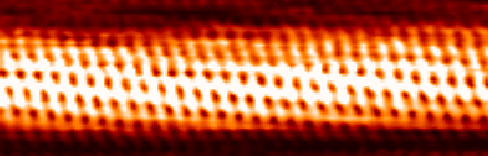
individual atoms on the surface, as in the image of a carbon nanotube in
Figure 7.7.7.
Figure 7.7.7: An STM image of a carbon nanotube: Atomic-scale
resolution allows us to see individual atoms on the surface. STM images are in
gray scale, and coloring is added to bring up details to the human eye.
However, the STM having a
resolution of 1 pm doesn't mean it would have the positional placement accuracy
of atoms to that degree.
One possibility to accomplish
this level of placement accuracy is to first use the STM to create a
rectangular array of atoms at ca. 1 nm spacing. Then use this as a mask to
create spacing of atomic to subatomic distances. We would suffuse gaseous metal
over the rectangular array that would then produce, like with a negative image,
an array with spacing the size of the original atoms. So now the spacing would
be at atomic to subatomic widths. The gaseous metal once solidified would like
with a negative image form a new rectangular array with ca. 1 nm wall
thickness.
The gaseous metal may need to
be ionized of the same charge as the originally placed atoms so that they do
not stick to them as they cool.
Atom size spacing would be at
about 1 angstrom, 1/10th of a nm. But we might be able to get it at subatomic spacing.
For the original atoms forming the mask, we would use ionized atoms with their
outer electrons stripped off. It might be too difficult to use fully ionized
atoms, i.e., the actual positively charged nuclei, because of their small size
and the intense electric charge trying to push them apart.
But using an argon ion for
example we could get an electron radial distance of 2 pm, so an ion diameter
and spacing of 4 pm:
Atomic
Radii
Recall
that the probability of finding an electron in the various available orbitals
falls off slowly as the distance from the nucleus increases. This point is
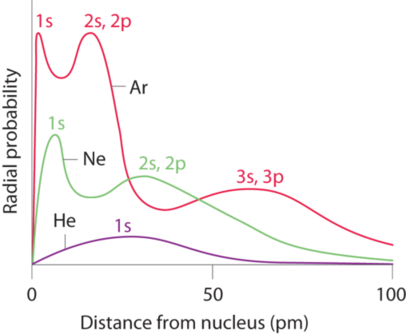
illustrated in Figure 7.3.1 which shows a plot of
total electron density for all occupied orbitals for three noble gases as a
function of their distance from the nucleus. Electron density diminishes
gradually with increasing distance, which makes it impossible to draw a sharp
line marking the boundary of an atom.
Figure 7.3.1: Plots of Radial Probability as a Function of Distance
from the Nucleus for He, Ne, and Ar. In He, the 1s electrons have a maximum radial probability at
≈30 pm from the nucleus. In Ne, the 1s electrons have a maximum at ≈8 pm, and the 2s and 2p electrons
combine to form another maximum at ≈35 pm (the n = 2 shell). In Ar, the 1s electrons have a maximum at ≈2 pm, the 2s and 2p electrons
combine to form a maximum at ≈18 pm, and the 3s and 3p electrons
combine to form a maximum at ≈70 pm.
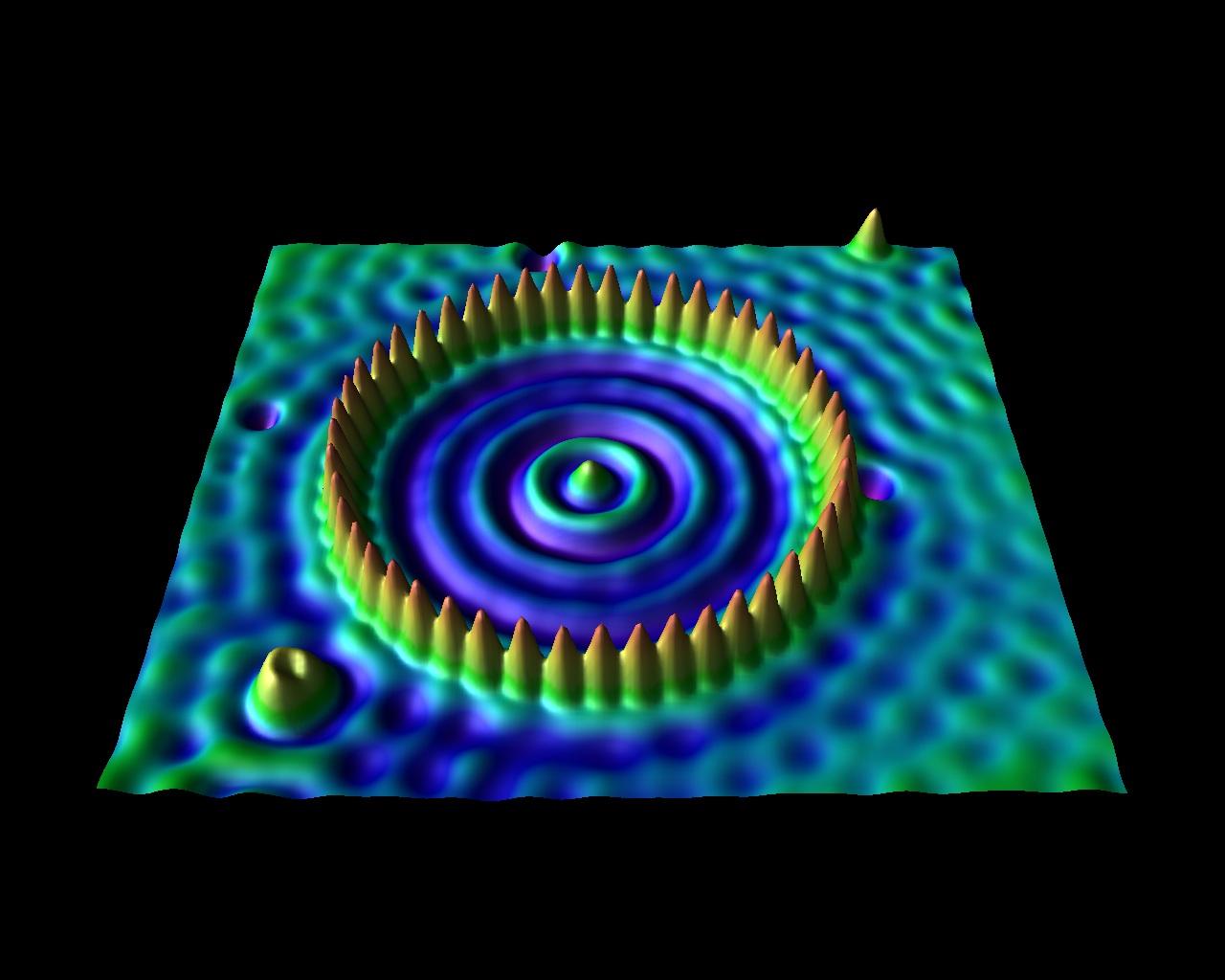
Cobalt atoms (red) are placed
on a copper surface (green) one at a time to form a Kondo droplet, leading to a
collective pattern that is the fundamental building block of superconductivity.
Credit: Dirk Morr
Scientists
have been interested in superconductors—materials that transmit electricity
without losing energy—for a long time because of their potential for advancing
sustainable energy production. However, major advances have been limited
because most materials that conduct electricity have to be very cold, anywhere
from -425 to -171 degrees Fahrenheit, before they become superconductors.
A new
study by University of Illinois at Chicago researchers published in the
journal Nature Communications shows that it is possible to
manipulate individual atoms so that they begin working
in a collective pattern that has the potential to become superconducting
at higher temperatures.
These still have only about 1
nm spacing between the atoms though, so on these as well we need methods to
achieve atomic to subatomic spacing.
We have an additional problem also
though. While positioning of atoms through the STM has been done in 2-dimensions
since the 90's, in 3-dimensions this has only been done more recently and not
with as much positional accuracy.
But for either a superluminal
communication fiber or superconducting fiber to be operational in practice you
want more than just a single atomic thickness. One possibility is that atoms
have been placed on single-atomic layer graphene as the substrate. Then
multiple layers of these each with their attached atom or ion arrays could be
placed one atop the other.
STM's are now common in many
university physics and chemistry labs. So either the superluminality or
superconductivity possibilities could be testable in many labs. However, for
the superluminality tests, since the STM produced atomic arrays are initially
likely to be small, the test of the speed of the signals would have to be
within the femtosecond range. Not many labs have time measurement devices of
this accuracy.
Easier then would be to test
the superconductivity possibility. Remarkably, there now even DIY constructed
STM's made by amateurs for which this may be even be testable on:
The possibility of quantum
mechanics having an interpretation in terms of superluminal speeds has
important ramifications. Actually, this has been known since the fifties with
the Bohmian interpretation of QM:
This interpretation however
does require superluminal speeds, and with such not being observed it was not
the preferred viewpoint. However, if superluminal speeds are actually observed
this or other non-local theories become preferred.
One advantage it would provide
is a reduction in the number of subatomic particles required: separate
antimatter particles would no longer be needed. Wheeler and Feynman once
proposed that the antimatter electron, the positron, was really just an
electron going back in time.
This dovetails with the idea
of superluminal speeds since the usual view of relativity is that superluminal
speeds would require signaling backwards in time. However, with the
reinterpretation of relativity by Reichenbach, superluminal speeds would not
necessarily require backwards in time signaling if using a non-standard, i.e.,
not using light signals, method of clock synchronization. This could be
provided when we have arbitrarily fast superluminal communication.
Perhaps not realized at the
time when Wheeler and Feynman proposed their backwards in time positron, is
that if using light-signal synchronization bodies that are faster-than-light
would give the appearance of traveling back in time. See the
discussion here:
Einstein, Relativity and Absolute
Simultaneity (Paperback)by William Lane Craig, Quentin Smith.
Then in such a scenario
particles and signals are not traveling backwards in time, but only give
that appearance due to an inaccurate clock synchronization method.
Then when we observe
electron-positron annihilation, what's really happening is the electron breaks
the local vacuum speed of light, thus generating vacuum Cherenkov radiation, The
electron then proceeds away at superluminal speed once it
breaks the light-speed barrier. This is what we interpret as a positron
traveling towards the "collision point".
This also explains why we see
so much more normal matter than antimatter, superluminal speeds are uncommon.
Much research now is being
devoted to quantum computers, with the prospect of orders of magnitude increase
in our ability to solve calculational problems. The same can be said of
superluminal computers if they are created.
An important class of
computationally complex problems are known as non-polynomial(NP) problems. Some
for example have known exponential time solutions. They are believed to be more
complex to solve than problems which can be solved in polynomial time. But one
of the most important unsolved problems in math and computer science is
to prove that they can not be solved in polynomial time. This
is the basis of the "P=NP?" problem.
If arbitrarily fast signaling
is possible then we may be able to do an end-around to the issue. Even if
problems do in fact require exponential time we may be able to solve them in
practical times.
A nice intro to the issues of
"P=NP?" is given in this video:
I like how she describes the
prospect of having this much computing power at our disposal at about the 13:20
point in the video.
Finally, one of the benefits of quantum mechanics when it was first proposed was that it returned the concept of free will to human existence since Newtonian physics was completely deterministic.
If the predictions and observations of QM can be explained by just superluminal speeds then we are back at the possibility the universe is deterministic.