Showing posts with label Planetary Resources. Show all posts

Sunday, February 15, 2015

Low cost Europa lander missions.

Copyright 2015 Robert Clark
  
 NASA has proposed funding for a future orbital mission to Europa. This is expected to have a billion dollar cost. A NASA-funded lander mission to Europa was expected to be too expensive. University of Arizona researcher Christopher Impey suggests doing privately funded missions to Europa:

SUNDAY, FEBRUARY 8, 2015
Let’s Send a Private Mission to Europa, Expert Says.
http://www.astrowatch.net/2015/02/lets-send-private-mission-to-europa.html

 Indeed, by following the commercial space approach an actual lander mission, not just orbital, can be mounted for costs in the range of one of NASA's lowest cost Discovery-class missions.

 Some observations by the Hubble telescope were that Europa may have plumes like Enceladus though those observations have not been confirmed. If it does, then it may be the subice ocean on Europa could be reached simply by traveling though the fissures, like on Enceladus, not requiring melting through the ice.

 For getting funding for a privately-financed mission, imagine how much interest there would be among the public if we could actually access this subsurface ocean. As a point of comparison the Mars Pathfinder missions web site caused such overloads, with 40+ million hits per day, that some mirror sites crashed or had to have access limited:

Traffic on Mars
by Chuck Toporek
Asst. Managing Editor
Web Review
However, the most interesting and little known fact about the amount of traffic to the mirror sites comes from France, where the government actually pleaded with computer users to stop accessing the two Mars Pathfinder mirrors. You see, the phone systems in France carry all of the Internet traffic in the country, so when people started visiting the mirror sites at VisuaNet and Le Centre National D'Etudes Spatiales (CNES), they tied up the phone lines and basically disabled the country.
http://mars.jpl.nasa.gov/MPF/press/webreview/index4.html

 Private companies that provided funding could be allowed to advertise on the mission web site.

Mission Delta-V requirements.
 The spacecraft first has to be sent on a trajectory towards Jupiter. This requires a delta-v of 6.3 km/s. Following a Hohmann trajectory it takes about 2.7 years to arrive at Jupiter. Aside from this Jupiter transfer delta-v, it will need to be placed into Jupiter/Europa orbit on arrival, and then sent towards a landing on Europa. According to this report this will require a delta-v in the range of 3.9 km/s:
European Cryo-Ocean Exploration Submersible (ECOES).
Preliminary Design Report. 
 We'll use a cryogenic, hydrogen-fueled stage for the injection into a trajectory towards Jupiter. And because of the long travel time, we'll use storable (hypergolic) propellants for the propulsive maneuvers at Jupiter.
Falcon 9 v.1.1 sized launcher.
 The expendable version of the Falcon 9 v1.1 has a payload to LEO of ca. 16.6 metric tons (mT). We'll use the Ariane H10-3 hydrogen-fueled upper stage for the Jupiter trajectory insertion. It has a 11.86 mT propellant mass, 1.24 mT dry mass, and 445 s Isp. Then it can carry 2.4 mT to the 6.3 km/s delta-v needed for the flight towards Jupiter:
445*9.81ln(1 + 11.86/(1.24 + 2.4)) = 6,324 m/s
 For the stage, at Jupiter we'll use the Integrated Apogee Boost Subsystem (IABS) stage.
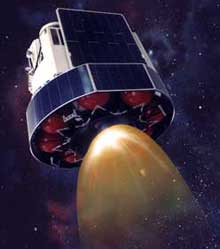
 An artist's concept of a DSCS satellite being boosted by the IABS. Photo: U.S. Air Force
 
 This is a small kick-stage used to put geosynchronous satellites in their final orbits. It has a 1,578 kg gross mass and 275 kg dry mass, for a 1,303 kg propellant mass, and a 312 s Isp. Then this could provide a 220 kg spacecraft with the 3.92 km/s delta-v needed to land on Europa:
312*9.81ln(1 + 1303/(275 + 220)) = 3,947 m/s. 
 The Falcon 9 v.1.1 costs in the range of $56 million, the Ariane H10-3 cryogenic stage costs in the range of $12 million and the IABS stage costs in the range of $15 million, for a ca. $83 million launch cost.
 For a model of a low cost lander we might use the Mars Pathfinder mission. This weighed only 264 kg for the lander plus 10.5 kg for the rover. The development cost for the lander was less than $150 million. The development cost of  $150 million is quite low for a planetary mission. However,  privately financed it would be even less than that, perhaps as much as a factor of 10 cheaper.
  SpaceX was able to develop the Falcon 9 at a 90% (!) saving off  the development cost of a fully government-financed launcher of similar size. Planetary Resources Inc. plans to produce imaging satellites at a fraction of the usual cost.
Arkyd 100 space telescope.
 With mission costs this low we might want to produce a separate orbiter mission at Europa. As models for this we might use the small Mars orbiters Mars Odyssey and Mars Climate Orbiter.

Falcon Heavy sized launcher.

 The Falcon Heavy will allow a larger payload to be transported to the Europan surface. It is expected to be able to carry 53 metric tons to LEO. We'll use two Centaur stages together for the injection into a trajectory towards Jupiter. For the maneuvers at Jupiter, we'll use the storable propellant stage Delta K. This has a 6 mT propellant load, 0.95 mT dry mass, and 319 s Isp. Then it can provide a 1 mT spacecraft with the 3.9 km/s delta-v needed for the Europa landing:
319*9.81ln(1 + 6/(0.95 + 1)) = 4,397 m/s.
 The Centaur has several incarnations. It's propellant load is in the range of 20 mT, dry mass ca. 2 mT, and Isp ca. 451 s. Then two Centaurs together could provide the 6.3 km/s delta-v needed for the Jupiter flight carrying the 7.95 mT total mass of the Delta K stage + Europa lander:
451*9.81ln(1 + 40/(4 + 7.95)) = 6,500 m/s.
  The Falcon Heavy will cost in the range of $125 million. The Centaurs cost in the range of $30 million each and the Delta K stage costs ca. $4.35 million. Then the total launch cost will be in the range of $189.35 million.
 As a model of a 1 metric ton lander we might use the Mars Curiosity rover. This is a $1 billion mission however. The commercial space approach however should be able to produce a similar size spacecraft for a fraction of this cost.
 
   Bob Clark 
 

UPDATE, February, 20, 2015:

 The web traffic to the NASA web site for the Mars Exploration Rovers was even more extraordinary, measuring in the billions of hits:

NASA’s Web Site for 2005
By Digital Trends Staff — January 7, 2005
The U.S. National Aeronautics and Space Administration Web portal continues to drive high traffic numbers — more than 17 billion hits in 2004, report both NASA and Speedera Networks, a leading global provider of on-demand distributed application hosting and content delivery services. Speedera delivers content from the space agency’s portal to visitors seeking access to the site from around the world. Popular events on the NASA Web site, including the ongoing Mars Exploration Rover mission entering its remarkable second year, as well as upcoming major projects such as the launch and comet encounter of NASA’s Deep Impact satellite mission in 2005, are expected to drive continued high levels of traffic, according to NASA officials.
http://www.digitaltrends.com/computing/nasas-web-site-for-2005/

 It was estimated there were 142 million visits to the site during this period. So the question is how much advertising could be sold for a site this well visited?

Tuesday, January 6, 2015

NASA Technology Transfer for manned BEO spaceflight.

Copyright 2015 Robert Clark

  The Morpheus lunar lander developed by NASA demonstrates how successful NASA can be when it takes a low cost approach to developing new systems. Not only can the Morpheus be used for unmanned robotic landers, but scaled up it can produce a manned lunar lander at orders (plural) of magnitude lower cost than the $10 billion NASA previously estimated for a lunar lander. Then Project Morpheus becomes a prime example of how NASA's Technology Transfer program can be utilized.


 The orders of magnitude reduction in cost is important for enabling the low cost commercial space approach to BEO (beyond low Earth orbit) spaceflight. For this to work, first, the companies that engage in the commercial space approach have to be convinced they can make a profit on such ventures. This is much easier to do when the development costs are in the ten's of millions of dollars range rather than the billions of dollars range

 Now note that by taking a smaller, modular approach to BEO spaceflight, as exemplified for example by the Early Lunar Access proposal, it is only a lander that would be needed to be developed for lunar flights.

Early Lunar Access. Credit: NASA

This actually is also the case for asteroidal flights since the delta-v to near Earth asteroids is actually less than that to the Moon. No hugely expensive super heavy lift launchers would be required. Only currently existing launchers, or those fully paid for by the developer such as the Falcon Heavy, would be used. Then that huge proportion of the development cost of such missions for the HLV would be eliminated.

 Then at least the development costs, aside from the launch costs, can become manageable for private financing. Then private BEO proposals such as by Golden Spike Company. Planetary Resources, Inc., Deep Space Industries, etc. become feasible.


  Bob Clark

Saturday, May 18, 2013

On the lasting importance of the SpaceX accomplishment, Page 3: towards European human spaceflight.

Copyright 2013 Robert Clark 


European Human Spaceflight

The EU released a report critical of the ESA's policy on new launchers:

The EU Seems to Really Dislike ESA’s New Launch Vehicle Policy.
Doug Messier
on March 17, 2013, at 5:57 am
www.parabolicarc.com/2013/03/17/the-eu-seems-to-really-dislike-esas-launch-vehicle-policy/

  The report is rather opaque about what changes the EU wants in space policy as opposed to what the ESA is proposing. One thing I noted is that it wants the ESA to keep up with technological advances the other space programs in the world are embarking on.

 This possibly might relate to the proposal of the Ariane 6 to use all solids on the lower stages. This is going backwards, not forwards in technology. A forwards suggestion for the Ariane 6 would have been the option that uses liquid fuel for a core stage simply by adding a second Vulcain to the Ariane 5 core stage.
 Note this would have high commonality with the current Ariane 5 which the ESA also wants to save on costs rather than having to design entire new solid lower stages. But the most important advantage of this is a key technological advance it would provide to keep up with the other space faring nations.

 Russian and China have manned orbital launchers, and the U.S. will again also in the short near term. India is even planning on manned launchers. But the ESA has no plans on producing a manned launcher. Space advocates in Europe should regard this as unacceptable. But the key point is by using the multi-Vulcain option for the Ariane 6 this would provide Europe with a manned spaceflight capability.

 Another source of friction with the EU is that ESA is constrained to apportion work according to members financial participation, while the EU is under no such constraints:

CNES Design Team Sets ‘Triple-seven’ Goal for Ariane 6.
By Peter B. de Selding | Jan. 2, 2013
https://spacenews.com/33019cnes-design-team-sets-triple-seven-goal-for-ariane-6/

From the article:
...after months of hard selling that saw them pitted against much of France’s industry, CNES officials last year convinced Fioraso that Ariane 6 — less expensive and less powerful than Ariane 5, and carrying just one satellite at a time to orbit — is the way of the future.
The design of the rocket — two solid-fueled lower stages and a cryogenic upper stage, plus solid-fueled strap-on boosters — was frozen Nov. 21 during a meeting of ESA government ministers.ESA Launcher Director Antonio Fabrizi said this design, and no other, is what ministers approved.
and:
Ariane 6 has been conceived from the start as a “next-generation” rocket that in many ways looks like a throwback — more of a less-expensive Lockheed Martin Atlas 5, or a Proton launched from the equator. Ariane 5 can do more things for more customers.
But if it meets its design goal, Ariane 6 will reach a financial equilibrium that has eluded Ariane 5. CNES officials say economic criteria account for 43 percent of the design decisions made for the rocket, with technical criteria accounting for just 30 percent.
The remaining 27 percent of the design choices are being made on the basis of Europe’s existing industrial capacity.
French industry is responsible for around 50 percent of the construction of Ariane 5. Eymard said the agency assumes France will carry about the same load for Ariane 6.
Beyond the French contribution, all bets are off. CNES has penciled in Germany at 25 percent, and Italy at 10-15 percent. The Italian share should be relatively easy to secure because Italy already is heavily involved in production, with Snecma of France, of the solid-fueled strap-on boosters used on the Ariane 5 rocket. Italy is also the lead investor in the new Vega small-satellite launcher, which made its inaugural flight in early 2012.
Because of the all-but-guaranteed work share of Italian industry in the Ariane 6 solid-fueled stages, the Italian government is not likely to resist taking its 10-15 percent stake despite its public-debt crisis.
Ensuring German industry sufficient work will not be as straightforward, European government and industry officials said.
 This article shows the difficulty the ESA will have in developing innovative launch solutions. The biggest factor in deciding which launcher to develop is how much work it can provide to the ESA, member countries. This supersedes even lowered costs.

The ESA could develop a low cost launcher that would be comparable in cost to the SpaceX Falcon 9, AND moreover would give Europe an independent manned launch capability simply by adding a second Vulcain to the Ariane 5 core. Ironically though, this option is not chosen because it would be TOO low cost: it would be simple, quick - and not provide enough work to the ESA member countries.

The only way Europe is going to get low cost space access, it now appears, is if it is done under the commercial space approach. As proven by SpaceX this can cut 90% (!) off the development costs when privately financed. And in fact it should be even easier and cheaper than the SpaceX case since the components already exist in the Ariane 5 core, built in France, and Vulcain II engines, built in Germany. Even the capsule for the manned launchers is largely already designed in the Orbital Sciences, Cygnus capsule, which is actually built in Italy. You would just need to supply life support and heat shield to the capsule already designed to be pressurized.

 The only thing needed are entrepreneurs in Europe like Elon Musk in the U.S. with the insight to carry it out. In the blog posts "On the lasting importance of the SpaceX accomplishment" and "On the lasting importance of the SpaceX accomplishment, Page 2" I discussed the fact that space development costs were cut dramatically by SpaceX by private financing.

 NASA has found with its commercial crew program that it can develop manned launchers in general at lower costs by opting for a more commercial approach to their development. In fact NASA's commercial space program was presaged by the Air Force's Evolved Expendable Launch Vehicle (EELV) program. The Air Force only had to pay $500 million out of a $3.5 billion development cost for the Delta IV and $500 million out of a $2 billion development cost for the Atlas V. For the Delta IV, that's a 86% (!) savings in development cost.

 NASA also has saved in development cost on Orbital Science's Antares launcher. It only had to pay $288 million out of a development cost of $472 million for a 5 metric ton class launcher. 

 Then the suggestion to the EU is to institute a similar program for European manned launchers. Politically the ESA appears to be set on the all-solid Ariane 6. But what the EU could do is put out a request to European industry for commercially developed man-rated launchers that would be largely privately funded aside for perhaps some seed money, a la SpaceX. To sweeten the pot, the EU could state that as part of their policy they will use these European launchers for their manned flights as long as they are comparable in price to say what they are paying the Russians for their launchers.

 The Russians are charging $63 million per seat for flights on the Soyuz, so for three crew in the range of $190 million. This is almost the cost of a full Ariane 5 launch, a vehicle capable of 20 metric tons (mT) to LEO.

 A vehicle capable of carrying a manned capsule could be done at a 5 mT payload capability, a quarter the size of the Ariane 5. SpaceX spent $300 million developing the Falcon 9, capable of 10 mT to LEO. Then a vehicle half the size, that was also largely privately funded as was the Falcon 9, might cost ca. $150 million.

 Considering the payload for our twin-Vulcain Ariane likely will be above 5 mT though, we might instead estimate the development cost as $200 million based on how much JAXA spent to add a second cryogenic engine to the H-IIA core.

 Also, I've been informed by people who aware of CNES studies on a multi-Vulcain Ariane that the estimated price for the two-Vulcain Ariane 5 core would be only 50 million euros, about $60 million(!) So for only a ca. $200 million development cost and a $60 million launch cost the ESA could have manned spaceflight ability.

 Another source of income for such a launcher with the Cygnus capsule would be deliveries to the ISS. SpaceX is charging NASA about $133 million for ca. 6,000 kg delivery of cargo using the Falcon 9. Part of this inflated cost above the $54 million cost of the Falcon 9 is the use of the expensive Dragon capsule. The Cygnus is a smaller capsule with a much smaller development cost, so would be much cheaper than the Dragon. Using a ca. 8,000 kg payload for the launcher and ca. 2,000 kg mass for the Cygnus, this launcher could match the 6,000 kg delivery capacity of the Falcon 9 at a much reduced price.

 European Moon Flights

 According to NASA administrator Charles Bolden, NASA will not be returning us to the Moon but may engage in partnerships with other space agencies or private entities who could. Then it's interesting the ESA has the required lightweight in-space stages and lightweight capsule in the Cygnus to accomplish this at low cost.

Another key fact is that NASA has shown with SpaceX and now with Orbital Sciences that development costs can be cut drastically (by 80 to 90% !) by following a commercial approach. Then this could be a project NASA could encourage, at low cost to NASA, by partnering with ESA and private entities like Golden Spike, Planetary Resources, Inc., etc, while at the same time satisfying the critics who want us to return to the Moon.


   Bob Clark

Sunday, June 17, 2012

Low cost development and applications of the new NRO donated telescopes, Page 4.

Copyright 2012 Robert Clark 

 A key reason why these space telescopes developed under a more commercial approach can be done much more cheaply is the more expensive "space qualified" electronics have been found to be unnecessary. This is described by Dr. John Hunter in regards to G-hardening the electronics:

Propellant Delivery to Orbit in Support of Mars Exploration
 with Hydrogen Gas Guns - Dr. John Hunter.

 About 14 minutes in Hunter discusses standard off the shelf components can be used with inexpensive modifications even in regards to gas gun launch at hundreds of g's. As an example he notes cell phones have to be designed to survive such high g's just from being dropped from normal height.

 Radiation resistance can also be done with off the shelf electronics with inexpensive modifications. This is argued by Dennis Wingo whose area of expertise is developing electronics for space use:

Bootstrapping the Moon.
By Dennis Wingo Posted Wednesday, May 7, 2008
Ideas to Lower the Cost of the Effort
Avionics
The first thing to attack is the military industrial complex focus on radiation tolerance for integrated circuits. This one thing has driven the cost of space projects higher and higher as designers have to use several generations old microprocessors, and all types of integrated circuits. This is because there are specifications that individual chips have to meet for latch up and single event upsets. Since most off the shelf (COTS) chips are not particularly radiation hardened, this means that for hardware that goes through the radiation belts or is used in environments where radiation might be a problem that you have to modify existing chip designs to harden them.
This is enormously expensive and the market for these chips is very small in comparison to the commercial market so the number of advanced chips flying is actually very small and the tendency is that the current generation of space qualified chips are several generations behind their commercial brethren with the gap growing year by year. This is why the International Space Station is controlled by 80386 25 Mhz microprocessors that were obsolete in the commercial world in 1992. What it also means is that the tools for software development are ether generations behind as well or are very poorly designed as it is much more expensive for these systems with a very limited market and installed base.
This has been the case since the early 1990's as the amateur radio satellites proved when they basically completely abandoned the concept of space qualified and successfully flew advanced chips. They were able to do this via the concept of shielding the chips with tantalum or other chip and box level shielding techniques. It costs a little weight but with the advances in chip technology, software, and software systems, the total systems costs can be dramatically lowered.
An example of one government organization that understood this was the Strategic Defense Initiative Organization's Clementine mission in 1993 that flew commercial state of the art processors and dynamic RAM memory for the imaging system. It worked fine but the military spec RAD 3000 had a software glitch that opened up a thruster and ended the mission before they could go to an asteroid after successfully operating in lunar orbit for several months. More recent software errors have reportedly crippled much more expensive spacecraft. Today with software growing to as much as 1/3 of the total cost of an advanced spacecraft major savings can be accomplished and schedules compressed by using this approach. So that iPhone that you love may be your communicator on the Moon! The European Space Agency was able last year to get NASA to agree to using the advanced technology of Wi-Fi and the Internet protocol for the lunar outpost. This was a celebrated victory.

http://www.spaceref.com/news/viewnews.html?id=1287

 So off the shelf electronic components can be used with just a little extra weight for shielding.

 This has majorly important results if you already have the space qualified optical components and support structure. It means the space based scopes can then be completed for little more than for the ground versions. 

 This report shows those ground scope costs are surprisingly low compared to the prices now charged for comparable space telescopes:

The Scaling Relationship Between Telescope Cost and Aperture Size for Very Large Telescopes.
Gerard T. van Belle
Michelson Science Center, California Institute of Technology, Pasadena, CA 91125
****@ipac.caltech.edu
and
Aden Baker Meinel & Marjorie Pettit Meinel
Jet Propulsion Laboratory, California Institute of Technology, Pasadena, CA 91109
****@earthlink.net


http://www.eso.org/~gvanbell/publications/van_belle_meinel2_2004.pdf 


 You see the ground scopes in the 2 to 3 meter diameter range are in the $10 to $20 million range and even less. 

This supports the claim of PRI that a commercial approach to the telescope construction can cut costs by one to two orders of magnitude.


  Bob Clark

Wednesday, June 13, 2012

Low cost development and applications of the new NRO donated telescopes, Page 3.

Copyright 2012 Robert Clark

Credit: NASA/JPL-Caltech/UCLA. This is a mosaic of the images covering the entire sky as observed by the Wide-field Infrared Survey Explorer (WISE), part of its All-Sky Data Release.  

 The WISE mission has released all the images taken during the duration of the mission:

NASA Releases New WISE Mission Catalog of Entire Infrared Sky.
03.14.12

"Today, WISE delivers the fruit of 14 years of effort to the astronomical community," said Edward Wright, WISE principal investigator at UCLA, who first began working on the mission with other team members in 1998.
WISE launched Dec. 14, 2009, and mapped the entire sky in 2010 with vastly better sensitivity than its predecessors. It collected more than 2.7 million images taken at four infrared wavelengths of light, capturing everything from nearby asteroids to distant galaxies. Since then, the team has been processing more than 15 trillion bytes of returned data. A preliminary release of WISE data, covering the first half of the sky surveyed, was made last April.
The WISE catalog of the entire sky meets the mission's fundamental objective. The individual WISE exposures have been combined into an atlas of more than 18,000 images covering the sky and a catalog listing the infrared properties of more than 560 million individual objects found in the images. Most of the objects are stars and galaxies, with roughly equal numbers of each. Many of them have never been seen before.
http://www.nasa.gov/mission_pages/WISE/news/wise20120314.html

WISE Delivers Millions of Galaxies, Stars, Asteroids.
04.14.11
Astronomers across the globe can now sift through hundreds of millions of galaxies, stars and asteroids collected in the first bundle of data from NASA's Wide-field Infrared Survey Explorer (WISE) mission.
"Starting today thousands of new eyes will be looking at WISE data, and I expect many surprises," said Edward (Ned) Wright of UCLA, the mission's principal investigator. 

The Wide-field Infrared Survey Explorer
All-Sky Data Release
March 14, 2012

 The WISE mission has made many important discoveries: 

WISE Finds Few Brown Dwarfs Close to Home.
June 08, 2012
WISE was launched in 2009 and surveyed the entire sky in infrared light in 2010. One of the mission's main science goals was to survey the sky for the elusive brown dwarfs. These small bodies start their lives like stars, but lack the bulk required to burn nuclear fuel. With time, they cool and fade, making them difficult to find. 
Improvements in WISE's infrared vision over past missions have allowed it to pick up the faint glow of many of these hidden objects. In August 2011, the mission announced the discovery of the coolest brown dwarfs spotted yet, a new class of stars called Y dwarfs. One of the Y dwarfs is less than 80 degrees Fahrenheit (25 degrees Celsius), or about room temperature, making it the coldest star-like body known. Since then, the WISE science team has surveyed the entire landscape around our sun and discovered 200 brown dwarfs, including 13 Y dwarfs. 

NASA Survey Counts Potentially Hazardous Asteroids.
May 16, 2012
PASADENA, Calif. -- Observations from NASA's Wide-field Infrared Survey Explorer (WISE) have led to the best assessment yet of our solar system's population of potentially hazardous asteroids. The results reveal new information about their total numbers, origins and the possible dangers they may pose.
Potentially hazardous asteroids, or PHAs, are a subset of the larger group of near-Earth asteroids. The PHAs have the closest orbits to Earth's, coming within five million miles (about eight million kilometers), and they are big enough to survive passing through Earth's atmosphere and cause damage on a regional, or greater, scale.
The new results come from the asteroid-hunting portion of the WISE mission, called NEOWISE. The project sampled 107 PHAs to make predictions about the entire population as a whole. Findings indicate there are roughly 4,700 PHAs, plus or minus 1,500, with diameters larger than 330 feet (about 100 meters). So far, an estimated 20 to 30 percent of these objects have been found.
While previous estimates of PHAs predicted similar numbers, they were rough approximations. NEOWISE has generated a more credible estimate of the objects' total numbers and sizes.
"The NEOWISE analysis shows us we've made a good start at finding those objects that truly represent an impact hazard to Earth," said Lindley Johnson, program executive for the Near-Earth Object Observation Program at NASA Headquarters in Washington. "But we've many more to find, and it will take a concerted effort during the next couple of decades to find all of them that could do serious damage or be a mission destination in the future."

in addition to the searches for nomad planets and hypothesized planets at the edge of the Solar System: 

Can WISE Find the Hypothetical 'Tyche'?
February 18, 2011
Frequently Asked Questions
Q: When could data from WISE confirm or rule out the existence of the hypothesized planet Tyche?
A: It is too early to know whether WISE data confirms or rules out a large object in the Oort cloud. Analysis over the next couple of years will be needed to determine if WISE has actually detected such a world or not. The first 14 weeks of data, being released in April 2011, are unlikely to be sufficient. The full survey, scheduled for release in March 2012, should provide greater insight. Once the WISE data are fully processed, released and analyzed, the Tyche hypothesis that Matese and Whitmire propose will be tested.

  With the release of the image database, to help with the search for brown drawfs, potentially harmful asteroids, nomad planets, and extreme Solar System planets I recommend the use of distributed computing such as that used for the Seti@Home project to allow potentially millions of people to take part in the searches. With the great interest in the public in extraterrestrial life and possible Earth impacting asteroids, and with the possibility of discovering a new Solar System planet, there very likely would be a great deal of interest in such a project.

 And with asteroid mining ventures needing to find high value asteroids nearby, they could offer prizes, i.e., rewards, for those users who happened to find them.


  Bob Clark

Tuesday, June 12, 2012

Low cost development and applications of the new NRO donated telescopes, Page 2.

Copyright 2012 Robert Clark 
Credit: NASA simulated image of extreme Solar System bodies


Hubble-class scopes can be placed at GEO rather than a Lagrangian point.

The Planetary Resources, Inc. version of such an infrared scope would operate in low Earth orbit. Then it quite likely could be launched by a Falcon 9, at a ca. $50 million launch cost. However, the plans for the Wide Field Infrared Survey Telescope (WFIRST) that these NRO scopes could be used for would be to place it at a Sun-Earth Lagrangian point millions of miles away. But according to this article the large size of these new scopes would allow them to be placed much nearer, in geosynchronous orbit:

Ex-Spy Telescope May Get New Identity as a Space Investigator.
By DENNIS OVERBYE
Published: June 4, 2012

The telescope’s short length means its camera could have the wide field of view necessary to inspect large areas of the sky for supernovae.
Even bigger advantages come, astronomers say, from the fact that the telescope’s diameter, 94 inches, is twice as big as that contemplated for Wfirst, giving it four times the light-gathering power, from which a whole host of savings cascade.
Instead of requiring an expensive launch to a solar orbit, the telescope can operate in geosynchronous Earth orbit, complete its survey of the sky four times faster, and download data to the Earth faster.
Equipped with a coronagraph, which blocks light from the sun’s disk to look for exoplanets, another of Wfirst’s goals, the former spy telescope could see planets down to the size of Jupiter around other stars.
http://www.nytimes.com/2012/06/05/science/space/repurposed-telescope-may-explore-secrets-of-dark-energy.html

 Then they could be launched at least by a Falcon Heavy at a $100 million launch cost. The colder temperatures out at GEO compared to LEO would make the PRI asteroid search more sensitive also.


Cost advantage of a single large scope compared to multiple small scopes.

 In regards to PRI financing the development of such a scope, PRI has announced plans to make small telescopes of about 9" diameter to be sold for Earth imaging purposes and to combine hundreds to thousands of these for the asteroid search:

APRIL 26, 2012
Planetary Resources could take megapixel images of exoplanet and makes billions by 2020 before mining anything.
http://nextbigfuture.com/2012/04/planetary-resources-could-use-passively.html


However, linking up optical or infrared telescopes in orbit to form a single coherent image has not been done before and likely will add significantly to the price of the individual scopes. If it does work then the resolution will be as the widest distance between the scopes. However the light collecting area, which is what is needed for the sensitivity of an asteroid search, will only be as the sum of the areas of the scopes.
 The new NRO scopes have 11 times the diameter of the planned PRI telescopes. So it would take 121 of the PRI scopes to make up the sensitivity of a single one of the NRO scopes, assuming they are able to get a single coherent image from the combined scopes. 
 PRI has said they expect to cut the costs of their scopes by 1 to 2 orders of magnitude below that of, for example, a telescope as on the WISE mission. This would make them in the $3 to $30 million dollar range. With the complexity of the wide scale link up of the scopes at hundreds to thousands of kilometer distances,  it seems likely it would be closer to the higher range. Even if the Arkyds amount to $10 million each including launch costs, that would still be over a billion dollars to match the sensitivity of a single one of the NRO  scopes. In that case a single one of the NRO scopes at a few hundred million dollar cost would be advantageous.


The Hubble-class scopes properly instrumented can serve as upgrades both for the WISE and WFIRST scopes. 

 Interesting articles here about the WISE capability to detect large unknown planets at the very fringes of the Solar System:

Up telescope! Search begins for giant new planet.Tyche may be bigger than Jupiter and orbit at the outer edge of thesolar system. BY PAUL RODGERS SUNDAY 13 FEBRUARY 2011
http://www.independent.co.uk/news/science/up-telescope-search-begins-for-giant-new-planet-2213119.html

About that Giant Planet Possibly Hiding in the Outer Solar System...by NANCY ATKINSON on FEBRUARY 16, 2011
http://www.universetoday.com/83363/about-that-giant-planet-possibly-hiding-in-the-outer-solar-system/

 The 40 times greater collecting area means the Hubble-class scopes could perform a much more sensitive search than WISE for these extreme Solar System planets.
 Another possible use would be the search for nomad or rogue planets which are planets in the interstellar space between star systems:

Researchers say galaxy may swarm with 'nomad planets'. A good count, especially of the smaller objects, will have towait for the next generation of big survey telescopes, especially thespace-based Wide-Field Infrared Survey Telescope and the ground-based Large Synoptic Survey Telescope, both set to begin operation in theearly 2020s. A confirmation of the estimate could lend credence to another possibility mentioned in the paper - that as nomad planets roam theirstarry pastures, collisions could scatter their microbial flocks to seed life elsewhere. February 23, 2012 BY ANDY FREEBERG
http://phys.org/news/2012-02-galaxy-swarm-nomad-planets.html

 Again the Hubble-class scopes would have much better sensitivity to detect them than the Wide-Field Infrared Survey Telescope(WFIRST) scope mentioned.
 It has been speculated such nomad planets could have life in subsurface water. Since some of these nomads are believed to be ejected from other star systems, nomads near to us or captured by our Solar System would provide a more near term route to search for life in other star systems.
 Because of the interest in the search for extraterrestrial life, you could have another source for private funding for such scopes. One could have for example the scope named after a foundation or individual who provided a large portion of the funding, like the Keck telescope.


   Bob Clark


Friday, June 8, 2012

Low cost development and applications of the new NRO donated telescopes.

Copyright 2012 Robert Clark

Credit: simulated image of Hubble-class telescope at Mars from NASA images.


NASA gets two military spy telescopes for astronomy. 
By Joel Achenbach, Published: June 4 
The announcement Monday raised the obvious question of why the 
intelligence agency would no longer want, or need, two Hubble-class 
telescopes. A spokeswoman, Loretta DeSio, provided information 
sparingly. 
“They no longer possessed intelligence-collection uses,” she said of 
the telescopes.

http://www.washingtonpost.com/national/health-science/nasa-gets-military-spy-telescopes-for-astronomy/2012/06/04/gJQAsT6UDV_story.html 

The explanation clearly is that Hubble scale telescopes are now 
obsolete for surveillance as I earlier argued, [1].


Asteroid Detection for Planetary Defense and Asteroidal Prospecting.

 A useful application of the new scopes would be detection of asteroids for planetary defense purposes, and for the new asteroid mining ventures. For instance the wide field camera on the WISE mission satellite was able to find this Trojan class asteroid:

NASA's WISE Mission Finds First Trojan Asteroid Sharing Earth's Orbit.
07.27.11 
 The mirror on the new scopes is 100 inches compared to 16 inches for the WISE mission satellite, resulting in nearly 40 times greater collecting area and sensitivity.

 In fact, NASA might be able to have the satellite development be partially funded by the asteroid mining ventures. If so, then the development could be done much more cheaply with a commercial approach to their development.

 Indeed Planetary Resources referred to the NASA WISE satellite in stating they could produce comparable telescopes to the WISE at 1 to 2 order of magnitude lower costs:

Billionaire-backed asteroid mining venture starts with space telescopes.
The key factor is the cost: Lewicki noted that an imaging instrument like NASA's Wide-field Infrared Survey Explorer would typically cost hundreds of millions of dollars. "We're looking to go one to two orders of magnitude below that," he said.  [2]

 For a Hubble-class telescope this would be reduced at least to the few hundred million dollar cost range, thus solving the funding problem NASA has for deploying such scopes. That the scopes could indeed be produced at such reduced costs is given credence by the fact that SpaceX was able to cut development costs both for their launchers and their spacecraft by an order of magnitude by following a commercial approach to their development. 

 Note also that Hubble was designed and built in the 1980's, 25 years ago. From Moore's law there have been major reductions in size and cost of electronic components since then, which  further supports the idea the development costs can be done much more cheaply now for the instruments than was the case for Hubble.

 For the launch costs, Hubble was done by the shuttle with a ca. 20 mT payload capacity. So a Hubble-class scope launched just to LEO could be done by any of the current largest launchers with a 20 mT capacity to LEO, at costs in the $200 million range. 

 However, Hubble was just barely above 10 mT in weight, at about 11 mT. Reportedly these new scopes weigh less than Hubble and with the reduction and size and weight in electronics since the time Hubble was developed, these new scopes quite likely could be brought in at 10 mT or less. In that case they could be launched to LEO by a Falcon 9 at a $50 million launch cost.

Mars Imaging Satellites.

 Another useful application of one of the scopes would be for a Mars orbital satellite. Again as developed by Planetary Resources in a commercial approach to the development it could be done for a few hundred million dollars. 

 The mirror on the current highest resolution Mars satellite Mars Reconnaissance Orbiter(MRO) has a 20 inch diameter with a resolution on the Mars surface of 25 centimeters, about 10 inches. Then the 100 inch diameter on the Hubble class scope would give a resolution of 5 centimeters, about 2 inches. 

 MRO came within 100 km of the surface at periapsis during aerobraking on Mars, [3], while its final orbit was at about 300 km. However, MRO did not do imaging at closest approach during aerobraking. If a Hubble class scope did such imaging, then at 100 km altitude it could get sub-inch resolution at periapsis.

 Mars orbiting satellites typically have both wide field and narrow field cameras, with the wide field cameras giving much courser resolution than the narrow field. However, these new scopes reportedly can give resolution nearly as good as Hubble even with a wide field. 

 This is important because for the Mars orbiters when taking their highest resolution images with the narrow field cameras, the coverage of the surface is quite spotty. However, with these new scopes having wide field capability at high resolution you can get entire surface coverage at high resolution. This would require high data throughput of course which should now be possible with state of art computer storage density and processing speeds.

 For the launch cost, Robert Zubrin suggests the Falcon Heavy could send 14 mT to Mars orbit with a conventional hydrogen-fueled upper stage, say of Centaur-type, [4]. A single one of the current largest Centaurs at 20 mT gross mass probably wouldn't do it though. You would need two, either parallel or serially staged. At a Centaur cost of $30 million, assign $60 million for the cost of the upper stage. Then with a $100 million cost of the Falcon Heavy, the launch cost would probably be under $200 million, when you add on the cost of integrating the Centaurs to the rest of the vehicle.

Speculations on the Next Mars Imaging Satellites after the Hubble-class.

 Because of the ever improving resolution of orbital satellites sent to Mars, I once wrote rather tongue-in-cheek that we will soon be able to resolve Martian microbes from orbit, [5]. However, remarkable new research might imply such astonishing resolution near term might actually come to pass. 

 To get such high resolution from orbit would require an impractically large mirror, one might  think. This is because the diffraction limit of classical electromagnetic wave theory puts limits on the degree of resolution you can get for a given size mirror. However, new research in "negative refractive index" materials shows using quantum mechanics you can get resolution actually beyond the diffraction limit. The result is you can get much better resolution for a given size mirror than previously thought possible, [6], [7].


  Bob Clark


REFERENCES.

1.)Newsgroups: sci.astro, sci.physics, sci.space.policy, sci.astro.amateur, us.military.army 
From: Robert Clark <rgregorycl...@yahoo.com> 
Date: 23 Apr 2007 02:49:39 -0700 
Subject: Orbital surveillance satellites now exceed 1 inch resolution. 


2.)Billionaire-backed asteroid mining venture starts with space telescopes.
23 Apr, 2012 11:37pm, EDT

3.)Mars cameras debut as NASA craft adjusts orbit.
MISSION STATUS REPORT
Posted: April 13, 2006

4.)The Use of SpaceX Hardware to Accomplish Near-Term Human Mars Mission.

5.)Newsgroups: sci.astro, sci.physics, sci.geo.geology, alt.sci.planetary, sci.astro.amateur
From: "Robert Clark" <rgregorycl...@yahoo.com>
Date: 10 Jan 2007 09:12:09 -0800
Subject: We will soon be able to resolve Mars microbes from orbit. ;-)

6.)Negative index metamaterials.

7.)Superlens.


Could Blue Origin develop a lander for Artemis III?

Copyright 2025 Robert Clark SpaceX is coming under increasing criticism for its delay in developing the Starship lunar lander: U.S. Is Losin...