Showing posts with label DC-X. Show all posts

Monday, June 19, 2023

Towards a revolutionary advance in spaceflight: an all-liquid Ariane 6.

 Copyright 2023 Robert Clark


Imagined Ariane 6 sans SRB's with twin Vulcains.


 Abstract.

 Most orbital rockets have payload fractions in the range of 3% to 4%. The Ariane 6 using 2 and 4 SRB’s, because of the large size of the SRB’s and because solids are so inefficient on both mass ratio and ISP, the two key components of the rocket equation, it will count among the worst rockets in history at a payload fraction of only 2%.

 In contrast a two Vulcain Ariane 6 could have a payload fraction of 7% and a three Vulcain Ariane 6 could have a payload fraction of 7.5%. This is well-above what any other rocket has ever achieved in the history of space flight.

 So how is an all-liquid Ariane 6 able to accomplish this? First, this version is based on the Ariane 5 core. The mass ratio for the Ariane 5 it turns out is quite extraordinary for a hydrogen+liquid oxygen(called “hydrolox”) stage at 16.3 to 1. This is in the range commonly seen by dense propellants. To use a colorful analogy, it’s like the ArianeSpace engineers in designing the Ariane 5 core found a way to make liquid hydrogen as dense as kerosene!

 Obviously, this is not what happened. But they must have found a way to achieve extreme lightweighting of a hydrolox stage. To put this in perspective, the mass ratio of the famous Centaur hydrolox upper stage is at 10 to 1, achieved back in the 1960’s. And the Delta IV hydrolox core is at a quite ordinary 8.7 to 1 mass ratio. So the Ariane 5 core is about twice as good as the Delta IV core on this key mass ratio scale.

 Because the Ariane 5 core has the high Isp of a hydrolox stage while achieving (somehow!) the high mass ratio of a dense propellant stage, it calculates out to have the highest delta-v of any rocket stage in the history of spaceflight.

 Since delta-v is the single most important parameter for orbital rockets, you can legitimately argue the Ariane 5 core is the greatest rocket stage ever produced in the history of spaceflight.

 The high 7.5% payload fraction of the all-liquid Ariane 6 would mean SpaceX would have to be chasing ArianeSpace rather than the other way around.

 To put this advance in perspective, it would be like SpaceX using the very same Merlin engines and the very same propellant tanks, and the very same size Falcon 9, suddenly being able to change the Falcon 9 payload from 22 tons to 40 tons.

 It will represent a paradigm shift in terms of the payloads that rockets will be expected to deliver to orbit.

 Usually, when we think of a radical shift in rocket capability we imagine some great advance in engines such as nuclear, or some great advance in materials to greatly reduce tank weight.

 Quite extraordinary is the the fact this radical increase in rocket capability can come from using currently existing engines and tanks.

Introduction.

 Mitchell Burnside Clapp is an engineer and former Air Force officer who had been prominent in programs back-in-the-day to find low cost space access, such as the DC-X. Here, he was calculating some existent or previous space stages that just on the ideal delta-v parameter would have SSTO capability:


==================================================

Propellant density, scale, and lightweight structure


.


Mitchell Burnside Clapp's profile photo

Mitchell Burnside Clapp

Jul 19, 1995, 3:00:00 AM
There has been some speculation about Atlas being one of the
lightest aerospace structures ever built. The thing that keeps
it from being a single stage to orbit machine is its relatively
heavy and low performance engines.

I decided to examine the historical record on this issue and
developed the table you see below. All the weights are in
thousands of pounds; the Ideal DV colum is in kft/sec
. Prop wt
refers to the weight of propellants. The Isp numbers are
referenced as far as possible to vacuum Isp. The engine data are
from CPIA Revised Liquid Propellant Engine Manual (1972), and
Rocketdyne, SEP, Aerojet, and Pratt and Whitney product
information sheets. The vehicle weight data are from Isakowitz’
Space Launch Systems, 1st Ed. Ideal DV is calculated from the
rocket equation [DV = Isp * g * ln (gross/(gross-prop))]. The
column labeled PMSMF refers to the Propulsion-Free Structural
Mass Fraction, which refers to the weight of the stage after the
engine is removed, divided by the gross weight. This residual
weight includes the electronics, tankage, and so forth.

Here are the data:

Stage Prop Wt Gross Wt Engine Wt Isp PFSMF Ideal DV
Titan II Stg 1 260.0 269.0 3.258 287 2.13% 31.372
Black Arrow Stg 1 28.7 31.1 1.426 250 2.99% 20.755
Saturn V Stg 1 4584.0 4872.0 93.080 265 4.00% 24.114
Titan III Stg 1 294.0 310.0 3.343 283 4.08% 26.959
Titan IV Stg 1 340.0 359.0 3.343 283 4.36% 26.731
Delta 6925 Stg 1 211.3 223.8 2.528 295 4.46% 27.383
Atlas E 248.8 266.7 4.371 312 5.07% 27.073
Saturn V Stg 2 993.0 1071.0 17.400 425 5.66% 35.821
Zenit Stg 1 703.0 778.0 26.575 337 6.22% 25.364
Titan III Stg 2 77.2 83.6 1.144 312 6.29% 25.796
Saturn IB Stg 2 233.0 255.0 3.480 425 7.26% 33.504
Titan II Stg 2 59.0 65.0 1.102 308 7.54% 23.611
Saturn IB Stg 1 889.0 980.0 16.072 263 7.65% 20.111
Ariane 5 Stg 1 342.0 375.0 3.630 430 7.83% 33.624
Saturn 5 Stg 3 238.0 263.0 3.480 425 8.18% 32.179
Energia Core 1810.0 1995.0 21.000 452 8.22% 34.583

Zenit Stg 2 178.0 198.0 2.480 350 8.85% 25.816
Black Arrow Stg 2 6.5 7.8 .531 265 9.52% 15.450
Titan IV Stg 2 77.2 87.0 1.144 312 9.95% 21.919
Delta 6925 Stg 2 13.4 15.4 .207 267 11.82% 17.416

...

7. There are several stages that have SSTO-class delta-V figures
(anything over 30000 fps). The Titan II first stage can itself
deliver 1400 pounds to low earth orbit as it sits, with no
modifications to engine or structure. That’s pretty impressive,
even if a load of propellant for it costs $2.5 miilion.

==================================================

https://groups.google.com/g/sci.space.policy/c/PZgWB9WWhNw/m/gWAavQL8AAAJ

 However, since the SSTO was dismissed as not worth-while an important implication of such high delta-v stages was missed: when the first stage gets such high delta-v, the upper stage can be much smaller to get the same payload to orbit.

 Or said another way, a high delta-v first stage gets high payload to orbit with just a small size upper stage. 

 Of those high delta-v stages Burnside Clapp listed as of 1995, the Ariane 5 is the only one yet existent. And in actuality its even much better than listed in the table.

 You see, the Ariane 5 core had a forward skirt called the JAVE("Jupe AVant Equipée") that transmitted the thrust of the two side boosters to the core. Without the side boosters, this would be removed in our version. The JAVE weighed 1,700 kg. So lets calculate again the ideal delta-v without the JAVE. Note I'm using the lighter Ariane 5 "G" stage here, rather than the later "E" version, at a 158 ton propellant load and 12 ton dry mass. Removing the JAVE brings down the dry mass to 10.3 tons. I'll use the slightly better 434s vacuum Isp for the Vulcain now rather than the 430s Mitchell Burnside Clapp used in his 1995 calculation. Then the ideal delta-v is:

434*9.81Ln(1 + 158/10.3) = 11,900 m/s, or 39,000 ft/sec. 

 This is by far the best ideal delta-v ever produced by any single rocket stage in the entire history of spaceflight, exceeding also the delta-v's for the separate rocket stages on the Falcon 9.

 How were the Europeans able to produce such an extraordinary rocket stage? Firstly, they used hydrogen/oxygen(hydrolox) propellant on the core; this is known to produce the highest efficiency on the ISP scale of any chemical propellant. But this is well known and you see several stages among the highest listed used hydrolox. What's really extraordinary is the mass ratio, i.e., propellant fraction of the stage.

The mass ratio is gross mass divided by dry mass and it is important for a rocket stage for it is used in the rocket equation to determine what is the delta-v it could achieve:


The total mass of the stage would be 158 + 10.3 = 168.3 tons. Then the mass ratio would 168.3/10.3 = 16.3. As a point of comparison the famous Centaur upper stage was able to get a 10 to 1 mass ratio and this was considered a remarkable engineering achievement for a hydrolox rocket stage. 

 Hydrolox stages are able to get high ISP, but because hydrogen is such low density, the mass ratio is usually comparatively low. Dense propellant combinations such kerosene/oxygen(kerolox) are usually higher. For instance the mass ratio for the Atlas 5 kerolox first stage is about 16 to 1, and the Falcon 9 first stage is somewhat higher at about 20 to 1. But kerolox is about 3 times denser than hydrolox. So conceivably a kerolox stage such as the Atlas 5 or Falcon 9 using the same lightweighting methods as the Ariane 5 could get a mass ratio of 50 to 1!

 The mass ratio of the Ariane 5 core for a hydrogen stage is so remarkable that it should be used as a model for any stage hydrolox or kerolox.

Cost of the side SRB's is the source of the high Ariane 6 pricing.

 That parameter of ideal delta-v that the Ariane 5 core has superiority on over any other rocket ever built suggests that that should be built upon and not disregarded. Instead what has been used on the Ariane 5 and Ariane 6 are solid stages that are among the worst on this key parameter. Because solids are pressure-fed meaning the entire propellant tank has to operate as the combustion chamber requiring thick tank walls, they usually have poor mass ratio, despite the solids propellants higher density. Worse, the other key parameter in the rocket equation ISP is also among the worst with solids. 

 If it were only small solid side boosters used with the Ariane 5 and Ariane 6 then this would not have the severe reducing effect on the rocket efficiency that they did have. But instead the side rockets used on the Ariane 5 and 6 were huge in comparison to other side boosters used for example with the Atlas 5 and Delta IV, which were commonly only ~1/10th the size of the booster core stage.

 My speculation here, but I think the Space Shuttle design is what influenced ArianeSpace to use such large solid side boosters. Perhaps it was not known at the time when the Ariane 5 was first being designed but the Space Shuttle was a financial disaster. Such large side boosters are also used on the SLS which is also a financial disaster. The huge solid boosters used in both contributed to that.

 The newly designed solids on the Ariane 6 make the situation worse. Their size is about the size of the entire core stage of the Ariane 6, and the fact they use carbon-fiber make them more expensive. To understand how expensive is that use of carbon-fiber for the solids note the reason SpaceX decided to move away from carbon-fiber to steel for the StarShip:

Why SpaceX Abandoned Carbon Fiber.
…
The other concern was cost. SpaceX determined that it would spend upwards of $130,000 per ton to use carbon fiber as the primary rocket body material. On the other hand, it would spend just $2,500 per ton for stainless steel. It doesn’t take a mathematician to figure out that spending 50 times as much on carbon fiber would put considerable strain on the Starship project.
https://markets.rockwestcomposites.com/we-now-know-why-spacex-abandoned-carbon-fiber

 To provide an estimate of how bad is the cost issue against the Ariane 6 solids in comparison to just using an additional Vulcain, note the €75 million cost of the two SRB version of the Ariane 6 compared to the €115 million of the four SRB version. Then, as a first order estimate, we can take the cost of two SRB’s as €40 million. But the cost of a single Vulcan is only €10 million! So the two SRB’s planned for the base version costs 4 times as much as just adding a second Vulcain!

Therefore, again as a first order estimate, we can take the cost of a Ariane 6 with no SRB’s by subtracting off the estimated €40 million for the two SRB’s to get a no SRB price of only €35 million.Then the price of the two SRB's is more than the price of the entire rest of the rocket. So adding on a Vulcain at €10 million would give a price of €45 million, about $50 million. Note this compares quite favorably with the current $67 million cost of the Falcon 9 new.

 Further indication of how expensive are the Ariane 6 SRB's is found by comparing to other carbon-fiber, also called graphite-fiber, SRB's. The GEM 63 are carbon-fiber solid side boosters have about a 50 ton propellant load and cost estimated in the range $5 to $7 million.Then we can estimate the Ariane 6 SRB's to cost three times more to bring them to $15 to $21 million each, in the price range of the estimate you get from comparing the Ariane 6 two SRB and Ariane 6 four SRB pricing.

 There needs to be a discussion among the European space community about the use of these large expensive boosters when the same can be accomplished much more cheaply  by just using additional Vulcain engines on the core.

Payload Calculation for a Two Vulcain Ariane 6. 

 In the blog post, "Multi-Vulcain Ariane 6", I estimated about 11 tons to LEO using a two Vulcain, no SRB version for the Ariane 6. Note though I was originally trying to find a lower cost approach to the Ariane 6, so I actually used the Ariane 5 core. BUT because of my thrust constraints I chose to use the original, somewhat smaller version the Ariane 5 "G" core, rather than the later "E" version, at 12 ton dry mass and 158 propellant mass.

 For the upper stage, again because of limited take off thrust constraints I did not use the current ESC-A cryogenic upper stage of the Ariane 5 at ~19 ton gross mass, nor the ~30 ton cryogenic upper stage of the Ariane 6. I also did not like that the ESC-A had such a poor mass ratio at only 5 to 1. I used instead the Ariane 4's H10 cryogenic upper stage:

ARIANE 4 STAGE 3
Specifications are given in H10/H10+/H10-3 order.
Designation: H10/H10+/H10-3
Engine: single cryogenic open cycle SEP HM-7B
Length: 10.73 m/11.05 m/11.05 m
Diameter: 2.60 m
Dry mass: 1,200 kg/1,240 kg/1,240 kg, excluding interstage 2/3

Oxidizer: liquid oxygen
Fuel: liquid hydrogen
Propellant mass: 10,800 kg/11,140 kg/11,860 kg
Thrust: 63 kN vac/63.2 kN vac/64.8 kN vac
http://www.braeunig.us/space/specs/ariane.htm

 Note that in addition to being lighter this has a much better mass ratio at over 10 to 1, rivaling the famous Centaur upper stage.
 I also assumed the Vulcain thrust could be ramped up ca. 9% as was shown possible with the SSME's and the RS-68 engine on the Delta IV rocket. Then I asserted for the Vulcain likely the same would hold, as they are all hydrolox engines. 
 But a commenter to my blog cited a report giving estimated Ariane 6 values that estimated a 104 tons sea level thrust, so 208 tons for two, already held for the latest version:  

Launcher analysis and cost benefits

No 638719. Launcher analysis and cost benefits. Max Calabro (TIA). Emmanuella Gizzi (AVIO). Ref. Ares(2018)1042920 - 23/02/2018 


 If that is the case then I don't have to assume the Vulcain 2.1 thrust ramped up.

 But even without a higher thrust level Vulcain, we could take a smaller propellant load of ca. 140 tons for the Ariane 6 core so it could still have sufficient thrust for takeoff. Since this is only about a 10% reduced propellant load for the first stage it would be a relatively small reduction in payload.

 While I used the smaller, earlier Ariane 4 H10 upper stage because of my reduced thrust, we can now use the higher efficiency and thrust Vinci engine rather than the original HM-7B on this upper stage. The Vinci has a 180 kiloNewton vacuum thrust and 457s vacuum Isp. But using a slightly longer nozzle we can give it the 465.5 vacuum Isp of the RL10-B2. Remarkably with a sufficiently long nozzle we can give an upper stage hydrolox engine a vacuum Isp in the 480+s range. However, we'll use in our calculations the Isp number proven possible with currently in use engines of a 465.5s vacuum Isp.

As for the dry mass of the core with a second Vulcain, we removed the JAVE subtracting off 1,700 kg from the dry mass. Adding on a second Vulcain adds on 1,800 kg, bringing the dry mass back to about the original 12 tons.

However, another consideration is the doubled thrust might require thickened tank walls. I estimated in an earlier blog post that the increased thrust might require an additional 1,000 kg for the thicker tank walls. However, it should be noted the supported weight that needs to be carried above the core with a smaller upper stage and smaller payload mass is half as big as that of the Ariane 5. So advanced structural analysis programs need to be applied to find the needed degree of tank strengthening and added weight to the dry mass.

Still at most 1,000 kg needs to be added to the dry mass according to my prior estimate and this results in a proportionally small reduction in the payload mass. Then for this first order estimate we'll take simply 12,000 kg as the dry mass.

Now use the payload estimator at SilverbirdAstronautics.com giving the results:


 The payload to LEO calculated is 14,000 kg, exceeding the ~10 ton LEO payload of the Ariane 6 version with two SRB's by 40%.

 For the payload to geosynchronous transfer orbit, change the apogee to 35,700 km. The result is:


  The calculated payload to GTO of 6,652 kg is nearly 50% higher than the 4,500 kg GTO payload of the Ariane 6 version with two SRB's.

 
Payload Calculation for a Three Vulcain Ariane 6. 
 A three Vulcain format for an all-liquid Ariane 6 is actually preferred. The reason is you don't have such a thrust limitation as the two Vulcain case.This allows you to choose a larger upper stage resulting in a higher payload. 

 I have presented the two Vulcain case here and in some previous postings because of the low development cost, less than $200 million. Indeed, it most likely could be done for less than $100 million. 

 However, adding two additional Vulcains will require a higher development cost. It still likely will be in the few hundred million dollars range, well less than the multi-billion dollar development cost of the current version of the Ariane 6. 

 Again a key consideration is added tank wall thickness needed for the tripled thrust. In a prior blog post, I discussed a rocket that had been proposed by Northrup Grumman, the  Liberty rocket that would use a shuttle derived SRB as a first stage, a la the Ares I rocket, and an Ariane 5 core as an upper stage. 

 As described in this video, the SRB to be used would have had a thrust 12 times that of the Vulcain yet the increased thickness of the tanks on the Ariane 5 core would only need to be 50%:


 As the tank mass of the Ariane 5 core is in the range of 4 tons, this would mean the increased tank mass would have needed to be in the range of 2 tons. Since the three Vulcain format would mean far less less thrust than that of the Liberty rocket, the increased tank mass would be less than this. So we'll take the additional core mass as a max of 2,000 beyond that of the additional 3,600 kg for the added two Vulcains. 

 Since we have higher thrust we'll use the larger Ariane 5 "E" core at 170 propellant load and 14 dry mass. Subtracting off again the 1,700 kg for the JAVE, while adding on 3,600 for the two added Vulcains and 2,000 kg for the thickened tank walls brings the dry mass to about 18,000 kg. But because we have much more liftoff thrust with three Vulcains we can use much larger upper stages, such as the currently planned 30 ton hydrolox upper stage of the Ariane 6, or even larger 40 ton or 50 ton hydrolox stages.

 We'll take our upper stage as 50 tons propellant load with a Centaur-like 10 to 1 mass ratio, so a 5 ton dry mass, a la the ULA Centaur V. We'll use three Vinci engines on the upper stage to give a thrust of 540 kN and assume a RL10-like 465.5s Isp. Then the input page on the SilverbirdAstonautics.com payload estimator appears as:


The payload to LEO is estimated as:


And the GTO payload is:


 This is slightly less than the LEO payload of the Falcon 9, but about the same payload of the Falcon 9 for the lucrative GTO market.

 It is likely cheaper also than the Falcon 9 new. The reason is the Ariane 6 core and upper stage without SRB's is about €35 million, and the bulk of this price would be the core since the upper stage is such small relative size. For instance the price of the Falcon 9 is 3/4ths due to the first stage compared to the second stage. 

 Then using a 50% larger upper stage for the Ariane 6 might add another €5 million to the price, bringing it to €40 million. Then the two additional Vulcains would bring the price to €60 million, a bit less than the $67 million price of the Falcon 9 new.

The All-Liquid Ariane 6 as a Revolutionary Advance in Spaceflight.

 A key parameter for rocket efficiency that rocket engineers always use is payload fraction. For almost all rockets this is in the range of 3% to 4%. But because of those huge SRB’s the Ariane 6 uses, its payload fraction counts as among the worst in history at only in the range of 2%. But the two Vulcain no SRB version of the Ariane 6 would be in the range of 7%! And the three Vulcain no SBR version would be in the range of 7.5%.

On this key parameter rocket engineers use to rate orbital rockets the all-liquid Arianes would literally be the best rockets in the history of space flight with no other rocket even coming close.

They would literally be a paradigm shift in rocket efficiency. Other launch companies would have to strive to reach their level of efficiency. And most simply could not.

 To put this advance in perspective, it would be like SpaceX using the very same Merlin engine and the very same propellant tanks, and the very same size Falcon 9, suddenly being able to change the Falcon 9 payload from 22 tons to 40 tons. 

Plus, while being nearly twice as good as the Falcon 9 on this key parameter the all-liquid Ariane 6 would also be cheaper!


 Robert Clark


Monday, October 3, 2022

The raptor engine can open up the space frontier - if only SpaceX would allow it.

Copyright 2022 Robert Clark

  SpaceX has decided that the Raptors will first be used on the Superheavy/Starship, and perhaps even to only to be used on these vehicles. That SpaceX wants to put the Raptors on SH/SS is understandable since they want a super heavy lift rocket for Mars flights. However, Elon Musk has also spoken about opening up the space frontier. Then using the Raptors only on the largest space vehicles is the opposite of what they should be doing. 

 SpaceX shows great insight in wanting to produce fully reusable space vehicles since throughout history reusable transport vehicles have always been used. But in their approach to the SH/SS they are missing an extremely important fact. By insisting the SH/SS must be the be-all-end-all for ALL spaceflight they are ignoring the fact transport vehicles going back even to the horse-drawn era have always come in different sizes.

 SpaceX seems to be operating under the assumption making only this largest transport vehicle will be a competitive advantage in regards to size of the cargo that can be carried, therefore lowering the cost per kilo to orbit. But actually this is fallacious. It would be like trying to argue it would be optimal to only allow Greyhound buses and tractor trailers on the roads with no smaller vehicles allowed. In actuality, the number of transport vehicles on the road of various sizes from small to large is why the amount of transport, both cargo and human is so large.

 One might attempt to argue perhaps air transport would be more relevant to the question of only allowing the largest of transport vehicles to fly to space. But even here the argument is just as fallacious: the amount of transport by the wide-body aircraft is a tiny proportion of the amount of air transport occurring:


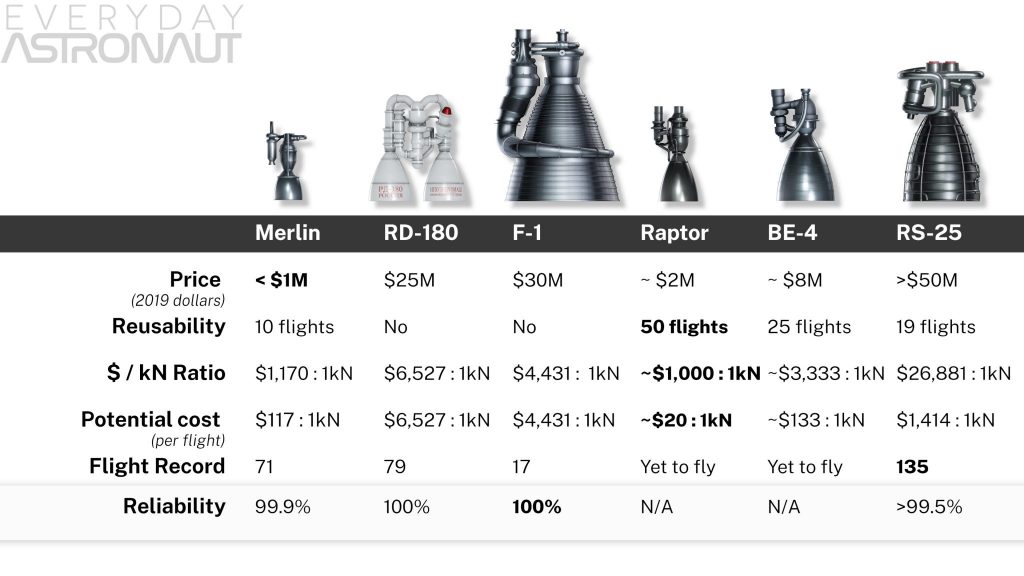
 Instead of their current approach, the SpaceX plan should be to allow other companies to use the Raptor in their own space vehicles. It is a fact that the engine is the most expensive development of a space vehicle. SpaceX is intending to produce the Raptor in high volume to reduce their cost. The cost of the Raptor is trending down to only $1 million per engine. By allowing space companies to purchase the Raptor would greatly reduce their development cost for their own rockets. 

 Calculations for Smaller Launchers. 

 It's puzzling why for so many years it was said SSTO's were not feasible or not with significant payload with current technology. Actually, high payload SSTO's are well within current tech and have been since the 70's with the advent of the staged-combustion, high-performance SSME hydrogen-fueled engines in the U.S. and the kerosene-fueled RD-180 and RD-170 engines in Russia. 

We now have the advent of the Raptor staged-combustion, high performance methane-fueled engine. This also makes possible SSTO with high payload: any of the current or past kerosene-fueled engines could become SSTO's when switched out to methane-fueled using the Raptor engine. The advantage is the Raptor engine in high volume production would be low cost.

 The Atlas I.

 This was the original rocket from the 60's that first sent John Glenn to orbit. At the time the engines were not advanced enough for SSTO. Because of the limited engines, extraordinary lengths were endeavored to reduced weight, including what were called "balloon tanks". These were tanks that maintained their structural integrity in simply being pressurized, to the extent they could not support their own weight if left unfueled or unpressurized. From the Astronautix web page:

SLV-3 Atlas / Agena B.
Family: Atlas. Country: USA. Status: Hardware. Department of
Defence Designation: SLV-3.
Standardized Atlas booster with Agena B upper stage.
Specifications
Payload: 600 kg. to a: 19,500 x 103,000 km orbit at 77.5 deg
inclination trajectory.
Stage Number: 0. 1 x Atlas MA-3 Gross Mass: 3,174 kg. Empty Mass:
3,174 kg. Thrust (vac): 167,740 kgf. Isp: 290 sec. Burn time: 120 sec.
Isp(sl): 256 sec. Diameter: 4.9 m. Span: 4.9 m. Length: 0.0 m.
Propellants: Lox/Kerosene No Engines: 2. LR-89-5
Stage Number: 1. 1 x Atlas Agena SLV-3 Gross Mass: 117,026 kg.
Empty Mass: 2,326 kg.
 Thrust (vac): 39,400 kgf. Isp: 316 sec. Burn
time: 265 sec. Isp(sl): 220 sec. Diameter: 3.1 m. Span: 4.9 m. Length:
20.7 m. Propellants: Lox/Kerosene No Engines: 1. LR-105-5
Stage Number: 2. 1 x Agena B Gross Mass: 7,167 kg. Empty Mass: 867
kg. Thrust (vac): 7,257 kgf. Isp: 285 sec. Burn time: 240 sec. Isp(sl): 0
sec. Diameter: 1.5 m. Span: 1.5 m. Length: 7.1 m. Propellants: Nitric
acid/UDMH No Engines: 1. Bell 8081

http://www.astronautix.com/a/atlasslv-3agenab.html

 You see the Stage 1 had a surprisingly high mass ratio of 50 to 1(!). However, the Atlas I was unusual in that it had a drop engine, listed here as Stage Number 0, that provided most of the lift-off thrust. The Stage Number 1 listed here had what was called a sustainer engine that flew the rest of the flight but did not have enough thrust for lift-off. So we'll remove that and replace it with the Raptor 2 sea level engine. This upgraded Raptor has an increased sea level thrust of 230-tons, with only slightly reduced vacuum Isp of ~ 350s. The Raptor 2 at 1,500 kg mass weighs about 1,000 kg more than the engine original used on the Atlas I Stage Number 1, so call the stage dry mass as 3,326 kg. 

 Normally methane-LOX propellant has a density of 800 kg/m^3 compared to 1,000 kg/m^3 for kerosene-LOX. But with supercooling the density of methane-LOX is about that of kerosene-LOX so we'll leave the propellant mass amounts the same in the calculations below.

 Then using a delta-v to orbit of ~9,150 m/s we can get ~5 tons to orbit for this Raptor powered Atlas I:

350*9.81Ln(1 + 114.7/(3.3 + 5)) = 9,250 m/s.

The Falcon 9 1st and 2nd stage.

 For the Falcon 9 1st stage:

TypeFalcon 9 FT Stage 1
Length42.6 m (47m w/ Interstage)
Diameter3.66 m
Inert Mass~22,200 kg (est.)
Propellant Mass411,000 kg (According to FAA)
FuelRocket Propellant 1
OxidizerLiquid Oxygen
LOX Mass287,430 kg
RP-1 Mass123,570 kg
LOX Volume234,700 l
RP-1 Volume143,900 l
LOX TankMonocoque
RP-1 TankStringer & Ring Frame
MaterialAluminum-Lithium
Interstage Length4.5 m (est.)
GuidanceFrom 2nd Stage
Tank PressurizationHeated Helium
Propulsion9 x Merlin 1D
Engine ArrangementOctaweb
 
   The 9 Merlin engines had a total sea level thrust of 775 tons-force. We'll replace them with three  Raptor 2 sea level engines of total 690 tons-force sea level thrust. It will be about 300 kilos increased weight for the engines so we'll use a dry weight of 22.5 tons. Then using the 350s Isp we get a ~8 ton payload:

350*9.81Ln(1 + 411/(22.5 + 8)) = 9,175 m/s. sufficient for LEO.

 For the Falcon 9 2nd stage:

TypeFalcon 9 FT Stage 2
Length12.6m (Separated Length)
Diameter3.66 m
Inert Mass4,000 kg (est.)
Propellant Mass107,500 kg (est.)
FuelRocket Propellant 1
OxidizerLiquid Oxygen
LOX Mass75,200 kg (est.)
RP-1 Mass32,300 kg (est.)
LOX TankMonocoque
RP-1 TankMonocoque
MaterialAluminum-Lithium
GuidanceInertial
Tank PressurizationHeated Helium
Propulsion1 x Merlin 1D Vac
Engine TypeGas Generator
Propellant FeedTurbopump
Thrust934kN
Engine Dry Weight~490kg
Burn Time397 s
Specific Impulse348s
Chamber Pressure>9.7MPa (M1D Standard)
Expansion Ratio165

  We'll only need a single Raptor 2 here to swap out the Merlin Vacuum engine. The Raptor weighs about 1,000 kilos more, so call the new dry mass 5,000 kg. Then this could get 3,000 kg to LEO:

350*9.81Ln(1 + 107.5/(5 + 3)) = 9,160 m/s.

 Note for both these cases the payload fraction will be 2% - 3%, which is in the range common for expendable rockets, countering the myth SSTO's can't carry significant payload. Actually, for both these cases the payload would be somewhat more because the simple rocket equation estimate doesn't take into account take-off thrust/weight ratio which is high in these two cases, which will increase the actual payload.

 The capability of an SSTO to carry significant payload is still controversial, however. So we'll look at a two-stage-to-orbit version of a Raptor powered version of the F9. Note here the upper stage only fires at high altitude so we can use the vacuum version of the Raptor with a ~380s vacuum Isp. Then we can get ~34 tons to LEO:

350*9.81Ln(1 + 411/(22.5 + 112.5 + 34)) + 380*9.81Ln(1 +107.5/(5 + 34)) = 9,160 m/s, sufficient for orbit with a 34 ton payload. This is a 50% improvement over the current F9 expendable payload of 22 tons.

For a ~200-ton gross mass vehicle.

 We will be basing cost estimates on the first version of the Falcon 9, now called v1.0, a ~300 ton gross mass vehicle. However, for cost reasons we're considering launchers as single stage launchable by a single Raptor, so we'll take our stage as approx. 200-tons gross mass. Take the propellant load of the stage as ~200 tons. For both the 1st and 2nd stages of the current Falcon 9 with the Merlins swapped out to use Raptors, we saw above both stages had mass ratios of about 20 to 1. So assume the mass ratio as about 20 to 1 with this new launcher, with an ~10 ton dry mass. Then the rocket equation gives:
350*9.81Ln(1 + 200/(10 + 5)) = 9,140 m/s, sufficient for a payload of 5 tons to LEO.

Cost Estimates.

 SpaceX shocked the space industry by developing the original version of the Falcon 9, now called Falcon 9 v1.0, at only a $300 million development cost:

Falcon 9.
In 2011, SpaceX estimated that Falcon 9 v1.0 development costs were on the order of US$300 million.[39] NASA estimated development costs of US$3.6 billion had a traditional cost-plus contract approach been used.[40] A 2011 NASA report "estimated that it would have cost the agency about US$4 billion to develop a rocket like the Falcon 9 booster based upon NASA's traditional contracting processes" while "a more commercial development" approach might have allowed the agency to pay only US$1.7 billion".[41]

 This was only a tenth of the development cost of a usual government-financed launcher of this size, approx. 300 tons gross mass. Note too developing a new engine makes up the lion-share of the development of a new rocket. Look for example at this breakdown of of the development costs of the Ariane 5 rocket:

Development budget

Again, Ariane 5, from 'Europäische Tragerraketen, band 2', Bernd Leitenberger:

Studies and tests 125
solid boosters 355
H120 first stage 270
HM60 (Vulcain) engine and test stands 738

other elements of the first stage and boosters 95
upper stage and VEB 200
ground support in Europe 80
Buildings and other structures in Kourou (launch pad) 450
Test flights 185
Total 2498
ESA and CNES management 102

https://space.stackexchange.com/questions/17777/what-is-the-rough-breakdown-of-rocket-costs

 For our scenario we would not be using solid rockets, nor using an upper stage. For the Ariane 5, the ESA also built entire new launch facilities in Kourou, Guyana in equatorial Africa, while we'll assume using existing NASA facilities for our launch. Of the remaining costs, you see the Vulcain engine development cost was more than half the remaining costs, and far more than the Ariane 5 core stage itself. 

 So without new engine development, the development of a new 300 ton gross mass rocket might be less than a $150 million cost. So for our ~200-ton gross mass vehicle, estimate it as 2/3rds of that, so ~$100 million development cost. And for a 100-ton gross mass rocket perhaps 1/3rd of that so only $50 million. Note, we'll be following the SpaceX low cost commercial-space approach to rocket development, to be sure.

  As an example of a smaller launch vehicle commercial-space development cost, the SpaceX Falcon 1 cost about $90 million, but this was with the Merlin engine development cost. Without that, the development might have been less than half of that, or less than $45 million. Note too, the Falcon 1 development cost included the development of the upper stage and its separate engine. Then following the Ariane 5 costing model, we might estimate the development cost of the first stage only without engine development cost, as a only a quarter of the total development cost, so only ~$25 million. 

 As another example of development cost of a smaller rocket, consider the DC-X suborbital demonstrator rocket. This had a development cost of $60 million. It used off-the-shelf hydrogen-fueled RL-10A engines, saving on engine development costs. The DC-X was at about 9,000 kilo hydrogen-oxygen propellant load. Since kerosene-LOX or supercooled methane-LOX as propellant is three times as dense this would correspond to a vehicle of similar dimensions but of 3 times larger propellant load so ca. 27,000 kilos, about the size of the Falcon 1.

 What about the cost of a launch to the customer? Note that when a launch company prices its launches it includes in that an amount to cover its development cost after some number of launches. The actual production cost of a launcher will be several times less than the cost charged to the customer for a launch. 

 In both the Falcon 1 and the Falcon 9 v1.0 cases the initial price SpaceX charged was about 1/10th the development cost, though this proportion does go down as the number of rockets is increased. For the original Falcon 9 v1.0 the price charged was about $27 million, about 1/10th the $300 million development cost and for the Falcon 1 the price charged was $8 to $9 million, also about 1/10th the development cost of $90 million.

 So for the approx. 200-ton gross mass vehicle the price for the stage without the engine cost might be 1/10th of $100 million, or $10 million. And the cost with the Raptor engine added on? 

Customer Pricing for the Raptor Engine.

 The $1 million estimated cost of the Raptor when produced in volume will actually be the production cost to SpaceX. Remember the price for the engine SpaceX will charge the customer will include some amount to cover development cost. We don't know that development cost for the Raptor so we cant use the 1/10th estimate. Plus, this will be when SpaceX is producing the engine in high volume where that initial pricing estimate will likely not be valid.

 For lack of a better estimate we'll compare the customer pricing for the current version of the Falcon 9 to SpaceX's production costs of a single rocket:

INNOVATION
SPACEX: ELON MUSK BREAKS DOWN THE COST OF REUSABLE ROCKETS
SpaceX CEO Elon Musk has lifted the lid on why reusing Falcon 9 boosters makes long-term economic sense.
...
In terms of the marginal costs, the costs associated with producing just one extra rocket, Musk also recently shed some further light on the figures. In an interview with Aviation Week in May, Musk listed the marginal cost of a Falcon 9 at $15 million in the best case. He also listed the cost of refurbishing a booster at $1 million. This would fit with Musk's most recent claim that the costs of refurbishment make up less than 10 percent of the booster costs.

 So the price of the Falcon 9 of $60 million is about 4 times that of the production cost. Then based on that we might expect the price to the customer of $4 million, bringing the price of 200-ton gross mass 5-ton payload mass single stage to $14 million.

 However, that Raptor wikipedia article also says at mass-production of 500 engines per year the production cost might drop to only $250,000 per engine. In that case a 4 times markup would make the customer price $1 million, giving a price of $11 million for the stage.

Reusable Launcher.

 These though would be the expendable prices. According to Tim Dodd, the "Everyday Astronaut", the Raptor engine is expected to be reusable 50 times:


 Then if the maintenance cost is small compared to the launch cost, at the $11 million price point, that would be approx. $220,000 per launch. 

 And the price per kilo for a reusable version? That would be dependent on the how much the extra mass for reusability systems subtract from the payload. 

Heat Shield and Landing Legs.

  We'll envision this as a VTVL (vertical take-off vertical landing) SSTO. Then we need to add heat shield, and landing legs. For weight of the heat shield, from the Apollo era it was about 15% of the weight of the reentry vehicle. However, SpaceX's PICA-X is about half the weight so about 7.5% of the landed weight, approx. the dry weight.


 Besides that, non-ablative thermal protection is now available at similar light-weight to PICA-X:

TPS Materials and Costs for Future Reusable Launch Vehicles.

 For the landing legs, that is commonly estimated as 3% of the landed weight:

Landing gear weight (Gary Hudson; George Herbert; Henry Spencer) 

 However, with modern composite materials we can probably get it to be half that. So call it 1.5% of the landed weight, which is approx. the stage dry weight.

Propellant for landing.
 I remember thinking when reading of the debate about reusable vehicles between proponents of horizontal winged and vertical propulsive landing that all this debate was about a measly 100 m/s delta-v. as for example discussed here:

Horizontal vs. vertical landing (Henry Spencer; Mitchell Burnside Clapp)

 The reason is whether you use wings or not almost all the speed of orbital velocity is going to be killed off aerodynamically on return. For even for vertical landing, the stage entering broadside will be slowed to terminal velocity, approx. 100 m/s. This is only about 1.3% that of orbital velocity of 7,800 m/s.
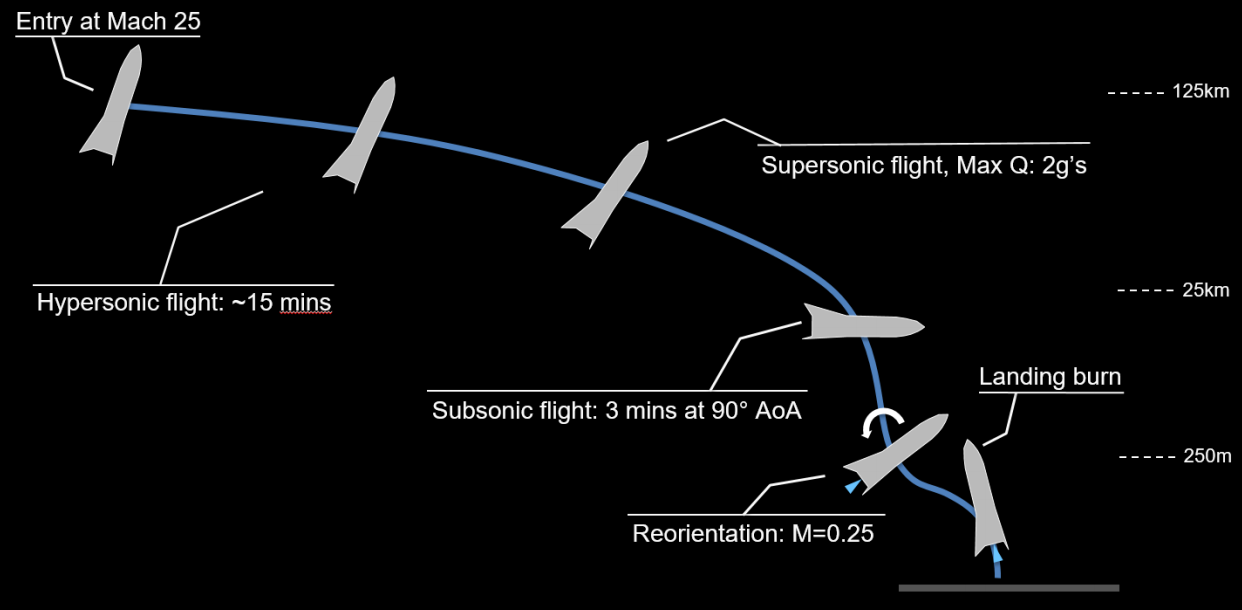
This was confirmed by a graphic just released by SpaceX about the BFR’s Starship upper stage reentry:


 This shows for the a vertically landed stage, it only has to fire the engines at about Mach 0.25, 80 m/s. So it only has to kill off 80 m/s propulsively. But with the stage just needing to kill off a 80 m/s velocity with a 3,300 m/s Raptor sea level exhaust velocity, about 330s Isp, by the rocket equation the mass ratio to do this is e[80/3300] = 1.025. Subtracting 1 from this is the ratio of the propellant required to the dry mass, about 2.5%. All together that's 11.5% of the dry mass, or only about 1 ton lost due to reusability.

 Then at that $220,000 cost per flight for a 50 use reusable  launcher, at a 4,000 kilo payload as reusable, the per kilo cost would be $220,000/4,000kg = $55/kilo.


   Robert Clark
   Adjunct Professor
   Dept. of Mathematics
   Widener University
   Chester, PA USA
 

Could Blue Origin develop a lander for Artemis III?

Copyright 2025 Robert Clark SpaceX is coming under increasing criticism for its delay in developing the Starship lunar lander: U.S. Is Losin...