Sunday, August 26, 2012

The Coming SSTO's: Applications to interplanetary flight.

Copyright 2012 Robert Clark

Credit: NASA image of an Orbital Transfer Vehicle with aerobrake. From David S.F. Portree's page: Shuttle-Era Manned Mars Flyby (1985).

 Note also a key fact about SSTO's is that the delta-V requirement for
a round-trip mission from LEO to the lunar surface is a little less
than that for flights from Earth's surface to LEO. Then if you could
do orbital refueling, you could have a single, reusable vehicle that
does lunar missions. This important capability about SSTO's is
mentioned in G. Harry Stine's very nice book Halfway to Anywhere:
Achieving America's Destiny in Space
:

"...an SSTO that is refueled in orbit has the capability to fly to the
Moon, land, lift off, and fly back without additional refueling."
Halfway to Anywhere: Achieving America's Destiny in Space, p. 220.
http://www.amazon.com/dp/0871318474

A table that gives the delta-V budget for trips in the Earth-Moon
system is given here:

Delta-V budget.
Earth–Moon space.

  From this you can calculate that the delta-V for a round trip from
LEO to the lunar surface is less than that for getting to LEO.
It has been argued that SSTO's are not economical. But that such a
vehicle with orbital refueling could also be used for lunar missions
changes the economic equations significantly.
 Surprisingly such SSTO's could also be used for Mars missions.
Elon Musk has argued in favor of promoting creating a self-sustaining
colony on Mars:
Elon Musk "Mars Pioneer Award" Acceptance Speech - 15th Annual
International Mars Society Convention.

 For such a colony he proposes reusable vehicles and getting propellant for
return trips from Mars. Musk proposes cutting the costs to space by two
orders of magnitude by reusability. Then there would be also a dramatic drop
in the cost to lift the large amount of propellant to space.
 So let's suppose there are propellant depots at LEO. Since Musk proposes a
self-sustaining colony on Mars, lets also suppose propellant depots in low
Mars orbit for return trips.
Here's a map of delta-v's between Mars/Moon/Earth:

 If you add up the delta-v's from low Earth orbit to low Mars orbit you get
6.1 km/s. Now use the same specifications for the Falcon 9 v1.1 first stage
as estimated before, 13 mT dry mass and 375 mT propellant load. Then
you could transport 45 mT from LEO to low Mars orbit:

311*9.81ln(1 + 375/(13 + 45)) = 6,130 m/s.


   Bob Clark


Friday, August 17, 2012

A liquid water component to clouds and fogs on Mars.

Copyright 2012 Robert Clark


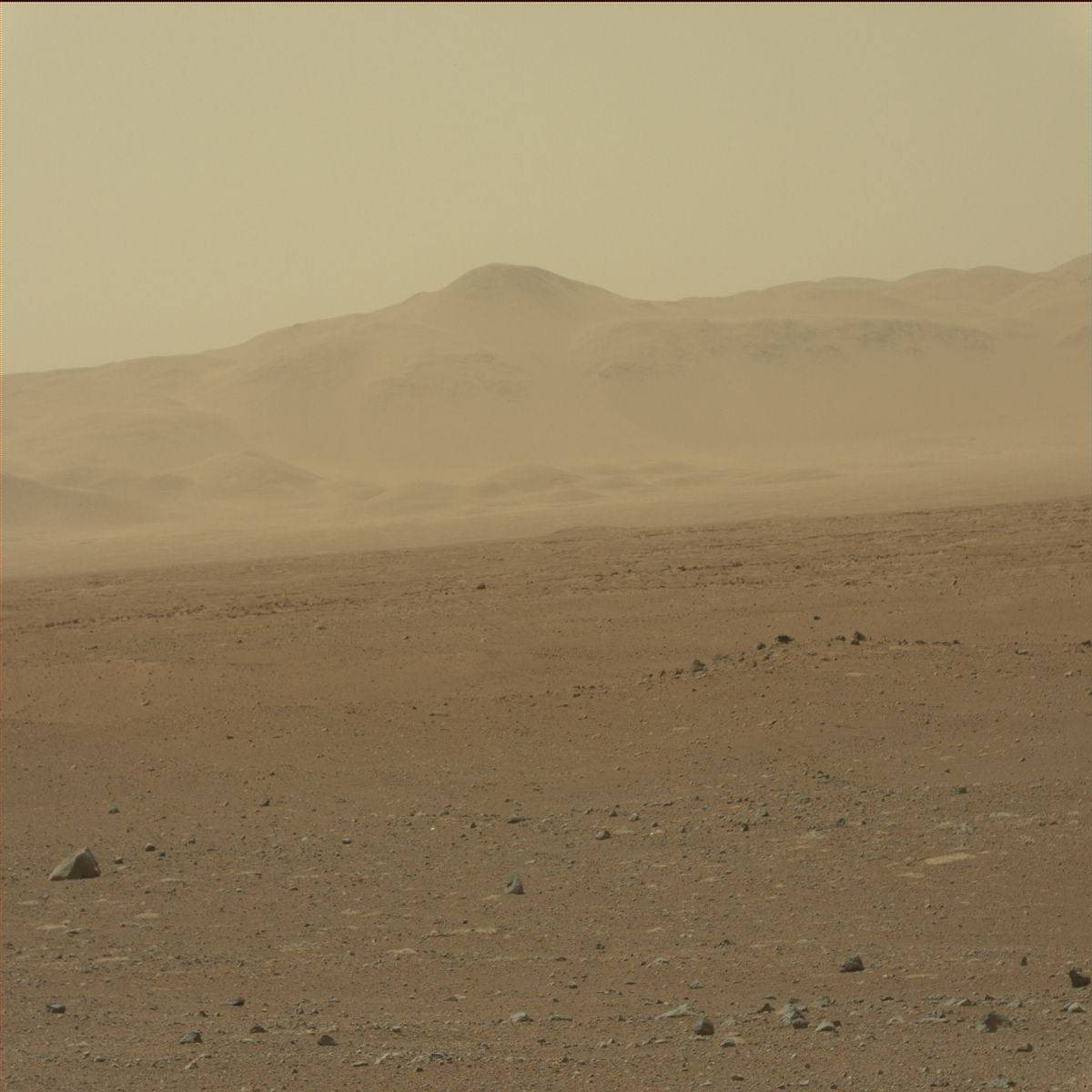
Curiosity Surveys a Martian 'Mojave Desert': Big Pic.
Aug. 8, 2012 --
http://news.discovery.com/space/big-pic-mars-curiosity-mojave-desert-120808.html

The panoramic image shows what appears to be "haze" at the base of the mountains in the distance in Gale crater. This was predicted prior to landing:

Pink skies, water ice haze in forecast for Curiosity landing.
12:56 PM, Aug 5, 2012
"PASADENA, CALIF. — Expect pink skies with a chance of a water ice haze over Gale Crater Monday when NASA’s Mars Science Laboratory and Curiosity rover arrive at the red planet.
"Seasonal winter temperatures are expected to be a balmy 10 degrees Fahrenheit when Curiosity touches down at 3 p.m. local Mars time."
http://www.floridatoday.com/article/20120804/SPACE/120804008/Pink-skies-water-ice-haze-forecast-Curiosity-landing

 It is important to realize that clouds, fogs and hazes can have some proportion of liquid water even well below freezing temperature. This is well known to happen when salts are dissolved in the water through freezing point depression. But it can also happen with pure water through supercooling.
 The temperature at which supercooled liquid water can occur can even be below -40C, which,  coincidentally is also -40F:

Supercool Water.
Posted: 11/28/11
"Liquid water as cold as minus 40 F has been found in clouds. Scientists have done experiments showing liquid water can exist at least down to minus 42 F."
http://www.astrobio.net/pressrelease/4363/supercool-water

**************************************************************

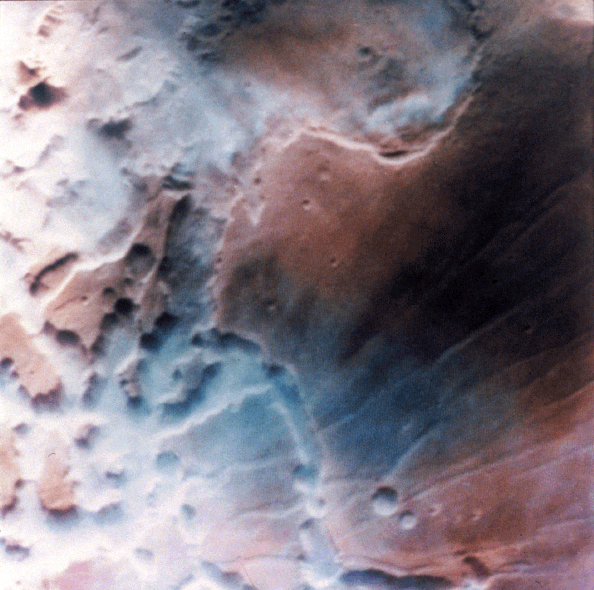
 Noctis Labyrinthus, part of the Valles Marineris system, frequently shows dense low lying clouds/fogs that give the appearance of precipitation carrying clouds on Earth:

Clouds in Noctis Labyrinthis.
Credit: NASA, Viking orbiter image.
This image shows early morning fog in the Noctis Labyrinthis, at the westernmost end of Valles Marineris. This fog, which is probably composed of water ice, is confined primarily to the low-lying troughs, but occasionally extends over the adjacent plateau. The region shown is about 300 kilometers (186 miles) across.
http://www.solarviews.com/cap/mars/noctis.htm


Noctis Labyrinthus, labyrinth of the night.
Mars Express
European Space Agency
30 November 2007
http://www.esa.int/SPECIALS/Mars_Express/SEMWBK73R8F_0.html

 Here's another great image showing dense clouds/fogs in Valles Marineris somewhat further west of Noctis:


taken from this ESA report:

Adsorption water driven processes on Mars.
D. Möhlmann
FIRST MARS EXPRESS SCIENCE CONFERENCE
21-25 February 2005, ESA/ESTEC
http://sci.esa.int/science-e/www/object/doc.cfm?fobjectid=36779

The author reaches these conclusions:

Adsorption water in the upper martian surface is an actual challenge
to martian surface chemistry and possibly also to exobiology:
* Adsorption water makes possible and/or supports a martian surface
chemistry, also at present: These processes are energetically driven
by photons (UV). Current martian surface chemistry is mainly (non-
thermal) photo-chemistry.
* Existing iron oxides (as haematite), UV and adsorption water are a
cause for the production of oxidizing OH-radicals, which are expected
to contribute to the oxidation of organics (Methane, carbonaceous
meteorites).
* Adsorption water mobilizes acids (as sulfuric acid), which can
modify earlier formed carbonates (surface cover by sulfates, e.g.).
* Adsorption water covered catalytic surfaces of minerals are expected
to be essential agents in non-thermal photo-chemical processes. Photon
driven non-thermal redox-processes on catalytic surfaces might
together with atmospheric CO2 cause a non-biogenic production of
organics (?). Related experiments are in preparation.
* Adsorption water deposits also on the surfaces (cell walls) of
microbes etc. There, it can be a source of water for the microbial
metabolism. Physico-chemical processes can be supported by adsorption
water. To study the relevance of adsorption water for life-processes
is a current challenge to exobiology. Related experiments are in
preparation.

 This Mars Express image of Valles Marineris with the dense fogs was taken May 25, 2004 in mid southern Autumn on Mars at a time approaching Mars aphelion.
 Equatorial clouds are known to be seasonal on Mars, frequently occurring near aphelion. It is now nearing the end of southern Winter on Mars, at the time of the Curiosity landing. It would be interesting to find out if higher resolution imaging by Mars Reconnaissance Orbiter also detects these dense low lying clouds/fogs during the next southern Autumn on Mars.
 Some MRO images near the location of the image with the dense clouds/fogs:

HiRISE | Latitude/Longitude Search Results.
Search by latitude and longitude range.
Latitude from: -25 to -5
Longitude from: 290 to 310 (Note: this is measured in east longitude.)
http://hirise.lpl.arizona.edu/geographikos.php?q1=-25&q2=-5&q3=290&q4=310&order=release_date&submit=Search

**************************************************************


This report suggests clouds may be harder to form on Mars than thought previously:

RELEASE: 07_89AR
NASA Study Reveals Less Water in Mars' Clouds.
Dec. 6, 2007

MOFFETT FIELD, Calif. – Martian clouds may contain less water than previously thought, according to a new NASA study.
New NASA laboratory measurements of simulated martian clouds reveal that scientists may have been overestimating the amount of water in the planet's atmosphere.
"The martian clouds we are studying are composed of water ice, like some clouds on Earth. However, they are forming at very cold temperatures, often below minus 100 degrees Celsius (minus 148 degrees Fahrenheit)," said Tony Colaprete, a planetary scientist at NASA's Ames Research Center, Moffett Field, Calif. "What we have found in our laboratory studies is that it is much harder to initiate cloud formation at these cloud temperatures than what we thought," he explained.

http://www.nasa.gov/centers/ames/news/releases/2007/07_89AR.html


The last statement in the NASA news release is misleading:
The amount of water in the martian atmosphere varies greatly in spaceand time," Colaprete observed. Clouds in the atmosphere largelycontrol the amount of water that comes off of the north pole andmigrates to the south pole."If all the water in the atmosphere were to freeze out to the surface,it would make a layer of ice about one-fifth the thickness of a humanhair, according to Colaprete."Cloud mass is typically only 10 to 20 percent of the total watercontent. However, the thin martian atmosphere is much more sensitive/reactive to the influence of these clouds," he said.
 Since the water vapor content on Mars is known to be so low that implies that the water content in any cloud must be even lower. But actually it is because overall the cloud cover of the entire planet is relatively low.
 But the water content in precipitation clouds can be much higher than the water vapor content in the surrounding area. For instance during a storm you can have many inches of rainfall or snowfall. But the water vapor content on Earth is at most 5 to 6 precipitable cm, about 2 to 2.5 inches (the amount of water vapor in an atmospheric column if it were condensed.)

The NASA report focused on clouds at very cold temperatures -100C. But it is known there are daytime clouds/fogs very close to the surface on Mars where the temperatures will be much higher than this, frequently above -40C for instance. As mentioned above, this is a temperature at which even pure water in clouds can undergo supercooling to remain in liquid form. Indeed supercooling is a major part of cloud formation on Earth:

Cloud.
http://en.wikipedia.org/wiki/Cloud


 In any case clouds at such low temperatures have been observed on Mars. Also even at such low temperatures it is still possible some proportion of the condensed water in the clouds is in liquid form. For instance actual measurements of Polar Stratospheric Clouds on Earth show that liquid water aerosols with nitric and sulfuric acid can be liquid down to -80 C:

Polar Stratospheric Clouds.
Type I a (Nitric acid trihydrate particle - NAT)
crystalline particles forming at 195 K,
Type I b (Supercooled ternary solution - STS)
spherical liquid particles forming at 193 K,
Type II (Water ice) ice crystals forming below 188 K.


Chemical Analysis of Polar Stratospheric Cloud Particles.
Jochen Schreiner, Christiane Voigt, Andreas Kohlmann, Frank Arnold, Konrad Mauersberger, Niels Larsen
Science, 12 February 1999: vol. 283 no. 5404 pp. 968-970.
A balloon-borne gondola carrying a particle analysis system, a backscatter sonde, and pressure and temperature sensors was launched from Kiruna, Sweden, on 25 January 1998. Measurements within polar stratospheric cloud layers inside the Arctic polar vortex show a close correlation between large backscatter ratios and enhanced particle-related water and nitric acid signals at low temperatures. Periodic structures in the data indicate the presence of lee waves. The H2O/HNO3 molar ratios are consistently found to be above 10 at atmospheric temperatures between 189 and 192 kelvin. Such high ratios indicate ternary solution particles of H2O, HNO3 [nitric acid], and H2SO4 [sulfuric acid] rather than the presence of solid hydrates.
http://www.sciencemag.org/content/283/5404/968.abstract

 Because these Earth clouds are stratospheric, they occur at pressures near those on the surface of Mars. Then low lying fogs or clouds on Mars would occur at similar pressures and temperatures to the liquid water containing PSC's on Earth.

 Also recent work by Bogdan et.al. suggests some liquid water in clouds could remain down to -140C(!)

New Observations On Properties Of Water.
ScienceDaily (Dec. 13, 2006) -- Recent research on the properties of
water reveals information relevant for cloud physics and even
cryopreservation science.
Experimental studies conducted by Ph.D. Anatoli Bogdan at the
University of Helsinki, Finland, have received broad interest in the
scientific world, as the results might have applications even in the
cryopreservation of cells and tissues. Bogdan's results show that
mixture droplets consisting of sulphuric acid and water can be slowly
cooled down to-140 degrees Celsius and then heated again without ice
formation.
http://www.sciencedaily.com/releases/2006/12/061213104104.htm

Reversible Formation of Glassy Water in Slowly Cooling Diluted Drops.
J. Phys. Chem. B, 110 (25), 12205 -12206, 2006. 10.1021/jp062464a S1520-6106(06)02464-3
Web Release Date: June 6, 2006
http://pubs.acs.org/cgi-bin/abstract.cgi/jpcbfk/2006/110/i25/abs/jp062464a.html

 This might make it possible for even lower temperature Polar Mesopheric Clouds, also called noctilucent clouds, on Earth to contain liquid water. The Aeronomy of Ice in the Mesosphere (AIM) satellite was recently launched to study such clouds on Earth. If such clouds are also found to contain some proportion of liquid water, that would greatly increase the range of possibilities for liquid water in clouds on Mars.
 The term "noctilucent clouds" comes from the fact they often have a luminous appearance at night:


The secrets of night shining clouds.

http://earthsky.org/earth/nasa-satellite-observations-of-noctilucent-clouds-show-complex-atmospheric-interactions

Meteor Smoke Makes Strange Clouds.
August 7, 2012:  Anyone who's ever seen a noctilucent cloud or “NLC” would agree: They look alien.  The electric-blue ripples and pale tendrils of NLCs reaching across the night sky resemble something from another world.
http://science.nasa.gov/science-news/science-at-nasa/2012/07aug_meteorsmoke/

 The NLC's often have a bluish tint. Interestingly it has often been noticed both from ground-based observations and from Mars spacecraft that there are frequent bluish clouds on Mars:


Mars Pathfinder.
Dr. Mark Lemmon, University of Arizona
Mars Pathfinder Imaging Team

These clouds from Sol 15 have a new look. As water ice clouds cover the sky, the sky takes on a more bluish cast. This is because small particles (perhaps a tenth the size of the Martian dust, or one-thousandth the thickness of a human hair) are bright in blue light, but almost invisible in red light. Thus, scientists expect that the ice particles in the clouds are very small. The clouds were imaged by the Imager for Mars Pathfinder (IMP).
http://mars.jpl.nasa.gov/MPF/science/clouds.html

 It would be interesting to find out if the NLC's on Earth contain the sulfuric acid content to allow the NLC cloud particles to remain partially liquid down to the extremely low temperatures suggested by Bogdan et.al. It would also be interesting to find out if the bluish clouds on Mars also have this sulfuric acid component.


   Bob Clark


About the life on Mars question.


Copyright 2012 Robert Clark


 I was watching “This Week at NASA” after the Curiosity landing. I was interested in how the voice-over describing the landing phrased the life on Mars question. It said Curiosity will try to determine if the conditions are right for microbial life to exist on Mars:

Curiosity Has Landed! on This Week @NASA.


It was notable to me this was phrased in the present tense, not for microbial life to have existed on Mars, but to exist on Mars. Since Viking with the general consensus that the current life on Mars question was answered in the negative, usually NASA missions were described as only determining if life could have existed in the past on Mars, not the present.
On the “NASA360″ episode shown this week, the NASA scientist interviewed Dr. Bruce Jakosky of the Curiosity and upcoming MAVEN Mars missions described them also as determining if conditions are right for life to exist on Mars, present tense:

NASA 360 Season 3, Show 19.


Bob Clark

Saturday, August 4, 2012

The Coming SSTO's: Falcon 9 v1.1 first stage as SSTO.

Copyright 2012 Robert Clark 


  I've been arguing that SSTO's are actually easy because how to achieve 
them is perfectly obvious: use the most weight optimized stages and 
most Isp efficient engines at the same time, i.e., optimize both 
components of the rocket equation. But I've recently found it's even 
easier than that! It turns out you don't even need the engines to be 
of particularly high efficiency. 
SpaceX is moving rapidly towards testing its Grasshopper scaled-down 
version of a reusable Falcon 9 first stage: 

Reusable rocket prototype almost ready for first liftoff. 
BY STEPHEN CLARK 
SPACEFLIGHT NOW 
Posted: July 9, 2012 
http://www.spaceflightnow.com/news/n1207/10grasshopper/ 

SpaceX deserves kudos for achieving a highly weight optimized Falcon 9 
first stage at a 20 to 1 mass ratio. However, the Merlin 1C engine has 
an Isp no better than the engines we had in the early sixties at 304 
s, and the Merlin 1D is only slightly better on the Isp scale at 311 s. 
This is well below the highest efficiency kerosene engines (Russian) 
we have now whose Isp's are in the 330's. So I thought that closed 
the door on the Falcon 9 first stage being SSTO. 

However, I was surprised when I did the calculation that because of 
the Merlin 1D's lower weight, the Falcon 9 first stage could indeed be 
SSTO. For the calculation we'll need the F9 dry mass and propellant 
mass. I'll use the Falcon 9 specifications estimated by GW Johnson, a 
former rocket engineer, now math professor: 

WEDNESDAY, DECEMBER 14, 2011 
Reusability in Launch Rockets. 
http://exrocketman.blogspot.com/2011/12/reusability-in-launch-rockets.html

The first stage propellant load is given as 553,000 lbs, 250,000 kg, 
and the dry weight as 30,000 lbs, 13,600 kg. 

I'll actually calculate the payload for the first stage of the new version of 
the Falcon 9, version 1.1. The Falcon Heavy will use this version's first stage 
for its core stage and side boosters. SpaceX expects the Falcon 9 v1.1 
to be ready by the end of the year. 

Elon Musk has said version 1.1 will be about 50% longer: 

Q&A with SpaceX founder and chief designer Elon Musk. 
BY STEPHEN CLARK 
SPACEFLIGHT NOW 
Posted: May 18, 2012 
http://www.spaceflightnow.com/falcon9/003/120518musk/ 

I'll assume this is coming from 50% larger tanks. This puts the 
propellant load now at 375,000 kg. Interestingly SpaceX says the side 
boosters on the Falcon Heavy will have a 30 to 1 mass ratio. This 
improvement is probably coming from the fact it is using the lighter 
Merlin 1D engines, and because scaling up a rocket actually improves 
your mass ratio, and also not having to support the weight of an upper 
stage and heavy payload means it can be made lighter. 

So I'll assume for this SSTO version of the Falcon 9 v1.1 the mass 
ratio is 30 to 1, which makes the dry mass 13 mT. 

To estimate the payload I'll use the payload estimation program of 
Dr. John Schilling:

Launch Vehicle Performance Calculator. 
http://www.silverbirdastronautics.com/LVperform.html 

It actually gives a range of likely values of the payload. But I've found 
the midpoint of the range it specifies is a reasonably accurate estimate 
to the actual payload for known rockets. 

Input the vacuum values for the thrust in kilonewtons and Isp in 
seconds. The program takes into account the sea level loss. SpaceX 
gives the Merlin 1D vacuum thrust as 161,000 lbs and vacuum Isp 
as 311 s: 

FALCON 9 OVERVIEW. 
http://www.spacex.com/falcon9.php 

For the 9 Merlins this is a thrust of 9*161,000lb*4.46N/lb = 6,460 
kN. Use the default altitude of 185 km and select the Cape Canaveral 
launch site, with a 28.5 degree orbital inclination to match the 
Cape's latitude. 

Input the dry mass of 13,000 kg and propellant mass of 375,000 kg. 
The other options I selected are indicated here:


Then it gives an estimated 7,564 kg payload mass:

===================================== 
Launch Vehicle: User-Defined Launch Vehicle 
Launch Site: Cape Canaveral / KSC 
Destination Orbit: 185 x 185 km, 28 deg 
Estimated Payload: 7564 kg 
95% Confidence Interval: 3766 - 12191 kg 
=====================================

This may be enough to launch the Dragon capsule, depending on the mass 
of the Launch Abort System(LAS). 


Bob Clark

UPDATE, Sept. 26, 2013:

 See more accurate calculations using Dr. John Schillings Launch Performance Calculator here:

The Coming SSTO's: Page 2.
http://exoscientist.blogspot.com/2013/08/the-coming-sstos-page-2.html


UPDATE, August 26, 2014:

 This blog post actually used the estimated specifications for the Falcon Heavy side boosters, as this was supposed to have an even better mass efficiency than the core stage. However, Elon Musk gave a speech where he gave some values for the Falcon 9 v1.1 first stage that allow us to estimate the propellant and dry masses for the stage. Then we can calculate the payload capability of a F9 v1.1 core stage SSTO itself. I estimate it as ca. 5,000 kg:

The Coming SSTO's: Falcon 9 v1.1 first stage as SSTO, Page 2.
http://exoscientist.blogspot.com/2013/11/the-coming-sstos-falcon-9-v11-first.html

Thursday, June 21, 2012

Low Cost HLV, page 3: Lightweighting the S-IC Stage.

Copyright 2012 Robert Clark


                                                    SASSTO 
                                                    SASSTO - Saturn-derived SSTO Launch Vehicle 
                                                    Credit: © Mark Wade


 I showed in the post Low Cost HLV, page 2: Comparison to the S-IC Stage that the S-IC first stage of the Saturn V could give a nearly 20-to-1 mass ratio using a lighter thrust structure and using four RD-171 engines instead of five F-1 engines. But in fact we can do better than this. The S-IC of the 1960's did not have available the aluminum-lithium alloy used for example on the Falcon 9 and shuttle ET. Here I calculate a lighter structure using this lighter alloy and some mass reducing structural changes.

 The tank mass of the S-IC stage and of some other rocket stages is discussed in this key report:

Single Stage To Orbit Mass Budgets Derived From Propellant Density and Specific Impulse.
John C. Whitehead
32nd AIAA/ASME/SAE/ASEE Joint Propulsion ConferenceLake Buena Vista, FLJuly 1-3, 1996
http://www.osti.gov/bridge/servlets/purl/379977-2LwFyZ/webviewable/379977.pdf

 On page 8 in Fig. 6 is given a comparison of the tank weights of the Saturn S-IC, Atlas II, and shuttle ET:


 We've already reduced the mass of the stage down to 113,000 kg by using a lighter thrust structure in the prior post. Fins are not really needed for large rockets with computer guidance and control, so remove these to reduce the mass again to 112,000 kg. The  four 4 meter diameter RD-171 engines can fit under the 10 meter diameter S-IC tank, so remove the engine fairings to bring the mass down to 108,000 kg.
 Now use common bulkhead design to reduce the tank mass further. The question of using common bulkhead design for the S-IC arose during the Apollo design period:

SP-4206 Stages to Saturn.
7. The Lower Stages: S-IC and S-II.
THE S-IC AND THE HUNTSVILLE CONNECTION.
The main configuration of the S-IC had already been established by MSFC, including the decision to use RP-1, as opposed to the LH2 fuel used in the upper stages. Although LH2 promised greater power, some quick figuring indicated that it would not work for the first stage booster.Liquid hydrogen was only one half as dense as kerosene. This density ratio indicated that, for the necessary propellant, an LH2 tank design would require a far larger tank volume than required for RP-1. The size would create unacceptable penalties in tank weight and aerodynamic design. So, RP-1 became the fuel. In addition, because both the fuel and oxidant were relatively dense, engineers chose a separate, rather than integral, container configuration with a common bulkhead. The leading issue prior to the contract awards related to the number of engines the first stage would mount.
http://history.nasa.gov/SP-4206/ch7.htm#197

   This could be interpreted to mean the density of the propellant made it unfeasible, but I think the relatively smaller tankage mass using the dense propellants made the more difficult common bulkhead design unnecessary. For instance as you see in that Fig. 6 from Whitehead's report, in the shuttle ET tank the intertank weighs more than the entire oxygen tank. The relative weight of the intertank is not as bad for the kerosene S-IC. Still, common bulkhead design is used for the large kerosene first stage on the Falcon 9 to help save weight.

 So to minimize stage weight we will remove the interstage and one of the bulkheads. Assuming top and bottom bulkheads weigh the same for each of the LOX and kerosene tanks on the S-IC, then from the information in Fig. 6, the LOX bulkheads weigh 4 mT each and the kerosene, 3.3 mT. Conservatively, let's say we remove one of the kerosene bulkheads instead of a LOX bulkhead since we may need the larger LOX bulkhead for strength. Then also removing the 6 mT intertank, we bring the dry mass down to 99 mT.

 Now estimate the weight saving using the lighter aluminum-lithium alloy. From the Wikipedia page on the shuttle ET, the tank weight reduced from 35,000 kg using aluminum alloy 2219, the same alloy used for the S-IC tanks, to 26,500 kg using aluminum-lithium alloy, a reduction of 24%.

 After the structural changes, the tanks now weigh 25.5 mT. Subtracting off 24% from this is a reduction in mass by 6 mT. This brings the stage mass down to 93 mT.

 Keep in mind though, the plan is to use a shuttle ET size tank to save cost on tooling. The ca. 720 mT hydrolox of the shuttle ET becomes ca. 2,100 mT with the 3 times denser kerolox. This turns out to be about the same kerolox carried by the S-IC. So the purpose here was just to get an idea of a lightweight stage you can get using modern materials.

 Now notice you get significant payload as a SSTO using the RD-171 engines at 338 s vacuum Isp. Taking the required delta-v to orbit as 9,150 m/s for kerolox, you can get 48 mT to orbit:

338*9.81ln(1 + 2,100/(93 + 48)) = 9,170 m/s.

 Note though that if we are to use the shuttle ET as a stage then the pointed end of the LOX tank would need to be removed. We could take the equivalent cylindrical LOX tank of the same volume. It would have the same dry weight, so the stage dry mass stays the same.

 However, if you take the full length of a cylindrical tank now as 46.9 m and the diameter as 8.4 m, per the specifications of the SLWT version of the ET, and the density of kerolox as about 1,030 kg/m^3, then we get about 2,600 mT kerolox. The tank weight would increase somewhat without the pointed end, but not by much compared to the entire stage weight. Then you could loft 82 mT to orbit:

338*9.81ln(1 + 2,600/(93 + 82)) = 9,160 m/s.

 A propellant load of 2,600 mT at dry mass of 93 mT corresponds to a mass ratio close to 29 to 1, rather high. But SpaceX has said with their side boosters on the Falcon Heavy they expect to achieve a mass ratio of 30 to 1, and mass ratio does get better as you scale up a stage,with this shuttle ET size stage being much larger.

 This payload of 82 mT is better than the 70 mT to be carried by the interim SLS. Remember our HLV is to be developed using the SpaceX-style commercial approach. Then based on a $2,000/kg price of the Falcon Heavy, the full two stage version of our HLV as comparably priced might only cost ca. $200 million per launch at a 100 mT payload to orbit.

 So the SSTO version would even cost less than this, perhaps only ca. $100 million per launch for the 82 mT payload to orbit.

 The dry weight could be lightened further by using composites. Estimates put the weight savings in the structural mass in the 40% range for a fully composite structure. In that case the payload could exceed 100 mT for this SSTO.

 An increase of the Isp could be possible by using an aerospike or plug nozzle, up to the range of 360 s. The multi-nozzle format of the RD-171 engines makes this feasible. The four nozzles of each engine would be shortened and arranged around a central aerospike. This was the idea behind the aerospikes planned for the X-33 and VentureStar. It was also used earlier in the planned Beta SSTO of Dietrich Koelle and the SASSTO SSTO of Phillip Bono.

 An argument against this was that the aerospike nozzle would make the propulsion system too heavy. For instance for the aerospike on the X-33 the thrust/weight ratio was only 40 to 1, compared to a 70 to 1 ratio for the SSME's for example. However, the lightweight, high temperature ceramics and composites available now should make the T/W comparable to bell nozzle engines:

Ceramic Materials for Reusable Liquid Fueled Rocket Engine Combustion Devices.
http://ammtiac.alionscience.com/pdf/AMPQ8_1ART06.pdf


  Bob Clark

Note: The SASSTO SSTO shown at the top and discussed near the end was derived from the Saturn S-IVB stage, not the S-IC, and was hydrogen fueled. The Beta SSTO discussed was also hydrogen fueled. However, a key result of the cited report of John C. Whitehead is that it is actually easier to make a kerosene-fueled SSTO. This is because the large and heavy hydrogen fuel tanks swamps out the advantage of its higher Isp.  - B.C., 6/22/2012.

Sunday, June 17, 2012

Low cost development and applications of the new NRO donated telescopes, Page 4.

Copyright 2012 Robert Clark 

 A key reason why these space telescopes developed under a more commercial approach can be done much more cheaply is the more expensive "space qualified" electronics have been found to be unnecessary. This is described by Dr. John Hunter in regards to G-hardening the electronics:

Propellant Delivery to Orbit in Support of Mars Exploration
 with Hydrogen Gas Guns - Dr. John Hunter.

 About 14 minutes in Hunter discusses standard off the shelf components can be used with inexpensive modifications even in regards to gas gun launch at hundreds of g's. As an example he notes cell phones have to be designed to survive such high g's just from being dropped from normal height.

 Radiation resistance can also be done with off the shelf electronics with inexpensive modifications. This is argued by Dennis Wingo whose area of expertise is developing electronics for space use:

Bootstrapping the Moon.
By Dennis Wingo Posted Wednesday, May 7, 2008
Ideas to Lower the Cost of the Effort
Avionics
The first thing to attack is the military industrial complex focus on radiation tolerance for integrated circuits. This one thing has driven the cost of space projects higher and higher as designers have to use several generations old microprocessors, and all types of integrated circuits. This is because there are specifications that individual chips have to meet for latch up and single event upsets. Since most off the shelf (COTS) chips are not particularly radiation hardened, this means that for hardware that goes through the radiation belts or is used in environments where radiation might be a problem that you have to modify existing chip designs to harden them.
This is enormously expensive and the market for these chips is very small in comparison to the commercial market so the number of advanced chips flying is actually very small and the tendency is that the current generation of space qualified chips are several generations behind their commercial brethren with the gap growing year by year. This is why the International Space Station is controlled by 80386 25 Mhz microprocessors that were obsolete in the commercial world in 1992. What it also means is that the tools for software development are ether generations behind as well or are very poorly designed as it is much more expensive for these systems with a very limited market and installed base.
This has been the case since the early 1990's as the amateur radio satellites proved when they basically completely abandoned the concept of space qualified and successfully flew advanced chips. They were able to do this via the concept of shielding the chips with tantalum or other chip and box level shielding techniques. It costs a little weight but with the advances in chip technology, software, and software systems, the total systems costs can be dramatically lowered.
An example of one government organization that understood this was the Strategic Defense Initiative Organization's Clementine mission in 1993 that flew commercial state of the art processors and dynamic RAM memory for the imaging system. It worked fine but the military spec RAD 3000 had a software glitch that opened up a thruster and ended the mission before they could go to an asteroid after successfully operating in lunar orbit for several months. More recent software errors have reportedly crippled much more expensive spacecraft. Today with software growing to as much as 1/3 of the total cost of an advanced spacecraft major savings can be accomplished and schedules compressed by using this approach. So that iPhone that you love may be your communicator on the Moon! The European Space Agency was able last year to get NASA to agree to using the advanced technology of Wi-Fi and the Internet protocol for the lunar outpost. This was a celebrated victory.

http://www.spaceref.com/news/viewnews.html?id=1287

 So off the shelf electronic components can be used with just a little extra weight for shielding.

 This has majorly important results if you already have the space qualified optical components and support structure. It means the space based scopes can then be completed for little more than for the ground versions. 

 This report shows those ground scope costs are surprisingly low compared to the prices now charged for comparable space telescopes:

The Scaling Relationship Between Telescope Cost and Aperture Size for Very Large Telescopes.
Gerard T. van Belle
Michelson Science Center, California Institute of Technology, Pasadena, CA 91125
****@ipac.caltech.edu
and
Aden Baker Meinel & Marjorie Pettit Meinel
Jet Propulsion Laboratory, California Institute of Technology, Pasadena, CA 91109
****@earthlink.net


http://www.eso.org/~gvanbell/publications/van_belle_meinel2_2004.pdf 


 You see the ground scopes in the 2 to 3 meter diameter range are in the $10 to $20 million range and even less. 

This supports the claim of PRI that a commercial approach to the telescope construction can cut costs by one to two orders of magnitude.


  Bob Clark

Friday, June 15, 2012

On the lasting importance of the SpaceX accomplishment, Page 2.

Copyright 2012 Robert Clark 


Nice video here with Alan Lindenmoyer, NASA's head of the commercial crew program:

America's New Paths in Space.

 At about the 6:17 point in the video, Lindenmoyer makes the key point that it's part of NASA's charter to stimulate the commercial space industry in America. Then efforts by some in government to limit NASA's support of the commercial crew program are disregarding a key component of why NASA exists in the first place.

 Supporters of commercial space access have long argued that aerospace companies could create a privately developed launcher at costs in the range they spend to produce new jet airliners at a few billion dollars. See this argument for example in Harry G. Stine's Halfway to Anywhere: Achieving America's Destiny In Space.

The problem is there is a much larger market for airline travel than for space travel to pay for those large up front development costs. However, a key result of the success of SpaceX in privately developing a launcher and capsule is that they were able to develop them while cutting 90% off the usual cost estimates for the development of such vehicles. Then following their cost cutting model, instead of the usual estimate of a few billion dollars to develop a launcher it would only cost in the few hundred million dollars range.

 This means there is a market that the usual large aerospace companies and even the smaller new ones such as SpaceX, Orbital Sciences, Sierra Nevada,  Blue Origin, etc. would have in order to pay back this much reduced initial investment. Such a market is the same as that for jet airliners, private, commercial passengers.
 Peter Diamandis makes this point in this effective TED lecture where he refers to this market as "self-loading carbon payloads":

Peter Diamandis: Taking the next giant leap in space.


  A well researched example of such a manned vehicle would be the fully orbital, fully reusable DC-Y follow-on to the DC-X. It was estimated to have a $5 billion development cost which would include 4 flight vehicles. However, the important point is as privately developed, that could be reduced to perhaps $500 million to get a fully reusable, manned launcher.


   Bob Clark

Could Blue Origin develop a lander for Artemis III?

Copyright 2025 Robert Clark SpaceX is coming under increasing criticism for its delay in developing the Starship lunar lander: U.S. Is Losin...